



Community hub
Recent from talks
Knowledge base stats:
Talk channels stats:
Members stats:
Ready-mix concrete
Ready-mix concrete (RMC) is concrete that is manufactured in a batch plant, according to each specific job requirement, then delivered to the job site "ready to use".
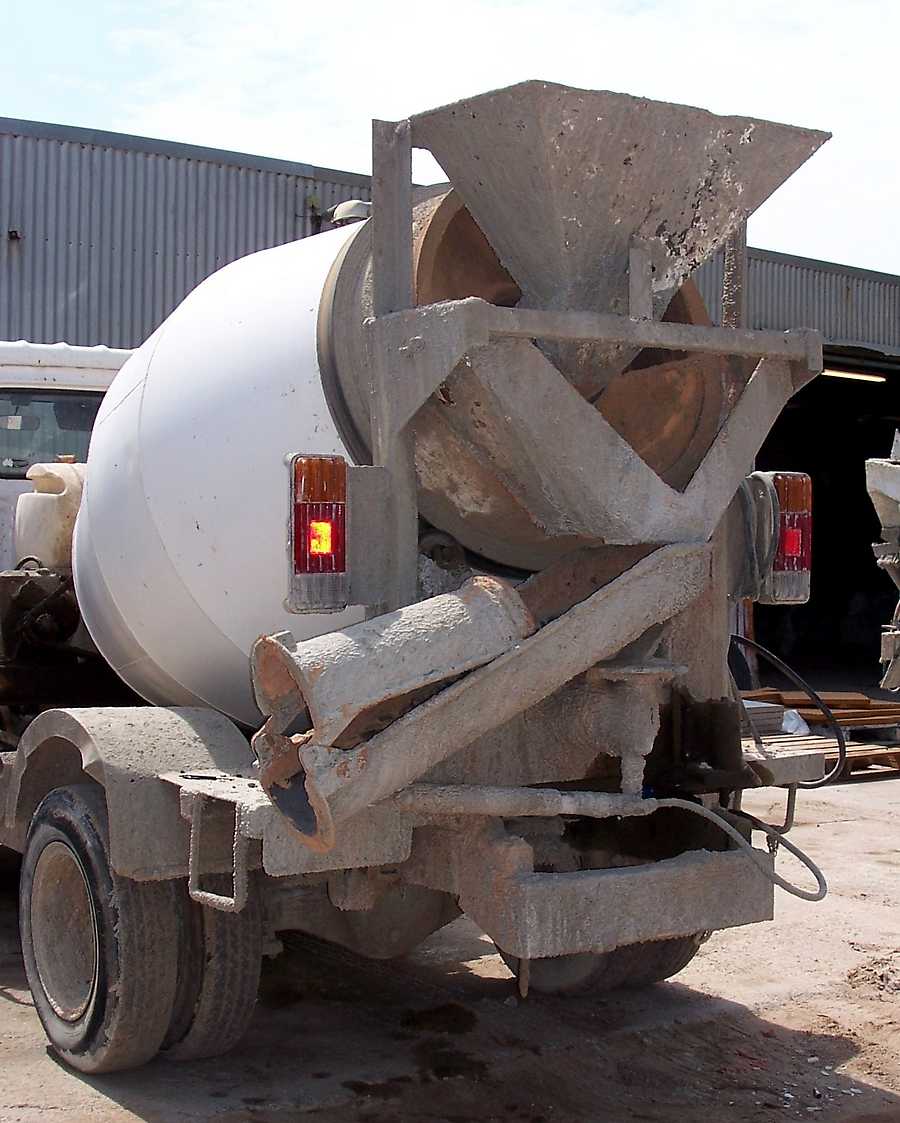
There are two types with the first being the barrel truck or in-transit mixers. This type of truck delivers concrete in a plastic state to the site. The second is the volumetric concrete mixer. This delivers the ready mix in a dry state and then mixes the concrete on site. However, other sources divide the material into three types: Transit Mix, Central Mix or Shrink Mix concrete.
Ready-mix concrete refers to concrete that is specifically manufactured for customers' construction projects, and supplied to the customer on site as a single product. It is a mixture of Portland or other cements, water and aggregates: sand, gravel, or crushed stone. All aggregates should be of a washed type material with limited amounts of fines or dirt and clay. An admixture is often added to improve workability of the concrete and/or increase setting time of concrete (using retarders) to factor in the time required for the transit mixer to reach the site. The global market size is disputed depending on the source. It was estimated at 650 billion dollars in 2019. However it was estimated at just under 500 billion dollars in 2018.
There is some dispute as to when the first ready-mix delivery was made and when the first factory was built. Some sources suggest as early as 1913 in Baltimore. By 1929 there were over 100 plants operating in the United States. The industry did not expand significantly until the 1960s, and has continued to grow since then.
Batch plants combine a precise amount of gravel, sand, water and cement by weight (as per a mix design formulation for the grade of concrete recommended by the structural engineer or architect), allowing specialty concrete mixtures to be developed and implemented on construction sites.
Ready-mix concrete is often used instead of other materials due to the cost and wide range of uses in building, particularly in large projects like high-rise buildings and bridges. It has a long life span when compared to other products of a similar use, like roadways. It has an average life span of 30 years under high traffic areas compared to the 10 to 12 year life of asphalt concrete with the same traffic.
Ready-mixed concrete is used in construction projects where the construction site is not willing, or is unable, to mix concrete on site. Using ready-mixed concrete means product is delivered finished, on demand, in the specific quantity required, in the specific mix design required. For a small to medium project, the cost and time of hiring mixing equipment, labour, plus purchase and storage for the ingredients of concrete, added to environmental concerns (cement dust is an airborne health hazard) may simply be not worthwhile when compared to the cost of ready-mixed concrete, where the customer pays for what they use, and allows others do the work up to that point. For a large project, outsourcing concrete production to ready-mixed concrete suppliers means delegating the quality control and testing, material logistics and supply chain issues and mix design, to specialists who are already established for those tasks, trading off against introducing another contracted external supplier who needs to make a profit, and losing the control and immediacy of on-site mixing.
Ready-mix concrete is bought and sold by volume – usually expressed in cubic meters (cubic yards in the US). Batching and mixing is done under controlled conditions. In the UK, ready-mixed concrete is specified either informally, by constituent weight or volume (1-2-4 or 1-3-6 being common mixes) or using the formal specification standards of the European standard EN 206+ A1, which is supplemented in the UK by BS 8500. This allows the customer to specify what the concrete has to be able to withstand in terms of ground conditions, exposure, and strength, and allows the concrete manufacturer to design a mix that meets that requirement using the materials locally available to a batching plant. This is verified by laboratory testing, such as performing cube tests to verify compressive strength, flexural tests, and supplemented by field testing, such as slump tests done on site to verify plasticity of the mix.
Hub AI
Ready-mix concrete AI simulator
(@Ready-mix concrete_simulator)
Ready-mix concrete
Ready-mix concrete (RMC) is concrete that is manufactured in a batch plant, according to each specific job requirement, then delivered to the job site "ready to use".
There are two types with the first being the barrel truck or in-transit mixers. This type of truck delivers concrete in a plastic state to the site. The second is the volumetric concrete mixer. This delivers the ready mix in a dry state and then mixes the concrete on site. However, other sources divide the material into three types: Transit Mix, Central Mix or Shrink Mix concrete.
Ready-mix concrete refers to concrete that is specifically manufactured for customers' construction projects, and supplied to the customer on site as a single product. It is a mixture of Portland or other cements, water and aggregates: sand, gravel, or crushed stone. All aggregates should be of a washed type material with limited amounts of fines or dirt and clay. An admixture is often added to improve workability of the concrete and/or increase setting time of concrete (using retarders) to factor in the time required for the transit mixer to reach the site. The global market size is disputed depending on the source. It was estimated at 650 billion dollars in 2019. However it was estimated at just under 500 billion dollars in 2018.
There is some dispute as to when the first ready-mix delivery was made and when the first factory was built. Some sources suggest as early as 1913 in Baltimore. By 1929 there were over 100 plants operating in the United States. The industry did not expand significantly until the 1960s, and has continued to grow since then.
Batch plants combine a precise amount of gravel, sand, water and cement by weight (as per a mix design formulation for the grade of concrete recommended by the structural engineer or architect), allowing specialty concrete mixtures to be developed and implemented on construction sites.
Ready-mix concrete is often used instead of other materials due to the cost and wide range of uses in building, particularly in large projects like high-rise buildings and bridges. It has a long life span when compared to other products of a similar use, like roadways. It has an average life span of 30 years under high traffic areas compared to the 10 to 12 year life of asphalt concrete with the same traffic.
Ready-mixed concrete is used in construction projects where the construction site is not willing, or is unable, to mix concrete on site. Using ready-mixed concrete means product is delivered finished, on demand, in the specific quantity required, in the specific mix design required. For a small to medium project, the cost and time of hiring mixing equipment, labour, plus purchase and storage for the ingredients of concrete, added to environmental concerns (cement dust is an airborne health hazard) may simply be not worthwhile when compared to the cost of ready-mixed concrete, where the customer pays for what they use, and allows others do the work up to that point. For a large project, outsourcing concrete production to ready-mixed concrete suppliers means delegating the quality control and testing, material logistics and supply chain issues and mix design, to specialists who are already established for those tasks, trading off against introducing another contracted external supplier who needs to make a profit, and losing the control and immediacy of on-site mixing.
Ready-mix concrete is bought and sold by volume – usually expressed in cubic meters (cubic yards in the US). Batching and mixing is done under controlled conditions. In the UK, ready-mixed concrete is specified either informally, by constituent weight or volume (1-2-4 or 1-3-6 being common mixes) or using the formal specification standards of the European standard EN 206+ A1, which is supplemented in the UK by BS 8500. This allows the customer to specify what the concrete has to be able to withstand in terms of ground conditions, exposure, and strength, and allows the concrete manufacturer to design a mix that meets that requirement using the materials locally available to a batching plant. This is verified by laboratory testing, such as performing cube tests to verify compressive strength, flexural tests, and supplemented by field testing, such as slump tests done on site to verify plasticity of the mix.