



Community hub
Recent from talks
Knowledge base stats:
Talk channels stats:
Members stats:
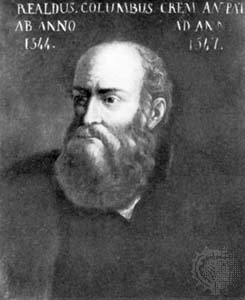
Realdo Colombo
Matteo Realdo Colombo (c. 1515 – 1559) was an Italian professor of anatomy and a surgeon at the University of Padua between 1544 and 1559.
Matteo Realdo Colombo or Realdus Columbus, was born in Cremona, Lombardy, the son of an apothecary named Antonio Colombo. Although little is known about his early life, it is known he took his undergraduate education in Milan, where he studied philosophy, and he appears to have pursued his father's profession for a short while afterwards. He left the apothecary's life and apprenticed to the surgeon Giovanni Antonio Lonigo, under whom he studied for 7 years. In 1538 he enrolled in the University of Padua where he was noted to be an exceptional student of anatomy. While still a student, he was awarded a Chair of Sophistics at the university. In 1542 he returned briefly to Venice to assist his mentor, Lonigo.
Realdo Colombo studied philosophy in Milan, and then he trained to be a surgeon for several years under a Venetian named Giovanni Antonio Plato, also known as Lonigo or Leonicus. By 1538, during the years of Andreas Vesalius, Columbo had arrived at Padua where he studied medicine, anatomy, and he lectured to arts students on sophistics, or logic. Columbo became a close friend of Vesalius and possibly assisted him at a dissection. Vesalius was away in Basel when Columbo was temporarily appointed to teach in his place, and eventually, Colombo received this position more permanently.
In 1544, Colombo went to the University of Pisa and performed many dissections; he was referred to “As Master of Anatomy and Surgery.” Then in 1548, Columbo went to Rome where he taught anatomy at the papal university for about ten years until his death in 1559. While Colombo was in Rome, he took on a project with Michelangelo and became his personal physician and friend. He intended to collaborate with Michelangelo on an illustrated anatomy text to rival De Fabrica but this never came to pass, likely due to Michelangelo's advanced age. Although not much is known about Colombo's biography, his relationship with the more familiar Michelangelo has helped historians better understand his views. He also performed the autopsy on the body of St. Ignatius of Loyola.
The relationship between Colombo and Vesalius is not entirely clear. Colombo was appointed to one of the posts in surgery at the University of Padua in 1541 to replace Vesalius while he traveled to Basel in order to supervise the printing of De Humani Corporis Fabrica. It is often thought that Colombo was a student of Vesalius, but this may not have been the case. Regardless, they had become bitter rivals by 1555. While teaching Vesalius' classes in 1543, Colombo pointed out several errors Vesalius made, most notably attributing properties of cows' eyes to the eyes of humans as well as claiming to have discovered a vein in the human body, the existence of which Vesalius had previously denied. Although Vesalius has been much maligned for correcting Galen, Colombo was the one to criticize him for his own mistakes. When Vesalius returned, he was outraged. He publicly ridiculed Colombo, calling him an "Ignoramus" and stating that "what meager knowledge [Colombo] has of anatomy he learned from me"[This quote needs a citation] on a number of occasions. Despite Vesalius's claims, it is likely that Colombo was a proper colleague of Vesalius rather than a student. For one thing, Vesalius attributes many of his discoveries in De Fabrica to Colombo who is referred to as a, "very good friend." Vesalius and Colombo were also from very different academic backgrounds. Vesalius was a Galenic expert, trained in Leuven, whereas Colombo began his study of anatomy as a surgeon. Finally, Colombo refers frequently to Lonigo as his teacher of surgery and anatomy, never mentioning Vesalius. While both Colombo and Vesalius were in favor of returning to the anatomical practice of vivisection, as the Alexandrians did, Colombo was the only one to actually do so. This is one of the main reasons as to why Colombo criticized Vesalius. Vesalius criticized Galen while he himself continued to show the anatomy of animals, instead of humans, in his book.
Colombo's only published text, De Re Anatomica, was released shortly after his death in 1559. His sons, Lazarus and Phoebus, were responsible for overseeing the final stages of the publishing process of his book after Colombo’s death interrupted it. Many of the contributions made in De Re Anatomica overlapped the discoveries of another anatomist, Gabriele Falloppio, most notably in that both Colombo and Falloppio claimed to have discovered the clitoris. Although both Colombo and Falloppio gave claim to what was actually the re-discovery of the clitoris, it is Colombo who is credited as having been the anatomist who correctly identified the clitoris as a predominantly sexual organ. Falloppio published his own book, Observationes Anatomicae, in 1561, but there is evidence that Falloppio had written notes on his discovery of the clitoris eleven years earlier in 1550. In 1574, Leone Giovanni Battista Carcano (1536–1606), a student of Falloppio, formally charged Colombo of plagiarism, although since Colombo had been dead for over a decade nothing came of these charges.
Realdo Colombo did not accept the work of previous anatomists without proof, and in some cases sought to criticize or discredit them. He especially criticized Galen’s work, and was angered by those who swore on Galen’s ideas, saying “that they dare to affirm that Galen is to be taken as Gospel, and that nothing in his writing is not true!” For example, he argued that Galen’s use of animals in dissection was not solid evidence that his anatomy was sound. He also criticized Vesalius for his hypocrisy in correcting Galen’s work while still avoiding human dissection. Colombo instead respected the work of Alexandrian physicians, as he viewed their use of human dissection as more accurate than animal dissection or vivisection. His use of vivisection to examine the contractions of the heart and arteries contradicted Galen’s findings, and supported the theories of the Alexandrian physician Erasistratus.
Prior to Colombo’s work, anatomists such as Galen and Vesalius examined blood vessels separately from the organs of the body. Colombo instead considered these vessels together with the organs they support, and from this was able to conceptualize the flow of blood to and from each organ, supporting his discovery of pulmonary transition of the blood. Colombo also viewed the lungs separately from the heart, and assigned it as having a special role in respiration. This approach to examination gave him a more firm understanding of the functions of the organs as well, and strengthened his criticisms of Galen.
Hub AI
Realdo Colombo AI simulator
(@Realdo Colombo_simulator)
Realdo Colombo
Matteo Realdo Colombo (c. 1515 – 1559) was an Italian professor of anatomy and a surgeon at the University of Padua between 1544 and 1559.
Matteo Realdo Colombo or Realdus Columbus, was born in Cremona, Lombardy, the son of an apothecary named Antonio Colombo. Although little is known about his early life, it is known he took his undergraduate education in Milan, where he studied philosophy, and he appears to have pursued his father's profession for a short while afterwards. He left the apothecary's life and apprenticed to the surgeon Giovanni Antonio Lonigo, under whom he studied for 7 years. In 1538 he enrolled in the University of Padua where he was noted to be an exceptional student of anatomy. While still a student, he was awarded a Chair of Sophistics at the university. In 1542 he returned briefly to Venice to assist his mentor, Lonigo.
Realdo Colombo studied philosophy in Milan, and then he trained to be a surgeon for several years under a Venetian named Giovanni Antonio Plato, also known as Lonigo or Leonicus. By 1538, during the years of Andreas Vesalius, Columbo had arrived at Padua where he studied medicine, anatomy, and he lectured to arts students on sophistics, or logic. Columbo became a close friend of Vesalius and possibly assisted him at a dissection. Vesalius was away in Basel when Columbo was temporarily appointed to teach in his place, and eventually, Colombo received this position more permanently.
In 1544, Colombo went to the University of Pisa and performed many dissections; he was referred to “As Master of Anatomy and Surgery.” Then in 1548, Columbo went to Rome where he taught anatomy at the papal university for about ten years until his death in 1559. While Colombo was in Rome, he took on a project with Michelangelo and became his personal physician and friend. He intended to collaborate with Michelangelo on an illustrated anatomy text to rival De Fabrica but this never came to pass, likely due to Michelangelo's advanced age. Although not much is known about Colombo's biography, his relationship with the more familiar Michelangelo has helped historians better understand his views. He also performed the autopsy on the body of St. Ignatius of Loyola.
The relationship between Colombo and Vesalius is not entirely clear. Colombo was appointed to one of the posts in surgery at the University of Padua in 1541 to replace Vesalius while he traveled to Basel in order to supervise the printing of De Humani Corporis Fabrica. It is often thought that Colombo was a student of Vesalius, but this may not have been the case. Regardless, they had become bitter rivals by 1555. While teaching Vesalius' classes in 1543, Colombo pointed out several errors Vesalius made, most notably attributing properties of cows' eyes to the eyes of humans as well as claiming to have discovered a vein in the human body, the existence of which Vesalius had previously denied. Although Vesalius has been much maligned for correcting Galen, Colombo was the one to criticize him for his own mistakes. When Vesalius returned, he was outraged. He publicly ridiculed Colombo, calling him an "Ignoramus" and stating that "what meager knowledge [Colombo] has of anatomy he learned from me"[This quote needs a citation] on a number of occasions. Despite Vesalius's claims, it is likely that Colombo was a proper colleague of Vesalius rather than a student. For one thing, Vesalius attributes many of his discoveries in De Fabrica to Colombo who is referred to as a, "very good friend." Vesalius and Colombo were also from very different academic backgrounds. Vesalius was a Galenic expert, trained in Leuven, whereas Colombo began his study of anatomy as a surgeon. Finally, Colombo refers frequently to Lonigo as his teacher of surgery and anatomy, never mentioning Vesalius. While both Colombo and Vesalius were in favor of returning to the anatomical practice of vivisection, as the Alexandrians did, Colombo was the only one to actually do so. This is one of the main reasons as to why Colombo criticized Vesalius. Vesalius criticized Galen while he himself continued to show the anatomy of animals, instead of humans, in his book.
Colombo's only published text, De Re Anatomica, was released shortly after his death in 1559. His sons, Lazarus and Phoebus, were responsible for overseeing the final stages of the publishing process of his book after Colombo’s death interrupted it. Many of the contributions made in De Re Anatomica overlapped the discoveries of another anatomist, Gabriele Falloppio, most notably in that both Colombo and Falloppio claimed to have discovered the clitoris. Although both Colombo and Falloppio gave claim to what was actually the re-discovery of the clitoris, it is Colombo who is credited as having been the anatomist who correctly identified the clitoris as a predominantly sexual organ. Falloppio published his own book, Observationes Anatomicae, in 1561, but there is evidence that Falloppio had written notes on his discovery of the clitoris eleven years earlier in 1550. In 1574, Leone Giovanni Battista Carcano (1536–1606), a student of Falloppio, formally charged Colombo of plagiarism, although since Colombo had been dead for over a decade nothing came of these charges.
Realdo Colombo did not accept the work of previous anatomists without proof, and in some cases sought to criticize or discredit them. He especially criticized Galen’s work, and was angered by those who swore on Galen’s ideas, saying “that they dare to affirm that Galen is to be taken as Gospel, and that nothing in his writing is not true!” For example, he argued that Galen’s use of animals in dissection was not solid evidence that his anatomy was sound. He also criticized Vesalius for his hypocrisy in correcting Galen’s work while still avoiding human dissection. Colombo instead respected the work of Alexandrian physicians, as he viewed their use of human dissection as more accurate than animal dissection or vivisection. His use of vivisection to examine the contractions of the heart and arteries contradicted Galen’s findings, and supported the theories of the Alexandrian physician Erasistratus.
Prior to Colombo’s work, anatomists such as Galen and Vesalius examined blood vessels separately from the organs of the body. Colombo instead considered these vessels together with the organs they support, and from this was able to conceptualize the flow of blood to and from each organ, supporting his discovery of pulmonary transition of the blood. Colombo also viewed the lungs separately from the heart, and assigned it as having a special role in respiration. This approach to examination gave him a more firm understanding of the functions of the organs as well, and strengthened his criticisms of Galen.