Hubbry Logo
Gabriele FalloppioGabriele FalloppioMain
Open search
Gabriele Falloppio
Community hub
Gabriele Falloppio
logo
8 pages, 0 posts
0 subscribers
Be the first to start a discussion here.
Gabriele Falloppio
Gabriele Falloppio
from Wikipedia

Gabriele Falloppio (1522/23 – 9 October 1562) was an Italian Catholic priest and anatomist often known by his Latin name Fallopius. He was one of the most important anatomists and physicians of the sixteenth century, giving his name to the fallopian tube.

Key Information

Life

[edit]

Falloppio grew up in Modena. His father died early but thanks to the support of affluent relatives he enjoyed a thorough humanist education in Modena, learning Latin and Greek and moving in the local circle of humanist scholars. He was for some years in the service of the Church, among others as a kind of warden at Modena's cathedral, but soon turned to medicine. In 1544, he performed a public anatomy in Modena. In 1545, at the latest, he began to study medicine at the University of Ferrara, at that time one of the best medical schools in Europe. It was there also that he much later, in 1552, when he was already professor in Padua, received his medical doctorate under the guidance of Antonio Musa Brasavola. He taught on medicinal plants in Ferrara but was not professor of anatomy there, as has sometimes been claimed. He also was never a personal student of Andreas Vesalius as is often falsely maintained (he explicitly called himself a student of Vesalius in the sense only that he had read his works). In 1548, he took the chair of anatomy at the University of Pisa. In 1551, he was invited to occupy the chair of anatomy and surgery at the University of Padua and also lectured on medicinal plants or botany. In Padua, he shared his house over years with the German botanist Melchior Wieland which gave rise to some suspicions about the nature of their relationship and got Falloppio involved in Wieland's vitriolic controversy with the irascible botanist Pietro Andrea Mattioli. Falloppio was a very popular teacher and had numerous students. He also ran an extensive medical and surgical practice and took his students with him so they could learn from him. He died in Padua in October 1562, not even 40 years old. His plans for a major illustrated anatomical textbook were thus never realized.[1]

Contributions

[edit]
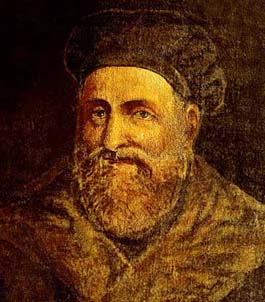
Gabriele Falloppius explaining one of his discoveries to the Cardinal Duke of Ferrara

Falloppio published only one major work during his lifetime, the Observationes anatomicae, which first came out in 1561. Here he presented his numerous new anatomical findings, correcting and expanding on the works of Galen and Vesalius. Some of his findings referred to the head and the brain. He added much to what was known before about the internal ear and described in detail the tympanum and its relations to the osseous ring in which it is situated. He also described minutely the circular and oval windows (fenestræ) and their communication with the vestibule and cochlea. He was the first to point out the connection between the mastoid cells and the middle ear. His description of the lacrimal ducts in the eye was a marked advance on those of his predecessors and he also gave a detailed account of the ethmoid bone and its cells in the nose. The aquaeductus Fallopii, the canal through which the facial nerve passes after leaving the auditory nerve, is also named after him. He also described the Fallopian hiatus, an opening in the anterosuperior part of the petrosal bone.[2]

His contributions to the anatomy of the bones and muscles were very valuable as well. He discovered, among others, the muscle that lifts the upper eyelid. He studied the reproductive organs in both sexes, and gave the first precise description of the uterine tube, which leads from the ovary to the uterus and bears his name to this day. He was the first to describe the ileocecal valve, which prevents a reflux of fecal matter from the colon to the small intestines, and demonstrated its function to his students. He also was the first to identify the vessels in the abdomen which were later called lacteals because of their milky appearance after meals.

His contributions to practical medicine were also important. He was the first to use an aural speculum for the diagnosis and treatment of diseases of the ear, and his writings on surgical subjects are still of interest. After his death, some of his students published their lectures, in particular, on ulcers, tumors, medical cosmetics, and other surgical topics and on botany and mineral waters. In his lectures, Falloppio also described, around 1555, a linen sheath that previously had been soaked in medicinal substances and then dried and some authors have praised him as the inventor of the condom. The sheath was not to be used during intercourse, however. A man who had intercourse with a woman he suspected of being infected with the French disease or syphilis was to put the sheath over the glans penis after intercourse and leave it there for several hours to destroy infectious matter that might have entered the skin. Some authors have taken Falloppio's claim seriously - which is clearly phantastical - that he tested this sheath on a thousand or more men.[3][4]

Falloppio also lectured extensively on mineral waters and their medicinal qualities and presented the results of his chemical analysis of the waters from various springs by means of distilliation. He argued against Fracastor's theory of fossils, as described as follows in Charles Lyell's Principles of Geology:

Falloppio of Padua conceived that petrified shells had been generated by fermentation in the spots where they were found, or that they had in some cases acquired their form from 'the tumultuous movements of terrestrial exhalations.' Although a celebrated professor of anatomy, he taught that certain tusks of elephants dug up in his time at Puglia were mere earthy concretions, and, consistently with these principles, he even went so far as to consider it not improbable, that the vases of Monte Testaceo at Rome were natural impressions stamped in the soil.[5]

Legacy

[edit]

Various anatomical structures were described by Falloppio, including fallopian tube, Fallopian canal, and Fallopian ligament.

A genus of about 12 species of flowering plants bears his name (Fallopia).

Works

[edit]
  • Omnia, quæ adhuc extant opera (1584) (mostly a collection of student notes on Falloppio's lectures)
  • Falloppio, Gabriele. 1562. Observationes anatomicae. Venetiis: Apud Marcum Antonium Vlmum.[6] (first published in 1561)
  • Kunstbuch Des hocherfarnen und weytberhümpten Herrn Gabrielis Fallopij, der Artzney Doctorn von mancherley nutzlichen Künsten . Sampt einem andern büchlin / durch Christophorum Landrinum außgangen. Manger, Augspurg 1578 Digital edition by the University and State Library Düsseldorf (spurious, wrongly attributed to Falloppio)
  • Gabrielis Fallopii Wunderlicher menschlichem Leben gewisser und sehr nutzlicher Secreten drey Bücher : vom Authore selbst in Italienischer Sprach publicirt, jetzund aber Teutscher Nation zu gutem in unser Muttersprach ubersetzet. Iennis / N. Hoffmann, Franckfurt am Mayn 1616 Digital edition by the University and State Library Düsseldorf (spurious, wrongly attributed to Falloppio)

See also

[edit]

References

[edit]
[edit]
Revisions and contributorsEdit on WikipediaRead on Wikipedia
from Grokipedia
Gabriele Falloppio (1523–1562), also known by his Latin name Fallopius, was an Italian Catholic , physician, and whose meticulous dissections and publications significantly advanced Renaissance-era understanding of human , particularly in the reproductive, auditory, and nervous systems. Born in to a noble family, he initially studied and was ordained a in 1542 before pursuing medicine, earning his degree from the in 1548 under the tutelage of Antonio Musa Brassavola. His career included professorships in at the universities of , (from 1548), and (from 1551 until his death), where he also lectured on and , serving as personal physician to prominent figures including members of the papal court. Falloppio's most enduring contribution was his detailed description of the oviducts, which he named tuba uteri for their trumpet-like shape, correctly identifying them as the pathway connecting the ovaries to the uterus—a correction to earlier misconceptions by Andreas Vesalius—and earning them the eponym "fallopian tubes" in modern terminology. He also introduced key anatomical terms such as vagina (sheath) for the birth canal and placenta for the afterbirth, while providing the first accurate accounts of the cochlea, semicircular canals, and other inner ear structures, as well as the chorda tympani nerve and lacrimal passages. In preventive medicine, amid the syphilis epidemic, he advocated for a linen sheath soaked in chemicals as a prophylactic barrier, reportedly testing it successfully on over 1,100 men, detailed in his posthumously published treatise De morbo gallico liber absolutissimus (1564). His seminal work, Observationes anatomicae (1561), compiled findings from hundreds of dissections, critiquing and building upon Vesalius's De humani corporis fabrica, and influenced subsequent anatomists like Hieronymus Fabricius. Other posthumous publications, including Explicatio tabularum anatomicarum Bartholamei Eustii (1564) and De partibus similaribus humani corporis (1575), further disseminated his botanical and anatomical insights, with the plant genus Fallopia later named in his honor. Falloppio died prematurely on October 9, 1562, in Padua, likely from tuberculosis or pleurisy at age 39, leaving a legacy as one of the foremost anatomists of the 16th century despite his short life.

Early Life and Education

Birth and Family Background

Gabriele Falloppio was born in late 1522 or early 1523 in , , a city then serving as the capital of the of Modena under the Este family. The exact date remains uncertain, though historical estimates place it around this period based on contemporary records. He was born into a noble but impoverished family, with his father, Girolamo Falloppio (also known as Girvò), working as both a soldier and a before dying in 1533 when Gabriele was about ten years old. His mother, Caterina de’ Bergomozzi, passed away around 1550, leaving the family in financial hardship that profoundly shaped his early years. Falloppio had at least one younger brother, Giulio Ludovico, baptized on 4 October 1524, and he appears to have been the eldest surviving son amid these challenges. In Modena's vibrant environment, Falloppio received an early education influenced by and emerging scientific thought, tutored by scholars such as Francesco da Porta and Ludovico Castelvetro. The city's intellectual circles, including the Accademia modenese, exposed him to local physicians like Niccolò Machella and humanists such as Agostino Gadaldini, fostering interests in classical texts and within the cultural milieu of the Este court. Due to the family's following his father's , Falloppio pursued clerical , serving as a clergyman in and holding benefices by 1545, which provided financial stability and instilled early discipline; he was ordained a in 1542. This path, though later set aside for medical studies, reflected the era's common route for educated youth from modest noble backgrounds.

Medical and Academic Training

Falloppio's formal began amid financial hardships following his father's death in , which delayed his studies until family circumstances improved in the early 1540s. He initially pursued philosophy and surgery in , where he gained practical experience through dissections on cadavers of executed criminals under the guidance of local physician Niccolò Machella. Around 1540, he enrolled at the , one of Europe's premier medical schools at the time, to advance his training in . At Ferrara, Falloppio studied under the renowned botanist and physician Antonio Brassavola, whose expertise in pharmacology complemented the Galenic traditions that dominated Renaissance medical curricula. These studies emphasized humoral theory and classical texts, but Falloppio was also exposed to the revolutionary empirical approach of Andreas Vesalius's De humani corporis fabrica (1543), which encouraged direct observation over ancient authority and profoundly shaped his emerging interest in anatomy. Financial constraints persisted, prolonging his coursework, but he ultimately earned his MD degree in 1548. During the 1540s, Falloppio served briefly as a priest-physician in rural parishes near , combining his clerical duties with patient care to hone practical clinical skills amid limited resources. This period bridged his ecclesiastical background and medical aspirations, allowing him to apply rudimentary surgical knowledge in real-world settings. Concurrently, he engaged in self-directed studies during his years, traveling to collect plant specimens in the ; these explorations laid the groundwork for his later work in and .

Professional Career

Academic Appointments

Falloppio began his academic career at the , where he had completed his medical studies under the guidance of notable physicians such as Antonio Musa Brasavola. In 1548, he was appointed professor of anatomy there, marking his first formal university position and allowing him to build upon his early training in and . This role at , a leading center for in 16th-century , provided Falloppio with the platform to refine his skills in and practical before advancing to more prominent institutions. In 1548, Falloppio moved to the as chair of and , a position secured through the patronage of , the Grand Duke of , who sought to elevate the university's medical faculty. During his tenure from 1548 to 1551, he introduced innovative teaching practices, including public dissections that drew scholars from across and enhanced Pisa's reputation as a hub for anatomical study. This period underscored the integration of with , as Falloppio oversaw the university's botanical collections to support medicinal research. Falloppio's rising acclaim led to his appointment in 1551 as professor of anatomy, surgery, and botany at the , a position offered by the to succeed Realdus Columbus in the chair once held by . He held this role until his death in 1562, during which time his reputation for meticulous dissections and interdisciplinary approaches propelled his rapid ascent within Italy's academic elite. In addition to his teaching duties, Falloppio assumed administrative responsibilities, including supervision of the renowned at —Europe's first such institution—where he fostered connections between anatomical inquiry and the study of . At , he had similarly managed botanical resources, emphasizing their role in surgical and pharmaceutical advancements.

Teaching Methods and Notable Students

Gabriele Falloppio employed innovative teaching methods that emphasized hands-on anatomical instruction, diverging from the rote memorization of Galenic texts prevalent in earlier . As professor of , , and at the from 1551 until his death, he combined the roles of (lecturer), ostensor (demonstrator), and sector (dissector) during public anatomical demonstrations, personally conducting dissections on fresh cadavers to promote empirical through direct sensory experience, or autopsia. These sessions, often held in temporary public theaters and lasting up to ten days or more, utilized executed criminals, allowing for detailed, systematic exploration of structures; Falloppio advised students to first practice on animals such as monkeys and sheep before human dissections to build practical skills ethically. His lectures preceded these dissections, featuring structured explanations enhanced by illustrations—such as diagrams of eye anatomy and cautery instruments—and focused on correcting errors in predecessors like and Vesalius through personal verification rather than theoretical speculation, fostering a commitment to over authoritative dogma. Falloppio integrated into his medical to underscore the practical application of natural sciences in healing, using live demonstrations and field excursions to the of Padua's , which he supervised. He taught herbal remedies alongside by presenting like salsaparilla and bark in lectures, linking their pharmacological properties—drawn from Latin, Greek, and Islamic traditions—to anatomical knowledge and surgical practice, thereby encouraging students to view holistically through observation of living specimens and models. This approach complemented his anatomical teachings, as he incorporated zoological dissections of live animals to illustrate physiological functions, distinguishing his by blending empirical with therapeutic in a manner that prioritized real-world utility over abstract theory. His methods proved highly popular, attracting hundreds of students from across Europe to Padua's medical faculty, where crowds filled public anatomies and even rioted to demand continuation of his lectures upon his occasional absences. Falloppio's emphasis on ethical practices—such as justifying the use of condemned individuals while avoiding vivisection and unnecessary harm—along with his moderate, evidence-based critiques of Vesalius's more illustrative and theoretically oriented style, further enhanced his reputation as a masterful educator who inspired empirical rigor in anatomical study. Among his notable students were Hieronymus Fabricius ab Aquapendente, who succeeded him at Padua and advanced embryology and vascular anatomy, and Volcher Coiter, a Dutch anatomist who pioneered comparative osteology and published early illustrations of fetal skeletons based on Falloppio's influences. These pupils extended Falloppio's legacy, with Fabricius's work on venous valves providing early foundations for William Harvey's later circulatory theories.

Anatomical and Medical Contributions

Discoveries in Human Anatomy

Gabriele Falloppio's most renowned anatomical discovery was the uterine tubes, now known as the fallopian tubes, which he described in detail in his 1561 work Observationes anatomicae. Through meticulous dissections of human and animal cadavers, including humans, sheep, and cows, he identified these structures as slender, -shaped passages—naming them "tuba uteri" for their resemblance to a —connecting the uterine cornua to the ovaries and emphasizing their essential role in by facilitating the transport of ova. This was the first accurate depiction of the tubes as distinct female organs, correcting earlier misconceptions by and , who had erroneously likened them to the male and as mere conduits. Falloppio made significant contributions to the understanding of the ear and structures, rediscovering the —later termed the aqueduct of Falloppio or Fallopian canal—which houses the as it emerges from the auditory nerve and traverses the . He also provided the first clear descriptions of the within the , elucidating their role in balance and spatial orientation, and identified the nerve, detailing its path and function in taste sensation from the tongue. Additionally, he was the first to note the connection between the and the , advancing knowledge of auditory anatomy and potential pathways for infection spread. Falloppio introduced the term "cavum tympani" for the and described its , oval and round windows, further refining the inner ear's architecture. To examine the ear, he pioneered the use of an aural speculum, enabling direct visualization for diagnosis and treatment of ear disorders. Beyond the reproductive and auditory systems, Falloppio's empirical approach yielded other key observations, such as the first description of the and its function in preventing reflux of fecal matter from the colon into the during . He also detailed the lesser wings of the , contributing to cranial anatomy by clarifying their structure and position within the skull base. These findings stemmed from his extensive dissections of cadavers, often those of executed criminals, which allowed him to challenge Galenic errors—particularly in ear ossicles and female reproductive anatomy—while building on Vesalius's foundational work by emphasizing sensory organs and providing more precise, observation-based corrections.

Innovations in Treatment and Prevention

Falloppio made significant advancements in the treatment of , then known as the "French disease," by integrating his anatomical observations with practical therapies. He recommended mercury-based ointments and infusions derived from wood, a plant from the , as primary remedies, while cautioning against the toxic effects of prolonged mercury , which could lead to lethal intoxication in patients. In his detailed descriptions of the disease's symptoms—including initial chancres, rashes, and progression to severe ulceration and bone involvement—he emphasized its venereal transmission through sexual contact, as outlined in his treatise De morbo gallico. A cornerstone of Falloppio's preventive innovations was the invention of a sheath, described in his 1564 treatise De morbo gallico liber absolutissimus, designed specifically to block transmission during intercourse. This device, a fine covering for the soaked in a chemical solution of mercury and , was intended as a mechanical barrier rather than a contraceptive, with Falloppio reporting successful trials on over 1,100 men where none contracted the . By applying his understanding of vectors, he positioned this sheath as a proactive measure against venereal , influencing later discussions on protective barriers in . In , Falloppio advanced the use of plant-based remedies through extensive cataloging and empirical analysis, drawing on ancient sources like Dioscorides while incorporating field observations from botanical gardens. His lectures and writings, such as De simplicibus medicamentis purgantibus (1565), detailed numerous for therapeutic applications, promoting chemical extractions and distillations over simple herbal preparations to isolate active compounds more effectively. For tumors, he prescribed purgatives, , and astringents alongside surgical interventions, advocating removal of affected tissues with precision to avoid recurrence, as discussed in De tumoribus praeter naturam (1563). In treating disorders, he utilized thermal waters like those at Bagni di Corsena to restore hearing and linked symptoms such as to progression, building on his anatomical descriptions of the auditory . Falloppio's surgical techniques reflected his anatomical expertise, particularly in improving hernia repairs by emphasizing precise incision and suturing based on the structures of the . He recommended reducing the sac, excising redundant tissue, and closing the defect with ligatures or cautery, while warning against operations in frail patients due to high mortality risks. In wound care, he stressed practices, including washing ulcers with alum-infused waters, maintaining clean hands and instruments during procedures, and ensuring adequate lighting and patient positioning to minimize —principles that prefigured modern antisepsis. These methods, applied to conditions like anal fistulas and post-surgical , prioritized and empirical outcomes.

Publications

Primary Works During Lifetime

Gabriele Falloppio's sole major publication during his lifetime was Observationes anatomicae, issued in in 1561 by Marco Antonio Ulmo. Structured as an epistolary addressed to his colleague Pietro Manna, a physician from , the work comprised numerous detailed anatomical observations derived from Falloppio's dissections, primarily correcting and expanding upon the findings of and . It covered key areas such as the (including the first description of the fallopian tubes, termed tuba uterina), the structure of the ear (notably the ), , and the , presented with empirical precision and supported by illustrations for clarity. The book avoided bold claims of revolution, framing its content as humble "observations" to navigate potential conflicts with authorities, and was reprinted in 1562 with additions, reflecting its immediate acclaim among anatomists. In addition to this printed work, Falloppio circulated unpublished letters and short treatises that disseminated his ideas prior to his death in 1562. His ideas on (morbus gallicus), including preventive measures like a linen sheath soaked in —an early conceptual precursor to the —based on his recognition of the disease's venereal transmission, were shared among peers like and Girolamo Mercuriale and later published posthumously. These manuscripts influenced contemporary medical discourse without formal publication during his life. Falloppio also produced brief botanical writings tied to his role as professor of and superintendent of the University of Padua's garden, including plant lists compiled for colleagues such as Aldrovandi in the late 1550s. These inventories documented medicinal species in the garden, aiding pharmacological studies and reflecting his integration of with , though none were published before 1562. His overall writing style across these works was concise, empirical, and firsthand, emphasizing personal dissections and trials (pericula and experimenta) while respectfully critiquing ancient and recent authorities, thus prioritizing practical utility over theoretical speculation.

Posthumous Compilations and Influence

Following Falloppio's death in 1562, his students and colleagues undertook the task of compiling and publishing his extensive but unfinished body of work, drawing primarily from lecture notes, manuscripts, and correspondence to preserve his contributions across , , , and . One of the earliest such efforts was the 1564 publication of De morbo gallico, a on that included discussions of its transmission and prevention, as well as Explicatio tabularum anatomicarum Bartholamei Eustii, alongside other emerging compilations of his surgical and botanical lectures that incorporated unreleased notes from his tenure. These initial releases laid the groundwork for broader collections, reflecting the collaborative spirit among his pupils, including Girolamo Fabrizi d'Acquapendente (), who succeeded him as professor of and at the and helped safeguard his intellectual legacy. The most comprehensive posthumous edition, Omnia, quae adhuc extant opera, appeared in Venice in 1584 under the publisher Felice Valgrisi, spanning over 1,000 pages and gathering a wide array of Falloppio's materials into three volumes. This compilation integrated previously published treatises with newly edited content, including letters on medical consultations, detailed works on (De morbo gallico), tumors (De tumoribus praeter naturam), and (De simplicibus medicamentis purgantibus and De compositione medicamentorum), alongside sections on surgical techniques, , and mineral waters. Additional posthumous works included De partibus similaribus humani corporis (1575). The edition featured added indices for easier navigation, woodcut illustrations of anatomical structures and , and annotations that clarified Falloppio's observational methods, making it a key resource for medical students and practitioners. The editorial process relied heavily on contributions from Falloppio's students and associates, such as Andrea Marcolino and Volcher Coiter, who transcribed and organized lecture notes while striving to retain his original voice through verbatim reproductions of his empirical descriptions and dissections. However, editors occasionally introduced interpretations or rearrangements to address inconsistencies from repeated lectures over years, which occasionally amplified Falloppio's emphasis on direct observation over ancient authorities like . Fabricius, in particular, drew upon these materials in his own teachings, including his work on venous valves, ensuring their dissemination and influencing 17th-century anatomists such as . Early reception of these compilations highlighted their immediate impact, with naturalist praising the botanical sections for their precise descriptions of medicinal plants and purgatives, which he incorporated into his own encyclopedic works on . The syphilis treatises, in particular, sparked widespread debates across on transmission, as Falloppio's of contagion via "morbid particles" absorbed through skin pores—preventable by a medicated sheath—challenged prevailing views on divine punishment or miasmatic origins, prompting responses from physicians like and influencing preventive practices into the 17th century.

Later Life, Death, and Legacy

Personal Challenges and Death

Throughout his career, he maintained a balance between his Catholic faith and scientific pursuits, avoiding any notable conflicts with the by framing his anatomical work as complementary to divine creation. In his later years at the , Falloppio endured significant personal strains from his demanding workload, which included lecturing, dissections, and administrative duties, leading to chronic fatigue by 1556. These pressures, compounded by ongoing family financial obligations, contributed to his physical decline, culminating in a chronic lung disease likely . Despite treatments by contemporary physicians, his condition worsened, and he died on October 9, 1562, at the age of 39 in . Falloppio's death was honored by the , reflecting his esteemed status among colleagues. He was interred in the Church of St. Anthony in , a site befitting his contributions to and his enduring ties to the institution. His will emphasized his scholarly legacy, though specific bequests such as book donations to the university library underscore his commitment to advancing knowledge for future generations.

Enduring Impact and Modern Recognition

Gabriele Falloppio's anatomical discoveries profoundly influenced subsequent generations of scholars, particularly through his successor at the , ab Aquapendente (1533–1619), who built upon Falloppio's detailed dissections of vascular and valvular structures in his own work on venous valves. Fabricius, in turn, mentored (1578–1657), whose seminal 1628 treatise De Motu Cordis on blood circulation drew directly from Fabricius's observations of valves, which echoed Falloppio's foundational emphasis on precise anatomical mapping of the venous system. Falloppio's rigorous approach to dissection and description laid essential groundwork for the fields of , through his mappings of the ear's bony structures, and gynecology, via his elucidation of the female reproductive tract, influencing clinical practices that persist in modern surgical techniques. Several anatomical features bear Falloppio's name as eponyms, reflecting his enduring legacy in medical : the (oviduct), Fallopian aqueduct (canal for the in the ), Fallopian ligament (a band of tissue in the inguinal region), and Fallopian arch (related to the inguinal ligament's superior boundary). His contributions extended beyond human anatomy to ; the plant genus (Polygonaceae family), which includes like Japanese knotweed, was named in his honor by in 1763, recognizing Falloppio's early systematic descriptions of flora alongside his medical pursuits. These eponyms underscore his role in standardizing terminology, a theme revisited in contemporary scholarship that highlights how his precise Latin descriptors corrected earlier inaccuracies and shaped interdisciplinary scientific language. Recent reassessments have clarified and expanded Falloppio's impact, addressing historical gaps in areas like and . Michael Stolberg's 2022 biography, Gabrielle Falloppia, 1522/23–1562: The Life and Work of a Anatomist, draws on unpublished manuscripts to emphasize Falloppio's innovations in , his pharmacological experiments with herbal remedies for conditions like the "French disease" (), and his interactive teaching methods, including student-led dissections that fostered empirical inquiry at . Post-2020 research has further illuminated his dacryological contributions, such as early descriptions of regurgitation, as detailed in a 2024 analysis of Padua's anatomical school, which integrates Falloppio's work with that of Vesalius and Fabricius to trace the evolution of lacrimal drainage understanding. As of 2025, studies continue to reference his foundational observations in lacrimal , including differential regurgitation from puncta and canalicular openings into the . Regarding syphilis prevention, modern studies have clarified myths surrounding his linen sheath device, confirming it as an early prophylactic soaked in medication to avert transmission during intercourse, rather than a direct precursor to the modern , based on his 1564 posthumous De Morbo Gallico. These scholarly efforts, including explorations of his botanical legacy, reveal how Falloppio's integrated approach to , , and continues to inform ongoing research in reproductive health, otolaryngology, and historical .

References

Add your contribution
Related Hubs
User Avatar
No comments yet.