



Community hub
Recent from talks
Knowledge base stats:
Talk channels stats:
Members stats:
Scratching
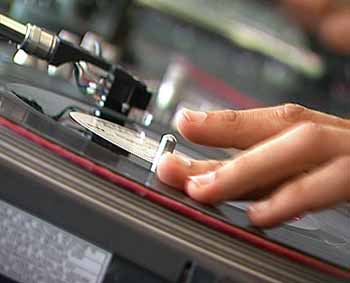
Scratching, sometimes referred to as scrubbing, is a DJ and turntablist technique of moving a vinyl record back and forth on a turntable to produce percussive or rhythmic sounds. A crossfader on a DJ mixer may be used to fade between two records simultaneously.
While scratching is most associated with hip hop music, where it emerged in the mid-1970s, from the 1990s it has been used in some styles of EDM like techno, trip hop, and house music and rock music such as rap rock, rap metal, rapcore, and nu metal. In hip hop culture, scratching is one of the measures of a DJ's skills. DJs compete in scratching competitions at the DMC World DJ Championships and IDA (International DJ Association), formerly known as ITF (International Turntablist Federation). At scratching competitions, DJs can use only scratch-oriented gear (turntables, DJ mixer, digital vinyl systems or vinyl records only). In recorded hip hop songs, scratched "hooks" often use portions of other songs.
A rudimentary form of turntable manipulation that is related to scratching was developed in the late 1940s by radio music program hosts, disc jockeys (DJs), or the radio program producers who did their own technical operation as audio console operators. It was known as back-cueing, and was used to find the very beginning of the start of a song (i.e., the cue point) on a vinyl record groove. This was done to permit the operator to back the disc up (rotate the record or the turntable platter itself counter-clockwise) in order to permit the turntable to be switched on, and come up to full speed without ruining the first few bars of music with the "wow" of incorrect, unnaturally slow-speed playing. This permitted the announcer to time their remarks, and start the turntable in time for when they wanted the music on the record to begin.
Back cueing was a basic skill that all radio production staff needed to learn, and the dynamics of it were unique to the brand of professional turntable in use at a given radio station. The older, larger and heavier turntables needed a 180-degree backward rotation to allow for run up to full speed; some of the newer 1950s models used aluminum platters and cloth-backed rubber mats which required a third of a rotational turn or less to achieve full speed when the song began. All this was done in order to present a music show on air with the least amount of silence ("alive air") between music, the announcer's patter and recorded advertising commercials. The rationale was that any "dead air" on a radio station was likely to prompt a listener to switch stations, so announcers and program directors instructed DJs and announcers to provide a continuous, seamless stream of sound–from music to an announcer to a pre-recorded commercial, to a "jingle" (radio station theme song), and then immediately back to more music.
Back-cueing was a key function in delivering this seamless stream of music. Radio personnel demanded robust equipment and manufacturers developed special tonearms, styli, cartridges and lightweight turntables to meet these demands.
Modern scratching techniques were made possible by the invention of direct-drive turntables, which led to the emergence of turntablism. Early belt-drive turntables were unsuitable for scratching since they had a slow start-up time, and they were prone to wear and tear and breakage, as the belt would break from backspinning or scratching. The first direct-drive turntable was invented by Shuichi Obata, an engineer at Matsushita (now Panasonic), based in Osaka, Japan. It eliminated belts, and instead employed a motor to directly drive a platter on which a vinyl record rests. In 1969, Matsushita released it as the SP-10, the first direct-drive turntable on the market, and the first in their influential Technics series of turntables.
In the 1970s, hip hop musicians and club DJs began to use this specialized turntable equipment to move the record back and forth, creating percussive sounds and effects–"scratching"–to entertain their dance floor audiences. Whereas the 1940s–1960s radio DJs had used back-cueing while listening to the sounds through their headphones, without the audience hearing, with scratching, the DJ intentionally lets the audience hear the sounds that are being created by manipulating the record on the turntable, by directing the output from the turntable to a sound reinforcement system so that the audience can hear the sounds. Scratching was developed by early hip hop DJs from New York City such as Grand Wizzard Theodore, who described scratching as, "nothing but the back-cueing that you hear in your ear before you push it [the recorded sound] out to the crowd." He developed the technique when experimenting with the Technics SL-1200, a direct-drive turntable released by Matsushita in 1972 when he found that the motor would continue to spin at the correct RPM even if the DJ wiggled the record back and forth on the platter. Afrika Bambaataa made a similar discovery with the SL-1200 in the 1970s. The Technics SL-1200 went on to become the most widely used turntable for the next several decades.
Jamaican-born DJ Kool Herc, who immigrated to New York City, influenced the early development of scratching. Kool Herc developed break-beat DJing, where the breaks of funk songs—being the most danceable part, often featuring percussion—were isolated and repeated for the purpose of all-night dance parties. He was influenced by Jamaican dub music, and developed his turntable techniques using the Technics SL-1100, released in 1971, due to its strong motor, durability, and fidelity.
Hub AI
Scratching AI simulator
(@Scratching_simulator)
Scratching
Scratching, sometimes referred to as scrubbing, is a DJ and turntablist technique of moving a vinyl record back and forth on a turntable to produce percussive or rhythmic sounds. A crossfader on a DJ mixer may be used to fade between two records simultaneously.
While scratching is most associated with hip hop music, where it emerged in the mid-1970s, from the 1990s it has been used in some styles of EDM like techno, trip hop, and house music and rock music such as rap rock, rap metal, rapcore, and nu metal. In hip hop culture, scratching is one of the measures of a DJ's skills. DJs compete in scratching competitions at the DMC World DJ Championships and IDA (International DJ Association), formerly known as ITF (International Turntablist Federation). At scratching competitions, DJs can use only scratch-oriented gear (turntables, DJ mixer, digital vinyl systems or vinyl records only). In recorded hip hop songs, scratched "hooks" often use portions of other songs.
A rudimentary form of turntable manipulation that is related to scratching was developed in the late 1940s by radio music program hosts, disc jockeys (DJs), or the radio program producers who did their own technical operation as audio console operators. It was known as back-cueing, and was used to find the very beginning of the start of a song (i.e., the cue point) on a vinyl record groove. This was done to permit the operator to back the disc up (rotate the record or the turntable platter itself counter-clockwise) in order to permit the turntable to be switched on, and come up to full speed without ruining the first few bars of music with the "wow" of incorrect, unnaturally slow-speed playing. This permitted the announcer to time their remarks, and start the turntable in time for when they wanted the music on the record to begin.
Back cueing was a basic skill that all radio production staff needed to learn, and the dynamics of it were unique to the brand of professional turntable in use at a given radio station. The older, larger and heavier turntables needed a 180-degree backward rotation to allow for run up to full speed; some of the newer 1950s models used aluminum platters and cloth-backed rubber mats which required a third of a rotational turn or less to achieve full speed when the song began. All this was done in order to present a music show on air with the least amount of silence ("alive air") between music, the announcer's patter and recorded advertising commercials. The rationale was that any "dead air" on a radio station was likely to prompt a listener to switch stations, so announcers and program directors instructed DJs and announcers to provide a continuous, seamless stream of sound–from music to an announcer to a pre-recorded commercial, to a "jingle" (radio station theme song), and then immediately back to more music.
Back-cueing was a key function in delivering this seamless stream of music. Radio personnel demanded robust equipment and manufacturers developed special tonearms, styli, cartridges and lightweight turntables to meet these demands.
Modern scratching techniques were made possible by the invention of direct-drive turntables, which led to the emergence of turntablism. Early belt-drive turntables were unsuitable for scratching since they had a slow start-up time, and they were prone to wear and tear and breakage, as the belt would break from backspinning or scratching. The first direct-drive turntable was invented by Shuichi Obata, an engineer at Matsushita (now Panasonic), based in Osaka, Japan. It eliminated belts, and instead employed a motor to directly drive a platter on which a vinyl record rests. In 1969, Matsushita released it as the SP-10, the first direct-drive turntable on the market, and the first in their influential Technics series of turntables.
In the 1970s, hip hop musicians and club DJs began to use this specialized turntable equipment to move the record back and forth, creating percussive sounds and effects–"scratching"–to entertain their dance floor audiences. Whereas the 1940s–1960s radio DJs had used back-cueing while listening to the sounds through their headphones, without the audience hearing, with scratching, the DJ intentionally lets the audience hear the sounds that are being created by manipulating the record on the turntable, by directing the output from the turntable to a sound reinforcement system so that the audience can hear the sounds. Scratching was developed by early hip hop DJs from New York City such as Grand Wizzard Theodore, who described scratching as, "nothing but the back-cueing that you hear in your ear before you push it [the recorded sound] out to the crowd." He developed the technique when experimenting with the Technics SL-1200, a direct-drive turntable released by Matsushita in 1972 when he found that the motor would continue to spin at the correct RPM even if the DJ wiggled the record back and forth on the platter. Afrika Bambaataa made a similar discovery with the SL-1200 in the 1970s. The Technics SL-1200 went on to become the most widely used turntable for the next several decades.
Jamaican-born DJ Kool Herc, who immigrated to New York City, influenced the early development of scratching. Kool Herc developed break-beat DJing, where the breaks of funk songs—being the most danceable part, often featuring percussion—were isolated and repeated for the purpose of all-night dance parties. He was influenced by Jamaican dub music, and developed his turntable techniques using the Technics SL-1100, released in 1971, due to its strong motor, durability, and fidelity.