Hubbry Logo
TurntablismTurntablismMain
Open search
Turntablism
Community hub
Turntablism
logo
8 pages, 0 posts
0 subscribers
Be the first to start a discussion here.
Turntablism
Turntablism
from Wikipedia

DJ Qbert manipulating a record turntable at a turntablism competition in Lyon in 2006
World premiere of the Tri-Phonic Turntable, July 14, 1997, London
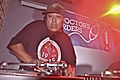
Record producer Jazzy Jeff manipulating a record turntable in England in 2005.

Turntablism is the art of manipulating sounds and creating new music, sound effects, mixes and other creative sounds and beats, typically by using two or more turntables and a cross fader-equipped DJ mixer.[1] The mixer is plugged into a PA system (for live events) or broadcasting equipment (if the DJ is performing on radio, TV or Internet radio) so that a wider audience can hear the turntablist's music. Turntablists typically manipulate records on a turntable by moving the record with their hand to cue the stylus to exact points on a record, and by touching or moving the platter or record to stop, slow down, speed up or, spin the record backwards, or moving the turntable platter back and forth (the popular rhythmic "scratching" effect which is a key part of hip hop music),[2] all while using a DJ mixer's cross-fader control and the mixer's gain and equalization controls to adjust the sound and level of each turntable. Turntablists typically use two or more turntables and headphones to cue up desired start points on different records (Greasley & Prior, 2013).

Turntablists, often called DJs (or "deejays"), generally prefer direct-drive turntables over belt-driven or other types, because the belt can be stretched or damaged by "scratching" and other turntable manipulation such as slowing down a record, whereas a direct drive turntable can be stopped, slowed down, or spun backwards without damaging the electric motor. The word turntablist is claimed to be originated by Luis "DJ Disk" Quintanilla (Primus, Herbie Hancock, Invisibl Skratch Piklz).[3] After a phone conversation with Disk, it was later popularised in 1995 by DJ Babu[4] to describe the difference between a DJ who simply plays and mixes records and one who performs by physically manipulating the records, stylus, turntables, turntable speed controls and mixer to produce new sounds. The new term coincided with the resurgence of hip-hop DJing in the 1990s.

According to most DJ historians, it has been documented that "DJ Babu" of the "Beat Junkies" / "Dilated Peoples" was the one who originally coined the term "turntablist". In 1995 while working on the groundbreaking mixtape "Comprehension", DJ Babu hand wrote the name "Babu The Turntablist" on hundreds of copies of this mixtape to describe his style of DJing, while working on the track "Turntablism" with "D-Styles" and DJ Melo-D, Babu would say "if someone plays the piano, we call them a pianist, if someone plays the guitar, we call them a guitarist, why don't we call ourselves Turntablists?" found in the documentary "Scratch (2001 film)" which was released in 2001.

John Oswald described the art: "A phonograph in the hands of a 'hiphop/scratch' artist who plays a record like an electronic washboard with a phonographic needle as a plectrum, produces sounds which are unique and not reproduced—the record player becomes a musical instrument."[5] Some turntablists use turntable techniques like beat mixing/matching, scratching, and beat juggling. Some turntablists seek to have themselves recognized as traditional musicians capable of interacting and improvising with other performers. Depending on the records and tracks selected by the DJ and their turntablist style (e.g., hip hop music), a turntablist can create rhythmic accompaniment, percussion breaks, basslines or beat loops, atmospheric "pads", "stabs" of sudden chords or interwoven melodic lines.

The underground movement of turntablism has also emerged to focus on the skills of the DJ. In the 2010s, there are turntablism competitions, where turntablists demonstrate advanced beat juggling and scratching skills.

History

[edit]

Precursors

[edit]

The use of the turntable as a musical instrument has its roots dating back to the 1930s, 1940s, and 1950s when musique concrète composers did experiments with audio equipment. Experimental composers (such as John Cage, Halim El-Dabh, and Pierre Schaeffer) used them to sample and create music that was entirely produced by the turntable. Cage's Imaginary Landscape No. 1 (1939) is composed for two variable speed turntables, frequency recordings, muted piano and cymbal. Edgard Varèse experimented with turntables even earlier in 1930, though he never formally produced any works using them. Though this school of thought and practice is not directly linked to the 1970s–2010 definition of turntablism within hip hop and DJ culture, it has had an influence on modern experimental sonic/artists such as Christian Marclay, Janek Schaefer, Otomo Yoshihide, Philip Jeck, and Maria Chavez. Turntablism as it is known today, however, did not surface until the advent of hip hop in the 1970s.

Examples of turntable effects can also be found on popular records produced in the 1960s and 1970s. This was most prominent in Jamaican dub music of the 1960s,[6] among deejays in the Jamaican sound system culture. Dub music introduced the techniques of mixing and scratching vinyl,[7] which Jamaican immigrants introduced to American hip hop culture in the early 1970s.[8] Beyond dub music, Creedence Clearwater Revival's 1968 self-titled debut album features a backspin effect in the song "Walk on the Water".

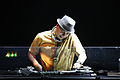
Sid Wilson of Slipknot operating direct-drive turntables at Mayhem Festival in 2008.

Direct-drive turntables

[edit]

Turntablism has origins in the invention of direct-drive turntables. Early belt-drive turntables were unsuitable for turntablism, since they had a slow start-up time, and they were prone to wear-and-tear and breakage,[9] as the belt would break from backspinning or scratching.[10] The first direct-drive turntable was invented by Shuichi Obata, an engineer at Matsushita (now Panasonic),[11] based in Osaka, Japan.[9] It eliminated belts, and instead employed a motor to directly drive a platter on which a vinyl record rests.[12] In 1969, Matsushita released it as the SP-10,[12] the first direct-drive turntable on the market,[13] and the first in their influential Technics series of turntables.[12] In 1971, Matsushita released the Technics SL-1100. Due to its strong motor, durability, and fidelity, it was adopted by early hip hop artists.[12]

A forefather of turntablism was DJ Kool Herc, an immigrant from Jamaica to New York City.[13] He introduced turntable techniques from Jamaican dub music,[8] while developing new techniques made possible by the direct-drive turntable technology of the Technics SL-1100, which he used for the first sound system he set up after emigrating to New York.[13] The signature technique he developed was playing two copies of the same record on two turntables in alternation to extend the b-dancers' favorite section,[8] switching back and forth between the two to loop the breaks to a rhythmic beat.[13]

The most influential turntable was the Technics SL-1200,[14] which was developed in 1971 by a team led by Shuichi Obata at Matsushita, which then released it onto the market in 1972.[9] It was adopted by New York City hip hop DJs such as Grand Wizard Theodore and Afrika Bambaataa in the 1970s. As they experimented with the SL-1200 decks, they developed scratching techniques when they found that the motor would continue to spin at the correct RPM even if the DJ wiggled the record back and forth on the platter.[14] Since then, turntablism spread widely in hip hop culture, and the SL-1200 remained the most widely used turntable in DJ culture for the next several decades.[12][14]

Hip-hop

[edit]
A DJ vinyl turntable system, consisting of two turntables and a crossfader-equipped DJ mixer

Turntablism as a modern art form and musical practice has its roots within African-American inner city hip-hop of the late 1970s. Kool Herc (a Jamaican DJ who immigrated to New York City), Afrika Bambaataa and Grandmaster Flash are widely credited for having cemented the now established role of DJ as hip hop's foremost instrumentalist.[15] Kool Herc's invention of break-beat DJing is generally regarded as the foundational development in hip hop history, as it gave rise to all other elements of the genre. His influence on the concept of "DJ as turntablist" is equally profound.

To understand the significance of this achievement, it is important to first define the "break". Briefly, the "break" of a song is a musical fragment only seconds in length, which typically takes the form of an "interlude" in which all or most of the music stops except for the percussion. Kool Herc introduced the break-beat technique as a way of extending the break indefinitely. This is done by buying two of the same record, finding the break on each record, and switching from one to the other using the DJ mixer: e.g., as record A plays, the DJ quickly backtracks to the same break on record B, which will again take the place of A at a specific moment where the audience will not notice that the DJ has switched records. Using that idea, Grandmaster Flash elaborated on Kool Herc's invention of break-beat DJing and came up with the quick-mix theory, in which Flash sectioned off a part of the record like a clock.[16] He described it as being "...like cutting, the backspin, and the double-back."[16]

Kool Herc's revolutionary techniques set the course for the development of turntablism as an art form in significant ways. Most important, however, he developed a new form of DJing that did not consist of just playing and mixing records one after the other. The type of DJ that specializes in mixing a set is well respected for his/her own set of unique skills, but playlist mixing is still DJing in the traditional sense. Kool Herc instead originated the idea of creating a sequence for his own purposes, introducing the idea of the DJ as the "feature" of parties, whose performance on any given night would be different from on another night, because the music would be created by the DJ, mixing a bassline from one song with a beat from another song (Greasley & Prior, 2013). The DJ would be examined critically by the crowd on both a technical and entertainment level.

Grand Wizzard Theodore, an apprentice of Flash, who accidentally isolated the most recognizable technique of turntablism: scratching. He put his hand on a record one day, to silence the music on the turntable while his mother was calling out to him and thus accidentally discovered the sound of scratching by moving the record back and forth under the stylus. Though Theodore discovered scratching, it was Flash who helped push the early concept and showcase it to the public, in his live shows and on recordings. DJ Grand Mixer DXT is also credited with furthering the concept of scratching by practicing the rhythmic scratching of a record on one or more turntables (often two), using different velocities to alter the pitch of the note or sound on the recording (Alberts 2002). DXT appeared (as DST) on Herbie Hancock's hit song "Rockit".[15] These early pioneers cemented the fundamental practice that would later become the emerging turntablist art form. Scratching would during the 1980s become a staple of hip hop music, being used by producers and DJs on records and in live shows. By the end of the 1980s it was very common to hear scratching on a record, generally as part of the chorus of a track or within its production.

On stage the DJ would provide the music for the MCs to rhyme and rap to, scratching records during the performance and showcasing his or her skills alongside the verbal skills of the MC. The most well known example of this 'equation' of MCs and DJ is probably Run-D.M.C. who were composed of two MCs and one DJ. The DJ, Jam Master Jay, was an integral part of the group since his turntablism was critical to Run DMC's productions and performances. While Flash and Bambaataa were using the turntable to explore repetition, alter rhythm and create the instrumental stabs and punch phrasing that would come to characterize the sound of hip hop, Grandmaster DST was busy cutting "real" musicians on their own turf. His scratching on Herbie Hancock's 1983 single, "Rockit", makes it perhaps the most influential DJ track of them all – even more than (Grandmaster Flash's) "Wheels of Steel", it established the DJ as the star of the record, even if he wasn't the frontman. Compared to "Rockit", West Street Mob's "Break Dancin' – Electric Boogie" (1983) was punk negation. As great as "Break Dancin'" was, though, it highlighted the limited tonal range of scratching, which was in danger of becoming a short-lived fad like human beat-boxing until the emergence of Code Money's DJ Brethren from Philadelphia in the mid-1980s.

Despite New York's continued pre-eminence in the hip-hop world, scratch DJing was modernized less than 100 miles down the road in Philadelphia, where the climate for the return of the DJ was created by inventing transformer scratching. Developed by DJ Spinbad, DJ Cash Money and DJ Jazzy Jeff, transforming was basically clicking the fader on and off while moving a block of sound (a riff or a short verbal phrase) across the stylus. Expanding the tonal as well as rhythmic possibilities of scratching, the transformer scratch epitomized the chopped-up aesthetic of hip hop culture. Hip hop was starting to become big money and the cult of personality started to take over. Hip hop became very much at the service of the rapper and Cash Money and DJ Jazzy Jeff were accorded maybe one track on an album – for example, DJ Jazzy Jeff's "A Touch of Jazz" (1987) and "Jazzy's in the House" (1988) and Cash Money's "The Music Maker" (1988). Other crucial DJ tracks from this period include Tuff Crew's DJ Too Tuff's "Behold the Detonator" "Soul Food" (both 1989)", and Gang Starr's "DJ Premier in Deep Concentration" (1989).

Decline in role of DJ in hip hop

[edit]

The appearance of turntablists and the birth of turntablism was prompted by one major factor – the disappearance or downplaying of the role of the DJ in hip-hop groups, on records and in live shows at the turn of the 1990s. This disappearance has been widely documented in books and documentaries (among them Black Noise and Scratch), and was linked to the increased use of DAT tapes and other studio techniques that would ultimately push the DJ further away from the original hip-hop equation of the MC as the vocalist and the DJ as the music provider alongside the producer. This push and disappearance of the DJ meant that the practices of the DJ, such as scratching, went back underground and were cultivated and built upon by a generation of people who grew up with hip hop, DJs and scratching. By the mid-90s the disappearance of the DJ in hip hop had created a sub-culture which would come to be known as turntablism and which focused entirely on the DJ using his turntables and a mixer to manipulate sounds and create music. By pushing the practice of DJing away, hip hop created the grounds for this sub-culture to evolve (Greasley & Prior, 2013).

Coining of terms

[edit]

The origin of the terms turntablist and turntablism are widely contested and argued about, but over the years some facts have been established by various documentaries (Battlesounds, Doug Pray's Scratch), books (DJ Culture), conferences (Skratchcon 2000) and interviews in online and printed magazines. These facts are that the origins of the words most likely lay with practitioners on the US West Coast, centered on the San Francisco Bay Area. Some claim that DJ Disk, a member of the Invisibl Skratch Piklz, was the first to coin the term, others claim that "DJ Babu", a member of the "Beat Junkies", was responsible for coining and spreading the term turntablist after inscribing it on his mixtapes as"Babu the Turntablist" and passing them around. Another claim credits DJ Supreme, 1991 World Supremacy Champion and DJ for Lauryn Hill. The truth most likely lies somewhere in between all these facts.

In an interview with the Spin Science online resource in 2005, "DJ Babu" added the following comments about the birth and spread of the term:

It was around 95, I was heavily into the whole battling thing, working on the tables constantly, mastering new techniques and scratches...[I] made this mixtape called "Comprehension", and on there was a track called "Turntablism" which featured Melo-D and D-Styles. And this is part of where this whole thing about turntablist came from. This was a time where [sic] all these new techniques were coming out, like flares and stuff, and there were probably 20 people or so, in around California between Frisco and LA, who knew about these. So we worked on them, talked about it and kicked about the ideas that these techniques and new ways of scratching gave us.[citation needed]

Mid- to late 1990s

[edit]

By the mid- to late 1990s the terms "turntablism" and "turntablist" had become established and accepted to define the practice and practitioner of using turntables and a mixer to create or manipulate sounds and music. This could be done by scratching a record or manipulating the rhythms on the record either by drumming, looping or beat juggling. The decade of the 1990s is also important in shaping the turntablist art form and culture as it saw the emergence of pioneering artists (Mix Master Mike, DJ Qbert, DJ Quest, DJ Krush, A-Trak, Ricci Rucker, Mike Boo, Pumpin' Pete, Prime Cuts) and crews (Invisibl Skratch Piklz, Beat Junkies, The Allies, X-Ecutioners), record labels (Asphodel), DJ Battles (DMC) and the evolution of scratching and other turntablism practices such as Beat Juggling which are viewable in the IDA (International DJ Association/ITF) World Finals.

Techniques

[edit]

More sophisticated methods of scratching were developed during that decade, with crews and individual DJs concentrating on the manipulation of the record in time with the manipulation of the cross fader on the mixer to create new rhythms and sonic artifacts with a variety of sounds. The evolution of scratching from a fairly simple sound and simple rhythmic cadences to more complicated sounds and more intricate rhythmical patterns allowed the practitioners to further evolve what could be done with scratching musically. These new ways of scratching were all given names, from flare to crab or orbit, and spread as DJs taught each other, practiced together or just showed off their new techniques to other DJs. Alongside the evolution of scratching, other practices such as drumming (or scratch drumming) and beat juggling were also evolved significantly during the 1990s.

Beat juggling was invented by Steve Dee, a member of the X-Men (later renamed X-Ecutioners) crew. Beat juggling essentially involves the manipulation of two identical or different drum patterns on two different turntables via the mixer to create a new pattern. A simple example would be to use two copies of the same drum pattern to evolve the pattern by doubling the snares, syncopating the drum kick, adding rhythm and variation to the existing pattern. From this concept, which Steve Dee showcased in the early 1990s at DJ battles, Beat Juggling evolved throughout the decade to the point where by the end of it, it had become an intricate technique to create entirely new "beats" and rhythms out of existing, pre-recorded ones (van Veen & Attias, 2012). These were now not just limited to using drum patterns, but could also consist of other sounds – the ultimate aim being to create a new rhythm out of the pre-recorded existing ones. While beat juggling is not as popular as scratching due to the more demanding rhythmical knowledge it requires, it has proved popular within DJ battles and in certain compositional situations (van Veen & Attias, 2012).

Studies

[edit]

One of the earliest academic studies of turntablism (White 1996) argued for its designation as a legitimate electronic musical instrument—a manual analog sampler—and described turntable techniques such as backspinning, cutting, scratching and blending as basic tools for most hip hop DJs. White's study suggests the proficient hip-hop DJ must possess similar kinds of skills as those required by trained musicians, not limited to a sense of timing, hand–eye coordination, technical competence and musical creativity. By the year 2000, turntablism and turntablists had become widely publicized and accepted in the mainstream and within hip hop as valid artists. Through this recognition came further evolution.

Evolution

[edit]

This evolution took many shapes and forms: some continued to concentrate on the foundations of the art form and its original links to hip hop culture, some became producers utilizing the skills they'd learnt as turntablists and incorporating those into their productions, some concentrated more on the DJing aspect of the art form by combining turntablist skills with the trademark skills of club DJs, while others explored alternative routes in utilizing the turntable as an instrument or production tool solely for the purpose of making music – either by using solely the turntable or by incorporating it into the production process alongside tools such as drum machines, samplers, computer software, and so on. Digital turntablism techniques later was coined into a term called controllerism, which inspired a movement of new digital DJs such as DJ Buddy Holly and Moldover. DJ Buddy and Moldover went on to create a song called "Controllerism" that pays homage to the sound of digitally emulated turntablism.

DJ Aron Scott DJing a set for a French radio station. He is using digital CDJ decks instead of phonograph turntables.

New DJs, turntablists and crews owe a distinct debt[why?] to pioneer old-school DJs like Kool DJ Herc, Grand Wizard Theodore, Grandmixer DST, Grandmaster Flash, and Afrika Bambaataa, also DJ Jazzy Jeff, DJ Cash Money, DJ Scratch, DJ Clark Kent, and other DJs of the golden age of hip hop, who originally developed many of the concepts and techniques that evolved into modern turntablism. Within the realm of hip hop, notable modern turntablists are the cinematic[when defined as?] DJ Shadow, who influenced Diplo and RJD2, among others,[citation needed] and the experimental DJ Spooky, whose Optometry albums showed that the turntablist can perfectly fit within a jazz setting.[according to whom?] Mix Master Mike was a founding member of the influential turntablist group Invisibl Skratch Piklz (begun in 1989 as Shadow of the Prophet) and later DJ for the Beastie Boys. Cut Chemist, DJ Nu-Mark, and Kid Koala are also known[by whom?] as virtuosi of the turntables.

Concerto for Turntable

[edit]

Concerto for Turntable is a groundbreaking musical work that integrates the art of turntablism with classical music composition. Co-created by DJ Radar and Raul Yanez, a composer and professor at Arizona State University, this composition showcases a unique melding of electronic and orchestral music elements. The concerto was first performed in notable venues including Carnegie Hall, symbolizing its acceptance into the classical music tradition.[17] The project was initially supported by Red Bull, which helped to sponsor its development and the premiere performance.[18] The concerto debuted at Arizona State University's Gammage Auditorium before its major premiere at Carnegie Hall on October 2, 2005.[19]

The Concerto for Turntable features a turntable as the solo instrument, complemented by a full symphony orchestra. This arrangement necessitated the development of "scratch notation" by DJ Radar to transcribe his turntable manipulations into a format readable by classically trained musicians. This innovative scoring method was crucial for integrating the turntable's electronic sounds with the acoustic orchestra.[20]

The premiere at Carnegie Hall was met with enthusiastic responses, highlighting the potential of digital instruments within classical music settings and demonstrating the artistic validity of turntablism.[21]

Techniques

[edit]

Chopped and screwed

[edit]

Starting in the 1980s in the Southern United States and burgeoning in the 2000s, a meta-genre of hip hop called "chopped and screwed" became a significant and popular form of turntablism. Often using a greater variety of vinyl emulation software rather than normal turntables, "chopped and screwed" stood out from previous standards of turntablism in its slowing of the pitch and tempo ("screwing") and syncopated beat skipping ("chopping"), among other added effects of sound manipulation.

DJ Screw Robert Earl Davis of Texas, innovated the art of chopping and screwing coining the phrase "chopped n screwed", taking original contemporary hit records and replaying them in the "chopped n screwed" art form. This gained a very large following finally paving the way for small, independent rap labels to turn a decent profit. However, it is thought by many that DJ Michael Price started slowing down vinyl recordings before the era of DJ Screw.

This form of turntablism, which is usually applied to prior studio recordings (in the form of custom mixtapes) and is not prominent as a feature of live performances, de-emphasizes the role of the rapper, singer or other vocalist by distorting the vocalist's voice along with the rest of the recording (van Veen & Attias, 2012). Arguably, this combination of distortion and audial effects against the original recording grants greater freedom of improvisation to the DJ than did the previous forms of turntablism. Via the ChopNotSlop movement, "Chopped and screwed" has also been applied to other genres of music such as R&B and rock music, thus transcending its roots within the hip-hop genre.[22][23]

Transform

[edit]
N.A.S.A. (DJ Zegon & Squeak E. Clean). The DJ on the left can be seen cuing up a part of a record by listening to the cue channel on one of his headphones.

A transform is a type of scratch used by turntablists. It is made from a combination of moving the record on the turntable by hand and repeated movement of the crossfader. The name, which has been associated with DJ Cash Money and DJ Jazzy Jeff,[24][25] comes from its similarity to the sound made by the robots in the 1980s cartoon, The Transformers.

Tear

[edit]

A tear is a type of scratch used by turntablists. It is made from moving the record on the turntable by hand. The tear is much like a baby scratch in that one does not need the fader to perform it, but unlike a baby scratch, when the DJ pulls the record back he or she pauses his or her hand for a split second in the middle of the stroke. The result is one forward sound and two distinct backward sounds. This scratch can also be performed by doing the opposite and placing the pause on the forward stroke instead. A basic tear is usually performed with the crossfader open the entire time, but it can also be combined with other scratches such as flares for example by doing tears with the record hand and cutting the sound in and out with the fader hand.

Taco Scratch

[edit]
DJ Natural Nate, doing his signature Taco Scratch

DJ Natural Nate, emerging by the late 1990s as a leading advocate for Breaks music when it was still a niche genre, made significant technical contributions to turntablism. He founded Bruise Your Body Breaks (BYBB), one of the first custom live internet DJ video/radio stations promoting both established and emerging talent globally. Nate's sets are known for their spontaneous transitions and deep rhythmic creativity. Technically, he is widely recognized for inventing both the “Bend” and the “Taco Scratch” techniques, which expanded what DJs could achieve with turntables. These innovations emphasised the idea that the turntable is a true musical instrument, helping shape the sound and performance ethos of Breaks and Electro Breaks. His mentorship and platform-building have also fostered new generations of DJs.

Orbit

[edit]

An orbit is a type of scratch used by turntablists. It is generally any scratch that incorporates both a forward and backward movement, or vice versa, of the record in sequence. The orbit was developed by DJ Disk who incorporated the flare after being shown by DJ Qbert.[citation needed] Usually when someone is referring to an orbit, they are most likely talking about flare orbits. For example, A 1 click forward flare and a 1 click backward flare in quick succession (altogether creating 4 very quick distinct sounds) would be a 1 click orbit. A 2 click forward flare and a 2 click backward flare in quick succession (altogether creating 6 very distinct sounds) would be a 2 click orbit, etc. Orbits can be performed once as a single orbit move, or sequenced to produce a cyclical never ending type of orbit sound.

Flare

[edit]
Marlon Williams aka DJ Marley Marl

Flare is a type of scratch used by turntablists. It is made from a combination of moving the record on the turntable by hand and quick movement of the crossfader. The flare was invented by its namesake, DJ Flare in 1987. This scratch technique is much like the "transform" in some ways, only instead of starting with the sound that is cutting up off, one starts with the sound on and concentrate on cutting the sound into pieces by bouncing the fader off the cut outside of the fader slot to make the sound cut out and then back in a split second.

Each time the DJ bounces the fader off the side of the fader slot it makes a distinct clicking noise. For this reason, flares are named according to clicks. A simple one click forward flare would be a forward scratch starting with the sound on as the DJ bounces/clicks the fader against the side once extremely quickly in the middle of the forward stroke creating two distinct sounds in one stroke of your record hand and ending with the fader open. In the same manner, 2 clicks, 3 clicks, and even more clicks (if a DJ is fast enough) can be performed to do different types of flares. The discovery and development of the flare scratch was instrumental in elevating this art form to the level of speed and technical scratching that is seen in the 2010s.

Chirp

[edit]
This photo of DJ Qbert shows the standard turntablist technique of manipulating the record with one hand while the other hand adjusts the controls on the DJ mixer.

A "chirp" is a type of scratch used by turntablists. It is made with a mix of moving the record and incorporating movement with the crossfade mixer. It was invented by DJ Jazzy Jeff. The scratch is somewhat difficult to perform because it takes a good amount of coordination. The scratch starts out with the cross-fader open. The DJ then moves the record forward while simultaneously closing the previously opened channel ending the first sound. Then, in a reverse fashion, the DJ opens the channel while moving the record backwards creating a more controlled sounding "baby scratch". Done in quick succession it sounds as though a chirp sound is being produced.

Stab

[edit]

A "stab" is quite similar to the chirp technique but requires the crossfade mixer to be "closed". The stab requires the user to push the record forward and back quickly and moving the crossfade mixer with a thumb pressed against it, which results in minimal sound coming out, producing a sharp "stabbing" noise".

Crab

[edit]

A "crab" is a type of scratch used by turntablists and originally developed by DJ Qbert. It is one of the most difficult scratch techniques to master. The crab is done by pushing the record forward and back while pushing the crossfader mixer open or closed through a quick succession of 4 movements with the fingers. Variations can also include 3 or 2 fingers, and generally it is recommended for beginners to start with 2 fingers and work their way to 4. It is a difficult move to master but also versatile and quite rewarding if done right.

Visual elements

[edit]

Visual elements may be linked to turntable movement, incorporating digital media including photographs, graphic stills, film, video, and computer-generated effects into live performance. A separate video mixer is used in combination with the turntable. In 2005 the International Turntablist Federation World final introduced the 'Experimental' category to recognise visual artistry.

Contests

[edit]

Like many other musical instrumentalists, turntablists compete to see who can develop the fastest, most innovative and most creative approaches to their instrument. The selection of a champion comes from the culmination of battles between turntablists. Battling involves each turntablist performing a routine (A combination of various technical scratches, beat juggles, and other elements, including body tricks) within a limited time period, after which the routine is judged by a panel of experts. The winner is selected based upon score. These organized competitions evolved from actual old school "battles" where DJs challenged each other at parties, and the "judge" was usually the audience, who would indicate their collective will by cheering louder for the DJ they thought performed better. The DMC World DJ Championships has been hosted since 1985. There are separate competitions for solo DJs and DJ teams, the title of World Champion being bestowed on the winners of each. They also maintain a turntablism hall of fame.[26]

Role of women

[edit]
A DJ mixing two record players at a live event

In Western popular music, women musicians have achieved great success in singing and songwriting roles, with top examples being Madonna, Celine Dion and Rihanna. However, there are relatively few women DJs or turntablists. Part of this may stem from a general low percentage of women in audio technology-related jobs. In a 2013 Sound on Sound article Rosina Ncube attested that few women work in the record production and sound engineering industry.[27] Ncube claimed that "[n]inety-five percent of music producers are male"[27] and that female producers are less well-known than their male counterparts despite accomplishing great feats within the music industry.[27] The vast majority of students in music technology programs are male.[citation needed]

In hip hop music, the low percentage of women DJs and turntablists may stem from the overall male domination of the entire hip hop music industry. Most of the top rappers, MCs, DJs, record producers and music executives are men. There are a small number of high-profile women, but they are rare. In 2007, University of North Carolina music professor Mark Katz's article stated that it is rare for women to compete in turntable battles and that this gender disparity has become a topic of conversation among the hip-hop DJ community.[28] In 2010, Rebekah Farrugia stated that in the EDM sphere, a male-centric culture has contributed to the marginalisation of women who seek to engage and contribute.[29] Whilst turntablism and broader DJ practices should not be conflated, Katz suggests that the broad use, or lack of use, of the turntable by women across genres and disciplines is impacted by "male technophilia".[28] Historian Ruth Oldenziel concurs in her writing on female engagement with engineering technology.[30] Oldenziel argues that socialization is a central factor in the lack of female engagement with technology, insisting that the historical socialisation of boys as technophiles has contributed to the prevalence of men who engage with technology.[30]

Lucy Green, professor of music at the University College London, focused on gender in relation to musical performers and creators, and specifically on educational frameworks as they relate to both.[31][page needed] She suggests that women's alienation from fields with strong technical aspects such as DJing, sound engineering and music producing should not only be attributed to a feminine dislike towards these instruments.[32] Instead she argues that women entering these fields are forced to complete the difficult task of disrupting a dominant masculine sphere.[32] Despite this,[original research?] women and girls do increasingly engage in turntable and DJ practices, individually[33] and collectively,[34] and "carve out spaces for themselves in EDM and DJ Culture".[29] There are various projects dedicated to the promotion and support of these practices such as Female DJs London.[35] Some artists and collectives go beyond these practices to be more gender inclusive.[36][page needed] For example, Discwoman, a New York-based collective and booking agency, describe themselves as "representing and showcasing cis women, trans women and genderqueer talent."[37]

[edit]

See also

[edit]

References

[edit]

Further reading

[edit]
[edit]
Revisions and contributorsEdit on WikipediaRead on Wikipedia
from Grokipedia
Turntablism is the specialized practice of using turntables, vinyl records, and mixers as musical instruments to manipulate and generate sounds, distinct from traditional DJing by emphasizing creative techniques such as , cutting, beat juggling, and chirping to produce rhythmic patterns, percussion, and compositions from recorded media. Emerging in the mid-1970s Bronx hip-hop scene, it evolved from block party DJing pioneered by figures like Kool Herc, who extended instrumental "breaks" in funk records to energize crowds, but crystallized with Grand Wizzard Theodore's accidental invention of the scratch technique in 1975—holding a record still while the needle moved backward, creating a rhythmic stutter—followed by its public debut in 1977. Grandmaster Flash further refined these methods in the late 1970s, developing precise cutting between duplicate records and quick-mix theory to isolate breaks, laying foundational causal mechanics for turntablism's performative complexity. The form gained global recognition through competitive showcases like the , launched in 1985 to highlight technical mastery, where early winners such as DJ Cheese and Cash Money demonstrated innovations in scratching velocity and pattern complexity, propelling turntablism from underground experimentation to a recognized virtuosic discipline. Later exponents, including and the crew in the 1990s, expanded its vocabulary with harmonic scratching and multi-turntable orchestration, influencing genres beyond hip-hop while sparking debates over the shift from analog vinyl fidelity to digital emulation's accessibility versus tactile loss.

Definition and Fundamentals

Core Principles and Distinction from DJing

Turntablism centers on the manual manipulation of turntables and vinyl records to generate rhythmic patterns, percussive effects, and novel sounds, treating the equipment as a percussive instrument akin to or drum machines. Fundamental techniques include , which produces tonal sweeps and rhythmic stutters by rapidly moving the record back and forth beneath the stylus while modulating volume via a crossfader, and beat , where short musical phrases from duplicate records are synchronized and rearranged across two turntables to construct layered beats or breakdowns. These methods rely on precise control of playback speed—typically or 45 RPM—to alter pitch and , enabling performers to create melodies, harmonies, and textures from pre-recorded material. In contrast to conventional DJing, which prioritizes —synchronizing the tempos and phases of multiple tracks for seamless transitions and extended mixes to sustain dancefloor energy—turntablism emphasizes soloistic performance and auditory innovation, often isolating the DJ's manipulations as the focal element rather than serving as unobtrusive accompaniment to vocals or full compositions. While DJs curate and blend entire songs to form cohesive sets, turntablists dissect and reconstruct audio fragments in real time, showcasing technical proficiency through routines that may incorporate body tricks or competitive elements, thereby elevating the turntable from a reproductive tool to a generative one. This distinction emerged prominently in hip-hop battles, where turntablism highlighted individual skill over collective mixing.

Physics of Sound Manipulation

Sound production in turntablism begins with the analog encoding of audio signals into the helical grooves of a vinyl record, where lateral or vertical undulations in the groove walls represent variations in as mechanical displacements. The , or needle, rides these grooves, converting the mechanical vibrations into an electrical signal via a cartridge—typically magnetic or piezoelectric—which outputs a voltage proportional to the of the groove modulation. At standard playback speeds of or 45 (rpm), the turntable's motor maintains a , yielding a linear at the that determines the pitch: scales directly with this speed, as the rate of groove traversal dictates how rapidly the encoded is reproduced. Manipulation techniques exploit deviations from this constant speed and direction to alter the acoustic output. In , the turntablist manually drags the record forward and backward relative to the fixed , varying the relative linear along the groove and producing pitch glissandi—sweeping changes from as low as 20 Hz to over 1 kHz in under 0.5 seconds, as observed in basic "baby" scratches. Forward motion accelerates or decelerates playback relative to nominal speed, shifting pitch upward or downward proportionally (e.g., a 30% speed increase raises pitch by a perfect fourth); backward motion reverses the groove traversal, effectively time-reversing the local audio segment and introducing phase inversion in the output signal. These modulations introduce nonlinear distortions, generating harmonics and transient noises characteristic of scratch timbres, with spectrograms revealing energy spikes from abrupt directional changes. Amplitude control complements velocity manipulation via the DJ mixer's crossfader, which rapidly attenuates the channel's output to create sharp onsets and offsets. In techniques like the chirp scratch, the turntablist synchronizes a forward record pull (increasing pitch) with crossfader closure for a decay, followed by reversal and reopening, yielding a frequency-swept "chirp" sound with defined attack-decay envelopes lasting 0.1–0.2 seconds per cycle. This combination exploits the causal relationship between mechanical input (hand force overriding turntable torque, typically under 3 grams tracking force for stylus stability) and acoustic result, where friction and groove geometry limit maximum reversal speeds to avoid skipping, preserving waveform fidelity amid manipulation. Beat juggling extends these principles across dual turntables, aligning phase-locked grooves for rhythmic recombination, but fundamentally relies on the same speed-direction-amplitude triad to dissect and reassemble audio causality.

Historical Development

Early Precursors and Technological Enablers

The manipulation of phonograph records as a performative technique predates hip-hop culture, tracing back to experimental composers in the early 20th century who treated turntables as instruments for generating novel sounds. In 1939, John Cage composed Imaginary Landscape No. 1, employing variable-speed turntables playing at 33 and 78 rpm alongside frequency test records and needle repositioning to produce rhythmic and textural effects, marking an early instance of intentional sonic disruption through mechanical intervention. Similarly, Paul Hindemith and others experimented with gramophones by accelerating or decelerating playback speeds and synchronizing dual machines, exploring acceleration-induced pitch shifts and phase discrepancies as compositional elements. Pierre Schaeffer advanced these practices in the 1940s through musique concrète, directly manipulating recorded sounds on shellac discs and turntables before the widespread adoption of magnetic tape. His 1948 piece Étude aux chemins de fer utilized locked-groove techniques and manual playback alterations—such as reversing direction and varying speeds—to loop and transform field recordings of locomotives into abstract compositions, establishing turntable-based editing as a foundational method for sound reorganization. These efforts relied on the inherent mechanical flexibility of disc playback systems, where operators could physically intervene in rotation and stylus tracking, though limited by acoustic-era equipment's fragility and inconsistent motor stability. Technological foundations emerged from late-19th-century inventions enabling reproducible sound. Thomas Edison's 1877 used wax cylinders for recording and playback, allowing rudimentary speed variations via hand-crank acceleration, as demonstrated by traveling showmen who altered playback rates for comedic pitch effects. Emile Berliner's 1885 gramophone introduced flat discs, facilitating longer durations and easier manual handling, which supported experimental manipulations like selective groove skipping. By the mid-20th century, electric turntables with belt-drive mechanisms provided steadier rotation, though prone to speed fluctuations (wow and flutter), while the advent of rpm and later rpm vinyl standards standardized playback for precise cueing. Jamaican sound systems in the represented a proto-practical precursor, where operators in mobile setups used dual turntables to extend instrumental breaks in imported R&B records, manually cueing and repeating sections to sustain dances amid scarce live music access. Techniques like "toasting"—rhythmic vocal overlays—and basic back-cueing laid causal groundwork for rhythmic repetition, influenced by post-colonial resource constraints that prioritized record longevity over fidelity. The 1969 introduction of direct-drive turntables, such as the Technics SP-10, enhanced torque and speed consistency, reducing slippage during manual interventions and enabling finer control essential for emergent live manipulations. These elements collectively bridged experimental abstraction to performative utility, setting the stage for hip-hop innovations without yet constituting full turntablism.

Emergence in 1970s Hip-Hop

Turntablism emerged within the nascent hip-hop culture of the South Bronx during the early 1970s, driven by DJ innovations at block parties that emphasized rhythmic manipulation over traditional record playback. On August 11, 1973, Clive Campbell, known as DJ Kool Herc, hosted a back-to-school party at 1520 Sedgwick Avenue, where he employed two Technics SL-1200 turntables to isolate and prolong the instrumental "breaks"—percussive segments in funk tracks like those by James Brown—by manually cueing and switching between copies of the same record. This breakbeat extension technique, dubbed the "Merry-Go-Round" by Herc, created seamless loops of up to several minutes, enabling MCs to perform extended vocal improvisations over intensified beats and fostering crowd energy without full songs. Building on Herc's foundation, Joseph Saddler, performing as , advanced turntable precision in the mid-1970s through his "Quick Mix Theory," a systematic approach involving fingertip control of the record, crossfader, and cueing to achieve rapid cuts between beats. Flash's methods, including backspinning to reset beats and the invention of the slipmat—a fabric mat under records for frictionless slipping—enabled tighter synchronization and rhythmic experimentation, distinguishing skillful manipulation from mere mixing. These techniques, honed in competitive party scenes, emphasized timing accuracy, often practiced with metronomes to align beats within milliseconds. A pivotal breakthrough occurred in 1975 when Theodore Livingston, aged 10 and known as Grand Wizzard Theodore, inadvertently created the scratching technique: while practicing records at high volume, he froze the vinyl under the stylus to silence his mother's reprimand, producing a rhythmic "tick" sound upon manual forward-and-backward motion. Theodore refined this into deliberate scratches, debuting it publicly on August 18, 1977, at the Sparkle Club using the Incredible Bongo Band's "Bongo Rock," integrating it with needle drops and drops for percussive effects. Concurrently, DJs like Afrika Bambaataa experimented with eclectic record fusion and early beat juggling in Zulu Nation gatherings, broadening turntable use to blend genres and create novel soundscapes. These 1970s developments collectively elevated the turntable to an expressive instrument, prioritizing manual sound sculpting—via breaks, cuts, and scratches—over passive reproduction, amid resource constraints that favored Technics direct-drive models for their and stability. This shift, rooted in competitive DJ battles and party demands for sustained percussion, birthed turntablism as hip-hop's instrumental core, influencing subsequent global adoption.

Expansion and Innovation in the 1980s

In 1981, released "The Adventures of Grandmaster Flash on the Wheels of Steel," the first commercially available hip-hop record to prominently feature turntable scratching and mixing techniques, demonstrating the potential of turntables as instruments beyond mere playback. This track layered samples from existing records like The Sugarhill Gang's "" and Queen's "," using cutting, backspinning, and punch phrasing to create rhythmic breaks, solidifying scratching's role in hip-hop production. The mid-1980s saw the formalization of competitive platforms that drove innovation and dissemination of techniques. The Disco Mix Club (DMC) launched its World DJ Championships in 1985, establishing an international stage for DJ battles that emphasized technical skill over simple mixing. These events encouraged experimentation with scratching variations and beat manipulation, fostering a competitive environment where participants refined precision and speed. A pivotal innovation was the transformer scratch, developed collaboratively by DJs including Spinbad, Cash Money, and Jazzy Jeff around 1986, characterized by rapid fader cuts mimicking the sound of the Transformers cartoon theme. Jazzy Jeff popularized it through live performances, such as his 1986 DMC appearance, integrating it into routines that showcased seamless transitions between scratches. DJ Cheese's victory at the 1986 DMC World Finals in marked a turning point, as his set introduced advanced routines to European audiences and highlighted the technique's evolution from block parties to global competition. Competitions like DMC accelerated turntablism's spread beyond New York, drawing participants from U.S. coasts and abroad, while trade shows amplified visibility and technique sharing. This era transformed turntablism from a localized hip-hop element into a distinct performative art form, with DJs increasingly recognized for instrumental prowess.

Peak and Commercialization in the 1990s

The 1990s represented the zenith of turntablism's technical evolution and competitive prominence, driven by formalized battles and crew formations that elevated scratching from underground hip-hop element to recognized performance art. The term "turntablism" itself emerged during this decade to distinguish virtuosic turntable manipulation from routine DJ mixing, reflecting a shift toward viewing the turntable as a solo instrument. Competitions like the DMC World DJ Championships amplified this, with 1992's victory by the Rock Steady DJs—comprising DJ Q-Bert, Mix Master Mike, and DJ Apollo—showcasing synchronized scratching routines that integrated chirps, stabs, and beat juggling before international audiences. The following year, Q-Bert and Mix Master Mike, competing as the Dream Team, secured another DMC world title, further codifying advanced phrases and hydroplane techniques. Groups such as the (ISP), formed in the early 1990s by Q-Bert and associates in San Francisco's Filipino-American DJ scene, pushed innovation through collaborative practice sessions that refined ensemble . ISP's routines emphasized precision and speed, influencing global practitioners via tapes and battle footage. Meanwhile, sustained Philadelphia-style influence with intricate, musical , building on his earlier DMC successes to mentor emerging talents. These developments coincided with equipment advancements, including Vestax's PDX series turntables launched in the late 1990s, which offered direct-drive stability rivaling Technics models and appealed to competitive users seeking enhanced torque for aggressive manipulations. Commercialization accelerated as turntablism permeated hip-hop production and media, with dedicated releases gaining traction. Q-Bert's solo album Demolition Pumpkin Squeeze Funk (1994) pioneered instrumental scratching tracks, layering effects over beats to demonstrate turntable expressiveness. The 1995 compilation Return of the DJ on Moonshine Music featured ISP alongside X-Ecutioners and , aggregating battle-proven cuts into accessible formats that sold modestly but established turntablism's viability beyond clubs. Mainstream crossover intensified late in the decade, exemplified by Mix Master Mike's 1998 integration into the , where his DMC-honed skills infused albums like with live segments, exposing the craft to broader audiences via major-label distribution. This era's blend of underground battles and commercial outputs, however, sparked debates over authenticity, as increased visibility risked diluting raw innovation amid rising production demands.

Post-2000 Shifts and Digital Adaptation

In the early , turntablism encountered significant disruptions from the widespread adoption of digital music distribution and production tools, which diminished reliance on physical vinyl records. The shift toward files and computer-based workflows enabled DJs to access expansive libraries without the logistical burdens of vinyl collection and maintenance, but it challenged the analog-centric practices that defined turntablism's tactile essence. This transition was accelerated by early digital vinyl systems (DVS), such as Final Scratch introduced around 1999–2000, which used proprietary timecode vinyl to manipulate computer-hosted audio files via traditional turntables. A pivotal adaptation arrived in 2004 with Scratch Live, developed in partnership with Rane Corporation, marking the first major software to seamlessly integrate analog turntable control with digital playback. This system employed timecoded vinyl or CDs to transmit control signals to a laptop, preserving , beat juggling, and pitch manipulation techniques while offering features like visual waveform displays, BPM estimation, and instant cueing—capabilities impractical with analog setups alone. Turntablists such as DJ Q-Bert and adopted these tools for live performances and battles, extending the art form's viability amid declining vinyl pressing. Subsequent software like ' further diversified options, incorporating integration for hybrid setups. The 2010 discontinuation of the turntable by intensified adaptation pressures, as this model had been the industry standard since the due to its direct-drive motor and durability. Manufacturers like Reloop and Numark responded with compatible alternatives, while DVS proliferation allowed turntablists to maintain analog interfaces atop digital cores, though purists debated the loss of vinyl's inherent friction and sonic imperfections. This era also birthed controllerism, where non-turntable hardware emulated via jog wheels and pads, broadening participation but diluting turntablism's strict focus on record manipulation. Competitions like the began incorporating digital categories by the mid-2000s, reflecting institutional acknowledgment of these evolutions. Despite innovations, analog turntablism's cultural prominence waned post-2000, coinciding with hip-hop's pivot to software-based production tools like Ableton Live and FL Studio, which prioritized sample chopping over live vinyl intervention. Community analyses attribute this to digital accessibility lowering entry barriers—reducing the skill premium of analog mastery—while enabling broader experimentation but fragmenting the dedicated turntablist scene. By the 2010s, hybrid DVS rigs became normative in professional contexts, sustaining techniques like chirps and transforms, yet underscoring a causal shift: digital efficiency supplanted analog constraints, fostering scalability at the expense of ritualistic physicality.

Essential Techniques

Scratching Variations

, a foundational technique in turntablism, entails manually moving the vinyl record back and forth beneath the stylus while modulating the crossfader to produce percussive and rhythmic sounds derived from short audio samples, such as drum breaks or vocal snippets. The baby scratch represents the simplest variation, involving basic forward and backward motions of the record to generate a rhythmic "wikky-wikky" effect; this technique was accidentally discovered by in 1975 when he abruptly stopped a spinning record to avoid noise, creating the initial scratch sound. More complex variations build on this foundation by incorporating fader cuts and multi-directional record movements. The tear scratch extends the baby scratch by adding an extra forward motion after the initial back-and-forth, producing a sharper, tearing sound often used for emphasis in routines. The chirp, an early fader-involved technique, pairs a quick record push or pull with a fader open-close motion, yielding a chirping effect suitable for melodic phrasing. Advanced variations demand precise coordination between hands and fader. The flare scratch utilizes multiple fader cuts per record motion—typically two or more—to create extended rhythmic bursts, enabling faster patterns than single-cut techniques. The crab scratch, pioneered by DJ Q-Bert in the early 1990s with the Invisible Skratch Piklz , employs sequential taps of multiple fingers on the crossfader for ultra-rapid cuts, simulating a machine-gun rhythm and significantly expanding scratching's speed and complexity. Drum scratching, developed by DJs Rafik and Craze, mimics percussion instruments by sequencing scratches to replicate , snare, and patterns, treating the turntable as a . These variations evolved through competitive innovation, with practitioners like Q-Bert refining techniques for battle performances, prioritizing precision and novelty over mere playback. Practitioners often combine them into routines, adapting to sample choice and tempo for musical expression.

Beat Juggling and Phrasing

Beat juggling constitutes a foundational turntablism technique wherein a DJ employs two identical vinyl records on separate turntables, rapidly switching between precisely cued sections via the mixer to isolate, loop, and recombine individual beats, thereby extending or generating novel rhythmic patterns. This method demands exact timing and fader control to maintain seamless transitions, often transforming a single drum break into polyrhythmic sequences or percussive solos. The practice traces its lineage to early hip-hop DJing innovations, particularly the breakbeat extension techniques introduced by around 1973, who used dual turntables to repeat short drum sections from records by alternating between copies, laying groundwork for rhythmic manipulation without pauses. By the , beat juggling matured into a sophisticated art form, recognized as one of turntablism's major advancements, with DJs achieving sub-second switches to construct complex grooves, as evidenced in routines. DJ has detailed its evolutionary genealogy, emphasizing incremental refinements over four decades from rudimentary cutting to intricate pattern-building, countering revisionist claims that overlook foundational contributions. Phrasing in turntablism extends beat juggling by structuring these manipulations into coherent musical units that align with the underlying track's phrase architecture, typically 4- or 8-beat segments mirroring song verses or choruses for enhanced flow and expressiveness. Pioneered in part through Grandmaster Flash's punch phrasing—isolating and accentuating specific beats within a break—phrasing ensures juggled elements "rhyme" rhythmically, akin to lyrical patterns, fostering musicality in battles where routines build across bars like 1st phrase (ACBC) to 2nd (ACDC). Integration of phrasing elevates beat juggling from mere technical display to performative composition; for instance, DJ Q-Bert's routines, such as his 2008 performance juggling "Dance to the Drummer's Beat," demonstrate phrase-aligned patterns that synchronize scratches and switches to create narrative builds, influencing subsequent generations in competitions like the DMC World Championships. This approach prioritizes causal rhythmic coherence over isolated tricks, enabling turntablists to craft extended solos that resonate with hip-hop's heritage while innovating percussive phrasing.

Advanced Manipulations and Effects

Advanced manipulations in turntablism extend basic scratching through intricate combinations of record motion, crossfader control, and manual pauses, enabling turntablists to craft complex rhythmic patterns and tonal effects from a single sound source. Techniques such as the chirp, involving forward scratches with an open fader to produce pitched, melodic bursts, and the stab, a rapid jab-like motion with a closed fader for sharp percussive hits, form building blocks for drum-like simulations. The crab scratch, developed by DJ Q-Bert in the early 1990s, employs multiple fingers—typically index and middle, up to four—to rapidly flick the crossfader, achieving high-speed cuts that generate machine-gun-like rhythms or subdivided sequences while minimizing hand fatigue. This fader-intensive method, resembling a crab's sideways motion, allows for sustained rapid scratching unattainable with single-finger techniques. Flare scratching, an evolution of transformer scratches, permits continuous record manipulation by briefly opening the fader between cuts, reducing the need for full hand resets and enabling fluid, extended phrases; variants like the swing flare add aggressive bursts through timed record pushes and pulls. The tear scratch inserts a brief manual pause mid-motion, akin to ripping , to create stuttered or echoed effects, enhancing phrasing in performances. Faderless techniques like the hydroplane involve gliding the record forward and backward at varying speeds to produce sweeping pitch bends and hydroplaning sounds, simulating whooshes or dives without mixer intervention, often executed one-handed for added complexity. These manipulations collectively allow turntablists to emulate digital effects—such as echoes via repetitive quick cuts or boomerang-like loops through coordinated reversals—directly from analog vinyl, fostering innovative rooted in physical precision.

Equipment and Technological Evolution

Analog Turntable Setups

Analog turntable setups in turntablism typically comprise two direct-drive turntables, a two-channel DJ mixer, specialized cartridges and styli, slipmats, and monitoring headphones to facilitate precise manipulation of vinyl records for scratching and beat juggling. These components enable the rapid start-stop control and low-latency response essential for rhythmic techniques developed in hip-hop culture. The series, first released in 1972 with the MK2 model in 1979, established the benchmark for turntablism due to its direct-drive motor delivering high torque of approximately 1.5 kg/cm, allowing instantaneous platter response for backspinning and cueing without slippage. This model's quartz-locked pitch control ensured stable playback speeds of and 45 RPM, critical for maintaining beat synchronization during complex routines, and it became ubiquitous among pioneers like by the early 1980s. Early adopters favored its S-shaped tonearm for balanced tracking and durability under aggressive handling. Cartridges and styli optimized for prioritize conical or spherical tips to minimize record wear and resist skipping during forward-backward motions, with models like the M44-7 offering high output (around 6.2 mV) and robust construction for intense use. Ortofon's Scratch series, featuring bonded spherical styli and elevated tracking force of 3-5 grams, provides enhanced skip resistance and longevity, often paired with lightweight headshells for quick swaps. These are mounted on turntables with adjustable counterweights to achieve optimal alignment, reducing distortion in high-frequency . DJ mixers in analog setups feature short-throw crossfaders with user-replaceable curves for sharp cuts and hamstering, alongside fader-start functionality that cues turntables via mixer channels. Two-channel models like early Rane or units include isolator knobs for frequency-specific filtering and gain staging to handle phono-level signals from turntables, often requiring external phono preamplifiers if the mixer lacks built-in . Slipmats, typically 100% felt or synthetic rugs measuring 12 inches in diameter, sit atop the platter to permit frictionless record movement while gripping the vinyl surface, with brands like Ortofon Scratch mats designed for minimal drag in turntablist applications. with closed-back design and swivel earcups, such as early or models, allow cueing one channel privately amid live performance noise.

Transition to Digital Tools

The transition to digital tools in turntablism marked a pivotal evolution from analog vinyl manipulation to hybrid systems that preserved tactile control while leveraging computational advantages. Digital vinyl systems (DVS), which use time-coded records to interface turntables with software controlling files, emerged as the primary bridge, beginning with the Final Scratch system introduced by in collaboration with around 1999–2000. This setup decoded audio timecode from special vinyl played on standard turntables, enabling DJs to scratch, cue, and mix from computer hard drives containing thousands of tracks, thus addressing vinyl's limitations in storage and availability without fully abandoning physical decks. Serato Scratch Live, released in 2004 through a partnership between Serato and Rane Corporation, refined DVS with dedicated hardware like the SL1 interface, achieving sub-millisecond latency for responsive playback and effects integration directly within the software. This allowed turntablists to perform complex routines on uncompressed digital files, incorporating features such as waveform visualization, loop points, and sample libraries, which expanded creative possibilities beyond analog constraints like record wear or groove damage. Concurrently, Pioneer's CDJ-1000, launched in 2001, introduced CD-based digital scratching via a large, touch-sensitive jog wheel simulating vinyl friction, facilitating portable setups in battles and clubs where vinyl transport proved cumbersome. Adoption accelerated in the mid-2000s amid declining vinyl production costs and rising digital music accessibility, though purists criticized DVS for potential latency artifacts and diminished "organic" feedback compared to pure analog. By 2011, competitions like the DMC World Championships formally permitted DVS, reflecting broader acceptance as evidenced by winners employing in routines that blended traditional with digital precision. This shift democratized turntablism, enabling global participants to compete without rare vinyl presses, while fostering innovations like software-based beat juggling and effects chaining.

Custom Modifications and Innovations

Turntablists frequently modify standard turntable components to enhance precision, durability, and responsiveness during scratching and manipulation, addressing limitations in stock designs like tonearm flex or platter slip. Common upgrades for the series include external power supplies to minimize electrical noise and stabilize quartz-locked speeds under variable loads, as well as reinforced armboards and SME 3009 tonearms for improved tracking during rapid movements. Innovative custom builds expand beyond upgrades, such as the QFO, co-developed with DJ Q-Bert and introduced around 2005, which integrates a crossfader, EQ controls, and directly into the turntable platter for standalone battle use without a separate mixer. The device's Anti-Skipping Tonearm Stabilizer (A.S.T.S.) and smooth pitch slider further facilitate uninterrupted . In experimental contexts, Janek Schaefer's Tri-Phonic Turntable, constructed in 1997, features three independently controllable tonearms on a single platter, enabling bidirectional playback, variable speeds, and simultaneous multi-vinyl layering for abstract . This design, which earned a , diverges from conventional mono-stylus setups to prioritize sonic complexity over replication fidelity. Portable turntablism drives modifications to compact models like the Numark PT-01, where straight tonearm kits replace curved stock arms to reduce skipping and improve stylus pressure control, often paired with custom headshells compatible with M44-7 cartridges. These adaptations, offered by specialists like Jesse Dean Designs, allow battery-powered units to approximate direct-drive performance in mobile battles. Functional enhancements predominate over aesthetic ones, such as LED pitch indicators, which aid visibility but do not alter core mechanics.

Competitions and Formal Recognition

Origins of Turntable Battles

Turntable battles trace their roots to the Bronx in the early 1970s, emerging from informal competitions among disc jockeys at block parties and community events amid economic hardship and cultural innovation in New York City's urban landscape. Jamaican immigrants, including Clive Campbell known as DJ Kool Herc, imported elements of sound system clashes from Kingston's street parties of the 1950s and 1960s, where rival crews competed via amplified setups, exclusive records, and performative toasting to captivate crowds. Herc adapted this rivalry on August 11, 1973, during a back-to-school fundraiser at 1520 Sedgwick Avenue, employing dual turntables to loop drum breaks and sustain dancer energy, inadvertently fostering a competitive ethos as other DJs sought to replicate and surpass his approach. These proto-battles manifested as DJ crews positioning equipment on opposite sides of streets or courts, vying to draw larger audiences through extended sets, louder volumes, and innovative mixing that prolonged "breaks" for breakdancers and emerging MCs. Pioneers like refined techniques such as quick mixing and backspinning around 1976, while invented in 1975 by manipulating records under the needle, elements that escalated competitive displays from mere playback to rhythmic manipulation and sound effects. Rivalries among figures including and the Zulu Nation crew intensified this evolution, with success gauged by crowd retention and party longevity rather than formal judging. By the late , such confrontations had solidified turntablism's battle format within hip-hop's foundational elements, prioritizing technical prowess and audience command over commercial recordings, though they remained grassroots until formalized competitions arose in the . This organic development underscored causal drivers like resource scarcity—limited access to new records compelled creative reuse—and social dynamics of neighborhood prestige, unmediated by institutional validation.

Major Global Events

The Disco Mix Club (DMC) World DJ Championships, launched in 1985 in , emerged as the longest-running and most influential global platform for turntablism, attracting competitors from , , and beyond to showcase routines centered on , beat juggling, and record manipulation. The inaugural event was won by British DJ Roger Johnson (RJ Scratch), setting a precedent for technical innovation that evolved from basic mixing to advanced turntable artistry. By 1986, American DJ Cheese's victory introduced widespread to international audiences, marking a pivotal shift toward turntablism as a competitive discipline rather than mere mixing. Subsequent DMC finals highlighted escalating complexity, with DJ Cash Money's 1988 win featuring pioneering chirp scratches and flare techniques that influenced global practitioners. The competition expanded to include national qualifiers across dozens of countries, culminating in annual world finals that by the drew thousands of spectators and broadcast coverage, solidifying turntablism's status as a skill-based . Notable young champions like (1997, at age 15) and multiple-time winner DJ Craze underscored the event's role in talent discovery and technique standardization. In recent years, the DMC Battle for World Supremacy subcategory has emphasized head-to-head battles, as seen in the 2024 finals where DJ K-SWIZZ defended against international challengers, maintaining the event's prestige amid digital tool integration. The International Turntablist Federation (ITF) World Championships, founded in 1995 and holding its first battle in 1996, provided a U.S.-centric yet globally oriented alternative focused on raw battles and beat manipulation categories. Early events, such as the 1996 inaugural won by , emphasized one-on-one confrontations that prioritized originality over routine performance, contrasting DMC's structured format. Competitors like Vinroc (1997–1998 winner) and (1999–2000) dominated, with the federation's headquarters fostering a network of regional qualifiers extending to and by the early 2000s. The ITF's influence peaked through VHS releases of battles, which disseminated techniques worldwide until its decline post-2005, when it merged elements into the International DJ Association. Other landmark global gatherings include the New Music Seminar's Battle for World Supremacy in 1982 New York, an early hip-hop industry showcase that prefigured formal turntablism contests by pitting DJs like against emerging talents. The Vestax DJ Extravaganza, running from the late 1980s to 2012 primarily in the U.S. but with international draw, awarded titles in and mixing divisions, crowning figures like and contributing to hardware innovations through sponsor ties. These events collectively elevated turntablism from underground battles to recognized global competitions, with ongoing iterations like the 2025 DMC finals in continuing to unite diverse national champions.

Judging Criteria and Evolution

In early turntable battles during the , judging was informal and audience-driven, with winners often determined by crowd energy, volume of the sound system, or the ability to maintain dancefloor engagement rather than specific technical metrics. Formal competitions, such as the launched in 1985, initially emphasized and seamless mixing as core criteria, reflecting the era's focus on club DJing over manipulation techniques. The introduction of scratching marked a pivotal evolution, beginning prominently at the 1986 DMC event where DJ Cheese's routine incorporated rapid record reversals and sound effects, earning the win and prompting judges to value technical precision in manipulation alongside mixing. This shift accelerated in the late 1980s and 1990s as turntablism-specific elements like beat juggling and phrasing gained prominence, with events like the International Turntablist Federation (ITF) competitions prioritizing turntable artistry over industry-novelty appeal criticized in earlier DMC judging. By the 2000s, criteria standardized across major events including DMC and IDA, incorporating balanced assessment by panels of 5-7 experienced DJ judges evaluating technical execution (e.g., scratch clarity, speed, and complexity), originality of routines, (rhythmic integration and flow), and overall performance impact. and juggling remained central in IDA's turntablism categories, while DMC's point system—where each judge awards points for top placements (3 for first, 2 for second, 1 for third)—ensured aggregated scores reflected these multifaceted standards. Recent adaptations, such as IDA's 6-minute elimination videos, continue to stress diverse skills without diluting emphasis on analog proficiency, though digital tools have sparked debates on maintaining traditional metrics. This evolution from subjective crowd validation to rigorous, multi-dimensional panels has elevated turntablism's legitimacy, fostering global standards while adapting to innovations like team categories added to DMC in 1999. However, critiques persist that overemphasis on technicality can overshadow musical cohesion, as noted by competitors advocating for judges to prioritize holistic routines over isolated tricks.

Cultural and Economic Impact

Influence on Hip-Hop and Broader Music

Turntablism fundamentally transformed hip-hop by elevating the DJ's role from playback operator to rhythmic innovator and performer. On August 11, 1973, DJ Kool Herc introduced the breakbeat technique at a Bronx party, manually switching between two turntables to isolate and extend percussion breaks from funk records like The Incredible Bongo Band's "Apache," creating extended dance segments that became the genre's rhythmic core. This method influenced subsequent DJs to manipulate records actively, fostering hip-hop's block-party origins and the development of MCing to engage crowds during breaks. In 1977, Grand Wizzard Theodore, then 12 years old, invented by inadvertently moving a record back and forth under the stylus while his mother scolded him, producing a rhythmic "wub-wub" sound that DJs adopted for percussive effects and . refined these innovations with techniques like cueing records to precise beats, crossfader cutting for rapid switches, and beat —layering segments from multiple records to build complex rhythms—which enabled precise mixing and became staples in hip-hop production by the late 1970s. These advancements turned the turntable into a compositional tool, directly contributing to hip-hop's expansion as records like Flash's "Adventures on the Wheels of Steel" in 1981 showcased solo DJ performances. Turntablism's influence extended beyond hip-hop into electronic and , where its sound manipulation informed genres like , , and through incorporated and vinyl effects in production. DJ Q-Bert advanced this crossover in the by treating the turntable as a melodic instrument via intricate routines and albums such as Wave Twisters (1998), influencing fusion acts and demonstrating applications in non-hip-hop contexts like live . Early precedents linked turntablism to , with composers experimenting with turntable effects pre-hip-hop, and later integrations appeared in for transitions and builds.

Commercialization and Industry Role

Turntablism gained mainstream commercial exposure through Herbie Hancock's 1983 single "Rockit," which featured scratching by Grand Mixer D.ST and reached number one on the Billboard Dance Club Songs chart, while its innovative music video won five MTV Video Music Awards and a Grammy for Best R&B Instrumental Performance. This crossover success introduced turntable manipulation to broader audiences beyond hip-hop block parties, bridging jazz fusion with emerging DJ techniques and demonstrating the viability of scratching as a marketable element in pop production. The adoption of direct-drive turntables like the series, introduced in 1972 and refined in the MK2 model by 1979, was propelled by turntablists' demands for pitch stability and torque during , establishing it as the industry standard and contributing to millions of units sold worldwide as DJ culture expanded. Manufacturers responded to this niche by developing specialized gear, such as high-torque motors and slipmats, which fueled a dedicated equipment market intertwined with hip-hop's growth into a billion-dollar industry by the . Competitions like the , founded in 1985, evolved into commercially sponsored events with brands such as Technics and providing financial backing, equipment prizes, and global promotion, enabling winners to secure tours, endorsements, and media appearances that monetized turntablism skills. These platforms facilitated transitions for turntablists into professional roles, including opening acts for major hip-hop tours and contributions to album production, though revenue streams remained secondary to and beat-making as hip-hop prioritized lyrical content over instrumental virtuosity. Turntablist collectives like the influenced commercial trajectories by innovating techniques disseminated through battle videos and instructional releases, inspiring a generation of DJs and indirectly boosting sales of battle-oriented records and accessories, while members pursued endorsements and appearances that embedded turntablism in hip-hop's economic ecosystem. Groups such as capitalized on this by signing major label deals and releasing albums like in 2002, featuring high-profile collaborations that charted on and expanded turntablism's role in crossover marketing. Despite these inroads, turntablism's industry footprint often manifested as a supplementary element in live performances and remixes rather than standalone revenue drivers, reflecting its specialization within hip-hop's broader commercialization.

Global Spread and Regional Variations

Turntablism expanded internationally in the 1980s through competitions organized by the Disco Mix Club (DMC), which established national events in multiple countries leading to annual world championships beginning in 1985. These events facilitated the exchange of techniques among DJs from diverse regions, transitioning from primarily mixing-focused battles to incorporating advanced scratching and beat juggling by the 1990s. The International Turntablist Federation (ITF), active in the late 1990s, further promoted scratching-specific battles across continents, emphasizing instrumental manipulation over seamless transitions. By the 2000s, DMC championships drew participants from over a dozen countries annually, with 2025 finals in Tokyo featuring finalists from 16 nations. In , particularly the where DMC originated, early turntablism emphasized creative mixing suited to discotheque environments, differing from the breakbeat manipulation central to American hip-hop origins. This evolved into hybrid styles blending precise with electronic music influences, as seen in UK DJs incorporating faster rhythms akin to . adopted similar competitive formats, with events fostering regional innovation; for instance, French and German scenes integrated turntablism into broader electronic festivals by the early 2000s. Asia, especially Japan, developed a distinct turntablism culture characterized by meticulous precision and technical discipline, aligning with cultural emphases on detail-oriented craftsmanship. Japanese DJs dominated DMC world titles in recent years, including DJ Fummy's 2025 Classic category win, reflecting the scene's growth since the 1990s when scratch DJing gained mainstream traction and turntables outsold electric guitars in 1999. Regional variations here often fuse scratching with local genres like or soundtracks, producing hybrid routines that prioritize rhythmic complexity over narrative mixing. In , turntablism pedagogy adapts Western techniques to state-influenced cultural contexts, focusing on formal training amid rapid . Other regions, such as and parts of , exhibit localized adaptations incorporating indigenous rhythms into scratching patterns, though competitive dominance remains with and ; global trade shows in the accelerated hardware access, enabling these variations. Overall, while core techniques like baby scratches and chirps spread uniformly via video recordings and battles, regional styles diverge in tempo, sound selection, and fusion with native music traditions.

Controversies and Critical Perspectives

Debates on Musical Legitimacy

Turntablism has historically provoked debate over its status as legitimate , primarily due to its dependence on manipulating pre-recorded phonograph records rather than generating sounds from traditional instruments or original compositions. Critics, influenced by thinkers such as , have characterized the turntable as a "repurposed object" for producing "meta-"—derivative rearrangements lacking the autonomy of conventional instrumentation. This perspective posits that turntablism's outputs, such as and beat juggling, constitute recombination rather than creation, potentially undermining claims to musical authorship. Proponents, including turntablists and scholars, argue that the practice qualifies as instrumental performance through precise control of sonic parameters like pitch variation via manual speed modulation, rhythmic patterning in scratches, and timbral alterations from . Acoustic analyses of routines reveal structured musical shapes, including expressive phrasing and dynamic shaping analogous to those in acoustic instruments, supporting turntablism's role as an electronic musical form. Efforts to formalize this legitimacy include the development of notation systems, such as turntablature, which transcribe scratches and routines to enable and archival, mirroring practices in established musical traditions. Mark Katz documents how 1990s turntablists pursued recognition by emphasizing technical innovation and live improvisation, distinguishing their work from mere playback to assert equivalence with musicianship. Regulatory bodies, such as the Canadian Radio-television and Commission, have classified turntables in this context as musical instruments for content regulation purposes. By 2000, within hip-hop circles, skepticism had waned, with turntablism accepted as a core element, though residual critiques persist in broader discourses questioning its or melodic . Turntablism frequently involves the manipulation of pre-recorded audio segments from vinyl records, such as breaks or vocal phrases, which constitutes sampling under law. These segments, when isolated and altered through techniques like or beat juggling, derive from copyrighted sound recordings owned by record labels or artists. Absent a , incorporating recognizable portions into recorded performances or commercial releases infringes the exclusive right to reproduce and prepare derivative works under the U.S. Act of 1976. A pivotal case establishing for sampling was Grand Upright Music, Ltd. v. Warner Bros. Records Inc. (1991), where rapper was sued for using a three-second sample from Gilbert O'Sullivan's 1972 track "Alone Again (Naturally)" without permission; the court ruled it infringement, famously declaring "," which prompted the hip-hop industry, including turntablists releasing albums, to prioritize sample clearances. This decision, combined with the Sixth Circuit's 2005 ruling in Bridgeport Music, Inc. v. that even uses of sound recordings require licensing—rejecting defenses for direct audio copying—severely curtailed unlicensed sampling in turntablism-derived works, as any audible snippet triggers liability regardless of transformation via . Empirical data shows sampling frequency in hip-hop tracks dropped by over 30% post-1991, with turntablist albums like those from the requiring extensive clearances or shifting to original sounds to avoid suits. Live turntable battles largely evade infringement claims due to public performance licenses from organizations like ASCAP and BMI, which cover DJ sets but not reproduction in recordings; however, distributing battle footage with uncleared samples risks secondary , as seen in discussions among practitioners who note that even brief break uses in scratch samples demand verification. Ethically, hip-hop sampling traditions, including turntablism, evolved informal norms crediting originators and avoiding "biting" (overly direct copies), as documented in ethnographic studies of producers who view ethical sampling as transformative homage rather than theft, though courts prioritize statutory rights over such customs. Critics argue this system incentivizes caution over innovation, with some turntablists resorting to royalty-free breaks or self-recorded analogs, but persistent unauthorized uses persist underground, underscoring tensions between artistic reuse and property rights.

Analog Purism vs. Digital Accessibility

In turntablism, analog purism emphasizes the exclusive use of vinyl records and direct-drive turntables, such as the series introduced in 1972, which provide tactile resistance and precise torque control essential for techniques like and backspinning. Practitioners in this camp, rooted in hip-hop's origins during the 1970s block parties, argue that physical media enforces discipline in and cueing without electronic aids, fostering creativity under constraints like record wear and limited libraries. This approach yields a warmer, uncompressed due to vinyl's analog waveform, which purists claim captures nuances lost in digital conversion. Digital accessibility, propelled by software like Serato Scratch Live launched in 2004, integrates digital vinyl systems (DVS) that use time-coded control records to manipulate MP3 or WAV files via computer interfaces. These tools reduce costs—eliminating the need for expensive vinyl collections—and enable portable setups with laptops, expanding participation beyond those with access to rare breakbeat records. Early adopters, including turntablist A-Trak, praised DVS for preserving scratching's physicality while adding effects like pitch-independent tempo adjustment and waveform visualization, which analog lacks. Critics of digital methods, including veteran turntablists, contend that inherent latencies in DVS (typically 2-10 milliseconds depending on hardware) and software glitches undermine the raw precision required for advanced routines, such as chirps or flares, potentially prioritizing over sonic depth. Empirical tests show digital systems can replicate analog via motorized platters, yet purists maintain that the absence of genuine record groove alters technique fundamentals, leading to a perceived dilution of barriers. Conversely, digital's empirical advantages include infinite looping without seam repetition and integration with controllers, which have lowered entry hurdles: by , over 50% of DJs reported hybrid use, per industry surveys. Competitive turntablism reflects this schism's evolution. The DMC World Championships maintain an "All Vinyl" category restricting participants to analog equipment—no laptops or DVS—since its 2023 relaunch, preserving purist standards in events like the 2025 Scratch World Final. However, the 2024 introduction of an open-format division permits hybrid analog-digital setups, including Serato-compatible mixers, acknowledging accessibility's role in sustaining global participation amid vinyl's declining production since the . This duality underscores turntablism's adaptation: analog endures for authenticity in elite circles, while digital broadens appeal, with data indicating a 30% rise in entry-level practitioners via affordable controllers post-2010.

Demographics and Underrepresentation

Turntablism remains predominantly , with women severely underrepresented in both practice and . Over 35 years of documented DJ battles, all overall winners have been , and competitive participation in regions like stands at approximately 99% male. This pattern aligns with broader trends in hip-hop production, where women face discouragement from technical and competitive elements central to the form. Racial demographics trace to African-American origins in 1970s Bronx hip-hop culture, yet the practice has diversified, incorporating substantial Asian American contributions, notably Filipino crews in the San Francisco Bay Area during the 1980s and 1990s. General U.S. DJ demographics show Whites at 55%, followed by Black or African American and Hispanic or Latino groups, though turntablism's niche focus on scratching may skew toward urban minority communities. Age distribution lacks comprehensive surveys but indicates a skew toward older practitioners, with many core turntablists aged 40–55 actively , while younger demographics increasingly favor digital controllers and EDM over traditional vinyl techniques. Underrepresentation extends beyond to potential barriers for non-urban or non-male participants, exacerbated by the physical demands of and historical gatekeeping in hip-hop scenes. Recent initiatives, such as female-led collectives, aim to address gaps through dedicated events and .

References

Add your contribution
Related Hubs
User Avatar
No comments yet.