Hubbry Logo
search
logo
2243480

Scratching

logo
Community Hub0 Subscribers
Read side by side
from Wikipedia
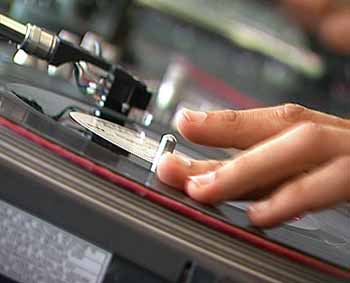
A DJ scratching a record

Scratching, sometimes referred to as scrubbing, is a DJ and turntablist technique of moving a vinyl record back and forth on a turntable to produce percussive or rhythmic sounds. A crossfader on a DJ mixer may be used to fade between two records simultaneously.

While scratching is most associated with hip hop music, where it emerged in the mid-1970s, from the 1990s it has been used in some styles of EDM like techno, trip hop, and house music and rock music such as rap rock, rap metal, rapcore, and nu metal. In hip hop culture, scratching is one of the measures of a DJ's skills. DJs compete in scratching competitions at the DMC World DJ Championships and IDA (International DJ Association), formerly known as ITF (International Turntablist Federation). At scratching competitions, DJs can use only scratch-oriented gear (turntables, DJ mixer, digital vinyl systems or vinyl records only). In recorded hip hop songs, scratched "hooks" often use portions of other songs.

History

[edit]

Precursors

[edit]

A rudimentary form of turntable manipulation that is related to scratching was developed in the late 1940s by radio music program hosts, disc jockeys (DJs), or the radio program producers who did their own technical operation as audio console operators. It was known as back-cueing, and was used to find the very beginning of the start of a song (i.e., the cue point) on a vinyl record groove.[1] This was done to permit the operator to back the disc up (rotate the record or the turntable platter itself counter-clockwise) in order to permit the turntable to be switched on, and come up to full speed without ruining the first few bars of music with the "wow" of incorrect, unnaturally slow-speed playing. This permitted the announcer to time their remarks, and start the turntable in time for when they wanted the music on the record to begin.

Back cueing was a basic skill that all radio production staff needed to learn, and the dynamics of it were unique to the brand of professional turntable in use at a given radio station. The older, larger and heavier turntables needed a 180-degree backward rotation to allow for run up to full speed; some of the newer 1950s models used aluminum platters and cloth-backed rubber mats which required a third of a rotational turn or less to achieve full speed when the song began. All this was done in order to present a music show on air with the least amount of silence ("alive air") between music, the announcer's patter and recorded advertising commercials. The rationale was that any "dead air" on a radio station was likely to prompt a listener to switch stations, so announcers and program directors instructed DJs and announcers to provide a continuous, seamless stream of sound–from music to an announcer to a pre-recorded commercial, to a "jingle" (radio station theme song), and then immediately back to more music.

Back-cueing was a key function in delivering this seamless stream of music. Radio personnel demanded robust equipment and manufacturers developed special tonearms, styli, cartridges and lightweight turntables to meet these demands.

Turntablism

[edit]
In the mid-1970s in the South Bronx, a young teen DJ named "Grand Wizzard Theodore" (right) invented the "DJ scratch" technique. Other DJs, like Grandmaster Flash, took the technique to higher levels.

Modern scratching techniques were made possible by the invention of direct-drive turntables, which led to the emergence of turntablism. Early belt-drive turntables were unsuitable for scratching since they had a slow start-up time, and they were prone to wear and tear and breakage,[2] as the belt would break from backspinning or scratching.[3] The first direct-drive turntable was invented by Shuichi Obata, an engineer at Matsushita (now Panasonic),[4] based in Osaka, Japan.[2] It eliminated belts, and instead employed a motor to directly drive a platter on which a vinyl record rests.[5] In 1969, Matsushita released it as the SP-10,[5] the first direct-drive turntable on the market,[6] and the first in their influential Technics series of turntables.[5]

In the 1970s, hip hop musicians and club DJs began to use this specialized turntable equipment to move the record back and forth, creating percussive sounds and effects–"scratching"–to entertain their dance floor audiences. Whereas the 1940s–1960s radio DJs had used back-cueing while listening to the sounds through their headphones, without the audience hearing, with scratching, the DJ intentionally lets the audience hear the sounds that are being created by manipulating the record on the turntable, by directing the output from the turntable to a sound reinforcement system so that the audience can hear the sounds. Scratching was developed by early hip hop DJs from New York City such as Grand Wizzard Theodore, who described scratching as, "nothing but the back-cueing that you hear in your ear before you push it [the recorded sound] out to the crowd."[7] He developed the technique when experimenting with the Technics SL-1200, a direct-drive turntable released by Matsushita in 1972 when he found that the motor would continue to spin at the correct RPM even if the DJ wiggled the record back and forth on the platter. Afrika Bambaataa made a similar discovery with the SL-1200 in the 1970s. The Technics SL-1200 went on to become the most widely used turntable for the next several decades.[8]

Jamaican-born DJ Kool Herc, who immigrated to New York City, influenced the early development of scratching. Kool Herc developed break-beat DJing, where the breaks of funk songs—being the most danceable part, often featuring percussion—were isolated and repeated for the purpose of all-night dance parties.[9] He was influenced by Jamaican dub music,[10] and developed his turntable techniques using the Technics SL-1100, released in 1971, due to its strong motor, durability, and fidelity.[5]

Although previous artists such as writer and poet William S. Burroughs had experimented with the idea of manipulating a reel-to-reel tape manually to make sounds, as with his 1950s recording, "Sound Piece"), vinyl scratching as an element of hip hop pioneered the idea of making the sound an integral and rhythmic part of music instead of an uncontrolled noise. Scratching is related to "scrubbing" (in terms of audio editing and production) when the reels of an open reel-to-reel tape deck (typically 1/4 inch magnetic audiotape) are gently rotated back and forth while the playback head is live and amplified, to isolate a specific spot on the tape where an editing "cut" is to be made. Today, both scratching and scrubbing can be done on digital audio workstations (DAWs) which are equipped for these techniques.

Christian Marclay was one of the earliest musicians to scratch outside hip hop. In the mid-1970s, Marclay used gramophone records and turntables as musical instruments to create sound collages. He developed his turntable sounds independently of hip hop DJs. Although he is little-known to mainstream audiences, Marclay has been described as "the most influential turntable figure outside hip hop"[11] and the "unwitting inventor of turntablism."[12]

In 1981 Grandmaster Flash released the song "The Adventures of Grandmaster Flash on the Wheels of Steel" which is notable for its use of many DJ scratching techniques. It was the first commercial recording produced entirely using turntables. In 1982, Malcolm McLaren & the World's Famous Supreme Team released a single "Buffalo Gals", juxtaposing extensive scratching with calls from square dancing, and, in 1983, the EP, D'ya Like Scratchin'?, which is entirely focused on scratching. Another 1983 release to prominently feature scratching is Herbie Hancock's Grammy Award-winning single "Rockit". This song was also performed live at the 1984 Grammy Awards, and in the documentary film Scratch, the performance is cited by many 1980s-era DJs as their first exposure to scratching. The Street Sounds Electro compilation series which started in 1983 is also notable for early examples of scratching. Also, a notable piece was "For A Few Dollars More" by Bill Laswell-Michael Beinhorn band Material, released on 12" single in Japan and containing scratch performed by Grand Mixer DXT, another pioneer of scratching.

Basic techniques

[edit]

Vinyl recordings

[edit]

Most scratches are produced by rotating a vinyl record on a direct drive turntable rapidly back and forth with the hand with the stylus ("needle") in the record's groove. This produces the distinctive sound that has come to be one of the most recognizable features of hip hop music.[13] Over time with excessive scratching, the stylus will cause what is referred to as "cue burn", or "record burn".[citation needed]

The basic equipment setup for scratching includes two turntables and a DJ mixer, which is a small mixer that has a crossfader and cue buttons to allow the DJ to cue up new music in their headphones without the audience hearing.[citation needed] When scratching, this crossfader is utilized in conjunction with the scratching hand that is manipulating the record platter. The hand manipulating the crossfader is used to cut in and out of the record's sound.[citation needed]

Digital vinyl systems

[edit]

Using a digital vinyl system (DVS) consists of playing vinyl discs on turntables whose contents are a timecode signal instead of a real music record.

  1. The turntables' audio outputs are connected to the audio inputs of a computer audio interface.
  2. The audio interface digitizes the timecode signal from the turntables and transfers it to the computer's DJ software.
  3. The DJ software uses this data (e.g., about how fast the platter is spinning) to determine the playback status, speed, scratch sound of the hardware turntables, etc., and it duplicates these effects on the digital audio files or computer tracks the DJ is using.
  4. By manipulating the turntables' platters, speed controls, and other elements, the DJ thus controls how the computer plays back digitized audio and can therefore produce "scratching" and other turntablism effects on songs which exist as digital audio files or computer tracks.

There is not a single standard of DVS, so each form of DJ software has its own settings. Some DJ software such as Traktor Scratch Pro or Serato Scratch Live supports only the audio interface sold with their software, requiring multiple interfaces for one computer to run multiple programs.

Some digital vinyl systems software include:

Non-vinyl scratching

[edit]

While some turntablists consider the only true scratching media to be the vinyl disc, there are other ways to scratch, such as:

  • Specialized DJ-CD players (CDJ) with jog wheels, allowing the DJ to manipulate a CD as if it were a vinyl record, have become widely available in the 2000s.
  • A vinyl emulation is an emulation software, which may be combined with hardware elements, which allows a DJ to manipulate the playback of digital music files on a computer via a DJ control surface (generally MIDI or a HID controller). DJs can scratch, beatmatch, and perform other turntablist operations that cannot be done with a conventional keyboard and mouse. DJ software performing computer scratch operations include Traktor Pro, Mixxx, Serato Scratch Live & Itch, VirtualDJ, M-Audio Torq, DJay, Deckadance, Cross.
  • DJs have also used magnetic tape, such as cassette or reel to reel to both mix and scratch. Tape DJing is rare, but Ruthless Ramsey[14] in the US, TJ Scratchavite[15] in Italy and Mr Tape[16] in Latvia use exclusively tape formats to perform.

Sounds

[edit]

Sounds that are frequently scratched include but are not limited to drum beats, horn stabs, spoken word samples, and vocals/lyrics from other songs. Any sound recorded to vinyl can be used, and CD players providing a turntable-like interface allow DJs to scratch not only material that was never released on vinyl, but also field recordings and samples from television and movies that have been burned to CD-R. Some DJs and anonymous collectors release 12-inch singles called battle records that include trademark, novel or hard-to-find scratch "fodder" (material). The most recognizable samples used for scratching are the "Ahh" and "Fresh" samples, which originate from the song "Change the Beat" by Fab 5 Freddy.

There are many scratching techniques, which differ in how the movements of the record are combined with opening and closing the crossfader (or another fader or switch, such as a kill switch, where "open" means that the signal is audible, and "closed" means that the signal is inaudible). This terminology is not unique; the following discussion, however, is consistent with the terminology used by DJ QBert on his Do It Yourself Scratching DVD.

Basic techniques

[edit]
  • Faderless scratches
    • Baby scratch - The simplest scratch form, it is performed with the scratching hand only, moving the record back and forth in continuous movements while the crossfader is in the open position.
      • Scribble scratch - The scribble scratch is by rapidly pushing the record back and forth. The crossfader is not used.
      • Drag scratch - Equivalent to the baby and scribble scratch, but done more slowly. The crossfader is not used.
      • Tweak scratch - Performed while the turntable's motor is not running. The record platter is set in motion manually, then "tweaked" faster and slower to create a scratch. This scratch form is best performed with long, sustained sounds.
      • Hydrophonic scratch - A baby scratch with a "tear scratch" sound produced by the thumb running in the opposite direction as the fingers used to scratch. This rubbing of the thumb adds a vibrating effect or reverberation to forward movements on the turntable.
    • Tear scratch - Tear scratches are scratches where the record is moved in a staggered fashion, dividing the forward and backward movement into two or more movements. This allows creating sounds similar to "flare scratches" without the use of the crossfader and it allows for more complex rhythmic patterns. The term can also refer to a simpler, slower version of the chirp.
      • Orbit scratch - Describes any scratch, most commonly flares, that is repeated during the forward and backward movement of the record. "Orbit" is also used as a shorthand for two-click flares.
  • Transformer scratch - with the crossfader closed, the record is moved with the scratching hand while periodically "tapping" the crossfader open and immediately closing it again.
    • Forward and backward scratch - The forward scratch, also referred to as scrubbing, is a baby scratch where the crossfader is closed during the backwards movement of the record. If the record is let go instead of being pushed forward it is also called "release scratch" or "drop". Cutting out the forward part of the record movement instead of the backward part gives a "backward scratch"
  • Chirp scratch - The chirp scratch involves closing the crossfader just after playing the start of a sound, stopping the record at the same point, then pushing it back while opening the fader to create a "chirping" sound. When performed using a recording of drums, it can create the illusion of doubled scratching speed, due to the attack created by cutting in the crossfader on the backward movement.
    • Flare scratch - Begins with the crossfader open, and then the record is moved while briefly closing the fader one or more times to cut the sound out. This produces a staggering sound which can make a single "flare" sound like a very fast series of "chirps" or "tears." The number of times the fader is closed ("clicks") during the record's movement is usually used as a prefix to distinguish the variations. The flare allows a DJ to scratch continuously with less hand fatigue than would result from the transformer. The flare can be combined with the crab for an extremely rapid continuous series of scratches.
      • Euro scratch - A variation of the "flare scratch" in which two faders are used simultaneously with one hand to cut the sound much faster. It can also be performed by using only the up fader and the phono line switch to cut the sound.
  • Crab scratch - Consists of moving the record while quickly tapping the crossfader open or closed with each finger of the crossfader hand. In this way, DJs are able to perform transforms or flares much faster than they could by manipulating the crossfader with the whole hand.
    • Twiddle scratch - A crab scratch using only the index and middle fingers.

Scratch combinations

[edit]

More complex combinations can be generated by grouping elementary crossfader motions (such as the open, close, and tap) into three and four-move sequences.[17] Closing and tapping motions can be followed by opens and taps, and opens can be followed by closes only.

Three move sequences switch position at beginning and end
open-close-tap closed-closed
tap-open-close closed-closed
close-tap-open open-open
open-close-open closed-open
close-open-close open-closed
close-tap-tap open-closed
tap-tap-tap closed-closed
tap-tap-open closed-open
four move sequences switch position at beginning and end
close-open-close-open open-open
close-open-close-tap open-closed
close-tap-open-close open-closed
close-tap-tap-tap open-closed
close-tap-tap-open open-open
open-close-open-close closed-closed
open-close-tap-tap closed-closed
open-close-tap-open closed-open
tap-tap-tap-tap closed-closed
tap-tap-tap-open closed-open
tap-tap-open-close closed-closed
tap-open-close-open closed-open
tap-open-close-tap closed-closed

Note that some sequences of motions ultimately change the direction of the switch, whereas others end in a position such that they can be repeated immediately without having to reset the position of the switch. Sequences that change the direction of the switch can be dovetailed with sequences that change it in the opposite directions to produce repeating patterns, or can be used to transition between open and closed crossfader techniques, such as chirps/flares and transforms, respectively.[18] These crossfader sequences are frequently combined with orbits and tears to produce combination scratches, such as the aquaman scratch, which goes "close-tap-open".[19]

Subculture

[edit]

While scratching is becoming more and more popular in pop music, particularly with the crossover success of pop-hip hop tracks in the 2010s, sophisticated scratching and other expert turntablism techniques are still predominantly an underground style developed by the DJ subculture. The Invisibl Skratch Piklz from San Francisco focuses on scratching. In 1994, the group was formed by DJs Q-Bert, Disk & Shortkut and later Mix Master Mike. In July 2000, San Francisco's Yerba Buena Center for the Arts held Skratchcon2000, the first DJ Skratch forum that provided "the education and development of skratch music literacy". In 2001, Thud Rumble became an independent company that works with DJ artists to produce and distribute scratch records.[citation needed]

In 2004, Scratch Magazine, one of the first publications about hip hop DJs and record producers, released its debut issue, following in the footsteps of the lesser-known Tablist magazine. Pedestrian is a UK arts organisation that runs Urban Music Mentors workshops led by DJs. At these workshops, DJs teach youth how to create beats, use turntables to create mixes, act as an MC at events, and perform club sets.

Use outside hip hop

[edit]

Scratching has been incorporated into a number of other musical genres, including pop, rock, jazz, some subgenres of heavy metal (notably nu metal) and some contemporary and avant-garde classical music performances. For recording use, samplers are often used instead of physically scratching a vinyl record.

DJ Product©1969, formerly of the rap rock band Hed PE, recalled that the punk rock band the Vandals was the first rock band he remembered seeing use turntable scratching.[20] Product©1969 also recalled the early rap metal band Proper Grounds, which was signed to Madonna's Maverick Records, as being another one of the first rock bands to utilize scratching in their music.[20]

Guitarist Tom Morello, known for his work with Rage Against the Machine and Audioslave, has performed guitar solos that imitate scratching by using the kill switch on his guitar. Perhaps the best-known example is "Bulls on Parade", in which he creates scratch-like rhythmic sounds by rubbing the strings over the pick-ups while using the pickup selector switch as a crossfader.

Since the 1990s, scratching has been used in a variety of popular music genres such as nu metal, exemplified by Linkin Park, Slipknot and Limp Bizkit. It has also been used by artists in pop music (e.g. Nelly Furtado) and alternative rock (e.g. Incubus). Scratching is also popular in various electronic music styles, such as techno.

See also

[edit]

Sources

[edit]
  • Allmusic's Grand Wizard Theodore biography (also at Artist Direct)
  • DJ Grandmaster Flash quoted in Toop, David (1991). Rap Attack 2, 65. New York: Serpent's Tail. ISBN 1-85242-243-2.

References

[edit]
Revisions and contributorsEdit on WikipediaRead on Wikipedia
from Grokipedia
Scratching is a DJ and turntablist technique used to produce rhythmic sounds and sound effects by manually moving a vinyl record back and forth on a turntable while the stylus is in contact with the groove.[1] Often performed with a crossfader on a DJ mixer to cut the audio in and out, it transforms the turntable into a percussive instrument central to hip hop music and broader electronic genres.[2] The technique originated in the mid-1970s Bronx hip hop scene, where DJs like Kool Herc pioneered breakbeat mixing, and Grand Wizzard Theodore is credited with inventing scratching around 1975 after accidentally manipulating a record to pause it.[3] It evolved through innovators such as Grandmaster Flash, becoming a staple of live performances and recordings by the early 1980s, exemplified in tracks like Herbie Hancock's "Rockit" (1983) and M/A/R/R/S's "Pump Up the Volume" (1987).[2] Scratching fostered the turntablist subculture, with practitioners competing in battles and advancing complex patterns, while digital tools have expanded its applications since the 1990s.[4]

Definition and Fundamentals

Definition and Origins

Scratching is a DJ technique involving the rhythmic manipulation of a vinyl record—or its digital equivalent—back and forth beneath a stylus on a turntable to generate distinctive percussive or melodic sounds, typically synchronized with underlying beats in hip hop and related genres.[5][6] This method transforms the turntable into a percussive instrument, allowing DJs to create rhythmic patterns and sound effects that enhance musical performances.[7] At its core, scratching relies on precise forward and reverse motions of the record, coordinated with a mixer's crossfader to mute and unmute the audio channel, producing sharp "cuts" in the sound.[6] DJs also control stylus pressure to modulate tone and avoid skips, ensuring clean execution while the record's groove interacts with the needle to yield varied sonic textures.[8] These mechanics enable the isolation and repetition of short audio samples, often from breakbeats, to build layered rhythms.[5] The technique emerged accidentally in 1975 in the Bronx, New York, when 12-year-old DJ Grand Wizzard Theodore paused a spinning record with his hand after his mother scolded him for playing music too loudly; upon moving the record back and forth, he discovered the scratching sound and refined it as a method to extend breaks in funk records.[3][9] Theodore, apprenticed under Grandmaster Flash, debuted the technique publicly in 1977 at age 14, introducing it to the local hip hop scene.[3] Early adoption occurred among Bronx DJs at block parties, where pioneers like Grandmaster Flash integrated scratching to prolong instrumental sections and energize crowds, cementing its role as a foundational element of hip hop music.[4][10] This innovation quickly spread within the emerging culture, evolving scratching from a practical trick into a performative staple.[3]

Essential Equipment

The essential equipment for scratching centers on hardware that enables precise manual control over audio playback, with direct-drive turntables serving as the foundational component. Direct-drive models, such as the Technics SL-1200 series, provide the necessary high torque and stable pitch control required for the rapid manipulations inherent to scratching, ensuring the platter responds instantly to hand torque without speed fluctuations.[11][12] These turntables feature a quartz-locked motor and adjustable pitch fader, allowing for consistent rotational speeds (typically 33⅓ or 45 RPM) even under intense physical interaction.[13] Vinyl records form the core medium for traditional scratching, with breakbeat-focused selections offering isolated drum loops ideal for rhythmic manipulation. Tracks from funk artists like James Brown, such as those compiled in Greatest Breakbeats, provide clean, punchy percussion breaks that have been staples since the technique's inception due to their dynamic range and loopable structure.[14][15] Specialized scratch records, often featuring wide grooves to accommodate aggressive stylus movement and labeled cue points for quick navigation, contain pre-curated vocal snippets, sound effects, and skipless loops designed specifically for turntablists.[16] A DJ mixer is crucial for integrating multiple audio sources, with the crossfader enabling rapid channel switching essential for layering scratches over beats. Crossfaders in scratching setups typically employ sharp-cut curves (such as transformer or cut-in styles) to minimize audio bleed during quick transitions, often adjustable via contour controls for precise timing.[17] Integrated EQ controls, usually three-band (low, mid, high), allow for frequency isolation, such as killing bass frequencies to highlight scratch sounds without muddiness. The stylus and cartridge must withstand lateral forces from back-and-forth motions, with high-output moving magnet designs like the Shure M44-7 optimized for this purpose. This cartridge's conical stylus and robust suspension provide superior tracking (1.5–3 grams force) and skip resistance, tailored for the side-to-side stresses of scratching while delivering clear highs and lows.[18][19] In modern setups, time-coded vinyl integrates digital libraries with analog control, introduced by systems like Serato Scratch Live in the early 2000s, where special records encode timing signals to mirror physical movements on software-based tracks.[20][21] Control surfaces, such as early digital vinyl systems (DVS) hardware including Rane interfaces, bridge this by mapping jog wheels and faders to virtual decks, preserving scratching feel without physical vinyl.[22]

History

Precursors to Scratching

In the 1940s and 1950s, avant-garde composers pioneered tape manipulation techniques that foreshadowed rhythmic sound experimentation central to later scratching practices. Pierre Schaeffer, a French engineer and composer, developed musique concrète by recording everyday sounds—such as locomotives and debris—onto magnetic tape or acetate discs, then altering them through splicing, looping, reversing playback, and speed variations to create abstract rhythmic patterns.[23] These methods, exemplified in works like Schaeffer's 1948 Étude aux chemins de fer, emphasized isolating and rearranging sound fragments for novel textures, influencing subsequent manual interventions in recorded media.[23] During the 1950s and 1960s, American radio disc jockeys advanced turntable handling for live broadcasting, laying technical foundations for precise record control. Figures like Douglas "Jocko" Henderson utilized dual turntables to perform back-cueing—positioning the needle ahead of the beat to cue the next track silently via headphones—enabling seamless transitions between songs without dead air.[24] Henderson, broadcasting on stations like WHAT-AM in Philadelphia and WADO-AM in New York, also incorporated echo effects through rudimentary reverb units or tape delays, enhancing vocal patter and musical flow to captivate audiences.[24] These practices, common among rhythm-and-blues DJs, prioritized rhythmic continuity and auditory layering, predating more aggressive manipulations.[24] Jamaican sound system culture in the 1960s and 1970s further evolved manual record intervention, blending selection with real-time effects in competitive dancehall settings. DJs known as selectors, such as King Tubby (Osbourne Ruddock), manually cued vinyl records on custom rigs to drop vocals or instruments abruptly, creating dramatic pauses and echoes via spring reverb chambers or early effects boxes.[25] Tubby's innovations in dub mixing—overdubbing and fading elements live during sound clashes—relied on precise needle drops and fader manipulations to produce rhythmic echoes and instrumental drops, transforming reggae tracks into immersive, interactive experiences.[25] Toasters like those accompanying Tubby's Home Town Hi-Fi system added rhymed commentary over these manipulations, fostering a performative ethos that emphasized crowd response.[25] By 1973, pre-hip hop party DJs in the Bronx adapted these global influences to extend instrumental sections, setting the stage for record isolation without yet incorporating full scratching. At block parties like the August 11 event at 1520 Sedgwick Avenue, Kool DJ Herc used two turntables and duplicate copies of funk records to isolate and loop "breaks"—percussive drum sections—prolonging them from seconds to minutes for dancers.[26] Herc's "Merry-Go-Round" method involved manual cueing to switch seamlessly between breaks, focusing on rhythmic extension rather than backward drags or forward pushes on the record.[26] This approach, drawn from Jamaican sound systems, prioritized breakbeat isolation to sustain energy, bridging earlier techniques toward hip hop's emergent innovations.[26]

Development in Hip Hop

Scratching was invented in 1975 by Grand Wizzard Theodore, a young Bronx DJ who accidentally discovered the technique by manipulating a record to pause it while being scolded by his mother for playing music too loudly.[3] It emerged as a defining element of hip-hop DJing in the mid-1970s, with Grandmaster Flash playing a pivotal role in its popularization through his development of the quick mix theory around 1976-1977.[27] This involved using the crossfader on the mixer for precise cuts, combined with record manipulation back and forth to create rhythmic interruptions in the sound, building on earlier breakbeat looping practices. Flash's innovation allowed DJs to isolate and repeat short segments of music with greater control, transforming the turntable into a performative instrument central to hip-hop sets. In live performances, scratching became essential for extending instrumental breaks, particularly over tracks like "Apache" by the Incredible Bongo Band, whose percussion-heavy section provided an ideal canvas for manipulation. By scratching and cutting during these breaks, DJs like Flash could prolong the rhythmic foundation, giving MCs more time to deliver extended rhymes without gaps in the music. This technique enhanced the energy of Bronx block parties, where seamless transitions kept dancers engaged and elevated the DJ's role from mere playback to active composition.[28] A landmark recording that showcased scratching commercially was Grandmaster Flash's 1981 track "The Adventures of Grandmaster Flash on the Wheels of Steel," widely recognized as the first major release to feature the technique prominently. In this piece, Flash layered scratches over samples from songs by Chic, Queen, and Blondie, demonstrating rhythmic complexity and crossfader precision that influenced countless subsequent hip-hop productions. The track's release on Sugar Hill Records marked scratching's transition from underground parties to recorded music, solidifying its place in the genre's sound.[29] The technique spread rapidly through influential crews like the Universal Zulu Nation in the late 1970s, where DJs such as Jazzy Jay refined scratching by focusing on isolating individual drum hits for sharper, more percussive effects. As a key member of the Zulu Nation alongside Afrika Bambaataa, Jazzy Jay incorporated these advancements into group performances, helping disseminate scratching across New York City's hip-hop scene and fostering a collaborative environment for innovation. This crew-based exchange accelerated the adoption of scratching as a core skill among aspiring DJs.[30] Technological aids further advanced scratching in the early 1980s, notably the introduction of slipmats—felt pads placed under records to allow smoother, frictionless manipulation without damaging the vinyl. Invented by Grandmaster Flash to facilitate quicker cueing and backspinning, slipmats enabled more fluid execution of cuts and scratches, reducing wear on equipment and records during extended sessions. This innovation, quickly adopted by the hip-hop community, supported the technique's maturation into a reliable performance tool.[31]

Rise of Turntablism

The term "turntablism" emerged in 1995, coined by DJ Babu of the Beat Junkies crew to differentiate the instrumental, performance-oriented aspects of DJing from traditional record mixing.[32] This distinction highlighted scratching and beat manipulation as a standalone art form, elevating the turntable from a playback device to a musical instrument capable of creating original compositions and sound effects.[4] In the 1980s, turntablism gained momentum through competitive platforms that showcased technical innovation, particularly the DMC World DJ Championships, which began in 1985 and quickly became a global stage for scratching routines.[33] These events encouraged DJs to push boundaries with complex patterns, fostering a competitive culture that transformed casual techniques into polished performances. A pivotal milestone came in 1994 with DJ Q-Bert's release of the mixtape Demolition Pumpkin Squeeze Musik, which featured intricate scratch routines and breakbeat manipulations, serving as a blueprint for aspiring turntablists and solidifying advanced vinyl handling as central to the practice.[4] By the 1990s, turntablism spread internationally, influencing scenes across Europe and Asia. In the UK, the DMC's European branches and local crews like those competing in national championships amplified the style, with DJs adapting American innovations to local hip-hop and electronic contexts.[33] In Asia, particularly Japan, turntablists such as DJ Krush integrated scratching into instrumental hip-hop, while companies like Vestax developed specialized gear that supported the growing emphasis on performative DJing.[34] This expansion was formalized in 1996 with the founding of the International Turntablist Federation (ITF) by DJ Disk and DJ Babu, which organized annual world championships to standardize rules and promote cross-cultural exchanges.[4] Entering the 2000s, turntablism adapted to digital tools, with software like Serato Scratch Live (introduced in 2004) allowing vinyl control over digital audio files, broadening accessibility without requiring extensive record collections.[33] However, major competitions like the DMC and ITF maintained a strong emphasis on vinyl mastery, preserving the tactile, analog roots of the art form amid technological shifts and ensuring its competitive integrity.[4]

Techniques

Vinyl-Based Scratching

Vinyl-based scratching refers to the manual manipulation of physical vinyl records on a turntable to create rhythmic and percussive sounds, fundamentally relying on the interaction between the record grooves, the stylus, and the DJ's hands. This technique, pioneered in the late 1970s, forms the core of turntablism and requires precise control over record movement and audio mixing via a crossfader.[5] The baby scratch is the most basic technique, involving a simple forward and backward motion of the record under the needle while using the crossfader to cut the sound on and off, producing a rhythmic "tick-tick" pattern.[5] Forward scratches emphasize pushing the record forward to generate the sound, with the crossfader timing adjusted to control tone and duration, while reverse scratches pull the record backward for a different tonal variation, often requiring careful speed modulation to maintain rhythm.[5] More advanced manual techniques include the tear and chirp scratches, which create stutter effects. The tear scratch achieves this by abruptly halting and resuming the backward motion with varying pressure, particularly effective on high-frequency sounds to produce a ripping quality.[5] The chirp scratch combines a fast baby scratch motion with precise crossfader cuts during the reverse phase, isolating high-frequency snippets for a chirping effect.[5] To master these techniques, DJs often use specialized battle records that feature pre-labeled cue points for consistent practice of timing and precision, such as the Super J record from the 1980s.[35] These records provide isolated sounds and beats ideal for repetitive drills. Common challenges in vinyl-based scratching include preventing needle skips and minimizing groove wear. Needle skips can be mitigated through proper turntable setup, including balanced tonearm, appropriate tracking force (typically 3-4 grams for DJ styli like the Shure M44-7), and a light touch during manipulation.[5] Groove wear, resulting from repeated stylus drags, is reduced by using dedicated scratch records and slipmats to allow smoother record rotation without excessive friction.[35]

Digital Scratching Methods

Digital scratching methods emerged in the early 2000s as DJs sought to replicate the tactile feel of vinyl manipulation using computer-based tools, allowing for precise control over digital audio files without relying solely on physical records. These techniques leverage software and hardware interfaces to simulate scratching motions, enabling turntablists to perform complex routines on laptops or dedicated controllers. Unlike traditional vinyl scratching, which depends on analog records and turntables, digital methods prioritize low-latency processing and virtual waveform displays to maintain rhythmic accuracy and creative flexibility. One foundational approach is time-coded vinyl systems, which bridge analog and digital realms by using specially pressed records embedded with unique audio signals to synchronize a computer's playback with a DJ's physical movements. Serato Scratch Live, debuting in 2003, pioneered this technology by allowing users to control digital tracks stored on a hard drive through standard turntables and these time-coded vinyls, effectively overlaying software analysis on hardware manipulation. This system processes the control signal in real-time to map jog wheel or fader actions to virtual scratching, supporting effects like pitch bending and backspinning with minimal audible delay when properly configured. Controller-based scratching represents a fully digital evolution, employing dedicated hardware with jog wheels, fader sliders, and MIDI pads to mimic turntable gestures without any vinyl involvement. Devices such as the Pioneer CDJ-2000, released in 2010, feature responsive jog wheels that detect speed and direction for authentic scratch simulation on USB-loaded tracks, integrating beat-matched looping and hot cues for seamless performance transitions. Similarly, the Numark NS6, introduced around 2011, offers dual jog wheels and performance pads on a controllerist-friendly layout, enabling precise waveform scrubbing and filter effects tailored to scratching patterns. These controllers often connect via USB to software, providing haptic feedback through motor-driven platters that vibrate in response to virtual record resistance. Software platforms form the backbone of digital scratching, offering intuitive interfaces for visualization and execution. Native Instruments' Traktor Pro, evolving since its 2009 version 3 release, includes Scratch Control mode with timecode emulation and a visual waveform display that highlights scratch points, allowing for low-latency (typically under 10ms) performance on compatible hardware. Virtual DJ, developed by Atomix Productions and widely adopted since the early 2000s, supports similar features through its jog wheel mapping and sync-locked scratching, where users can apply effects like echo or flanger directly during routines. Both platforms emphasize customizable mappings to adapt scratching techniques from vinyl traditions to digital inputs. Key advantages of digital scratching methods include access to expansive sound libraries from digital files, eliminating the need for physical record collections and reducing wear on equipment. Pitch stability is maintained through software algorithms that prevent speed fluctuations common in vinyl setups, while integrated recording tools capture performances directly for live remixing or post-production. These systems also facilitate collaboration in electronic music production by syncing with DAWs like Ableton Live. However, mastering digital scratching involves a notable learning curve, particularly in calibrating for latency, where ideal setups achieve under 5ms response times to avoid timing disruptions during rapid scratches. Emulating haptic feedback remains challenging, as many controllers approximate vinyl "drag" through software simulations rather than true mechanical resistance, requiring DJs to adjust techniques for optimal feel. Proper audio interface selection and buffer size adjustments are essential to minimize these issues.

Hybrid and Non-Traditional Approaches

Hybrid and non-traditional approaches to scratching extend the technique beyond conventional vinyl and digital DJ setups, incorporating experimental hardware, instrument crossovers, and inclusive adaptations. In the early 1990s, DJs began experimenting with CD scratching using players like the Denon DN-1000S, released in 1993, which featured a jog wheel for pitch control and cueing, enabling rudimentary manipulation of audio tracks similar to record scratching. This evolved with Pioneer's CDJ-500 in 1994, the first CD player designed specifically for DJs, incorporating a large jog dial to simulate platter movement for more tactile scratching attempts.[36] By the early 2000s, touch-sensitive platters on models like the Pioneer CDJ-1000 allowed for precise digital file scratching, bridging vinyl techniques to MP3s and CDs without physical media wear, as demonstrated in live performances where DJs used jog dials to imitate forward and reverse motions.[37] Systems like Final Scratch, introduced around 1999, further advanced MP3 scratching by pairing time-coded vinyl or CDs with software to control digital audio, facilitating hybrid setups that combined analog feel with digital precision.[38] Instrument integration has also innovated scratching, notably through "scratch guitar" techniques where guitarists employ effects pedals and switches to replicate DJ manipulations. Artist Buckethead, known for his experimental style, uses a killswitch—a momentary volume cut-off button—mounted on his guitar to create staccato, rhythmic interruptions that mimic the choppy sounds of record scratching, often combined with whammy bar dives and delay pedals for layered effects.[39] This approach, popularized in his live performances since the late 1990s, transforms the guitar into a turntable-like instrument, allowing string bends and picking to interact with abrupt silences for percussive, hip-hop-inspired textures.[40] Obscure inventions from the 1990s pushed boundaries with non-contact playback methods, such as laser turntables designed to read vinyl grooves optically without stylus wear. The ELP Laser Turntable, developed starting in 1989 and commercially available by 1997, employed multiple laser beams to scan record grooves, enabling playback and potential scratching simulations free from physical degradation, though its high cost limited adoption among DJs.[41] Priced at around $20,500 initially, this device represented an experimental hybrid by preserving analog warmth while eliminating friction, appealing to audiophiles and innovators seeking durable scratching alternatives.[42] Mobile app scratching emerged in the 2010s as an accessible entry point for casual practice, with tools like those from Scratch DJ Academy integrating touch-screen interfaces on iOS and Android devices to simulate turntable manipulation. Collaborations such as the djay app's DJ School series, featuring Scratch DJ Academy instructors since around 2013, provided virtual platters for scratching exercises using smartphone accelerometers and multi-touch gestures, allowing users to practice basic cuts and flares without hardware.[43] These apps democratized the technique, offering looped samples and tutorials for on-the-go learning, though they prioritized simulation over professional fidelity. Accessibility adaptations have made scratching inclusive for disabled DJs through modified controllers, including foot-pedal faders that enable hands-free operation. For instance, performers with mobility impairments have customized setups with pedal-based crossfaders and jog wheels, as seen in stories of DJs using foot controls to handle mixing and scratching duties during live sets. Devices like the GLYDR foot controller, adapted for music applications, allow precise parameter adjustments via pedals, supporting turntablists with upper-body limitations to execute hybrid techniques seamlessly.[44] These modifications emphasize ergonomic innovation, ensuring scratching remains viable across diverse physical abilities.

Sounds and Patterns

Basic Scratch Sounds

The forward scratch produces a characteristic rising pitch glissando effect, resulting from the acceleration of the record's motion under the DJ's hand, which increases the playback speed and thereby elevates the audio frequency. This sound, often lasting approximately 0.4 seconds or equivalent to a 1/16th note in rhythmic patterns, serves as a foundational building block in scratching routines by creating a dynamic, sweeping tonal ascent.[5] In contrast, the reverse scratch generates a descending pitch glissando, achieved by decelerating the record's motion, which mirrors the forward scratch but inverts the frequency change to produce a tension-releasing effect. This auditory descent provides rhythmic closure and balance, typically matching the duration of its forward counterpart for symmetrical phrasing in basic patterns.[5] Stab and click sounds emerge from rapid crossfader manipulations, yielding short, percussive hits from the source material; a stab involves a quick forward or backward motion with an abrupt fader cut, while a click adds a sharp, transient accent through fader release. These elemental hits, often high in pitch around 2 kHz for chirp-like stabs, function as crisp rhythmic punctuations. Pitch variations in these sounds are influenced by record speed, with 33⅓ RPM yielding lower rumbles and 45 RPM producing higher chirps, spanning a tonal range comparable to a major sixth interval due to adjustable pitch controls on turntables like the Technics SL-1200.[5] Synchronization of basic scratch sounds to the track's tempo integrates them into the groove, commonly aligning with hip hop beats in the 90-110 BPM range to maintain rhythmic coherence and propulsion. At these tempos, scratches lock into subdivisions like 1/16th notes, ensuring the percussive and glissando elements enhance rather than disrupt the underlying beat structure.[5][45]

Advanced Combinations

Advanced combinations in scratching involve layering multiple basic techniques into intricate patterns and routines that form musical phrases, enabling turntablists to create rhythmic complexity and narrative flow during performances. These combinations extend isolated sounds like baby scratches or chirps into cohesive sequences, often incorporating fader modulation, beat synchronization, and multi-turntable manipulation to produce polyrhythmic textures and dynamic builds. The crab scratch exemplifies a high-speed fader technique where the DJ uses three or four fingers—typically index, middle, ring, and pinky—in rapid succession to tap the crossfader while the thumb provides counter-resistance, generating a staccato "wub-wub" rhythm that mimics rapid-fire percussion.[46] Invented by DJ Qbert in the early 1990s as a variation on the twiddle scratch, it allows for accelerated layering over beats, often combined with forward-backward record movements to build intensity in routines.[47] This multi-finger approach enables seamless integration with other scratches, such as flares, to create extended rhythmic phrases without pausing the underlying track. Hydroplane scratching advances forward slide techniques by applying additional pressure from the non-record hand directly onto the vinyl surface, facilitating longer, smoother glides that produce sustained melodic runs without relying on the fader. This faderless method counters the record's natural momentum to extend the scratch duration, allowing turntablists to weave sweeping tones over basslines or vocal samples for a gliding, wave-like effect in combinations.[48] When modulated with subtle fader cuts, hydroplanes can transition into hybrid patterns, enhancing the melodic contour of performance routines. Beat juggling represents a foundational advanced combination using two turntables to alternate and manipulate identical record sections, creating polyrhythms by syncing elements like 4-bar loops at half-speed or double-time for layered percussion.[49] Pioneered by DJ Steve Dee in the mid-1980s, this technique involves precise cueing and crossfading to dissect and reassemble beats, transforming simple drum patterns into complex, evolving grooves that underpin longer scratch sequences.[50] For instance, juggling a kick-snare loop across turntables at varying speeds can sync with crab scratches to form polyrhythmic bridges, emphasizing syncopation and groove variation in live sets. Turntable routines in battles typically structure these combinations into 30- to 60-second sets, blending 5 to 10 distinct scratches and juggles to showcase technical prowess while forming a musical arc from introduction to climax.[51] Judged in events like the DMC World Championships on criteria including originality, musicality, and execution, these routines prioritize fluid transitions between techniques—such as chaining hydroplanes into beat juggles—to create cohesive phrases that engage audiences through rhythmic storytelling.[52] In the 2020s, digital scratching software and plugins have enhanced turntablism by simulating vinyl manipulation in digital audio workstations (DAWs). Tools like the Scratch Track plugin, updated as of October 2025, allow producers to add realistic scratches using timecoded inputs or MIDI controllers, integrating advanced effects and samples to expand creative workflows while supporting live and studio performance.[53][54]

Cultural and Social Aspects

Turntablist Subculture

The turntablist subculture revolves around a dedicated community of DJs who view turntablism as both an art form and a competitive skill, fostering tight-knit groups that emphasize innovation, mentorship, and preservation of techniques. Central to this subculture are longstanding crews such as the Rock Steady DJs, which emerged in the early 1990s as a DJ-focused extension of the broader Rock Steady Crew, providing a platform for collaborative practice and performance that helped solidify turntablism's communal identity.[55] Online forums have served as key hubs since the 2000s, with communities like DJ History enabling discussions on scratch techniques, equipment, and cultural evolution among enthusiasts worldwide.[56] Aesthetic debates within the subculture highlight tensions between vinyl purism, which prioritizes the tactile authenticity and sonic warmth of analog records, and digital accessibility, which offers portability and cost savings through software like Serato—sparks that intensified in the 2010s as younger turntablists adopted digital vinyl systems (DVS).[57] Purists argue that vinyl's physical manipulation yields superior sound depth and expression, while proponents of digital methods counter that it democratizes access without compromising creativity.[58] These discussions underscore the subculture's values of authenticity and adaptability, often playing out in crew gatherings and online threads. Educational initiatives reinforce the subculture's emphasis on skill-building and knowledge transmission, exemplified by DJ Q-Bert's Skratch University, launched in the 2000s to offer structured workshops, online tutorials, and global seminars teaching foundational and advanced scratching.[59] Through these resources, participants engage in a mentorship model that mirrors the crew dynamic, promoting technical mastery alongside creative expression. Gender dynamics reveal persistent underrepresentation, with women comprising a small fraction of turntablists; pioneers like DJ Shortee, active since the 1990s and recognized as a trailblazer in scratching, broke barriers as one of the few featured in major documentaries.[60] Modern figures such as DJ Perly continue this legacy; as the first female US DMC champion in 2017, she has contributed to efforts challenging the male-dominated landscape through advocacy and events like the Beat Junkie Institute's Ladies of Sound division.[4] Merchandise and media further bind the subculture, with custom battle records like the Power Up! 12" providing specialized vinyl for practice and performance, featuring skip-proof sounds tailored for intense scratching routines.[61] Documentaries such as the 2001 film Scratch, directed by Doug Pray, capture the subculture's ethos by profiling key figures and routines, inspiring new generations while documenting its evolution from underground art to recognized movement.[62]

Competitions and Battles

Scratching competitions, often referred to as DJ battles, emerged as a primary arena for turntablists to demonstrate proficiency and innovation, with formats typically featuring 1-on-1 head-to-head routines lasting 60 seconds to two minutes per round in elimination-style tournaments.[52][63] These battles emphasize direct confrontation, where competitors perform scratching sequences over provided beats, judged on execution and crowd response, including elements of "damage" through disruptive, high-energy displays that energize audiences.[64] The Disco Mix Club (DMC) World DJ Championships, established in 1985, stands as the longest-running and most prestigious scratching competition, initially focusing on vinyl-based routines and expanding to include international qualifiers.[52] Notable early winners include DJ Cheese from the USA in 1986 and DJ Craze from the USA in 1999, whose performances highlighted advanced scratching techniques and influenced global standards.[65] The International Turntablist Federation (ITF), founded in the mid-1990s, introduced specialized categories such as scratching and beat juggling, hosting world championships from 1997 onward with participants from over 15 countries, fostering a more structured competitive landscape before becoming defunct in the mid-2000s.[66][67] In the 1990s, regional rivalries between the US East Coast and West Coast scenes fueled intense battles, exemplified by matchups like DJ Cash Money (East Coast) versus Joe Cooley (West Coast), which showcased stylistic differences and heightened competitive stakes within the broader turntablist subculture.[68] These rivalries contributed to the evolution of scratching as a skill-validation mechanism, drawing larger crowds and media attention to events like the New Music Seminar battles. Judging in major competitions such as DMC evaluates performances based on musicality (rhythmic integration and flow), originality (creative elements), and technical difficulty (precision and complexity), ensuring a balanced assessment of artistic and skillful aspects.[69] Since the early 2010s, digital shifts have transformed competition rules, with DMC permitting digital vinyl systems (DVS) like Serato Scratch Live starting in 2011, allowing hybrid setups that combine turntables with software for scratching, thereby broadening accessibility and increasing global participation without compromising core techniques.[70][71] This adaptation has enabled more entrants from diverse regions, sustaining the vitality of scratching battles into the digital era.

Broader Applications

Use in Electronic Music

Scratching emerged as a key element in electronic music production and performance from the late 1980s onward, particularly in genres like house, where turntablists integrated it to add rhythmic texture and percussive flair to four-on-the-floor beats. A prominent early example is the 1987 hit "Pump Up the Volume" by M/A/R/R/S, which reached number one in the UK and heavily incorporated record scratches, extensive sampling, and elements evoking vinyl playback—including vocal samples referencing needle placement—to simulate DJ techniques in a groundbreaking pop-electronic crossover track.) Italian DJ Lello Romano, for instance, won Italy's national DMC scratching competition in 1990 and began incorporating scratches into house sets, blending hip-hop techniques with electronic grooves during the decade's club scene.[72] This fusion influenced producers who sampled scratches for beats, as seen in the work of Bay Area turntablists like DJ Q-Bert, whose style inspired electronic beatmakers such as Nosaj Thing in creating sample-heavy tracks with integrated scratch elements.[73] In techno and drum & bass, scratching contributed glitch-like effects and breakdowns, enhancing the high-energy, breakbeat-driven soundscapes of the era. DJ Hype, a pioneer in UK jungle and drum & bass, delivered scratch-heavy sets in the mid-1990s, using rapid cuts and transforms to punctuate fast-paced rhythms, as exemplified in his 1996 performance at London's Desire club where scratching amplified the genre's raw intensity.[74] These techniques often emulated turntable noise digitally, allowing for experimental manipulations that paralleled the glitch aesthetics in IDM productions. Live performances in electronic music increasingly relied on software tools for real-time scratching, enabling DJs to manipulate digital files with vinyl-like precision. Native Instruments' Traktor Scratch Pro, introduced in 2008 but building on 1990s digital innovations, supports timecode vinyl control for scratching over electronic tracks, facilitating seamless integration in house and techno sets.[75] Similarly, the REAKTOR-based Simple Scratch ensemble modulates sample speed and volume to replicate authentic scratching effects, allowing producers to layer them into live electronic compositions.[76] A seminal example of scratching's impact is DJ Shadow's 1996 album Endtroducing....., which pioneered the use of scratches alongside looped samples from diverse sources to craft atmospheric electronic instrumentals, influencing trip-hop and broader electronic production.[77] By the 2010s, scratching routines became a staple at major electronic festivals, showcased in DJ battles and workshops that highlighted its adaptability to dance music environments. Digital scratching methods have further enabled this portability, allowing turntablists to perform complex routines without physical vinyl setups. In the 2020s, scratching has seen revival in electronic subgenres like phonk and hyperpop, with artists such as DJ Premier collaborating on tracks that blend classic techniques with modern production tools.[78]

Integration in Other Genres

Scratching has extended beyond its hip-hop origins into rock music, where it often serves as a textural layer enhancing guitar-driven arrangements. Beck's 1996 album Odelay exemplifies this integration, featuring prominent turntable scratches layered over funky guitar riffs and samples to create a collage-like sound that blends alternative rock with hip-hop elements.[79] The production, handled by the Dust Brothers, incorporated scratching as a core rhythmic device, contributing to the album's Grammy-winning success and influencing subsequent rock experimentation with DJ techniques.[80] In the nu-metal genre during the 2000s, scratching became a staple in live performances and recordings, bridging heavy metal aggression with electronic manipulation. Linkin Park's DJ Joe Hahn frequently deployed scratches in their hybrid sets, using custom-pressed sample discs to interweave turntablism with rap-rock riffs, as heard in tracks from Hybrid Theory (2000) and during tours where his solos added dynamic breaks to songs like "With You."[81] Hahn's contributions helped define the band's sound and elevated scratching's role in mainstream rock arenas.[82] Pop and R&B have also embraced scratching through productions and remixes that infuse urban edge into melodic structures. A classic example is "Pump Up the Volume" by M/A/R/R/S (1987), which heavily incorporated scratching and sampling techniques, with intro elements simulating vinyl record scratch, crackle, and needle drop to evoke a DJ placing the needle on the record; the track became a number-one hit in the UK and demonstrated scratching's crossover appeal in pop and dance music.[83] The 1995 Bad Boy remix of Mariah Carey's "Fantasy," featuring Ol' Dirty Bastard's raw rap verse, includes DJ scratches by DXT that punctuate the track's upbeat rhythm, aiding Carey's crossover into hip-hop audiences while maintaining its pop accessibility.[84] This production choice, overseen by Sean Combs, highlighted scratching's versatility in elevating vocal hooks with gritty texture.[85] In film and media sound design, scratching provides rhythmic cues for high-energy sequences, simulating urgency and motion. The 2017 film Baby Driver employs a Califone Card Master tape machine as a diegetic tool for protagonist Baby to generate scratch-like beats from recordings, syncing these manipulated sounds with action scenes like car chases to immerse viewers in his tinnitus-masked worldview.[86] Sound designer Julian Slater integrated such effects to choreograph ambient noises and music, earning an Oscar nomination for their seamless fusion.[87] Experimental and classical contexts have seen scratching reimagined through mechanical innovation. Since the 1980s, French composer Pierre Bastien has constructed turntable-inspired sculptures using motors from old record players, creating automated devices that produce scratch-adjacent sounds via pulleys, valves, and rotating elements in his "mecanium" orchestra.[88] These kinetic works blend musique concrète with visual art, performing glitchy, percussive patterns that evoke scratching without traditional vinyl manipulation.[89] Globally, scratching has fused with regional styles for contemporary appeal, particularly in Bollywood productions of the 2010s. Indian DJs have blended scratching with filmi soundtracks to modernize dance numbers for club and festival scenes, infusing Hindi pop with urban hip-hop flair.[90]

References

User Avatar
No comments yet.