
Recent from talks
Red-giant branch
Knowledge base stats:
Talk channels stats:
Members stats:
Red-giant branch
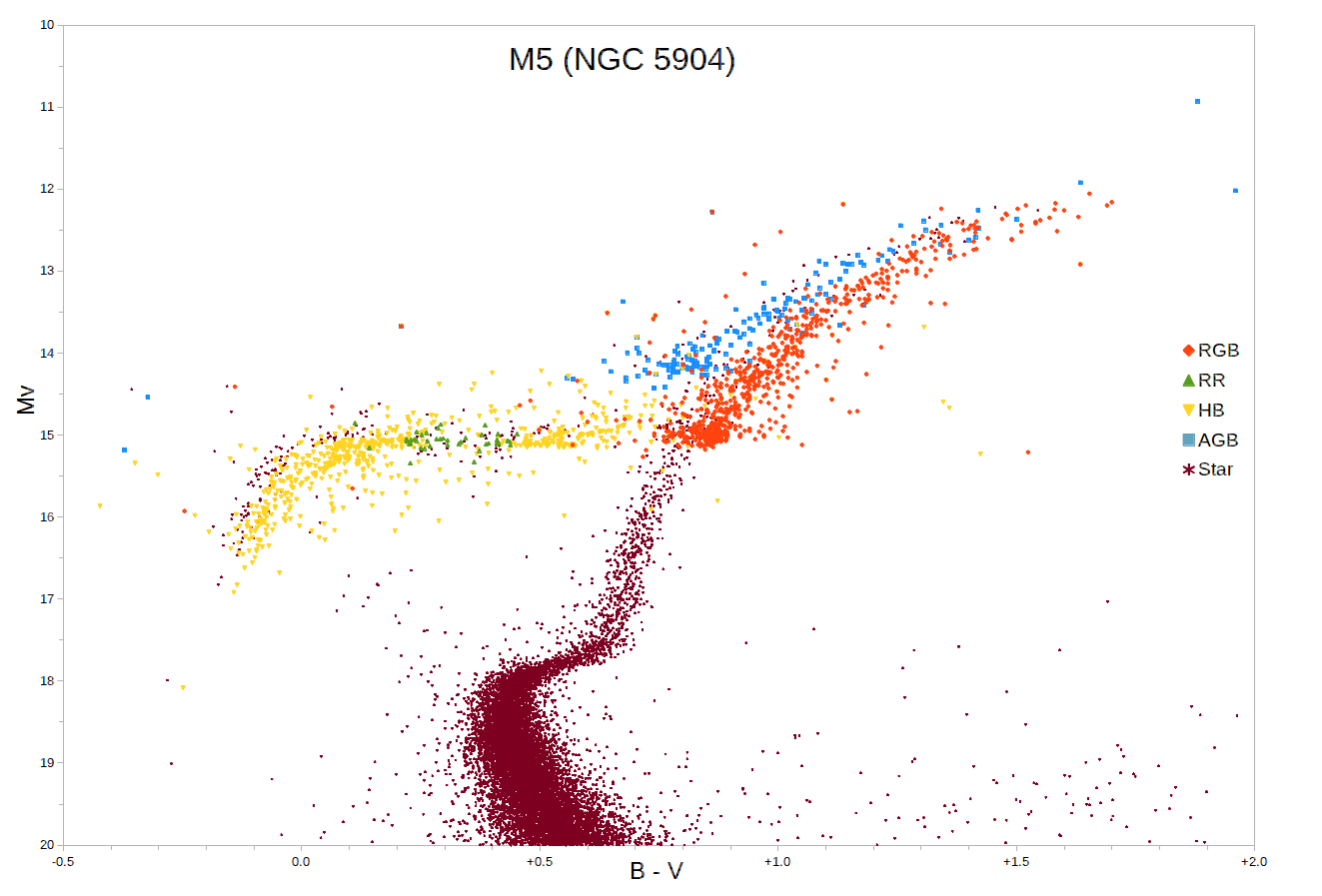
The red-giant branch (RGB), sometimes called the first giant branch, is the portion of the giant branch before helium ignition occurs in the course of stellar evolution. It is a stage that follows the main sequence for low- to intermediate-mass stars. Red-giant-branch stars have an inert helium core surrounded by a shell of hydrogen fusing via the CNO cycle. They are K- and M-class but much larger and more luminous than main-sequence stars of the same temperature.
Red giants were identified early in the 20th century when the use of the Hertzsprung–Russell diagram made it clear that there were two distinct types of cool stars with very different sizes: dwarfs, now formally known as the main sequence; and giants.
The term red-giant branch came into use during the 1940s and 1950s, although initially just as a general term to refer to the red-giant region of the Hertzsprung–Russell diagram. Although the basis of a thermonuclear main-sequence lifetime, followed by a thermodynamic contraction phase to a white dwarf was understood by 1940, the internal details of the various types of giant stars were not known.
In 1968, the name asymptotic giant branch (AGB) was used for a branch of stars somewhat more luminous than the bulk of red giants and more unstable, often large-amplitude variable stars such as Mira. Observations of a bifurcated giant branch had been made years earlier but it was unclear how the different sequences were related. By 1970, the red-giant region was well understood as being made up from subgiants, the RGB itself, the horizontal branch, and the AGB, and the evolutionary state of the stars in these regions was broadly understood. The red-giant branch was described as the first giant branch in 1967, to distinguish it from the second or asymptotic giant branch, and this terminology is still frequently used today.
Modern stellar physics has modelled the internal processes that produce the different phases of the post-main-sequence life of moderate-mass stars, with ever-increasing complexity and precision. The results of RGB research are themselves being used as the basis for research in other areas.
When a star with a mass from about 0.4 M☉ (solar mass) to 12 M☉ (8 M☉ for low-metallicity stars) exhausts its core hydrogen, it enters a phase of hydrogen shell burning during which it becomes a red giant, larger and cooler than on the main sequence. During hydrogen shell burning, the interior of the star goes through several distinct stages which are reflected in the outward appearance. The evolutionary stages vary depending primarily on the mass of the star, but also on its metallicity.
After a main-sequence star has exhausted its core hydrogen, it begins to fuse hydrogen in a thick shell around a core consisting largely of helium. The mass of the helium core is below the Schönberg–Chandrasekhar limit and is in thermal equilibrium, and the star is a subgiant. Any additional energy production from the shell fusion is consumed in inflating the envelope and the star cools but does not increase in luminosity.
Shell hydrogen fusion continues in stars of roughly solar mass until the helium core increases in mass sufficiently that it becomes degenerate. The core then shrinks, heats up and develops a strong temperature gradient. The hydrogen shell, fusing via the temperature-sensitive CNO cycle, greatly increases its rate of energy production and the stars is considered to be at the foot of the red-giant branch. For a star the same mass as the sun, this takes approximately 2 billion years from the time that hydrogen was exhausted in the core.
Hub AI
Red-giant branch AI simulator
(@Red-giant branch_simulator)
Red-giant branch
The red-giant branch (RGB), sometimes called the first giant branch, is the portion of the giant branch before helium ignition occurs in the course of stellar evolution. It is a stage that follows the main sequence for low- to intermediate-mass stars. Red-giant-branch stars have an inert helium core surrounded by a shell of hydrogen fusing via the CNO cycle. They are K- and M-class but much larger and more luminous than main-sequence stars of the same temperature.
Red giants were identified early in the 20th century when the use of the Hertzsprung–Russell diagram made it clear that there were two distinct types of cool stars with very different sizes: dwarfs, now formally known as the main sequence; and giants.
The term red-giant branch came into use during the 1940s and 1950s, although initially just as a general term to refer to the red-giant region of the Hertzsprung–Russell diagram. Although the basis of a thermonuclear main-sequence lifetime, followed by a thermodynamic contraction phase to a white dwarf was understood by 1940, the internal details of the various types of giant stars were not known.
In 1968, the name asymptotic giant branch (AGB) was used for a branch of stars somewhat more luminous than the bulk of red giants and more unstable, often large-amplitude variable stars such as Mira. Observations of a bifurcated giant branch had been made years earlier but it was unclear how the different sequences were related. By 1970, the red-giant region was well understood as being made up from subgiants, the RGB itself, the horizontal branch, and the AGB, and the evolutionary state of the stars in these regions was broadly understood. The red-giant branch was described as the first giant branch in 1967, to distinguish it from the second or asymptotic giant branch, and this terminology is still frequently used today.
Modern stellar physics has modelled the internal processes that produce the different phases of the post-main-sequence life of moderate-mass stars, with ever-increasing complexity and precision. The results of RGB research are themselves being used as the basis for research in other areas.
When a star with a mass from about 0.4 M☉ (solar mass) to 12 M☉ (8 M☉ for low-metallicity stars) exhausts its core hydrogen, it enters a phase of hydrogen shell burning during which it becomes a red giant, larger and cooler than on the main sequence. During hydrogen shell burning, the interior of the star goes through several distinct stages which are reflected in the outward appearance. The evolutionary stages vary depending primarily on the mass of the star, but also on its metallicity.
After a main-sequence star has exhausted its core hydrogen, it begins to fuse hydrogen in a thick shell around a core consisting largely of helium. The mass of the helium core is below the Schönberg–Chandrasekhar limit and is in thermal equilibrium, and the star is a subgiant. Any additional energy production from the shell fusion is consumed in inflating the envelope and the star cools but does not increase in luminosity.
Shell hydrogen fusion continues in stars of roughly solar mass until the helium core increases in mass sufficiently that it becomes degenerate. The core then shrinks, heats up and develops a strong temperature gradient. The hydrogen shell, fusing via the temperature-sensitive CNO cycle, greatly increases its rate of energy production and the stars is considered to be at the foot of the red-giant branch. For a star the same mass as the sun, this takes approximately 2 billion years from the time that hydrogen was exhausted in the core.
Recent media