
Recent from talks
Red River (Koner)
Knowledge base stats:
Talk channels stats:
Members stats:
Red River (Koner)
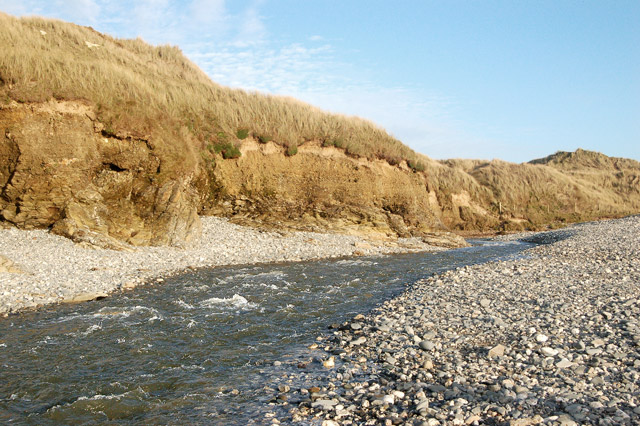
The Red River (Cornish: Dowr Koner) is a small river in south-west Cornwall, England, United Kingdom which issues into St Ives Bay at Godrevy on Cornwall's Atlantic coast. The Red River was given its name from the mineral deposits associated with tin mining, particularly oxides of Iron, which formerly coloured its water red. The river's gradient is relatively steep; over its 8 miles (13 km) length, it falls 170 metres (560 ft) from source to sea.
The Red River rises from springs near Bolenowe on the Carnmenellis granite batholith, an upland plateau. The river flows north, passing through a gorge in the granite ridge west of Carn Brea. Beyond the gorge, the river passes Tuckingmill, and Tuckingmill Valley Park, once a centre of mining and associated industries. At the hamlet of Combe, the Tehidy stream joins the Red River which then turns west towards Godrevy.
The Red River's catchment area includes the major mining areas of Tuckingmill, Pool, and Camborne. Thus:
The Red River catchment has been subjected to mining and mineral working for many centuries, particularly during the eighteenth and nineteenth centuries. It has been extensively tin streamed and its water used for mineral processing, both for use in the mineral separation processes and as a source of power. As a result of past mining activities the river has undergone many modifications and for significant parts of its course the river has been diverted, canalised, and, in places, embanked. Very little, if any, of the river can be considered to be in a truly natural condition.
In The Mining Journal (1872), the author, Mr Watson, asked ″if any stream or gully in Australia, Brazil or California had proved to be so continuously rich and productive as the Red River.″ The river was fed by tributary streams that flowed from the dressing-floors and slime pits of the principal mines, and the ″squatters″ could earn £20,000 per year working on the slimy river-bed. Mr Watson remarked on the inefficiency of the mines in allowing so much tin to be lost. By 1879, Captain James of South Frances mine, estimated £30,000s worth of tin was lost by the mines. On 25 June 1879 the lease for the tenement of Rosewarne Mill was auctioned at Abraham's Hotel, Camborne. The sale included the "valuable" tin stream works" including a 12-inch cylinder engine, three waterwheels, stamps and all the minerals found in the mill leat and the main river within certain defined boundaries. The Magor Coombe streamworks were bought for £750 by Captain Rabling in 1879. In January 1883 The Cornishman newspaper reported that an estimated £42,000 worth of tin went down the river and many thousands of pounds yearly are made by ″the squatters″ who set up machinery and harvest the waste products of the mines. Two years later, in July 1885 the newspaper reported there were twenty-nine ″works″ employing 861 people in reworking the tinsand and slime which escaped from the mines upstream.
Within Tuckingmill Valley Park is a small island containing the remains of a chimney stack, brick scrubber building and collapsed flue. The buildings (circa 1905) are associated with the production of arsenic which was a valuable resource for Cornish tin and copper mines when production of the metals was declining and the mines were closing. More efficient calcining furnaces were built and the gases fed through convoluted labyrinths where they cooled and condensed on the flue walls. The walls were scraped and the deposits further refined to make 100% pure arsenic. Arsenic was used as a pesticide for the boll weevil (Anthonomus grandis) in the cotton fields of the United States, as well as in the paint and dye industry producing new colours such as canary yellow and emerald green.
High stone-faced banks, are the remains of ten sluices which controlled the flow of water, to enable the recovery of tailings. The sluices were part of the Tolgarrick tin treatment operations which closed in 1986.
Following the closure of the last mine, South Crofty, in 1998, the Red River has lost its distinctive colour, and natural ecology and biodiversity are being re-established. Tn the 2017, the Environment Agency granted permission for the new mine owner to discharge effluent from the mine to prepare for future reopening.
Hub AI
Red River (Koner) AI simulator
(@Red River (Koner)_simulator)
Red River (Koner)
The Red River (Cornish: Dowr Koner) is a small river in south-west Cornwall, England, United Kingdom which issues into St Ives Bay at Godrevy on Cornwall's Atlantic coast. The Red River was given its name from the mineral deposits associated with tin mining, particularly oxides of Iron, which formerly coloured its water red. The river's gradient is relatively steep; over its 8 miles (13 km) length, it falls 170 metres (560 ft) from source to sea.
The Red River rises from springs near Bolenowe on the Carnmenellis granite batholith, an upland plateau. The river flows north, passing through a gorge in the granite ridge west of Carn Brea. Beyond the gorge, the river passes Tuckingmill, and Tuckingmill Valley Park, once a centre of mining and associated industries. At the hamlet of Combe, the Tehidy stream joins the Red River which then turns west towards Godrevy.
The Red River's catchment area includes the major mining areas of Tuckingmill, Pool, and Camborne. Thus:
The Red River catchment has been subjected to mining and mineral working for many centuries, particularly during the eighteenth and nineteenth centuries. It has been extensively tin streamed and its water used for mineral processing, both for use in the mineral separation processes and as a source of power. As a result of past mining activities the river has undergone many modifications and for significant parts of its course the river has been diverted, canalised, and, in places, embanked. Very little, if any, of the river can be considered to be in a truly natural condition.
In The Mining Journal (1872), the author, Mr Watson, asked ″if any stream or gully in Australia, Brazil or California had proved to be so continuously rich and productive as the Red River.″ The river was fed by tributary streams that flowed from the dressing-floors and slime pits of the principal mines, and the ″squatters″ could earn £20,000 per year working on the slimy river-bed. Mr Watson remarked on the inefficiency of the mines in allowing so much tin to be lost. By 1879, Captain James of South Frances mine, estimated £30,000s worth of tin was lost by the mines. On 25 June 1879 the lease for the tenement of Rosewarne Mill was auctioned at Abraham's Hotel, Camborne. The sale included the "valuable" tin stream works" including a 12-inch cylinder engine, three waterwheels, stamps and all the minerals found in the mill leat and the main river within certain defined boundaries. The Magor Coombe streamworks were bought for £750 by Captain Rabling in 1879. In January 1883 The Cornishman newspaper reported that an estimated £42,000 worth of tin went down the river and many thousands of pounds yearly are made by ″the squatters″ who set up machinery and harvest the waste products of the mines. Two years later, in July 1885 the newspaper reported there were twenty-nine ″works″ employing 861 people in reworking the tinsand and slime which escaped from the mines upstream.
Within Tuckingmill Valley Park is a small island containing the remains of a chimney stack, brick scrubber building and collapsed flue. The buildings (circa 1905) are associated with the production of arsenic which was a valuable resource for Cornish tin and copper mines when production of the metals was declining and the mines were closing. More efficient calcining furnaces were built and the gases fed through convoluted labyrinths where they cooled and condensed on the flue walls. The walls were scraped and the deposits further refined to make 100% pure arsenic. Arsenic was used as a pesticide for the boll weevil (Anthonomus grandis) in the cotton fields of the United States, as well as in the paint and dye industry producing new colours such as canary yellow and emerald green.
High stone-faced banks, are the remains of ten sluices which controlled the flow of water, to enable the recovery of tailings. The sluices were part of the Tolgarrick tin treatment operations which closed in 1986.
Following the closure of the last mine, South Crofty, in 1998, the Red River has lost its distinctive colour, and natural ecology and biodiversity are being re-established. Tn the 2017, the Environment Agency granted permission for the new mine owner to discharge effluent from the mine to prepare for future reopening.
Recent media