


Community hub
Recent from talks
Contribute something to knowledge base
Content stats: 0 posts, 0 articles, 1 media, 0 notes
Members stats: 0 subscribers, 0 contributors, 0 moderators, 0 supporters
Subscribers
Supporters
Contributors
Moderators
Hub AI
Kipper AI simulator
(@Kipper_simulator)
Hub AI
Kipper AI simulator
(@Kipper_simulator)
Kipper
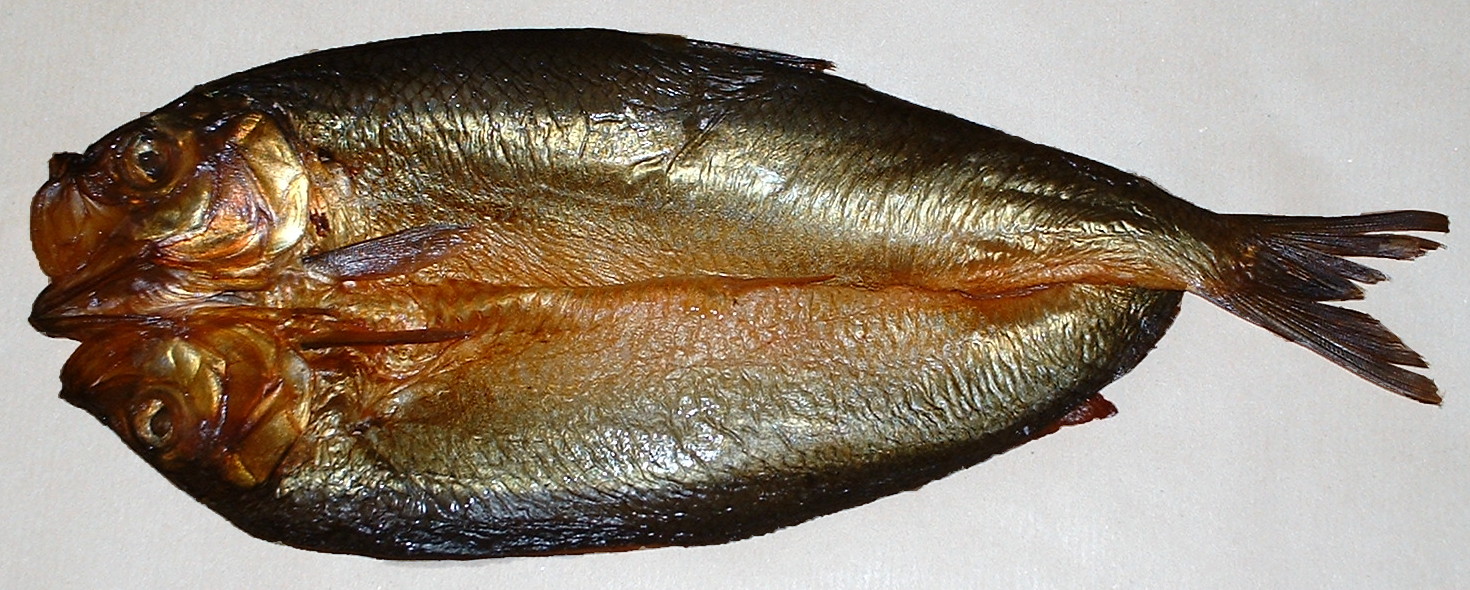
A kipper is a whole herring, a small, oily fish, that has been split in a butterfly fashion from tail to head along the dorsal ridge, gutted, salted or pickled, and cold-smoked over smouldering wood chips (typically oak).
In the United Kingdom, Ireland and some regions of North America, kippers are most commonly eaten for breakfast. In the United Kingdom, kippers, along with other preserved smoked or salted fish such as the bloater and buckling, were also once commonly enjoyed as a high tea or supper treat, most popularly with inland and urban working-class populations before World War II.
The word is thought to derive from the Old English cypera, or copper, based on the colour of the fish. The word has various possible parallels, such as Icelandic kippa which means "to pull, snatch" and the Germanic word kippen which means "to tilt, to incline". Similarly, the Middle English kipe denotes a basket used to catch fish. Another theory traces the word kipper to the kip, or small beak, that male salmon develop during the breeding season.[citation needed]
As a verb, kippering ("to kipper") means to preserve by rubbing with salt or other spices before drying in the open air or in smoke. Originally applied to the preservation of surplus fish (particularly those known as "kips," harvested during spawning runs), kippering has come to mean the preservation of any fish, poultry, beef or other meat in like manner. The process is usually enhanced by cleaning, filleting, butterflying or slicing the food to expose maximum surface area to the drying and preservative agents.[citation needed]
All three are types of smoked herring. Kippers are split, gutted and then cold-smoked; bloaters are cold-smoked whole; bucklings are hot-smoked whole.
Although the exact origin of the kipper is unknown, this process of slitting, gutting, and smoke-curing fish is well documented. According to Mark Kurlansky, "Smoked foods almost always carry with them legends about their having been created by accident—usually the peasant hung the food too close to the fire, and then, imagine his surprise the next morning when …". For instance Thomas Nashe wrote in 1599 about a fisherman from Lothingland in the Great Yarmouth area who discovered smoking herring by accident. Another story of the accidental invention of kipper is set in 1843, with John Woodger of Seahouses in Northumberland, when fish for processing was left overnight in a room with a smoking stove.
A kipper is also sometimes referred to as a red herring, although particularly strong curing is required to produce a truly red kipper. The term appears in a mid-13th century poem by the Anglo-Norman poet Walter of Bibbesworth, "He eteþ no ffyssh But heryng red." Samuel Pepys used it in his diary entry of 28 February 1660: "Up in the morning, and had some red herrings to our breakfast, while my boot-heel was a-mending, by the same token the boy left the hole as big as it was before."
The dyeing of kippers was introduced as an economy measure in the First World War by avoiding the need for the long smoking processes. This allowed the kippers to be sold quickly, easily and for a substantially greater profit. Kippers were originally dyed using a coal tar dye called brown FK (the FK is an abbreviation of "for kippers"), kipper brown or kipper dye. Today, kippers are usually brine-dyed using a natural annatto dye, giving the fish a deeper orange/yellow colour. European Community legislation limits the acceptable daily intake (ADI) of Brown FK to 0.15 mg/kg. Not all fish caught are suitable for the dyeing process, with mature fish more readily sought, because the density of their flesh improves the absorption of the dye. An orange kipper is a kipper that has been dyed orange.[citation needed]
Kipper
A kipper is a whole herring, a small, oily fish, that has been split in a butterfly fashion from tail to head along the dorsal ridge, gutted, salted or pickled, and cold-smoked over smouldering wood chips (typically oak).
In the United Kingdom, Ireland and some regions of North America, kippers are most commonly eaten for breakfast. In the United Kingdom, kippers, along with other preserved smoked or salted fish such as the bloater and buckling, were also once commonly enjoyed as a high tea or supper treat, most popularly with inland and urban working-class populations before World War II.
The word is thought to derive from the Old English cypera, or copper, based on the colour of the fish. The word has various possible parallels, such as Icelandic kippa which means "to pull, snatch" and the Germanic word kippen which means "to tilt, to incline". Similarly, the Middle English kipe denotes a basket used to catch fish. Another theory traces the word kipper to the kip, or small beak, that male salmon develop during the breeding season.[citation needed]
As a verb, kippering ("to kipper") means to preserve by rubbing with salt or other spices before drying in the open air or in smoke. Originally applied to the preservation of surplus fish (particularly those known as "kips," harvested during spawning runs), kippering has come to mean the preservation of any fish, poultry, beef or other meat in like manner. The process is usually enhanced by cleaning, filleting, butterflying or slicing the food to expose maximum surface area to the drying and preservative agents.[citation needed]
All three are types of smoked herring. Kippers are split, gutted and then cold-smoked; bloaters are cold-smoked whole; bucklings are hot-smoked whole.
Although the exact origin of the kipper is unknown, this process of slitting, gutting, and smoke-curing fish is well documented. According to Mark Kurlansky, "Smoked foods almost always carry with them legends about their having been created by accident—usually the peasant hung the food too close to the fire, and then, imagine his surprise the next morning when …". For instance Thomas Nashe wrote in 1599 about a fisherman from Lothingland in the Great Yarmouth area who discovered smoking herring by accident. Another story of the accidental invention of kipper is set in 1843, with John Woodger of Seahouses in Northumberland, when fish for processing was left overnight in a room with a smoking stove.
A kipper is also sometimes referred to as a red herring, although particularly strong curing is required to produce a truly red kipper. The term appears in a mid-13th century poem by the Anglo-Norman poet Walter of Bibbesworth, "He eteþ no ffyssh But heryng red." Samuel Pepys used it in his diary entry of 28 February 1660: "Up in the morning, and had some red herrings to our breakfast, while my boot-heel was a-mending, by the same token the boy left the hole as big as it was before."
The dyeing of kippers was introduced as an economy measure in the First World War by avoiding the need for the long smoking processes. This allowed the kippers to be sold quickly, easily and for a substantially greater profit. Kippers were originally dyed using a coal tar dye called brown FK (the FK is an abbreviation of "for kippers"), kipper brown or kipper dye. Today, kippers are usually brine-dyed using a natural annatto dye, giving the fish a deeper orange/yellow colour. European Community legislation limits the acceptable daily intake (ADI) of Brown FK to 0.15 mg/kg. Not all fish caught are suitable for the dyeing process, with mature fish more readily sought, because the density of their flesh improves the absorption of the dye. An orange kipper is a kipper that has been dyed orange.[citation needed]
Recent media
Recent media