


Community hub
Recent from talks
Contribute something
Nothing was collected or created yet.

In physics, mathematics, engineering, and related fields, a wave is a propagating dynamic disturbance (change from equilibrium) of one or more quantities. Periodic waves oscillate repeatedly about an equilibrium (resting) value at some frequency. When the entire waveform moves in one direction, it is said to be a travelling wave; by contrast, a pair of superimposed periodic waves traveling in opposite directions makes a standing wave. In a standing wave, the amplitude of vibration has nulls at some positions where the wave amplitude appears smaller or even zero.
There are two types of waves that are most commonly studied in classical physics: mechanical waves and electromagnetic waves. In a mechanical wave, stress and strain fields oscillate about a mechanical equilibrium. A mechanical wave is a local deformation (strain) in some physical medium that propagates from particle to particle by creating local stresses that cause strain in neighboring particles too. For example, sound waves are variations of the local pressure and particle motion that propagate through the medium. Other examples of mechanical waves are seismic waves, gravity waves, surface waves and string vibrations. In an electromagnetic wave (such as light), coupling between the electric and magnetic fields sustains propagation of waves involving these fields according to Maxwell's equations. Electromagnetic waves can travel through a vacuum and through some dielectric media (at wavelengths where they are considered transparent). Electromagnetic waves, as determined by their frequencies (or wavelengths), have more specific designations including radio waves, infrared radiation, terahertz waves, visible light, ultraviolet radiation, X-rays and gamma rays.
Other types of waves include gravitational waves, which are disturbances in spacetime that propagate according to general relativity; heat diffusion waves; plasma waves that combine mechanical deformations and electromagnetic fields; reaction–diffusion waves, such as in the Belousov–Zhabotinsky reaction; and many more. Mechanical and electromagnetic waves transfer energy,[1] momentum, and information, but they do not transfer particles in the medium. In mathematics and electronics waves are studied as signals.[2] On the other hand, some waves have envelopes which do not move at all such as standing waves (which are fundamental to music) and hydraulic jumps.

A physical wave field is almost always confined to some finite region of space, called its domain. For example, the seismic waves generated by earthquakes are significant only in the interior and surface of the planet, so they can be ignored outside it. However, waves with infinite domain, that extend over the whole space, are commonly studied in mathematics, and are very valuable tools for understanding physical waves in finite domains.
A plane wave is an important mathematical idealization where the disturbance is identical along any (infinite) plane normal to a specific direction of travel. Mathematically, the simplest wave is a sinusoidal plane wave in which at any point the field experiences simple harmonic motion at one frequency. In linear media, complicated waves can generally be decomposed as the sum of many sinusoidal plane waves having different directions of propagation and/or different frequencies. A plane wave is classified as a transverse wave if the field disturbance at each point is described by a vector perpendicular to the direction of propagation (also the direction of energy transfer); or longitudinal wave if those vectors are aligned with the propagation direction. Mechanical waves include both transverse and longitudinal waves; on the other hand electromagnetic plane waves are strictly transverse while sound waves in fluids (such as air) can only be longitudinal. That physical direction of an oscillating field relative to the propagation direction is also referred to as the wave's polarization, which can be an important attribute.
Definition
[edit]While waves are ubiquitous features of physical systems, no single definition adequately describes the topic. Examples and descriptions of common characteristics are used as an alternative to a single definition.[4]: 2 In abstract, waves are the dynamic manifestation of time-dependent field theory analogous to ballistics, the dynamic manifestation of particle mechanics, but this point of view misses the many visually appealing examples of waves like vibrating stringed instruments and fluid ripples.[5]: 1
Viewed microscopically, waves are changes in the value of physical property at a point in space that results from a delayed response to changes in adjacent regions. Examples of properties include pressure, temperature, height, or gravitational force. A physical medium, like vacuum, air, water, or solid rock may exhibit waves in different properties which may or may not be related. Properties like the heights spectators at a sporting event or the level of anxiety among political protestors may also be considered waves when the property depends upon delayed responds to physically adjacent events.[5]: 2
In physics, a physical quantity that has a value at points in space is called a field, so a wave is disturbance in a field resulting from delayed response to adjacent disturbances. Viewed macroscopically, a wave is the dynamic response of a field caused by effects that that can only propagate at a finite speed. Rotation of an electric dipole produce electromagnetic waves and the mutual rotation of binary stars produce gravitational waves, each of which propagate at the speed of light.[5]: 7
Periodic or sinusoidal waves are useful idealized examples, but the essential neighbor-to-neighbor interaction with delay means wave may propagate in non-linear, granular, or noisy medium which do not produce these ideal results. Temperature waves or chemical reaction waves demonstrate that waves need not be a material displacement.[5]: 10
Mathematical description
[edit]Single waves
[edit]A wave can be described as a number field, namely as a function where is a position and is a time.


The value of is a point of space, specifically in the region where the wave is defined. In mathematical terms, it is usually a vector in the Cartesian three-dimensional space . However, in many cases one can ignore one dimension, and let be a point of the Cartesian plane . This is the case, for example, when studying vibrations of a drum skin. One may even restrict to a point of the Cartesian line – that is, the set of real numbers. This is the case, for example, when studying vibrations in a violin string or recorder. The time , on the other hand, is always assumed to be a scalar; that is, a real number.


The value of can be any physical quantity of interest assigned to the point that may vary with time. For example, if represents the vibrations inside an elastic solid, the value of is usually a vector that gives the current displacement from of the material particles that would be at the point in the absence of vibration. For an electromagnetic wave, the value of can be the electric field vector , or the magnetic field vector , or any related quantity, such as the Poynting vector . In fluid dynamics, the value of could be the velocity vector of the fluid at the point , or any scalar property like pressure, temperature, or density. In a chemical reaction, could be the concentration of some substance in the neighborhood of point of the reaction medium.


For any dimension (1, 2, or 3), the wave's domain is then a subset of , such that the function value is defined for any point in . For example, when describing the motion of a drum skin, one can consider to be a disk (circle) on the plane with center at the origin , and let be the vertical displacement of the skin at the point of and at time .


Superposition
[edit]Waves of the same type are often superposed and encountered simultaneously at a given point in space and time. The properties at that point are the sum of the properties of each component wave at that point. In general, the velocities are not the same, so the wave form will change over time and space.
Wave spectrum
[edit]![[icon]](https://en.wikipedia.org/wiki/File:Wiki_letter_w_cropped.svg) | This section needs expansion with: concept summary. You can help by adding to it. (May 2023) |
Wave families
[edit]Sometimes one is interested in a single specific wave. More often, however, one needs to understand large set of possible waves; like all the ways that a drum skin can vibrate after being struck once with a drum stick, or all the possible radar echoes one could get from an airplane that may be approaching an airport.
In some of those situations, one may describe such a family of waves by a function that depends on certain parameters , besides and . Then one can obtain different waves – that is, different functions of and – by choosing different values for those parameters.



For example, the sound pressure inside a recorder that is playing a "pure" note is typically a standing wave, that can be written as

The parameter defines the amplitude of the wave (that is, the maximum sound pressure in the bore, which is related to the loudness of the note); is the speed of sound; is the length of the bore; and is a positive integer (1,2,3,...) that specifies the number of nodes in the standing wave. (The position should be measured from the mouthpiece, and the time from any moment at which the pressure at the mouthpiece is maximum. The quantity is the wavelength of the emitted note, and is its frequency.) Many general properties of these waves can be inferred from this general equation, without choosing specific values for the parameters.




As another example, it may be that the vibrations of a drum skin after a single strike depend only on the distance from the center of the skin to the strike point, and on the strength of the strike. Then the vibration for all possible strikes can be described by a function .


Sometimes the family of waves of interest has infinitely many parameters. For example, one may want to describe what happens to the temperature in a metal bar when it is initially heated at various temperatures at different points along its length, and then allowed to cool by itself in vacuum. In that case, instead of a scalar or vector, the parameter would have to be a function such that is the initial temperature at each point of the bar. Then the temperatures at later times can be expressed by a function that depends on the function (that is, a functional operator), so that the temperature at a later time is


Differential wave equations
[edit]Another way to describe and study a family of waves is to give a mathematical equation that, instead of explicitly giving the value of , only constrains how those values can change with time. Then the family of waves in question consists of all functions that satisfy those constraints – that is, all solutions of the equation.
This approach is extremely important in physics, because the constraints usually are a consequence of the physical processes that cause the wave to evolve. For example, if is the temperature inside a block of some homogeneous and isotropic solid material, its evolution is constrained by the partial differential equation

where is the heat that is being generated per unit of volume and time in the neighborhood of at time (for example, by chemical reactions happening there); are the Cartesian coordinates of the point ; is the (first) derivative of with respect to ; and is the second derivative of relative to . (The symbol "" is meant to signify that, in the derivative with respect to some variable, all other variables must be considered fixed.)


This equation can be derived from the laws of physics that govern the diffusion of heat in solid media. For that reason, it is called the heat equation in mathematics, even though it applies to many other physical quantities besides temperatures.
For another example, we can describe all possible sounds echoing within a container of gas by a function that gives the pressure at a point and time within that container. If the gas was initially at uniform temperature and composition, the evolution of is constrained by the formula

Here is some extra compression force that is being applied to the gas near by some external process, such as a loudspeaker or piston right next to .


This same differential equation describes the behavior of mechanical vibrations and electromagnetic fields in a homogeneous isotropic non-conducting solid. Note that this equation differs from that of heat flow only in that the left-hand side is , the second derivative of with respect to time, rather than the first derivative . Yet this small change makes a huge difference on the set of solutions . This differential equation is called "the" wave equation in mathematics, even though it describes only one very special kind of waves.

Wave in elastic medium
[edit]Consider a traveling transverse wave (which may be a pulse) on a string (the medium). Consider the string to have a single spatial dimension. Consider this wave as traveling


- in the direction in space. For example, let the positive direction be to the right, and the negative direction be to the left.
- with constant amplitude
- with constant velocity , where is
- independent of wavelength (no dispersion)
- independent of amplitude (linear media, not nonlinear).[6][7]
- with constant waveform, or shape


This wave can then be described by the two-dimensional functions
- (waveform traveling to the right)
- (waveform traveling to the left)



or, more generally, by d'Alembert's formula:[8] representing two component waveforms and traveling through the medium in opposite directions. A generalized representation of this wave can be obtained[9] as the partial differential equation

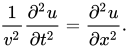
General solutions are based upon Duhamel's principle.[10]
Wave forms
[edit]
The form or shape of F in d'Alembert's formula involves the argument x − vt. Constant values of this argument correspond to constant values of F, and these constant values occur if x increases at the same rate that vt increases. That is, the wave shaped like the function F will move in the positive x-direction at velocity v (and G will propagate at the same speed in the negative x-direction).[11]
In the case of a periodic function F with period λ, that is, F(x + λ − vt) = F(x − vt), the periodicity of F in space means that a snapshot of the wave at a given time t finds the wave varying periodically in space with period λ (the wavelength of the wave). In a similar fashion, this periodicity of F implies a periodicity in time as well: F(x − v(t + T)) = F(x − vt) provided vT = λ, so an observation of the wave at a fixed location x finds the wave undulating periodically in time with period T = λ/v.[12]
Amplitude and modulation
[edit]

The amplitude of a wave may be constant (in which case the wave is a c.w. or continuous wave), or may be modulated so as to vary with time and/or position. The outline of the variation in amplitude is called the envelope of the wave. Mathematically, the modulated wave can be written in the form:[13][14][15] where is the amplitude envelope of the wave, is the wavenumber and is the phase. If the group velocity (see below) is wavelength-independent, this equation can be simplified as:[16] showing that the envelope moves with the group velocity and retains its shape. Otherwise, in cases where the group velocity varies with wavelength, the pulse shape changes in a manner often described using an envelope equation.[16][17]




Phase velocity and group velocity
[edit]
There are two velocities that are associated with waves, the phase velocity and the group velocity.
Phase velocity is the rate at which the phase of the wave propagates in space: any given phase of the wave (for example, the crest) will appear to travel at the phase velocity. The phase velocity is given in terms of the wavelength λ (lambda) and period T as


Group velocity is a property of waves that have a defined envelope, measuring propagation through space (that is, phase velocity) of the overall shape of the waves' amplitudes—modulation or envelope of the wave.
Special waves
[edit]Sine waves
[edit]
A sine wave, sinusoidal wave, or sinusoid (symbol: ∿) is a periodic wave whose waveform (shape) is the trigonometric sine function. In mechanics, as a linear motion over time, this is simple harmonic motion; as rotation, it corresponds to uniform circular motion. Sine waves occur often in physics, including wind waves, sound waves, and light waves, such as monochromatic radiation. In engineering, signal processing, and mathematics, Fourier analysis decomposes general functions into a sum of sine waves of various frequencies, relative phases, and magnitudes.
When any two sine waves of the same frequency (but arbitrary phase) are linearly combined, the result is another sine wave of the same frequency; this property is unique among periodic waves. Conversely, if some phase is chosen as a zero reference, a sine wave of arbitrary phase can be written as the linear combination of two sine waves with phases of zero and a quarter cycle, the sine and cosine components, respectively.Plane waves
[edit]A plane wave is a kind of wave whose value varies only in one spatial direction. That is, its value is constant on a plane that is perpendicular to that direction. Plane waves can be specified by a vector of unit length indicating the direction that the wave varies in, and a wave profile describing how the wave varies as a function of the displacement along that direction () and time (). Since the wave profile only depends on the position in the combination , any displacement in directions perpendicular to cannot affect the value of the field.


Plane waves are often used to model electromagnetic waves far from a source. For electromagnetic plane waves, the electric and magnetic fields themselves are transverse to the direction of propagation, and also perpendicular to each other.
Standing waves
[edit]
A standing wave, also known as a stationary wave, is a wave whose envelope remains in a constant position. This phenomenon arises as a result of interference between two waves traveling in opposite directions.
The sum of two counter-propagating waves (of equal amplitude and frequency) creates a standing wave. Standing waves commonly arise when a boundary blocks further propagation of the wave, thus causing wave reflection, and therefore introducing a counter-propagating wave. For example, when a violin string is displaced, transverse waves propagate out to where the string is held in place at the bridge and the nut, where the waves are reflected back. At the bridge and nut, the two opposed waves are in antiphase and cancel each other, producing a node. Halfway between two nodes there is an antinode, where the two counter-propagating waves enhance each other maximally. There is no net propagation of energy over time.
-
 One-dimensional standing waves; the fundamental mode and the first 5 overtones
 -
 A two-dimensional standing wave on a disk; this is the fundamental mode.
 -
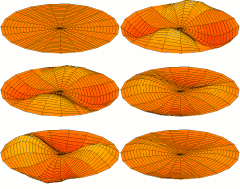 A standing wave on a disk with two nodal lines crossing at the center; this is an overtone.


Solitary waves
[edit]
A soliton or solitary wave is a self-reinforcing wave packet that maintains its shape while it propagates at a constant velocity. Solitons are caused by a cancellation of nonlinear and dispersive effects in the medium. (Dispersive effects are a property of certain systems where the speed of a wave depends on its frequency.) Solitons are the solutions of a widespread class of weakly nonlinear dispersive partial differential equations describing physical systems.
Physical properties
[edit]Propagation
[edit]Wave propagation is any of the ways in which waves travel. With respect to the direction of the oscillation relative to the propagation direction, we can distinguish between longitudinal wave and transverse waves.
Electromagnetic waves propagate in vacuum as well as in material media. Propagation of other wave types such as sound may occur only in a transmission medium.
Reflection of plane waves in a half-space
[edit]The propagation and reflection of plane waves—e.g. Pressure waves (P wave) or Shear waves (SH or SV-waves) are phenomena that were first characterized within the field of classical seismology, and are now considered fundamental concepts in modern seismic tomography. The analytical solution to this problem exists and is well known. The frequency domain solution can be obtained by first finding the Helmholtz decomposition of the displacement field, which is then substituted into the wave equation. From here, the plane wave eigenmodes can be calculated.[citation needed][clarification needed]
SV wave propagation
[edit]

The analytical solution of SV-wave in a half-space indicates that the plane SV wave reflects back to the domain as a P and SV waves, leaving out special cases. The angle of the reflected SV wave is identical to the incidence wave, while the angle of the reflected P wave is greater than the SV wave. For the same wave frequency, the SV wavelength is smaller than the P wavelength. This fact has been depicted in this animated picture.[18]
P wave propagation
[edit]Similar to the SV wave, the P incidence, in general, reflects as the P and SV wave. There are some special cases where the regime is different.[clarification needed]
Wave velocity
[edit]
Wave velocity is a general concept, of various kinds of wave velocities, for a wave's phase and speed concerning energy (and information) propagation. The phase velocity is given as: where:

- vp is the phase velocity (with SI unit m/s),
- ω is the angular frequency (with SI unit rad/s),
- k is the wavenumber (with SI unit rad/m).
The phase speed gives you the speed at which a point of constant phase of the wave will travel for a discrete frequency. The angular frequency ω cannot be chosen independently from the wavenumber k, but both are related through the dispersion relationship:

In the special case Ω(k) = ck, with c a constant, the waves are called non-dispersive, since all frequencies travel at the same phase speed c. For instance electromagnetic waves in vacuum are non-dispersive. In case of other forms of the dispersion relation, we have dispersive waves. The dispersion relationship depends on the medium through which the waves propagate and on the type of waves (for instance electromagnetic, sound or water waves).
The speed at which a resultant wave packet from a narrow range of frequencies will travel is called the group velocity and is determined from the gradient of the dispersion relation:

In almost all cases, a wave is mainly a movement of energy through a medium. Most often, the group velocity is the velocity at which the energy moves through this medium.

Waves exhibit common behaviors under a number of standard situations, for example:
Transmission and media
[edit]Waves normally move in a straight line (that is, rectilinearly) through a transmission medium. Such media can be classified into one or more of the following categories:
- A bounded medium if it is finite in extent, otherwise an unbounded medium
- A linear medium if the amplitudes of different waves at any particular point in the medium can be added
- A uniform medium or homogeneous medium if its physical properties are unchanged at different locations in space
- An anisotropic medium if one or more of its physical properties differ in one or more directions
- An isotropic medium if its physical properties are the same in all directions
Absorption
[edit]Waves are usually defined in media which allow most or all of a wave's energy to propagate without loss. However materials may be characterized as "lossy" if they remove energy from a wave, usually converting it into heat. This is termed "absorption." A material which absorbs a wave's energy, either in transmission or reflection, is characterized by a refractive index which is complex. The amount of absorption will generally depend on the frequency (wavelength) of the wave, which, for instance, explains why objects may appear colored.
Reflection
[edit]When a wave strikes a reflective surface, it changes direction, such that the angle made by the incident wave and line normal to the surface equals the angle made by the reflected wave and the same normal line.
Refraction
[edit]
Refraction is the phenomenon of a wave changing its speed. Mathematically, this means that the size of the phase velocity changes. Typically, refraction occurs when a wave passes from one medium into another. The amount by which a wave is refracted by a material is given by the refractive index of the material. The directions of incidence and refraction are related to the refractive indices of the two materials by Snell's law.
Diffraction
[edit]A wave exhibits diffraction when it encounters an obstacle that bends the wave or when it spreads after emerging from an opening. Diffraction effects are more pronounced when the size of the obstacle or opening is comparable to the wavelength of the wave.
Interference
[edit]
When waves in a linear medium (the usual case) cross each other in a region of space, they do not actually interact with each other, but continue on as if the other one were not present. However at any point in that region the field quantities describing those waves add according to the superposition principle. If the waves are of the same frequency in a fixed phase relationship, then there will generally be positions at which the two waves are in phase and their amplitudes add, and other positions where they are out of phase and their amplitudes (partially or fully) cancel. This is called an interference pattern.
Polarization
[edit]
The phenomenon of polarization arises when wave motion can occur simultaneously in two orthogonal directions. Transverse waves can be polarized, for instance. When polarization is used as a descriptor without qualification, it usually refers to the special, simple case of linear polarization. A transverse wave is linearly polarized if it oscillates in only one direction or plane. In the case of linear polarization, it is often useful to add the relative orientation of that plane, perpendicular to the direction of travel, in which the oscillation occurs, such as "horizontal" for instance, if the plane of polarization is parallel to the ground. Electromagnetic waves propagating in free space, for instance, are transverse; they can be polarized by the use of a polarizing filter.
Longitudinal waves, such as sound waves, do not exhibit polarization. For these waves there is only one direction of oscillation, that is, along the direction of travel.
Dispersion
[edit]
Dispersion is the frequency dependence of the refractive index, a consequence of the atomic nature of materials.[19]: 67 A wave undergoes dispersion when either the phase velocity or the group velocity depends on the wave frequency. Dispersion is seen by letting white light pass through a prism, the result of which is to produce the spectrum of colors of the rainbow. Isaac Newton was the first to recognize that this meant that white light was a mixture of light of different colors.[19]: 190
Doppler effect
[edit]The Doppler effect or Doppler shift is the change in frequency of a wave in relation to an observer who is moving relative to the wave source.[20] It is named after the Austrian physicist Christian Doppler, who described the phenomenon in 1842.
Mechanical waves
[edit]A mechanical wave is an oscillation of matter, and therefore transfers energy through a medium.[21] While waves can move over long distances, the movement of the medium of transmission—the material—is limited. Therefore, the oscillating material does not move far from its initial position. Mechanical waves can be produced only in media which possess elasticity and inertia. There are three types of mechanical waves: transverse waves, longitudinal waves, and surface waves.
Waves on strings
[edit]The transverse vibration of a string is a function of tension and inertia, and is constrained by the length of the string as the ends are fixed. This constraint limits the steady state modes that are possible, and thereby the frequencies. The speed of a transverse wave traveling along a vibrating string (v) is directly proportional to the square root of the tension of the string (T) over the linear mass density (μ):

where the linear density μ is the mass per unit length of the string.
Acoustic waves
[edit]Acoustic or sound waves are compression waves that propagate through gases, liquids, solids and plasmas. They travel at the speed given by:

or the square root of the adiabatic bulk modulus divided by the ambient density of the medium (see speed of sound).
Gravity waves
[edit]
Gravity waves are waves generated in a fluid medium or at the interface between two media when the force of gravity or buoyancy works to restore equilibrium. Surface waves on water are the most familiar example.
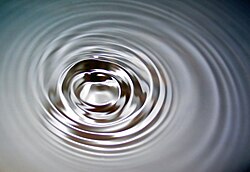
- Ripples on the surface of a pond are actually a combination of transverse and longitudinal waves; therefore, the points on the surface follow orbital paths.
- Inertial waves, which occur in rotating fluids and are restored by the Coriolis effect.
- Ocean surface waves, which are perturbations that propagate through water.
Body waves
[edit]Body waves travel through the interior of the medium along paths controlled by the material properties in terms of density and modulus (stiffness). The density and modulus, in turn, vary according to temperature, composition, and material phase. This effect resembles the refraction of light waves. Two types of particle motion result in two types of body waves: Primary and Secondary waves.
Seismic waves
[edit]Seismic waves are waves of energy that travel through the Earth's layers, and are a result of earthquakes, volcanic eruptions, magma movement, large landslides and large man-made explosions that give out low-frequency acoustic energy. They include body waves—the primary (P waves) and secondary waves (S waves)—and surface waves, such as Rayleigh waves, Love waves, and Stoneley waves.
Shock waves
[edit]
A shock wave is a type of propagating disturbance. When a wave moves faster than the local speed of sound in a fluid, it is a shock wave. Like an ordinary wave, a shock wave carries energy and can propagate through a medium; however, it is characterized by an abrupt, nearly discontinuous change in pressure, temperature and density of the medium.[22]
Shear waves
[edit]Shear waves are body waves due to shear rigidity and inertia. They can only be transmitted through solids and to a lesser extent through liquids with a sufficiently high viscosity.
Gravitational waves
[edit]
Gravitational waves also travel through space. The first observation of gravitational waves was announced on 11 February 2016.[23] Gravitational waves are disturbances in the curvature of spacetime, predicted by Einstein's theory of general relativity.
Other
[edit]- Waves of traffic, that is, propagation of different densities of motor vehicles, and so forth, which can be modeled as kinematic waves[24][25]
- Metachronal wave refers to the appearance of a traveling wave produced by coordinated sequential actions.
Electromagnetic waves
[edit]
An electromagnetic wave consists of two waves that are oscillations of the electric and magnetic fields. An electromagnetic wave travels in a direction that is at right angles to the oscillation direction of both fields. In the 19th century, James Clerk Maxwell showed that, in vacuum, the electric and magnetic fields satisfy the wave equation both with speed equal to that of the speed of light. From this emerged the idea that light is an electromagnetic wave. The unification of light and electromagnetic waves was experimentally confirmed by Hertz in the end of the 1880s. Electromagnetic waves can have different frequencies (and thus wavelengths), and are classified accordingly in wavebands, such as radio waves, microwaves, infrared, visible light, ultraviolet, X-rays, and gamma rays. The range of frequencies in each of these bands is continuous, and the limits of each band are mostly arbitrary, with the exception of visible light, which must be visible to the normal human eye.
Quantum mechanical waves
[edit]Schrödinger equation
[edit]The Schrödinger equation describes the wave-like behavior of particles in quantum mechanics. Solutions of this equation are wave functions which can be used to describe the probability density of a particle.
Dirac equation
[edit]The Dirac equation is a relativistic wave equation detailing electromagnetic interactions. Dirac waves accounted for the fine details of the hydrogen spectrum in a completely rigorous way. The wave equation also implied the existence of a new form of matter, antimatter, previously unsuspected and unobserved and which was experimentally confirmed. In the context of quantum field theory, the Dirac equation is reinterpreted to describe quantum fields corresponding to spin-1⁄2 particles.
.gif)
de Broglie waves
[edit]Louis de Broglie postulated that all particles with momentum have a wavelength

where h is the Planck constant, and p is the magnitude of the momentum of the particle. This hypothesis was at the basis of quantum mechanics. Nowadays, this wavelength is called the de Broglie wavelength. For example, the electrons in a CRT display have a de Broglie wavelength of about 10−13 m.
A wave representing such a particle traveling in the k-direction is expressed by the wave function as follows:

where the wavelength is determined by the wave vector k as:

and the momentum by:

However, a wave like this with definite wavelength is not localized in space, and so cannot represent a particle localized in space. To localize a particle, de Broglie proposed a superposition of different wavelengths ranging around a central value in a wave packet,[27] a waveform often used in quantum mechanics to describe the wave function of a particle. In a wave packet, the wavelength of the particle is not precise, and the local wavelength deviates on either side of the main wavelength value.
In representing the wave function of a localized particle, the wave packet is often taken to have a Gaussian shape and is called a Gaussian wave packet.[28][29][30] Gaussian wave packets also are used to analyze water waves.[31]
For example, a Gaussian wavefunction ψ might take the form:[32]

at some initial time t = 0, where the central wavelength is related to the central wave vector k0 as λ0 = 2π / k0. It is well known from the theory of Fourier analysis,[33] or from the Heisenberg uncertainty principle (in the case of quantum mechanics) that a narrow range of wavelengths is necessary to produce a localized wave packet, and the more localized the envelope, the larger the spread in required wavelengths. The Fourier transform of a Gaussian is itself a Gaussian.[34] Given the Gaussian:
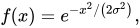
the Fourier transform is:
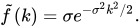
The Gaussian in space therefore is made up of waves:
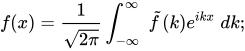
that is, a number of waves of wavelengths λ such that kλ = 2 π.
The parameter σ decides the spatial spread of the Gaussian along the x-axis, while the Fourier transform shows a spread in wave vector k determined by 1/σ. That is, the smaller the extent in space, the larger the extent in k, and hence in λ = 2π/k.
See also
[edit]Waves in general
[edit]- Mechanical wave, in media transmission
- Wave equation, general
- Wave interference, a phenomenon in which two waves superpose to form a resultant wave
- Wave Motion (journal), a scientific journal
- Wavefront, an advancing surface of wave propagation
Parameters
[edit]- Frequency
- Phase (waves), offset or angle of a sinusoidal wave function at its origin
- Standing wave ratio, in telecommunications
- Wavelength
- Wavenumber
Waveforms
[edit]- Creeping wave, a wave diffracted around a sphere
- Evanescent field
- Longitudinal wave
- Periodic travelling wave
- Sine wave
- Square wave
- Standing wave
- Transverse wave
Electromagnetic waves
[edit]- Dyakonov surface wave
- Dyakonov–Voigt wave
- Earth–ionosphere waveguide, in radio transmission
- Electromagnetic radiation
- Electromagnetic wave equation, describes electromagnetic wave propagation
- Microwave, a form of electromagnetic radiation
In fluids
[edit]- Airy wave theory, in fluid dynamics
- Capillary wave, in fluid dynamics
- Cnoidal wave, in fluid dynamics
- Edge wave, a surface gravity wave fixed by refraction against a rigid boundary
- Faraday wave, a type of wave in liquids
- Gravity wave, in fluid dynamics
- Internal wave, a wave within a fluid medium
- Shock wave, in aerodynamics
- Sound wave, a wave of sound through a medium such as air or water
- Tidal wave, a scientifically incorrect name for a tsunami
- Tollmien–Schlichting wave, in fluid dynamics
- Wind wave
In quantum mechanics
[edit]- Bloch's theorem
- Matter wave
- Pilot wave theory, in Bohmian mechanics
- Wave function
- Wave packet
- Wave–particle duality
In relativity
[edit]- Gravitational wave, in relativity theory
- Relativistic wave equations, wave equations that consider special relativity
- pp-wave spacetime, a set of exact solutions to Einstein's field equation
Other specific types of waves
[edit]- Alfvén wave, in plasma physics
- Atmospheric wave, a periodic disturbance in the fields of atmospheric variables
- Fir wave, a forest configuration
- Lamb waves, in solid materials
- Rayleigh wave, surface acoustic waves that travel on solids
- Spin wave, in magnetism
- Spin density wave, in solid materials
- Trojan wave packet, in particle science
- Waves in plasmas, in plasma physics
Related topics
[edit]- Absorption (electromagnetic radiation)
- Antenna (radio)
- Beat (acoustics)
- Branched flow
- Cymatics
- Diffraction
- Dispersion (water waves)
- Doppler effect
- Envelope detector
- Fourier transform for computing periodicity in evenly spaced data
- Group velocity
- Harmonic
- Huygens–Fresnel principle
- Index of wave articles
- Inertial wave
- Least-squares spectral analysis for computing periodicity in unevenly spaced data
- List of waves named after people
- Phase velocity
- Photon
- Polarization (physics)
- Propagation constant
- Radio propagation
- Ray (optics)
- Reaction–diffusion system
- Reflection (physics)
- Refraction
- Resonance
- Ripple tank
- Rogue wave
- Scattering
- Shallow water equations
- Shive wave machine
- Sound
- Standing wave
- Transmission medium
- Velocity factor
- Wave equation
- Wave power
- Wave turbulence
- Wind wave
- Wind wave#Formation
References
[edit]- ^ (Hall 1980, p. 8)
- ^ Pragnan Chakravorty, "What Is a Signal? [Lecture Notes]", IEEE Signal Processing Magazine, vol. 35, no. 5, pp. 175–177, Sept. 2018. doi:10.1109/MSP.2018.2832195
- ^ Santos, Edgar; Schöll, Michael; Sánchez-Porras, Renán; Dahlem, Markus A.; Silos, Humberto; Unterberg, Andreas; Dickhaus, Hartmut; Sakowitz, Oliver W. (2014-10-01). "Radial, spiral and reverberating waves of spreading depolarization occur in the gyrencephalic brain". NeuroImage. 99: 244–255. doi:10.1016/j.neuroimage.2014.05.021. ISSN 1095-9572. PMID 24852458. S2CID 1347927.
- ^ Billingham, J.; King, A. C. (2001). Wave Motion (1 ed.). Cambridge University Press. doi:10.1017/cbo9780511841033. ISBN 978-0-521-63257-7.
- ^ a b c d Freegarde, Tim (2012). Introduction to the Physics of Waves (1 ed.). Cambridge University Press. doi:10.1017/cbo9781139048149. ISBN 978-0-521-19757-1.
- ^ Michael A. Slawinski (2003). "Wave equations". Seismic waves and rays in elastic media. Elsevier. pp. 131 ff. ISBN 978-0-08-043930-3.
- ^ Lev A. Ostrovsky & Alexander I. Potapov (2001). Modulated waves: theory and application. Johns Hopkins University Press. ISBN 978-0-8018-7325-6.
- ^ Graaf, Karl F (1991). Wave motion in elastic solids (Reprint of Oxford 1975 ed.). Dover. pp. 13–14. ISBN 978-0-486-66745-4.
- ^ For an example derivation, see the steps leading up to eq. (17) in Redfern, Francis. "Kinematic Derivation of the Wave Equation". Physics Journal. Archived from the original on 2013-07-24. Retrieved 2012-12-11.
- ^ Jalal M. Ihsan Shatah; Michael Struwe (2000). "The linear wave equation". Geometric wave equations. American Mathematical Society Bookstore. pp. 37ff. ISBN 978-0-8218-2749-9.
- ^ Louis Lyons (1998). All you wanted to know about mathematics but were afraid to ask. Cambridge University Press. pp. 128 ff. ISBN 978-0-521-43601-4.
- ^ McPherson, Alexander (2009). "Waves and their properties". Introduction to Macromolecular Crystallography (2 ed.). Wiley. p. 77. ISBN 978-0-470-18590-2.
- ^ Christian Jirauschek (2005). FEW-cycle Laser Dynamics and Carrier-envelope Phase Detection. Cuvillier Verlag. p. 9. ISBN 978-3-86537-419-6.
- ^ Fritz Kurt Kneubühl (1997). Oscillations and waves. Springer. p. 365. ISBN 978-3-540-62001-3.
- ^ Mark Lundstrom (2000). Fundamentals of carrier transport. Cambridge University Press. p. 33. ISBN 978-0-521-63134-1.
- ^ a b Chin-Lin Chen (2006). "§13.7.3 Pulse envelope in nondispersive media". Foundations for guided-wave optics. Wiley. p. 363. ISBN 978-0-471-75687-3.
- ^ Longhi, Stefano; Janner, Davide (2008). "Localization and Wannier wave packets in photonic crystals". In Hugo E. Hernández-Figueroa; Michel Zamboni-Rached; Erasmo Recami (eds.). Localized Waves. Wiley-Interscience. p. 329. ISBN 978-0-470-10885-7.
- ^ The animations are taken from Poursartip, Babak (2015). "Topographic amplification of seismic waves". UT Austin. Archived from the original on 2017-01-09. Retrieved 2023-02-24.
- ^ a b Hecht, Eugene (1998). Optics (3 ed.). Reading, Mass. Harlow: Addison-Wesley. ISBN 978-0-201-83887-9.
- ^ Giordano, Nicholas (2009). College Physics: Reasoning and Relationships. Cengage Learning. pp. 421–424. ISBN 978-0534424718.
- ^ Giancoli, D. C. (2009) Physics for scientists & engineers with modern physics (4th ed.). Upper Saddle River, N.J.: Pearson Prentice Hall.
- ^ Anderson, John D. Jr. (January 2001) [1984], Fundamentals of Aerodynamics (3rd ed.), McGraw-Hill Science/Engineering/Math, ISBN 978-0-07-237335-6
- ^ "Gravitational waves detected for 1st time, 'opens a brand new window on the universe'". Canadian Broadcasting Corporation. 11 February 2016.
- ^ M.J. Lighthill; G.B. Whitham (1955). "On kinematic waves. II. A theory of traffic flow on long crowded roads". Proceedings of the Royal Society of London. Series A. 229 (1178): 281–345. Bibcode:1955RSPSA.229..281L. CiteSeerX 10.1.1.205.4573. doi:10.1098/rspa.1955.0088. S2CID 18301080.
- ^ P.I. Richards (1956). "Shockwaves on the highway". Operations Research. 4 (1): 42–51. doi:10.1287/opre.4.1.42.
- ^ A.T. Fromhold (1991). "Wave packet solutions". Quantum Mechanics for Applied Physics and Engineering (Reprint of Academic Press 1981 ed.). Courier Dover Publications. pp. 59 ff. ISBN 978-0-486-66741-6.
(p. 61) ...the individual waves move more slowly than the packet and therefore pass back through the packet as it advances
- ^ Ming Chiang Li (1980). "Electron Interference". In L. Marton; Claire Marton (eds.). Advances in Electronics and Electron Physics. Vol. 53. Academic Press. p. 271. ISBN 978-0-12-014653-6.
- ^ Walter Greiner; D. Allan Bromley (2007). Quantum Mechanics (2 ed.). Springer. p. 60. ISBN 978-3-540-67458-0.
- ^ John Joseph Gilman (2003). Electronic basis of the strength of materials. Cambridge University Press. p. 57. ISBN 978-0-521-62005-5.
- ^ Donald D. Fitts (1999). Principles of quantum mechanics. Cambridge University Press. p. 17. ISBN 978-0-521-65841-6.
- ^ Chiang C. Mei (1989). The applied dynamics of ocean surface waves (2nd ed.). World Scientific. p. 47. ISBN 978-9971-5-0789-3.
- ^ Greiner, Walter; Bromley, D. Allan (2007). Quantum Mechanics (2nd ed.). Springer. p. 60. ISBN 978-3-540-67458-0.
- ^ Siegmund Brandt; Hans Dieter Dahmen (2001). The picture book of quantum mechanics (3rd ed.). Springer. p. 23. ISBN 978-0-387-95141-6.
- ^ Cyrus D. Cantrell (2000). Modern mathematical methods for physicists and engineers. Cambridge University Press. p. 677. ISBN 978-0-521-59827-9.
Sources
[edit]- Fleisch, D.; Kinnaman, L. (2015). A student's guide to waves. Cambridge: Cambridge University Press. Bibcode:2015sgw..book.....F. ISBN 978-1107643260.
- Campbell, Murray; Greated, Clive (2001). The musician's guide to acoustics (Repr. ed.). Oxford: Oxford University Press. ISBN 978-0198165057.
- French, A.P. (1971). Vibrations and Waves (M.I.T. Introductory physics series). Nelson Thornes. ISBN 978-0-393-09936-2. OCLC 163810889.
- Hall, D.E. (1980). Musical Acoustics: An Introduction. Belmont, CA: Wadsworth Publishing Company. ISBN 978-0-534-00758-4..
- Hunt, Frederick Vinton (1978). Origins in acoustics. Woodbury, NY: Published for the Acoustical Society of America through the American Institute of Physics. ISBN 978-0300022209.
- Ostrovsky, L.A.; Potapov, A.S. (1999). Modulated Waves, Theory and Applications. Baltimore: The Johns Hopkins University Press. ISBN 978-0-8018-5870-3..
- Griffiths, G.; Schiesser, W.E. (2010). Traveling Wave Analysis of Partial Differential Equations: Numerical and Analytical Methods with Matlab and Maple. Academic Press. ISBN 9780123846532.
- Crawford jr., Frank S. (1968). Waves (Berkeley Physics Course, Vol. 3), McGraw-Hill, ISBN 978-0070048607 Free online version
- A. E. H. Love (1944). A Treatise on The Mathematical Theory of Elasticity. New York: Dover.
- E.W. Weisstein. "Wave velocity". ScienceWorld. Retrieved 2009-05-30.
External links
[edit] Definitions from Wiktionary
 Media from Commons
 Quotations from Wikiquote


- The Feynman Lectures on Physics: Waves
- Linear and nonlinear waves
- Science Aid: Wave properties – Concise guide aimed at teens Archived 2019-09-04 at the Wayback Machine
- "AT&T Archives: Similiarities of Wave Behavior" demonstrated by J.N. Shive of Bell Labs (video on YouTube)
| Patterns | .jpg) | |
|---|---|---|
| Causes | ||
| People | ||
| Related | ||
| International | |
|---|---|
| National | |
| Other | |

Mathematical Description
Single Waves
A wave is defined as a propagating disturbance of one or more quantities, such as pressure or electric field, that transfers energy through a medium or space without the net transport of matter.[10] Early conceptualizations of waves as propagating disturbances trace back to the late 17th century, when Christiaan Huygens proposed a wave model for light propagation through an all-pervading aether, detailed in his 1690 treatise Traité de la Lumière.[11] In the 18th century, Leonhard Euler advanced this framework by developing a mathematical theory of light as longitudinal vibrations in the aether, influencing subsequent optics and mechanics.[12] The general form of a one-dimensional progressive sinusoidal wave propagating in the positive x-direction is given by where represents the wave's displacement at position and time . Here, is the amplitude, the maximum magnitude of the displacement from equilibrium. The wave number characterizes the spatial periodicity, with , where is the wavelength. The angular frequency describes the temporal oscillation, with , where is the frequency, is the period, and . The phase is a constant that determines the wave's initial position relative to the origin. The wave speed is given by . The wavelength and period follow directly from the periodic nature of the sine function, which repeats every radians in its argument. For the spatial part, a change in by advances the phase by , yielding and thus . Similarly, for the temporal part, a change in by advances by , so and . This single-wave form serves as the fundamental building block, upon which more complex patterns arise through superposition of multiple such waves.[13]Superposition Principle
The superposition principle states that when two or more waves propagate simultaneously through the same medium, the resultant displacement at any point is the algebraic sum of the individual displacements produced by each wave independently.[14] This principle holds because waves do not interact destructively with one another but pass through each other unchanged, with their effects simply adding linearly.[15] The mathematical foundation of the superposition principle derives from the linearity of the wave equation, which governs the propagation of many classical waves. Consider the one-dimensional wave equation: where is the displacement and is the wave speed. If and are two solutions satisfying this equation, then their sum also satisfies it, as the second partial derivatives are linear operators: This additivity extends to any finite linear combination of solutions, establishing the principle for linear systems.[16][17] A classic example of the superposition principle in action is the formation of beats, which occur when two waves of nearly identical frequencies and (where is small) but the same amplitude overlap. For two sinusoidal waves with frequencies and , the resultant wave has an amplitude that varies periodically with a beat frequency equal to , producing audible pulsations in sound waves. This phenomenon is commonly observed when tuning musical instruments, such as two nearby piano keys sounding together.[15][18] Another important example of the superposition principle is the formation of standing waves. These occur when two waves of identical amplitude, frequency, and wavelength propagate in opposite directions. Their superposition produces a stationary pattern with nodes (points of zero displacement) and antinodes (points of maximum displacement). The displacement is expressed as where is the amplitude of each traveling wave. Standing waves are essential in systems exhibiting resonance, such as vibrating strings and air columns.[14] The superposition principle applies only to linear media and waves with small amplitudes relative to their wavelengths; it breaks down in nonlinear regimes where wave interactions alter the medium's response. In such cases, like the propagation of intense sound waves in air, the waves steepen and form shock fronts, where the simple algebraic addition no longer holds and new frequencies are generated through nonlinear coupling.[19][20] This limitation is evident in applications such as sonic booms, where superposition fails to predict the discontinuous wave profile.[21]Wave Equation
The wave equation is a fundamental partial differential equation that describes the propagation of waves in various media, such as mechanical vibrations in elastic solids or strings. In its one-dimensional form, it governs the transverse displacement of a medium along a line, where is position and is time. This equation arises from applying fundamental physical principles to idealized models of wave-supporting systems.[22] The one-dimensional wave equation is derived by considering a small segment of an elastic string under uniform tension with linear mass density . For a segment of length at position , the net vertical force due to tension at the ends is approximately , assuming small displacements where . By Newton's second law, this force equals the mass times acceleration: . Taking the limit as yields the wave equation: where is the wave speed. This derivation applies to elastic media like taut strings, capturing the balance between inertial forces and restoring tension.[22] The historical development of the wave equation traces to Jean le Rond d'Alembert, who in 1747 derived and solved it for the vibrating string problem in his work Réflexions sur la cause générale des vents. D'Alembert postulated the general solution using arbitrary functions, marking the first use of partial differential equations in mathematics and resolving the string's motion as superpositions of traveling waves. This breakthrough sparked debates with Euler and Bernoulli on solution forms, influencing the evolution of analysis; notably, it laid groundwork for separation of variables, which Joseph Fourier later expanded in 1822 for heat conduction, leading to Fourier series as a tool for representing arbitrary initial conditions in wave problems.[23] The wave equation generalizes to three dimensions for isotropic elastic media by applying Newton's second law to the displacement vector , where . Starting from the equation of motion and the isotropic stress-strain relation (with Lamé constants ), substitution yields Navier's equation: Decomposing into scalar (P-wave) and vector (S-wave) potentials and satisfies the scalar wave equations: with speeds and . For anisotropic media, the constitutive relation becomes with up to 21 independent elastic constants , leading to a more complex system without simple scalar forms, where wave speeds vary with direction.[24] Solving the wave equation requires specifying boundary conditions, which constrain the solution at domain edges, and initial value problems, which set the state at . Common boundary conditions include Dirichlet ( on fixed ends) or Neumann ( on free ends), ensuring physical realism like clamped or loose boundaries. For the initial value problem on a finite interval , one specifies the initial displacement and velocity , allowing determination of the full time evolution via methods like d'Alembert's formula or separation of variables. These conditions guarantee uniqueness and stability of solutions in well-posed problems.[25]Dispersion Relation
The dispersion relation specifies the connection between a wave's angular frequency and its wave number , typically written as . This relation arises from the underlying equations governing wave propagation in a given medium and dictates how different spatial and temporal scales interact.[26] In non-dispersive media, the dispersion relation takes the simple linear form , where is a constant representing the phase velocity . Under this condition, all frequency components of a wave travel at the same speed, preserving the shape of wave packets without spreading. This behavior is characteristic of waves in uniform media where the propagation speed does not depend on wavelength or frequency.[27] In dispersive media, the relation is nonlinear, causing the phase velocity to vary with and leading to the separation of wave components. A more standard dispersive example for surface gravity waves in deep water is , with the gravitational acceleration, which similarly causes pulse broadening by allowing longer waves to travel ahead of shorter ones.[28] The dispersion relation can be derived mathematically from the wave equation by assuming a plane-wave solution and incorporating assumptions about speed variation. Consider the one-dimensional wave equation for a non-dispersive case: where is the wave displacement and is constant. Substituting a trial solution yields or (taking the positive root for propagating waves). To obtain a dispersive relation, assume the propagation speed varies with frequency or wave number, modifying the equation to reflect medium-specific responses, such as frequency-dependent . For instance, if for some constant , the relation becomes ; this form emerges in systems where restoring forces scale quadratically with wave number, leading to the observed pulse spreading in dispersive propagation.[29] Such derivations highlight how deviations from constant speed introduce frequency dependence, fundamentally altering wave behavior.[30]Physical Properties in Media
Wave Propagation
Wave propagation refers to the mechanism by which disturbances in a medium travel from one point to another, maintaining their oscillatory nature while advancing in a specific direction. In many physical contexts, such as acoustics, electromagnetism, and mechanics, waves are modeled using solutions to the wave equation that describe their directional travel through space.[31] A fundamental solution to the wave equation in three dimensions is the plane wave, which represents a wave with wavefronts that are infinite parallel planes perpendicular to the direction of propagation. The mathematical form of a monochromatic plane wave is given by where is the complex amplitude, is the wave vector (with magnitude pointing in the propagation direction), is the position vector, is the angular frequency, and is time. This form satisfies the wave equation in homogeneous media and illustrates unidirectional propagation along .[32][33] Plane waves are idealized for far-field approximations but serve as building blocks for more complex wave patterns via superposition. For waves emanating from localized sources, such as a point source in three dimensions, the propagating disturbance approximates a spherical wave, where wavefronts form expanding spheres centered on the source. The wave function for a spherical wave decreases in amplitude as (with the radial distance) to conserve energy, given by . In two dimensions, a line source produces cylindrical waves with wavefronts as expanding cylinders and amplitude decaying as . These forms are exact solutions in free space and approximate real-world radiation from compact oscillators, like sound from a speaker or light from a bulb.[34][35] The evolution of wavefronts during propagation is elegantly described by the Huygens-Fresnel principle, which posits that every point on a wavefront acts as a source of secondary spherical wavelets, and the new wavefront is the envelope of these wavelets after a short time interval. This principle explains how plane waves remain planar and spherical waves expand radially, incorporating diffraction effects implicitly through interference of the secondary waves. It provides a geometric optics foundation for understanding wave advancement in homogeneous media.[36][37] In lossless media, where no energy dissipation occurs, waves propagate stably with constant amplitude and shape, preserving their form indefinitely. However, in absorbing media, interactions with the medium cause exponential decay in amplitude, leading to attenuation along the propagation path and setting the stage for energy loss mechanisms.[38][39]Velocity Measures
In wave propagation, two fundamental velocity measures describe the motion of wave components: phase velocity and group velocity. These concepts are crucial for distinguishing between the speed of individual wave crests and the overall transport of wave energy or information.[18] Phase velocity, denoted , is the speed at which a surface of constant phase propagates through the medium. For a monochromatic plane wave described by , where is the wave number and is the angular frequency, the phase velocity is given by This represents the velocity of the wave's peaks and troughs, assuming a single frequency component.[40][41] Group velocity, denoted , is the speed at which the envelope of a wave packet—a localized group of waves—propagates. It is defined as the derivative of the angular frequency with respect to the wave number, and corresponds to the velocity of the modulation or overall packet shape. To derive this, consider the superposition of two sinusoidal waves with nearly identical wave numbers and , and corresponding frequencies and . The resulting wave packet takes the form where . The envelope, given by the cosine term, moves at velocity , which in the limit becomes . The inner cosine oscillates at the average phase velocity . This superposition illustrates how group velocity emerges from the interference of waves with slightly differing wave numbers.[42][43][18] The group velocity is particularly significant for energy transport, as it determines the speed at which energy and information carried by the wave packet propagate. In non-dispersive media, where the dispersion relation is linear (, with constant), the phase and group velocities are equal: . This equivalence simplifies wave behavior, ensuring that both phase and energy advance at the same rate. In dispersive media, however, and differ, leading to phenomena like signal distortion over distance.[44][45][46]Amplitude and Intensity
In wave mechanics, the amplitude refers to the maximum displacement of a particle in the medium from its equilibrium position during oscillation.[6] For a sinusoidal wave described by , quantifies the wave's strength, influencing both displacement and associated energy.[5] Waves can undergo modulation, where a carrier wave's parameters are varied by a modulating signal. In amplitude modulation (AM), the amplitude of the carrier varies while its frequency remains constant, producing sidebands around the carrier frequency; this is commonly used in radio transmission.[47] Frequency modulation (FM), conversely, alters the carrier's instantaneous frequency proportional to the modulating signal's amplitude, with the carrier amplitude fixed, offering greater noise resistance in applications like broadcasting.[18] Wave intensity , defined as the average power per unit area perpendicular to propagation, is proportional to the square of the amplitude for linear waves, such that .[48] This relation arises because energy density scales with , and power flow follows accordingly. For electromagnetic waves, intensity is given by the time-averaged magnitude of the Poynting vector , yielding for a plane wave, where is the electric field amplitude and is the speed of light.[49] Derivations of energy density and power flow stem from solutions to the wave equation. For a transverse wave on a string satisfying , the kinetic energy density is and potential energy density is , where is linear density and is tension; time-averaging over a period gives total energy density .[50] The power flow, or intensity, is then , linking energy transport to wave speed . Similar forms hold for other waves, confirming .[48] Intensities spanning wide ranges are often measured on a logarithmic decibel (dB) scale, defined as , where is a reference intensity (e.g., W/m² for audible sound).[51] This scale compresses dynamic ranges, with a 10 dB increase corresponding to a tenfold intensity rise, facilitating comparisons in acoustics and optics.[52]Absorption and Attenuation
Absorption and attenuation refer to the processes by which waves lose energy as they propagate through a medium, primarily due to dissipative mechanisms that convert wave energy into heat or redirect it.[53] These losses result in a gradual decrease in wave amplitude and intensity over distance.[54] The attenuation of a wave is quantitatively described by the attenuation coefficient , which characterizes the exponential decay of the wave's amplitude with propagation distance . For a plane wave, the amplitude at distance is given by , where is the initial amplitude and has units of inverse length (e.g., nepers per meter).[53] This decay arises from both absorption, which dissipates energy within the medium, and scattering, which redirects wave energy away from the propagation direction.[53] Key mechanisms of absorption include viscous damping and thermal conduction, particularly prominent in mechanical and acoustic waves. Viscous damping occurs due to frictional forces from the medium's viscosity, where relative motion between fluid layers or particles generates shear stresses that convert kinetic energy into thermal energy.[54] Thermal conduction involves heat transfer across temperature gradients created by wave-induced compressions and rarefactions, leading to irreversible entropy increase and energy loss.[54] Scattering, a non-absorptive mechanism, results from interactions with inhomogeneities or particles in the medium, causing the wave to deviate and spread, effectively reducing forward-propagating energy; the scattering contribution to is proportional to the density of scatterers and their cross-sectional area.[54] In electromagnetic waves propagating through conductors, attenuation is dominated by ohmic losses, leading to the concept of skin depth , the distance over which the wave amplitude decays to of its surface value. The skin depth is given by , where is the permeability of free space, is the conductivity, and is the angular frequency; higher frequencies yield shallower penetration due to increased induced currents.[55] This arises from the complex wave number in conductors, where the imaginary part governs exponential decay.[55] A broader measure of wave dissipation is the quality factor , defined as , which quantifies the number of oscillation cycles before significant energy decay occurs.[56] High values indicate low attenuation, as seen in resonant systems where stored energy dominates over losses from the above mechanisms.[56] Overall, these processes ensure that wave intensity diminishes with distance, limiting propagation in dissipative media.[53]Wave Interactions
Reflection and Transmission
When a wave propagating in one medium encounters an interface with a different medium, it partially reflects back into the original medium and partially transmits across the boundary into the second medium. This division of energy arises from the requirement that certain physical quantities remain continuous at the interface to satisfy the underlying wave equation. For mechanical waves, such as those on a string, the displacement and its transverse derivative must be continuous; for acoustic waves, pressure and particle velocity continuity apply; and for electromagnetic waves, the tangential components of the electric and magnetic fields are continuous. These boundary conditions determine the amplitudes of the reflected and transmitted waves. At normal incidence, where the wave approaches perpendicular to the interface, the reflection and transmission coefficients can be expressed in terms of the media's refractive indices and for electromagnetic waves, or analogously via wave impedances for other types. The amplitude reflection coefficient is given by while the amplitude transmission coefficient is These Fresnel coefficients describe the fraction of the incident amplitude that reflects or transmits, with the reflected wave undergoing a phase shift of if . For general waves, the form is similar, replacing indices with acoustic or mechanical impedances and , where is density and is wave speed. For mechanical waves like those on a string (displacement amplitude), ; for acoustic waves (pressure amplitude), .[57][58] For oblique incidence, where the wave strikes the interface at an angle to the normal, the situation is more complex, but the boundary conditions still dictate the reflected and transmitted directions. The law of reflection states that the reflected angle , while the transmitted angle satisfies Snell's law: This relation ensures phase matching along the interface, preserving continuity of the wave's parallel components. The full Fresnel coefficients for oblique incidence depend on polarization (s- or p-waves) and involve the angles, but they reduce to the normal incidence case as .[59] A key phenomenon at oblique incidence occurs when the wave travels from a medium with higher refractive index () to one with lower index: if exceeds the critical angle , total internal reflection happens, with no energy transmitted and the entire wave reflected back, though an evanescent field penetrates briefly into the second medium. This condition, derived from Snell's law by setting , is fundamental to applications like optical fibers.[60] To minimize reflection and maximize transmission, impedance matching is employed, where the impedances of the two media are made equal (), resulting in and full transmission of the incident amplitude. In practice, this is achieved using intermediate layers or materials with graded properties, as in anti-reflective coatings or acoustic transducers, enhancing energy transfer efficiency.[58]Refraction and Diffraction
Refraction occurs when a wave passes from one medium to another with a different propagation speed, causing the wave's direction to bend at the interface. This bending alters the wave's path such that the angle of incidence and the angle of refraction are related by Snell's law, expressed as , where and are the refractive indices of the first and second media, respectively, and and are the angles measured from the normal to the interface.[61] The refractive index is defined as , where is the speed of the wave in vacuum and is its speed in the medium, reflecting the medium's effect on wave velocity.[61] Snell's law can be derived from Fermat's principle, which states that a wave travels between two points along the path that minimizes the travel time compared to nearby paths.[62] Applying this principle to refraction involves varying the intersection point at the interface and setting the time derivative to zero, yielding the relation .[62] For example, light entering water from air bends toward the normal because water's higher refractive index () slows the wave, minimizing the total time.[61] Diffraction refers to the bending and spreading of waves around obstacles or through apertures comparable in size to the wavelength. According to Huygens' principle, every point on a wavefront acts as a source of secondary spherical wavelets, which interfere to produce the observed pattern.[63] In single-slit diffraction, these wavelets from across the slit width interfere destructively at minima where , with and the wavelength, creating a central maximum flanked by alternating bright and dark fringes.[64] For a diffraction grating with slit spacing , constructive interference occurs at principal maxima satisfying the grating equation , where denotes the order. This equation arises from path differences between adjacent slits being integer multiples of , enabling wavelength separation in spectroscopy; for instance, a grating with m disperses visible light into distinct orders.[65] Multi-slit setups connect to interference patterns but emphasize the grating's resolving power through envelope modulation.[65]Interference and Coherence
Interference occurs when two or more waves superpose, resulting in regions of enhanced (constructive) or reduced (destructive) amplitude depending on their relative phases.[66] This phenomenon produces stable intensity patterns, such as fringes, provided the waves maintain a fixed phase relationship over the observation time.[67] A classic demonstration is Young's double-slit experiment, where coherent light passing through two closely spaced slits interferes on a distant screen.[68] The path difference δ between waves from the slits to a point on the screen is given by δ = d sin θ, where d is the slit separation and θ is the angle from the central axis.[69] Constructive interference, producing bright fringes, occurs when δ = mλ, with m an integer and λ the wavelength; destructive interference yields dark fringes at δ = (m + 1/2)λ.[69] For such interference patterns to be observable and stable, the light sources must be coherent, meaning their phase difference remains constant over the duration of the measurement.[67] Temporal coherence is quantified by the coherence time τ_c, the average time over which the phase is predictable, and the coherence length l_c = c τ_c, the distance light travels in that time (c is the speed of light).[70] Sustained interference requires the path difference to be much smaller than l_c; otherwise, random phase fluctuations wash out the pattern.[67] Thin-film interference exemplifies these principles in reflections from layered media, such as soap bubbles or oil slicks.[71] Light rays reflecting off the top and bottom surfaces of the film interfere, but a phase shift of π radians occurs for the ray reflecting from the denser medium (higher refractive index) compared to the rarer medium. This additional shift alters the conditions for constructive and destructive interference relative to simple path length differences, often resulting in iridescent colors visible to the eye.[71] Standing waves form through the interference of forward- and backward-propagating waves in a confined medium, such as a vibrating string fixed at both ends.[66] The superposition creates stationary nodes (points of zero amplitude) and antinodes (maximum amplitude), with the distance between consecutive nodes being λ/2, but adjacent nodes and antinodes separated by λ/4.[66] These patterns persist due to the reflected waves continuously reinforcing the same phase relations at fixed positions.[66]Polarization and Dispersion
Polarization describes the orientation and behavior of the oscillation direction in transverse waves, such as electromagnetic or mechanical waves on a string, where the displacement is confined to a plane perpendicular to the propagation direction.[72] Linear polarization occurs when the oscillation is confined to a straight line, with the electric field vector (for light) or displacement vector oscillating back and forth along that line.[73] Circular polarization arises when the vector tip traces a circle, either clockwise (left-handed) or counterclockwise (right-handed) as viewed facing the source, resulting from equal-amplitude components oscillating 90 degrees out of phase.[72] Elliptical polarization is the general case, where the vector traces an ellipse due to unequal amplitudes and arbitrary phase differences between orthogonal components.[73] These states can be fully described using Stokes parameters, a set of four quantities derived from intensity measurements through orthogonal polarizers, where is total intensity, and quantify linear polarization along perpendicular axes, and measures circular polarization; the degree of polarization is .[73] The mathematical treatment of polarization often employs Jones vectors, which represent the complex amplitudes of the electric field components in two orthogonal directions, typically horizontal () and vertical (), as a two-element column vector: where and are amplitudes and are phases.[74] For linear horizontal polarization, the vector is ; for right circular, ; and for elliptical, a superposition like with and .[74] Jones calculus facilitates propagation through optical elements via matrix multiplication, assuming fully polarized light.[74] Birefringence in anisotropic media causes changes in polarization by introducing different phase velocities for orthogonal components, splitting a linearly polarized wave into two with a relative phase shift.[72] For instance, a quarter-wave plate shifts the phase by , converting linear to circular polarization when the input is at 45° to the optic axis.[72] Optical activity, exhibited by chiral molecules without mirror symmetry, rotates the plane of linear polarization as the wave propagates, with the rotation angle proportional to path length and material concentration, as seen in solutions like corn syrup.[72] This effect stems from differing refractive indices for left- and right-circularly polarized light, effectively a form of circular birefringence.[72] Chromatic dispersion refers to the frequency dependence of the phase velocity in a medium, where (with as phase velocity and as frequency), arising from the material's response varying with wavelength.[75] This leads to pulse broadening, as different frequency components of a wave packet travel at different speeds, quantified by the group velocity dispersion (where is the propagation constant and ), causing temporal spreading proportional to the square root of the dispersion parameter and propagation distance.[75] In optical fibers, for example, a Gaussian pulse of initial duration broadens to , where GDD is the group delay dispersion, limiting high-speed data transmission.[75]Mechanical Waves
Waves on Strings and Membranes
Waves on strings represent a fundamental example of transverse mechanical waves propagating along one-dimensional elastic media under tension. These waves arise from transverse displacements of the string, governed by the one-dimensional wave equation derived from Newton's laws applied to small string elements.[76] The speed of a wave on a uniform string depends on the tension and the linear mass density , given by the formula . This relation emerges from balancing the net force due to tension components on a small string segment, leading to the wave propagation velocity. Increasing tension raises the speed, while higher density lowers it, as seen in applications like musical instrument strings where tuning adjusts to control pitch.[76][77] A progressive (traveling) sinusoidal transverse wave propagating along the string in the positive x-direction is described bywhere is the amplitude, is the wave number, is the angular frequency, is the phase constant, is the wavelength, is the frequency, and the wave speed . This form satisfies the wave equation and propagates at constant speed .[76] For a string of length fixed at both ends, the boundary conditions restrict possible vibrations to standing waves known as normal modes or harmonics. The frequencies of these modes are , where labels the harmonic number, with the fundamental mode () having wavelength and subsequent modes fitting integer half-wavelengths within . Each mode features antinodes and nodes between the fixed ends, contributing to the string's resonant behavior in instruments like guitars or violins.[78][79] A plucked string provides a practical illustration of these modes through Fourier series decomposition. When displaced transversely to height at position from one end and released from rest, the initial triangular shape decomposes into a superposition of sine modes: , where coefficients ensure odd harmonics dominate for central plucks, producing the characteristic timbre of plucked instruments. Over time, each mode evolves as , with higher modes decaying faster due to energy dissipation.[80][81] Extending to two dimensions, waves on membranes involve transverse vibrations of a flexible sheet under uniform tension, such as in drums. For a circular membrane of radius fixed at the boundary, the normal modes satisfy the two-dimensional wave equation in polar coordinates, yielding solutions of the form . The angular part or for integer gives azimuthal nodal lines, while the radial part involves Bessel functions of the first kind , where and with surface density . Frequencies are determined by boundary condition , so , with the -th zero of ; for example, the fundamental (0,1) mode has no nodal diameters and one nodal circle at the edge. These modes produce complex patterns observed in Chladni figures for drums.[82][83]