
Recent from talks
Relativistic quantum chemistry
Knowledge base stats:
Talk channels stats:
Members stats:
Relativistic quantum chemistry
Relativistic quantum chemistry combines relativistic mechanics with quantum chemistry to calculate elemental properties and structure, especially for the heavier elements of the periodic table. A prominent example is an explanation for the color of gold: due to relativistic effects, it is not silvery like most other metals.
The term relativistic effects was developed in light of the history of quantum mechanics. Initially, quantum mechanics was developed without considering the theory of relativity. Relativistic effects are those discrepancies between values calculated by models that consider relativity and those that do not. Relativistic effects are important for heavier elements with high atomic numbers, such as lanthanides and actinides.
Relativistic effects in chemistry can be considered to be perturbations, or small corrections, to the non-relativistic theory of chemistry, which is developed from the solutions of the Schrödinger equation. These corrections affect the electrons differently depending on the electron speed compared with the speed of light. Relativistic effects are more prominent in heavy elements because only in these elements do electrons attain sufficient speeds for the elements to have properties that differ from what non-relativistic chemistry predicts.
Beginning in 1935, Bertha Swirles described a relativistic treatment of a many-electron system, despite Paul Dirac's 1929 assertion that the only imperfections remaining in quantum mechanics "give rise to difficulties only when high-speed particles are involved and are therefore of no importance in the consideration of the atomic and molecular structure and ordinary chemical reactions in which it is, indeed, usually sufficiently accurate if one neglects relativity variation of mass and velocity and assumes only Coulomb forces between the various electrons and atomic nuclei".
Theoretical chemists by and large agreed with Dirac's sentiment until the 1970s, when relativistic effects were observed in heavy elements. The Schrödinger equation had been developed without considering relativity in Schrödinger's 1926 article. Relativistic corrections were made to the Schrödinger equation (see Klein–Gordon equation) to describe the fine structure of atomic spectra, but this development and others did not immediately trickle into the chemical community. Since atomic spectral lines were largely in the realm of physics and not in that of chemistry, most chemists were unfamiliar with relativistic quantum mechanics, and their attention was on lighter elements typical for the organic chemistry focus of the time.
Dirac's opinion on the role relativistic quantum mechanics would play for chemical systems has been largely dismissed for two main reasons. First, electrons in s and p atomic orbitals travel at a significant fraction of the speed of light. Second, relativistic effects give rise to indirect consequences that are especially evident for d and f atomic orbitals.
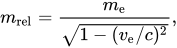
One of the most important and familiar results of relativity is that the relativistic mass of the electron increases as
Hub AI
Relativistic quantum chemistry AI simulator
(@Relativistic quantum chemistry_simulator)
Relativistic quantum chemistry
Relativistic quantum chemistry combines relativistic mechanics with quantum chemistry to calculate elemental properties and structure, especially for the heavier elements of the periodic table. A prominent example is an explanation for the color of gold: due to relativistic effects, it is not silvery like most other metals.
The term relativistic effects was developed in light of the history of quantum mechanics. Initially, quantum mechanics was developed without considering the theory of relativity. Relativistic effects are those discrepancies between values calculated by models that consider relativity and those that do not. Relativistic effects are important for heavier elements with high atomic numbers, such as lanthanides and actinides.
Relativistic effects in chemistry can be considered to be perturbations, or small corrections, to the non-relativistic theory of chemistry, which is developed from the solutions of the Schrödinger equation. These corrections affect the electrons differently depending on the electron speed compared with the speed of light. Relativistic effects are more prominent in heavy elements because only in these elements do electrons attain sufficient speeds for the elements to have properties that differ from what non-relativistic chemistry predicts.
Beginning in 1935, Bertha Swirles described a relativistic treatment of a many-electron system, despite Paul Dirac's 1929 assertion that the only imperfections remaining in quantum mechanics "give rise to difficulties only when high-speed particles are involved and are therefore of no importance in the consideration of the atomic and molecular structure and ordinary chemical reactions in which it is, indeed, usually sufficiently accurate if one neglects relativity variation of mass and velocity and assumes only Coulomb forces between the various electrons and atomic nuclei".
Theoretical chemists by and large agreed with Dirac's sentiment until the 1970s, when relativistic effects were observed in heavy elements. The Schrödinger equation had been developed without considering relativity in Schrödinger's 1926 article. Relativistic corrections were made to the Schrödinger equation (see Klein–Gordon equation) to describe the fine structure of atomic spectra, but this development and others did not immediately trickle into the chemical community. Since atomic spectral lines were largely in the realm of physics and not in that of chemistry, most chemists were unfamiliar with relativistic quantum mechanics, and their attention was on lighter elements typical for the organic chemistry focus of the time.
Dirac's opinion on the role relativistic quantum mechanics would play for chemical systems has been largely dismissed for two main reasons. First, electrons in s and p atomic orbitals travel at a significant fraction of the speed of light. Second, relativistic effects give rise to indirect consequences that are especially evident for d and f atomic orbitals.
One of the most important and familiar results of relativity is that the relativistic mass of the electron increases as