Recent from talks
Nothing was collected or created yet.
Coulomb's law
View on Wikipedia
| Electromagnetism |
|---|
Coulomb's inverse-square law, or simply Coulomb's law, is an experimental law[1] of physics that calculates the amount of force between two electrically charged particles at rest. This electric force is conventionally called the electrostatic force or Coulomb force.[2] Although the law was known earlier, it was first published in 1785 by French physicist Charles-Augustin de Coulomb. Coulomb's law was essential to the development of the theory of electromagnetism and may even be its starting point,[1] as it allowed meaningful discussions of the amount of electric charge in a particle.[3]
The law states that the magnitude, or absolute value, of the attractive or repulsive electrostatic force between two point charges is directly proportional to the product of the magnitudes of their charges and inversely proportional to the square of the distance between them.[4] Two charges can be approximated as point charges, if their sizes are small compared to the distance between them.[5] Coulomb discovered that bodies with like electrical charges repel:
It follows therefore from these three tests, that the repulsive force that the two balls – [that were] electrified with the same kind of electricity – exert on each other, follows the inverse proportion of the square of the distance.[6]
Coulomb also showed that oppositely charged bodies attract according to an inverse-square law:
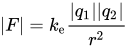
Here, ke is a constant, q1 and q2 are the quantities of each charge, and the scalar r is the distance between the charges.
The force is along the straight line joining the two charges. If the charges have the same sign, the electrostatic force between them makes them repel; if they have different signs, the force between them makes them attract.
Being an inverse-square law, the law is similar to Isaac Newton's inverse-square law of universal gravitation, but gravitational forces always make things attract, while electrostatic forces make charges attract or repel. Also, gravitational forces are much weaker than electrostatic forces.[2] Coulomb's law can be used to derive Gauss's law, and vice versa. In the case of a single point charge at rest, the two laws are equivalent, expressing the same physical law in different ways.[7] The law has been tested extensively, and observations have upheld the law on the scale from 10−16 m to 108 m.[7]
History
[edit]
Ancient cultures around the Mediterranean knew that certain objects, such as rods of amber, could be rubbed with cat's fur to attract light objects like feathers and pieces of paper. Thales of Miletus made the first recorded description of static electricity around 600 BC,[8] when he noticed that friction could make a piece of amber attract small objects.[9][10]
In 1600, English scientist William Gilbert made a careful study of electricity and magnetism, distinguishing the lodestone effect from static electricity produced by rubbing amber.[9] He coined the Neo-Latin word electricus ("of amber" or "like amber", from ἤλεκτρον [elektron], the Greek word for "amber") to refer to the property of attracting small objects after being rubbed.[11] This association gave rise to the English words "electric" and "electricity", which made their first appearance in print in Thomas Browne's Pseudodoxia Epidemica of 1646.[12]
Early investigators of the 18th century who suspected that the electrical force diminished with distance as the force of gravity did (i.e., as the inverse square of the distance) included Daniel Bernoulli[13] and Alessandro Volta, both of whom measured the force between plates of a capacitor, and Franz Aepinus who supposed the inverse-square law in 1758.[14]
Based on experiments with electrically charged spheres, Joseph Priestley of England was among the first to propose that electrical force followed an inverse-square law, similar to Newton's law of universal gravitation. However, he did not generalize or elaborate on this.[15] In 1767, he conjectured that the force between charges varied as the inverse square of the distance.[16][17]

In 1769, Scottish physicist John Robison announced that, according to his measurements, the force of repulsion between two spheres with charges of the same sign varied as x−2.06.[18]
In the early 1770s, the dependence of the force between charged bodies upon both distance and charge had already been discovered, but not published, by Henry Cavendish of England.[19] In his notes, Cavendish wrote, "We may therefore conclude that the electric attraction and repulsion must be inversely as some power of the distance between that of the 2 + 1/50th and that of the 2 − 1/50th, and there is no reason to think that it differs at all from the inverse duplicate ratio".
Finally, in 1785, the French physicist Charles-Augustin de Coulomb published his first three reports of electricity and magnetism where he stated his law. This publication was essential to the development of the theory of electromagnetism.[4] He used a torsion balance to study the repulsion and attraction forces of charged particles, and determined that the magnitude of the electric force between two point charges is directly proportional to the product of the charges and inversely proportional to the square of the distance between them.
The torsion balance consists of a bar suspended from its middle by a thin fiber. The fiber acts as a very weak torsion spring. In Coulomb's experiment, the torsion balance was an insulating rod with a metal-coated ball attached to one end, suspended by a silk thread. The ball was charged with a known charge of static electricity, and a second charged ball of the same polarity was brought near it. The two charged balls repelled one another, twisting the fiber through a certain angle, which could be read from a scale on the instrument. By knowing how much force it took to twist the fiber through a given angle, Coulomb was able to calculate the force between the balls and derive his inverse-square proportionality law.
Mathematical form
[edit]
Coulomb's law states that the electrostatic force experienced by a charge, at position , in the vicinity of another charge, at position , in a vacuum is equal to[20]
where is the displacement vector between the charges, a unit vector pointing from to , and the electric constant. Here, is used for the vector notation. The electrostatic force experienced by , according to Newton's third law, is .
If both charges have the same sign (like charges) then the product is positive and the direction of the force on is given by ; the charges repel each other. If the charges have opposite signs then the product is negative and the direction of the force on is ; the charges attract each other.[21]
System of discrete charges
[edit]The law of superposition allows Coulomb's law to be extended to include any number of point charges. The force acting on a point charge due to a system of point charges is simply the vector addition of the individual forces acting alone on that point charge due to each one of the charges. The resulting force vector is parallel to the electric field vector at that point, with that point charge removed.
Force on a small charge at position , due to a system of discrete charges in vacuum is[20]
where is the magnitude of the ith charge, is the vector from its position to and is the unit vector in the direction of .
Continuous charge distribution
[edit]In this case, the principle of linear superposition is also used. For a continuous charge distribution, an integral over the region containing the charge is equivalent to an infinite summation, treating each infinitesimal element of space as a point charge . The distribution of charge is usually linear, surface or volumetric.
For a linear charge distribution (a good approximation for charge in a wire) where gives the charge per unit length at position , and is an infinitesimal element of length,[22]
For a surface charge distribution (a good approximation for charge on a plate in a parallel plate capacitor) where gives the charge per unit area at position , and is an infinitesimal element of area,
For a volume charge distribution (such as charge within a bulk metal) where gives the charge per unit volume at position , and is an infinitesimal element of volume,[21]
The force on a small test charge at position in vacuum is given by the integral over the distribution of charge
The "continuous charge" version of Coulomb's law is never supposed to be applied to locations for which because that location would directly overlap with the location of a charged particle (e.g. electron or proton) which is not a valid location to analyze the electric field or potential classically. Charge is always discrete in reality, and the "continuous charge" assumption is just an approximation that is not supposed to allow to be analyzed.
Coulomb constant
[edit]The constant of proportionality, , in Coulomb's law: is a consequence of historical choices for units.[20]: 4–2
The constant is the vacuum electric permittivity.[23] Using the CODATA 2022 recommended value for ,[24] the Coulomb constant[25] is
Limitations
[edit]There are three conditions to be fulfilled for the validity of Coulomb's inverse square law:[26]
- The charges must have a spherically symmetric distribution (e.g. be point charges, or a charged metal sphere).
- The charges must not overlap (e.g. they must be distinct point charges).
- The charges must be stationary with respect to a nonaccelerating frame of reference.
The last of these is known as the electrostatic approximation. When movement takes place, an extra factor is introduced, which alters the force produced on the two objects. This extra part of the force is called the magnetic force. For slow movement, the magnetic force is minimal and Coulomb's law can still be considered approximately correct. A more accurate approximation in this case is, however, the Weber force. When the charges are moving more quickly in relation to each other or accelerations occur, Maxwell's equations and Einstein's theory of relativity must be taken into consideration.
Electric field
[edit]
An electric field is a vector field that associates to each point in space the Coulomb force experienced by a unit test charge.[20] The strength and direction of the Coulomb force on a charge depends on the electric field established by other charges that it finds itself in, such that . In the simplest case, the field is considered to be generated solely by a single source point charge. More generally, the field can be generated by a distribution of charges who contribute to the overall by the principle of superposition.
If the field is generated by a positive source point charge , the direction of the electric field points along lines directed radially outwards from it, i.e. in the direction that a positive point test charge would move if placed in the field. For a negative point source charge, the direction is radially inwards.
The magnitude of the electric field E can be derived from Coulomb's law. By choosing one of the point charges to be the source, and the other to be the test charge, it follows from Coulomb's law that the magnitude of the electric field E created by a single source point charge Q at a certain distance from it r in vacuum is given by
A system of n discrete charges stationed at produces an electric field whose magnitude and direction is, by superposition
Atomic forces
[edit]Coulomb's law holds even within atoms, correctly describing the force between the positively charged atomic nucleus and each of the negatively charged electrons. This simple law also correctly accounts for the forces that bind atoms together to form molecules and for the forces that bind atoms and molecules together to form solids and liquids. Generally, as the distance between ions increases, the force of attraction, and binding energy, approach zero and ionic bonding is less favorable. As the magnitude of opposing charges increases, energy increases and ionic bonding is more favorable.
Relation to Gauss's law
[edit]This article duplicates the scope of other articles, specifically Gauss's_law#Relation_to_Coulomb's_law. |
Deriving Gauss's law from Coulomb's law
[edit][citation needed] Strictly speaking, Gauss's law cannot be derived from Coulomb's law alone, since Coulomb's law gives the electric field due to an individual, electrostatic point charge only. However, Gauss's law can be proven from Coulomb's law if it is assumed, in addition, that the electric field obeys the superposition principle. The superposition principle states that the resulting field is the vector sum of fields generated by each particle (or the integral, if the charges are distributed smoothly in space).
Coulomb's law states that the electric field due to a stationary point charge is: where
- er is the radial unit vector,
- r is the radius, |r|,
- ε0 is the electric constant,
- q is the charge of the particle, which is assumed to be located at the origin.
Using the expression from Coulomb's law, we get the total field at r by using an integral to sum the field at r due to the infinitesimal charge at each other point s in space, to give where ρ is the charge density. If we take the divergence of both sides of this equation with respect to r, and use the known theorem[27]
where δ(r) is the Dirac delta function, the result is
Using the "sifting property" of the Dirac delta function, we arrive at which is the differential form of Gauss's law, as desired.
Since Coulomb's law only applies to stationary charges, there is no reason to expect Gauss's law to hold for moving charges based on this derivation alone. In fact, Gauss's law does hold for moving charges, and, in this respect, Gauss's law is more general than Coulomb's law.
Let be a bounded open set, and be the electric field, with a continuous function (density of charge).
It is true for all that .
Consider now a compact set having a piecewise smooth boundary such that . It follows that and so, for the divergence theorem:
But because ,
for the argument above ( and then )
Therefore the flux through a closed surface generated by some charge density outside (the surface) is null.
Now consider , and as the sphere centered in having as radius (it exists because is an open set).
Let and be the electric field created inside and outside the sphere respectively. Then,
- , and
The last equality follows by observing that , and the argument above.
The RHS is the electric flux generated by a charged sphere, and so:
with
Where the last equality follows by the mean value theorem for integrals. Using the squeeze theorem and the continuity of , one arrives at:
Deriving Coulomb's law from Gauss's law
[edit]Strictly speaking, Coulomb's law cannot be derived from Gauss's law alone, since Gauss's law does not give any information regarding the curl of E (see Helmholtz decomposition and Faraday's law). However, Coulomb's law can be proven from Gauss's law if it is assumed, in addition, that the electric field from a point charge is spherically symmetric (this assumption, like Coulomb's law itself, is exactly true if the charge is stationary, and approximately true if the charge is in motion).
Taking S in the integral form of Gauss's law to be a spherical surface of radius r, centered at the point charge Q, we have
By the assumption of spherical symmetry, the integrand is a constant which can be taken out of the integral. The result is where r̂ is a unit vector pointing radially away from the charge. Again by spherical symmetry, E points in the radial direction, and so we get which is essentially equivalent to Coulomb's law. Thus the inverse-square law dependence of the electric field in Coulomb's law follows from Gauss's law.
In relativity
[edit]Coulomb's law can be used to gain insight into the form of the magnetic field generated by moving charges since by special relativity, in certain cases the magnetic field can be shown to be a transformation of forces caused by the electric field. When no acceleration is involved in a particle's history, Coulomb's law can be assumed on any test particle in its own inertial frame, supported by symmetry arguments in solving Maxwell's equation, shown above. Coulomb's law can be expanded to moving test particles to be of the same form. This assumption is supported by Lorentz force law which, unlike Coulomb's law is not limited to stationary test charges. Considering the charge to be invariant of observer, the electric and magnetic fields of a uniformly moving point charge can hence be derived by the Lorentz transformation of the four force on the test charge in the charge's frame of reference given by Coulomb's law and attributing magnetic and electric fields by their definitions given by the form of Lorentz force[broken anchor].[28] The fields hence found for uniformly moving point charges are given by:[29]where is the charge of the point source, is the position vector from the point source to the point in space, is the velocity vector of the charged particle, is the ratio of speed of the charged particle divided by the speed of light and is the angle between and .
This form of solutions need not obey Newton's third law as is the case in the framework of special relativity (yet without violating relativistic-energy momentum conservation).[30] Note that the expression for electric field reduces to Coulomb's law for non-relativistic speeds of the point charge and that the magnetic field in non-relativistic limit (approximating ) can be applied to electric currents to get the Biot–Savart law. These solutions, when expressed in retarded time also correspond to the general solution of Maxwell's equations given by solutions of Liénard–Wiechert potential, due to the validity of Coulomb's law within its specific range of application. Also note that the spherical symmetry for gauss law on stationary charges is not valid for moving charges owing to the breaking of symmetry by the specification of direction of velocity in the problem. Agreement with Maxwell's equations can also be manually verified for the above two equations.[31]
Coulomb potential
[edit]Quantum field theory
[edit]This article may be too technical for most readers to understand. (October 2020) |

The Coulomb potential admits continuum states (with E > 0), describing electron-proton scattering, as well as discrete bound states, representing the hydrogen atom.[32] It can also be derived within the non-relativistic limit between two charged particles, as follows:
Under Born approximation, in non-relativistic quantum mechanics, the scattering amplitude is: This is to be compared to the: where we look at the (connected) S-matrix entry for two electrons scattering off each other, treating one with "fixed" momentum as the source of the potential, and the other scattering off that potential.
Using the Feynman rules to compute the S-matrix element, we obtain in the non-relativistic limit with
Comparing with the QM scattering, we have to discard the as they arise due to differing normalizations of momentum eigenstate in QFT compared to QM and obtain: where Fourier transforming both sides, solving the integral and taking at the end will yield as the Coulomb potential.[33]
However, the equivalent results of the classical Born derivations for the Coulomb problem are thought to be strictly accidental.[34][35]
The Coulomb potential, and its derivation, can be seen as a special case of the Yukawa potential, which is the case where the exchanged boson – the photon – has no rest mass.[32]
Verification
[edit]This section may contain an excessive amount of intricate detail that may only interest a particular audience. (October 2020) |

It is possible to verify Coulomb's law with a simple experiment. Consider two small spheres of mass and same-sign charge , hanging from two ropes of negligible mass of length . The forces acting on each sphere are three: the weight , the rope tension and the electric force . In the equilibrium state:
| 1 |
and
| 2 |
| 3 |
Let be the distance between the charged spheres; the repulsion force between them , assuming Coulomb's law is correct, is equal to
| Coulomb's law |
so:
| 4 |
If we now discharge one of the spheres, and we put it in contact with the charged sphere, each one of them acquires a charge . In the equilibrium state, the distance between the charges will be and the repulsion force between them will be:
| 5 |
We know that and: Dividing (4) by (5), we get:
| 6 |
Measuring the angles and and the distance between the charges and is sufficient to verify that the equality is true taking into account the experimental error. In practice, angles can be difficult to measure, so if the length of the ropes is sufficiently great, the angles will be small enough to make the following approximation:
| 7 |
Using this approximation, the relationship (6) becomes the much simpler expression:
| 8 |
In this way, the verification is limited to measuring the distance between the charges and checking that the division approximates the theoretical value.
See also
[edit]- Biot–Savart law
- Darwin Lagrangian
- Electromagnetic force
- Gauss's law
- Method of image charges
- Molecular modelling
- Newton's law of universal gravitation, which uses a similar structure, but for mass instead of charge
- Static forces and virtual-particle exchange
- Casimir effect
References
[edit]- ^ a b Huray, Paul G. (2010). Maxwell's equations. Hoboken, New Jersey: Wiley. pp. 8, 57. ISBN 978-0-470-54991-9. OCLC 739118459.
- ^ a b Halliday, David; Resnick, Robert; Walker, Jearl (2013). Fundamentals of Physics. John Wiley & Sons. pp. 609, 611. ISBN 9781118230718.
- ^ Roller, Duane; Roller, D. H. D. (1954). The development of the concept of electric charge: Electricity from the Greeks to Coulomb. Cambridge, Massachusetts: Harvard University Press. p. 79.
- ^ a b Coulomb (1785). "Premier mémoire sur l'électricité et le magnétisme" [First dissertation on electricity and magnetism]. Histoire de l'Académie Royale des Sciences [History of the Royal Academy of Sciences] (in French). pp. 569–577.
- ^ Srinivasan, M. V. (2025). Physics Part - I. National Council for Education Research and Training (NCERT). p. 20. ISBN 978-81-7450-631-3.
- ^ Coulomb (1785). "Second mémoire sur l'électricité et le magnétisme" [Second dissertation on electricity and magnetism]. Histoire de l'Académie Royale des Sciences [History of the Royal Academy of Sciences] (in French). pp. 578–611.
Il résulte donc de ces trois essais, que l'action répulsive que les deux balles électrifées de la même nature d'électricité exercent l'une sur l'autre, suit la raison inverse du carré des distances.
- ^ a b Purcell, Edward M. (21 January 2013). Electricity and magnetism (3rd ed.). Cambridge. ISBN 9781107014022.
{{cite book}}: CS1 maint: location missing publisher (link) - ^ Cork, C.R. (2015). "Conductive fibres for electronic textiles". Electronic Textiles: 3–20. doi:10.1016/B978-0-08-100201-8.00002-3. ISBN 9780081002018.
- ^ a b Stewart, Joseph (2001). Intermediate Electromagnetic Theory. World Scientific. p. 50. ISBN 978-981-02-4471-2.
- ^ Simpson, Brian (2003). Electrical Stimulation and the Relief of Pain. Elsevier Health Sciences. pp. 6–7. ISBN 978-0-444-51258-1.
- ^ Baigrie, Brian (2007). Electricity and Magnetism: A Historical Perspective. Greenwood Press. pp. 7–8. ISBN 978-0-313-33358-3.
- ^ Chalmers, Gordon (1937). "The Lodestone and the Understanding of Matter in Seventeenth Century England". Philosophy of Science. 4 (1): 75–95. doi:10.1086/286445. S2CID 121067746.
- ^ Socin, Abel (1760). Acta Helvetica Physico-Mathematico-Anatomico-Botanico-Medica (in Latin). Vol. 4. Basileae. pp. 224–25.
- ^ Heilbron, J.L. (1979). Electricity in the 17th and 18th Centuries: A Study of Early Modern Physics. Los Angeles, California: University of California Press. pp. 460–462 and 464 (including footnote 44). ISBN 978-0486406886.
- ^ Schofield, Robert E. (1997). The Enlightenment of Joseph Priestley: A Study of his Life and Work from 1733 to 1773. University Park: Pennsylvania State University Press. pp. 144–56. ISBN 978-0-271-01662-7.
{{cite book}}: CS1 maint: publisher location (link) - ^ Priestley, Joseph (1767). The History and Present State of Electricity, with Original Experiments. London, England. p. 732.
- ^ Elliott, Robert S. (1999). Electromagnetics: History, Theory, and Applications. Wiley. ISBN 978-0-7803-5384-8. Archived from the original on 2014-03-10. Retrieved 2009-10-17.
- ^ Robison, John (1822). Murray, John (ed.). A System of Mechanical Philosophy. Vol. 4. London, England: Printed for J. Murray.
- ^ Maxwell, James Clerk, ed. (1967) [1879]. "Experiments on Electricity: Experimental determination of the law of electric force.". The Electrical Researches of the Honourable Henry Cavendish... (1st ed.). Cambridge, England: Cambridge University Press. pp. 104–113.
- ^ a b c d Feynman, Richard P. (1970). The Feynman Lectures on Physics Vol II. Addison-Wesley. ISBN 9780201021158.
- ^ a b Fitzpatrick, Richard (2006-02-02). "Coulomb's law". University of Texas. Archived from the original on 2015-07-09. Retrieved 2007-11-30.
- ^ "Charged rods". PhysicsLab.org. Archived from the original on 2014-10-10. Retrieved 2007-11-06.
- ^ The International System of Units (PDF), V3.01 (9th ed.), International Bureau of Weights and Measures, Aug 2024, p. 15, ISBN 978-92-822-2272-0
- ^ "2022 CODATA Value: vacuum electric permittivity". The NIST Reference on Constants, Units, and Uncertainty. NIST. Archived from the original on 2024-06-24. Retrieved 2024-10-27.
- ^ Serway, Raymond A.; Jewett, John W., Jr. (2014). "Some Physical Constants". Physics for Scientists and Engineers (Ninth ed.). Cengage Learning. Inside Cover. ISBN 978-1-133-95405-7.
{{cite book}}: CS1 maint: multiple names: authors list (link) - ^ W. Shao; B. Jiang; J.K. Lv (2015). "Discussion on physics teaching innovation: Taking Coulomb's law as an example". In Dawei Zheng (ed.). Education Management and Management Science. CRC Press. pp. 465–468. doi:10.1201/b18636-105. ISBN 978-0-429-22704-2.
- ^ See, for example, Griffiths, David J. (2013). Introduction to Electrodynamics (4th ed.). Prentice Hall. p. 50. or Jackson, John David (1999). Classical Electrodynamics (3rd ed.). John Wiley & Sons. p. 35.
- ^ Rosser, W. G. V. (1968). Classical Electromagnetism via Relativity. pp. 29–42. doi:10.1007/978-1-4899-6559-2. ISBN 978-1-4899-6258-4. Archived from the original on 2022-10-09. Retrieved 2022-10-09.
- ^ Heaviside, Oliver (1894). Electromagnetic waves, the propagation of potential, and the electromagnetic effects of a moving charge. Archived from the original on 2022-10-09. Retrieved 2022-10-09.
- ^ Griffiths, David J. (1999). Introduction to electrodynamics (3rd ed.). Upper Saddle River, NJ: Prentice Hall. p. 517. ISBN 0-13-805326-X. OCLC 40251748.
- ^ Purcell, Edward (2011-09-22). Electricity and Magnetism. Cambridge University Press. doi:10.1017/cbo9781139005043. ISBN 978-1-107-01360-5. Archived from the original on 2023-12-30. Retrieved 2022-10-09.
- ^ a b Griffiths, David J. (16 August 2018). Introduction to quantum mechanics (Third ed.). Cambridge, United Kingdom. ISBN 978-1-107-18963-8.
{{cite book}}: CS1 maint: location missing publisher (link) - ^ "Quantum Field Theory I + II" (PDF). Institute for Theoretical Physics, Heidelberg University. Archived (PDF) from the original on 2021-05-04. Retrieved 2020-09-24.
- ^ Baym, Gordon (2018). Lectures on quantum mechanics. Boca Raton. ISBN 978-0-429-49926-5. OCLC 1028553174.
{{cite book}}: CS1 maint: location missing publisher (link) - ^ Gould, Robert J. (21 July 2020). Electromagnetic processes. Princeton, N.J. ISBN 978-0-691-21584-6. OCLC 1176566442.
{{cite book}}: CS1 maint: location missing publisher (link)
Spavieri, G., Gillies, G. T., & Rodriguez, M. (2004). Physical implications of Coulomb’s Law. Metrologia, 41(5), S159–S170. doi:10.1088/0026-1394/41/5/s06
Related reading
[edit]- Coulomb, Charles Augustin (1788) [1785]. "Premier mémoire sur l'électricité et le magnétisme". Histoire de l'Académie Royale des Sciences. Imprimerie Royale. pp. 569–577.
- Coulomb, Charles Augustin (1788) [1785]. "Second mémoire sur l'électricité et le magnétisme". Histoire de l'Académie Royale des Sciences. Imprimerie Royale. pp. 578–611.
- Coulomb, Charles Augustin (1788) [1785]. "Troisième mémoire sur l'électricité et le magnétisme". Histoire de l'Académie Royale des Sciences. Imprimerie Royale. pp. 612–638.
- Griffiths, David J. (1999). Introduction to Electrodynamics (3rd ed.). Prentice Hall. ISBN 978-0-13-805326-0.
- Tamm, Igor E. (1979) [1976]. Fundamentals of the Theory of Electricity (9th ed.). Moscow: Mir. pp. 23–27.
- Tipler, Paul A.; Mosca, Gene (2008). Physics for Scientists and Engineers (6th ed.). New York: W. H. Freeman and Company. ISBN 978-0-7167-8964-2. LCCN 2007010418.
- Young, Hugh D.; Freedman, Roger A. (2010). Sears and Zemansky's University Physics: With Modern Physics (13th ed.). Addison-Wesley (Pearson). ISBN 978-0-321-69686-1.
External links
[edit]- Coulomb's Law on Project PHYSNET
- Electricity and the Atom Archived 2009-02-21 at the Wayback Machine—a chapter from an online textbook
- A maze game for teaching Coulomb's law—a game created by the Molecular Workbench software
- Electric Charges, Polarization, Electric Force, Coulomb's Law Walter Lewin, 8.02 Electricity and Magnetism, Spring 2002: Lecture 1 (video). MIT OpenCourseWare. License: Creative Commons Attribution-Noncommercial-Share Alike.
Coulomb's law
View on GrokipediaHistorical Background
Early Concepts of Electricity
The earliest recorded observations of electrical phenomena date back to ancient Greece, where Thales of Miletus, around 600 BCE, noted that amber rubbed with fur or wool could attract lightweight objects such as feathers or straw, a phenomenon now understood as static electricity.[7] This qualitative discovery, preserved through accounts by later philosophers like Aristotle, marked the initial recognition of electric attraction but lacked any theoretical framework or distinction from other forces.[8] In the late 16th century, English physician William Gilbert advanced these ideas significantly in his seminal work De Magnete (1600), where he systematically differentiated electric forces from magnetic ones. Gilbert demonstrated that rubbing various substances, including amber and glass, produced attraction effects distinct from the permanent magnetism of lodestones, coining the term "electric" derived from the Greek word for amber (ēlektron). His experiments emphasized that electricity arose from friction and was temporary, contrasting with magnetism's enduring nature, laying groundwork for viewing electricity as a separate phenomenon.[9] The 17th century saw further progress in generating and manipulating static electricity, notably with Otto von Guericke's invention of an electrostatic generator around 1660. Guericke constructed a rotating globe of sulfur that, when rubbed, produced sparks and attracted light objects, enabling more consistent demonstrations of electrical effects and foreshadowing mechanical methods for studying repulsion and attraction.[10] Building on this, Stephen Gray's experiments in 1729 revealed the concept of electrical conduction, showing that "electric virtue" could transfer through certain materials like metal wires while being blocked by others such as silk or glass, thus classifying substances as conductors or non-conductors for the first time.[11] By the mid-18th century, Benjamin Franklin proposed the one-fluid theory of electricity in the 1740s, positing a single electrical fluid whose excess or deficiency in a body explained attraction and repulsion, and he introduced the terms "positive" (excess fluid) and "negative" (deficiency) charges. Franklin's kite experiment and related work unified diverse observations under this model, emphasizing charge conservation and the role of grounding in neutralizing effects.[12] In 1767, Joseph Priestley, in his book The History and Present State of Electricity, with Original Experiments, conjectured based on experiments with charged spheres that the electric force follows an inverse-square law, analogous to gravity.[13] An early attempt at quantification came in 1769 from Scottish physicist John Robison, who hypothesized an inverse-square law for electrical repulsion based on rough measurements balancing charged pith balls against springs, though his results lacked precision and experimental rigor.[14] These developments provided a qualitative foundation that paved the way for more accurate quantitative investigations.Charles-Augustin de Coulomb's Experiments
Charles-Augustin de Coulomb developed the torsion balance as a precise instrument to quantify electric forces, building on his earlier work on mechanical torsion presented to the French Academy of Sciences in 1784. The apparatus consisted of a lightweight rod or needle suspended by a thin silver filament or silk thread, typically about 28 inches long and weighing roughly 1/16 grain per foot, allowing it to twist under minimal force. At one end of the rod hung a small pith ball, made from the lightweight inner pith of elder wood and about 2-3 lignes (approximately 4.7-7 mm) in diameter, while the other end carried a counterweight for balance; the entire setup was enclosed in a glass cylinder roughly 12 inches in diameter and height to shield it from external influences. A micrometer scale enabled measurement of the torsion angle in degrees, with the twist directly proportional to the applied force.[4][15] In his 1785 experiments, conducted as part of his research for the French Academy of Sciences and influenced by analogies to Newton's inverse-square law of gravitation, Coulomb measured the repulsive force between similarly charged pith balls or small spheres. He electrified the balls using a pin or by contact with a charged globe, observing their repulsion which caused the suspended ball to deflect to an initial angle, such as 36 degrees on the measurement circle. To quantify the force, Coulomb applied torsion to the filament, drawing the balls closer while noting the required twist angle— for instance, 126 degrees of torsion reduced the separation to 18 degrees, and 567 degrees brought it to 8.5 degrees. He systematically varied the distances between the balls' centers, from about 2 to 16 inches, and adjusted charge amounts by using spheres of different sizes or densities to electrify them, ensuring the charges were of the same sign for repulsion. These trials demonstrated the force's dependence on both charge quantities and separation.[4][15][3] To ensure accuracy, Coulomb implemented controls for environmental factors that could interfere with measurements, such as air currents and humidity, which he noted caused charge dissipation over time. Experiments were performed inside a well-sealed glass chamber or closed box to minimize air resistance and disturbances, and he conducted them in dry conditions, recommending preliminary observations to account for any charge loss, estimated at about 1/40 per minute in some setups. Insulation was achieved through varnished tables and wax-coated supports to prevent unintended leakage of charge. By tensioning the filament over several days for stability and using a proof plane to sample charge densities uniformly, Coulomb isolated the pure electric interaction.[4][15] The key results from these 1785 trials, detailed in Coulomb's first memoir to the Academy, showed that the repulsive force between the charged balls was directly proportional to the product of their charge quantities—or more precisely, the densities of the electric fluid—and inversely proportional to the square of the distance between their centers. In one set of three tests, as the distance halved from an initial separation corresponding to 36 degrees, the required torsion force quadrupled, confirming the inverse-square relationship within the precision of his measurements, which he described as "the repulsive action... in the inverse ratio of the square of the distances." Coulomb emphasized the conformity between his experimental outcomes and theoretical expectations, noting that such precision was "hardly to be hoped for" given the apparatus's sensitivity. These findings, presented amid the Academy's investigations into electricity following qualitative observations by earlier researchers like Du Fay, marked a shift toward quantitative electrodynamics.[4][15][3]Initial Formulation and Publication
Charles-Augustin de Coulomb presented the initial formulation of what would become known as Coulomb's law in his 1785 memoir titled Premier Mémoire sur l'Électricité et le Magnétisme to the Académie Royale des Sciences.[16] In this work, he detailed experiments using a torsion balance to measure forces between charged objects, concluding that the repulsive force between two small spheres electrified with the same kind of electricity is directly proportional to the product of their electric densities and inversely proportional to the square of the distance between their centers.[4] This statement captured the essence of the inverse-square relationship for like charges, marking a quantitative advancement in understanding electrostatic interactions beyond qualitative observations. Coulomb extended the law to cases of attraction, asserting that the action between two electrified globes—whether repulsive or attractive—is directly proportional to the product of the densities of the electric fluid in the two electrified molecules and inversely proportional to the square of the distances separating them.[15] He emphasized that this form applies symmetrically to opposite charges, drawing an analogy to gravitational forces while grounding it in his experimental data. The memoir was formally published in the academy's proceedings in 1788, providing the first rigorous mathematical description of electrostatic forces.[3] Coulomb explicitly noted limitations in his formulation, stating that it assumes the charged bodies behave as point sources with distances much larger than their physical dimensions, thereby neglecting complications such as the induction of charges in nearby conductors.[15] These assumptions simplified the model for small, isolated spheres but highlighted the law's applicability to idealized conditions. Despite initial contestation in some circles, particularly in Germany, the law received praise from contemporaries like Pierre-Simon Laplace, who integrated it into broader mathematical frameworks for mechanics and electricity.[17] Coulomb's quantitative treatment of electric forces profoundly influenced the development of standardized units in physics, helping to establish the conceptual foundation for measuring charge; the SI unit of electric charge was later named the coulomb in his honor during the 19th century.[3] This recognition underscored the law's role in transitioning electricity from a qualitative phenomenon to a branch of precise science, paving the way for advancements in electromagnetism.Mathematical Formulation
Force Between Point Charges
Coulomb's law describes the electrostatic force between two stationary point charges in vacuum as directly proportional to the product of their magnitudes and inversely proportional to the square of the distance between them.[15] The magnitude of this force is given by where and are the charges, is the separation distance, and is the Coulomb constant, with being the vacuum permittivity.[15] The force is repulsive if the charges have the same sign and attractive if they have opposite signs, acting along the line joining the centers of the charges.[15] In vector form, the force exerted by charge on charge is where is the unit vector pointing from to . This formulation accounts for both magnitude and direction in three-dimensional space. The law applies under the assumptions of point-like charges that are at rest, in a non-relativistic regime, and surrounded by vacuum, with no intervening media affecting the interaction.[15] These conditions ensure the force arises solely from direct electrostatic interaction without magnetic or relativistic effects. For systems with multiple point charges, the superposition principle states that the total force on any one charge is the vector sum of the forces due to each of the other charges individually. This linearity allows complex configurations to be analyzed by pairwise interactions. As an illustrative example, consider two electrons, each with charge C, separated by 1 Å ( m), a typical atomic-scale distance. The repulsive force magnitude is N, highlighting the strength of electrostatic interactions at short ranges compared to gravitational forces./Book%3A_University_Physics_II_-Thermodynamics_Electricity_and_Magnetism(OpenStax)/02%3A_Electric_Charge_and_Electric_Field/2.04%3A_Electric_Field_Lines)Integration for Continuous Distributions
To compute the electrostatic force exerted by a continuous charge distribution on a point charge , the distribution is divided into infinitesimal charge elements . For a volume distribution with charge density , ; for a surface distribution, ; and for a line distribution, . The total force on is then the vector integral over the distribution of the pairwise Coulomb forces: where is the Coulomb constant, is the distance from the element to , and is the unit vector from to .[18][5] This integration approach extends the point-charge form of Coulomb's law to continua by applying the principle of superposition, summing contributions from all elements.[19] The process requires evaluating the scalar magnitude and vector direction for each , often necessitating a change to appropriate coordinates (e.g., spherical or cylindrical) based on the geometry.[20] A representative example is the force on a point charge due to an infinite uniform line charge with linear density . The contributions from symmetric elements on opposite sides of the line cancel in the parallel components, leaving only the radial force, which integrates to , proportional to rather than the inverse-square dependence for point charges.[21][22] For a uniformly charged thin spherical shell of total charge and radius , direct integration shows that the net force on a point charge inside the shell (at distance from the center) is zero, as vector contributions from all surface elements cancel pairwise due to symmetry. Outside the shell (), the force matches that of a point charge at the center, .[23][24] Vector nature of the integration poses significant challenges, particularly in expressing the position vector and charge elements correctly, which often leads to errors in coordinate setup and component resolution without symmetry to simplify.[25][26] Exploiting symmetries (e.g., axial or spherical) reduces the integral to scalar form for dominant components, but irregular distributions generally require full three-dimensional evaluation. For complex or irregular continuous distributions where analytical integration is infeasible, numerical methods approximate the integral by discretizing the charge into finite elements and summing forces via techniques like the trapezoidal rule or method of moments, enabling computational solutions in simulations.[27][28]Fundamental Constants
Definition of the Coulomb Constant
The Coulomb constant, denoted , serves as the proportionality factor in the expression for the electrostatic force between two stationary point charges in vacuum. It is fundamentally defined as where represents the vacuum permittivity, which quantifies the ability of empty space to permit electric fields. The vacuum permittivity has an experimentally determined value of F/m (CODATA 2022), with the uncertainty reflecting measurements tied to the fine-structure constant.[29] This definition yields a numerical value for the Coulomb constant of N·m²/C². Following the 2019 redefinition of the SI base units, which fixed the elementary charge and other constants, is derived from experimental determinations rather than being independently fixed, resulting in a relative standard uncertainty of about (CODATA 2022).[29] The constant's dimensions in the SI system are , where M denotes mass, L length, T time, and I electric current, underscoring its role in bridging mechanical and electrical quantities. An alternative expression for the Coulomb constant emphasizes its electromagnetic foundations: where is the vacuum permeability ( N A^{-2}, CODATA 2022) and is the speed of light in vacuum (exactly 299792458 m/s). This form illustrates how interconnects electrostatic interactions with the propagation characteristics of electromagnetic waves.[29][30] Historically, the constant evolved from the cgs electrostatic (esu) system, where (dimensionless) by definition of the statcoulomb unit, to the modern SI framework, which incorporates the ampere as a base unit and requires the explicit numerical value to ensure unit coherence.[31]Variations in Different Media and Units
In a dielectric medium, the electrostatic force between two point charges is modified due to the material's polarization, which induces bound charges that partially screen the interaction. The effective Coulomb constant becomes , where is the vacuum Coulomb constant and is the relative permittivity (or dielectric constant) of the medium. This reduction arises because the medium's molecules align with the electric field, creating an opposing field that diminishes the net force between the free charges.[32][33] For example, in water, which has a relative permittivity of approximately 80 at 20°C, the effective constant is reduced by a factor of 80 compared to vacuum, significantly weakening the force between charges immersed in it. This high value reflects water's strong polar nature, making it an effective medium for screening electrostatic interactions.[34][33] In alternative unit systems, the formulation of Coulomb's law varies to simplify equations. In Gaussian units (also known as cgs-esu), the Coulomb constant is set to 1, so the force is simply , with charges measured in statcoulombs—a unit defined such that two equal charges of 1 statcoulomb separated by 1 cm in vacuum repel with a force of 1 dyne.[35][36] The Heaviside-Lorentz unit system, a rationalized variant favored in theoretical physics, sets the Coulomb constant to , eliminating factors of from Maxwell's equations while maintaining consistency with relativistic field theories. This system uses the same base units as Gaussian but adjusts field definitions for cleaner Lagrangian formulations.[36] Conversion between SI and Gaussian units for charge is given by C statcoulombs, reflecting the dimensional scaling between the systems.[36] These variations have practical implications in devices like capacitors, where inserting a dielectric increases capacitance by a factor of due to the reduced effective force, enhancing energy storage. In electrolytes, such as ionic liquids, screening effects further modify long-range Coulomb interactions, leading to phenomena like overscreening in electrical double layers and influencing charge transport and capacitance behavior.[32][37]Relation to Electric Fields
Deriving the Electric Field
The electric field at a point in space is defined as the electrostatic force exerted on a small positive test charge placed at that point, divided by the magnitude of the test charge: .[38] This definition provides a way to describe the influence of charges without reference to the specific test charge, allowing the field to be attributed solely to the source charges.[39] Building on Coulomb's law for the force between two point charges, the electric field produced by a single point charge at a position from the charge is derived by considering the force on the test charge : , where is the Coulomb constant and is the unit vector in the direction from the source charge to the field point.[39] The direction of points away from positive charges and toward negative charges, reflecting the repulsive or attractive nature of the electrostatic force.[18] For a continuous distribution of charge, the total electric field is found by summing the contributions from each infinitesimal charge element using the principle of superposition, which states that the net field is the vector sum of the fields from all elements: , where the integral is taken over the entire distribution.[40] This approach treats the distribution as a collection of point charges, ensuring the derivation remains grounded in the point-charge formulation.[41] The SI unit of electric field strength is the newton per coulomb (N/C), equivalently expressed as the volt per meter (V/m), reflecting its dual interpretation as force per unit charge or potential gradient per unit distance.[42] The conceptual framework of the electric field traces its roots to Michael Faraday's introduction of "lines of force" in the 1830s, which visualized the spatial patterns of electrostatic influence as lines emanating from charges, offering an intuitive geometric interpretation of the forces quantified by Coulomb's law.[43]Field Lines and Superposition
Electric field lines provide a visual representation of the electric field derived from Coulomb's law, indicating both the direction and relative magnitude of the field at any point in space. The direction of the field lines is tangent to , pointing away from positive charges and toward negative charges.[44] For a single point charge, the field lines are radial, emanating symmetrically outward from a positive charge or inward toward a negative charge, reflecting the inverse-square dependence of the field strength on distance.[45] The density of these lines—defined as the number of lines per unit area perpendicular to the field—is proportional to the magnitude of , such that closer spacing indicates stronger fields; for a point charge, this density decreases as , consistent with the total flux through a closed surface being proportional to the enclosed charge.[44] The principle of superposition allows the total electric field from multiple charges to be obtained by vectorially adding the individual fields from each charge, as governed by Coulomb's law.[44] This is particularly evident in configurations like the electric dipole, formed by two equal and opposite point charges separated by a small distance. The dipole field lines emerge from the positive charge and curve toward the negative charge, resulting from the superposition of opposing radial fields; far from the dipole, the field approximates a pattern where lines are compressed along the axis and sparser perpendicular to it, with strength falling off as .[46] For a quadrupole, consisting of two oppositely oriented dipoles (e.g., +q, -q, -q, +q in a linear arrangement), superposition yields even more complex field patterns: lines form closed loops or intricate curves without net dipole moment, with the far-field strength decaying as , useful for modeling neutral systems like certain molecules.[46] These examples illustrate how superposition constructs global field geometries from local Coulomb interactions. Electrostatic fields from Coulomb's law exhibit symmetry properties characteristic of conservative vector fields. Specifically, the curl of the electric field vanishes, , implying that the line integral of around any closed path is zero, which ensures path independence for the work done by the field on a test charge.[47] This irrotational nature underscores the field's derivation from a scalar potential, aligning with the reversible, non-dissipative behavior of electrostatic forces. In visualizations, electric field lines conceptually originate on positive charges and terminate on negative charges, with the number of lines proportional to the charge magnitude; for a system with net positive charge, lines extend to infinity without terminating, and vice versa for net negative charge.[48] Pedagogical tools, such as interactive 2D and 3D simulations, enhance understanding by allowing users to arrange charges and observe resulting field patterns in real time; for instance, the PhET Charges and Fields simulation displays dynamic field lines and equipotentials for point charges, dipoles, and multipoles, facilitating exploration of superposition effects.[49] These visualizations reveal qualitative features like field compression between like charges or divergence around isolated points, aiding conceptual grasp without numerical computation.[50]Connections to Integral Forms
From Coulomb's Law to Gauss's Law
The electric flux through a closed surface is defined as the surface integral , where is the electric field and is the outward-pointing area element.[5] For a single point charge enclosed within an arbitrary closed surface, the flux can be derived by considering the geometry and the form of Coulomb's law. The electric field due to the point charge is , where is the distance from the charge and is the unit vector away from it. To compute the flux, one first considers a spherical surface centered on the charge, where the field is radial and uniform in magnitude, yielding . For a general closed surface, the flux remains the same due to the solid angle subtended by the surface at the charge: each infinitesimal area element on the surface contributes a flux proportional to the solid angle , and integrating over the full steradians gives , independent of the surface shape as long as the charge is inside. If the charge is outside, the net flux is zero by similar geometric cancellation.[5] For a general distribution of charges, the total electric field is the vector superposition of fields from each point charge, as per Coulomb's law. The total flux through a closed surface is thus the sum of fluxes from all individual charges, resulting in , where is the total charge enclosed by the surface; contributions from external charges cancel out.[5] This result relies crucially on the inverse-square dependence () in Coulomb's law, which ensures that the flux is independent of the surface's size or shape and depends only on the enclosed charge; for a different power law, such as with , the flux would vary with the surface geometry.[5] Applying the divergence theorem, which states that for any volume bounded by the surface, to Gauss's law yields the differential form , where is the charge density.[5]From Gauss's Law to Coulomb's Law
Gauss's law provides a powerful method to derive the electric field due to a point charge by exploiting symmetry, specifically recovering the inverse-square form of Coulomb's law. For a point charge at the origin, the charge distribution exhibits spherical symmetry, meaning the electric field is radial and constant in magnitude on any sphere of radius centered on the charge. To apply Gauss's law, , one selects a Gaussian surface as a sphere of radius enclosing the charge.[51][52] The electric flux through this closed surface simplifies due to symmetry: since is perpendicular to the surface and uniform, the flux is , where . With , Gauss's law yields Solving for , the magnitude of the field is directed radially outward for positive , which is precisely the point-charge form of Coulomb's law. This derivation assumes vacuum and electrostatic conditions.[53][54] This approach generalizes to show that only inverse-square laws are consistent with Gauss's law in three dimensions, as the flux through similar closed surfaces must remain constant regardless of size, implying a dependence to conserve the total "field lines" emanating from the source. For instance, if the field fell off as with , the flux would vary with surface radius, violating the law's enclosure principle.[55]/17%3A_Electric_Charge_and_Field/17.5%3A_Electric_Flux_and_Gausss_Law) However, this symmetry-based recovery of Coulomb's law is limited to highly symmetric charge distributions, such as isolated point charges or spherically symmetric spheres; for arbitrary distributions lacking such symmetry, Gauss's law requires numerical integration or other methods to determine , rather than yielding a simple analytical form.[51][52] Historically, Carl Friedrich Gauss formulated this integral law in 1835 as part of his study of the attraction of ellipsoids, providing a complementary theoretical foundation to Coulomb's experimental inverse-square law from 1785 by emphasizing flux conservation over direct force measurements.[56][57]Advanced Theoretical Contexts
Relativistic Formulation
In the rest frame of two stationary point charges, Coulomb's law describes the electrostatic force between them invariantly, as special relativity ensures that the laws of physics, including the form of the electrostatic interaction, remain unchanged across inertial frames when measured in the appropriate rest frame. This invariance arises because the electric field of a stationary charge transforms in such a way that the force law retains its Coulombian structure when both charges are at rest relative to the observer.[58] For charges in motion, the relativistic generalization of Coulomb's law incorporates magnetic effects, yielding the full Lorentz force law on a test charge with velocity : where the electric field and magnetic field at the position of the test charge are determined by the Liénard-Wiechert potentials of the source charges, which account for their retarded positions and velocities to ensure consistency with the finite speed of light. These potentials, derived from the relativistic wave equation for the electromagnetic four-potential, reduce to the Coulomb potential in the static limit but include velocity-dependent terms for moving sources, such as corrections that generate the magnetic field.[59][60] A perturbative approximation for low velocities () is provided by the Darwin Lagrangian, which extends the non-relativistic interaction by including order corrections to the Coulomb potential while neglecting radiation effects. The Darwin Lagrangian for two charges and with positions and and velocities and is where and is the unit vector along the line connecting the charges (in Gaussian units); this formulation captures the leading relativistic corrections to the mutual forces, including velocity-dependent magnetic interactions. Under Lorentz boosts between inertial frames, the electric and magnetic fields transform as components of the electromagnetic field tensor, mixing perpendicular components such that an electric field in one frame acquires a magnetic contribution in a boosted frame moving with velocity , while parallel components transform differently to preserve the invariance of the Lorentz force. For a boost along the -direction with velocity , the transformation equations are with ; this mixing demonstrates how purely electric Coulomb fields in the rest frame appear as combined electric and magnetic fields in moving frames.[61][58] The use of retarded potentials in the Liénard-Wiechert formulation enforces causality, ensuring that the fields at a point depend only on the source configuration at retarded times , preventing any influence faster than light and aligning the interaction with the relativistic principle of locality.[59]Coulomb Potential in Classical and Quantum Mechanics
The Coulomb potential in classical mechanics arises from the electrostatic interaction between two point charges and is given by where is the Coulomb constant, and are the charges, and is the distance between them.[62] This scalar potential satisfies Poisson's equation for charge distributions, and the associated electric field is obtained via , recovering the form for a point charge.[63] In classical orbital mechanics, the Coulomb potential governs the motion of charged particles, analogous to the gravitational Kepler problem due to the shared form. For an electron orbiting a proton, the effective one-body problem reduces to a central force , yielding elliptical orbits with conserved angular momentum and the Laplace-Runge-Lenz vector, just as in planetary motion.[64] However, unlike stable Keplerian orbits, the classical hydrogen atom is unstable: the accelerating electron radiates electromagnetic energy according to Larmor’s formula, causing the orbit to spiral inward and collapse on timescales of about seconds.[63] In quantum mechanics, the Coulomb potential serves as the central term in the Hamiltonian for the hydrogen atom, leading to the time-independent Schrödinger equation where is the reduced mass. Exact solutions in spherical coordinates yield wavefunctions labeled by quantum numbers , , and , with bound-state energies independent of and . For the ground state (), this gives eV, matching spectroscopic observations.[65] Relativistic corrections to the Coulomb potential address limitations in the non-relativistic treatment, particularly for fine structure in hydrogen spectra. The Darwin term, arising from the Foldy-Wouthuysen transformation of the Dirac equation, is a contact interaction (for Z=1), contributing to energy shifts of order , where is the fine-structure constant; combined with spin-orbit coupling, this splits levels such as the doublet by about 10 GHz.[66] In multi-particle systems like plasmas, the bare Coulomb potential is screened by surrounding charges, leading to a Debye-Hückel (Yukawa) form , where is the Debye length depending on temperature and electron density . This exponential decay resolves infrared divergences in scattering and thermodynamic calculations for weakly coupled plasmas ().[67]Applications and Limitations
Interatomic and Molecular Forces
Coulomb's law governs the electrostatic attractions in ionic bonds, where oppositely charged ions, such as Na⁺ and Cl⁻ in sodium chloride, form stable lattices in crystalline solids. The lattice energy, which quantifies the energy released upon forming the crystal from gaseous ions, is derived from summing Coulomb interactions over all ion pairs, adjusted by the Madelung constant α that accounts for the crystal's geometry. For the rock salt structure of NaCl, this yields the formula where is Coulomb's constant, is the ion charge magnitude, is the nearest-neighbor distance, and α ≈ 1.748.[68] Van der Waals forces encompass weak intermolecular attractions, with their core electrostatic component arising from interactions between permanent or induced dipoles, fundamentally rooted in Coulomb's law. Permanent dipole-dipole interactions (Keesom forces) between polar molecules scale with the inverse cube of the separation distance in aligned orientations, as the potential energy derives from the Coulombic attraction between partial charges on the dipoles. Induced dipole-dipole interactions (Debye forces) further contribute when a polar molecule polarizes a nonpolar one, enhancing the overall electrostatic binding in molecular assemblies.[69] Hydrogen bonding represents a stronger electrostatic interaction, driven by partial charges where a hydrogen atom covalently bonded to an electronegative atom like oxygen carries a partial positive charge, attracting the partial negative charge on a lone pair of another electronegative atom. In the O-H···O motif common in water and biomolecules, this dipole-dipole attraction typically yields bond strengths around 20 kJ/mol, significantly influencing molecular association and solubility.[70] At short ranges in atoms and molecules, the pure Coulombic attraction is modified by the Pauli exclusion principle, which enforces antisymmetric electron wavefunctions and prevents electron cloud overlap, leading to a rapid repulsive force that dominates over electrostatic terms. This quantum mechanical effect raises the energy of electrons forced into higher orbitals during atomic approach, effectively creating a steric barrier in systems like helium atoms or molecular bonds.[71] In biological contexts, these electrostatic principles underpin DNA base pairing, where hydrogen bonds and partial charge attractions between complementary bases (e.g., adenine-thymine) follow Coulomb's law, requiring close interatomic distances (~0.3 nm) to overcome the inverse-square decay and maintain double-helix stability. Similarly, protein folding relies on Coulombic interactions between charged and polar residues to stabilize secondary and tertiary structures, guiding the collapse of polypeptide chains into functional conformations through attractive forces between oppositely charged groups.[72][73]Classical Approximations and Breakdowns
Coulomb's law is derived under the assumption that the interacting entities are point charges, idealized as having negligible spatial extent compared to the separation distance between them. This approximation holds when the charges can be treated as localized, without significant internal structure influencing the interaction. Additionally, the law assumes quasi-static conditions, where the velocities of the charges are much smaller than the speed of light (v ≪ c), allowing the neglect of time-dependent effects such as magnetic fields generated by motion. Under these conditions, the electrostatic force is purely instantaneous, without retardation delays due to the finite speed of light propagation.[74][75] These classical approximations break down in regimes where other fundamental interactions or quantum effects become dominant. At nuclear scales, on the order of 10^{-15} m, the Coulomb repulsion between protons is overwhelmed by the strong nuclear force, which binds quarks within protons and neutrons, as well as the nucleons themselves in the nucleus; this short-range force (effective only below ~10^{-15} m) is approximately 100 times stronger than the electromagnetic interaction at those distances. In the presence of conductors, the simple pairwise Coulomb force requires modification via the method of images, which accounts for induced surface charges that redistribute to maintain equipotential conditions on the conductor, effectively altering the field experienced by external charges.[76] Quantum effects further invalidate the classical picture in certain scenarios. Quantum tunneling allows particles to penetrate Coulomb potential barriers that would be insurmountable classically, as seen in processes like alpha decay where alpha particles escape the nucleus despite insufficient kinetic energy to surmount the barrier; this probabilistic penetration modifies the effective interaction potential and decay rates. At high energies, pair production—where gamma rays in strong Coulomb fields create electron-positron pairs—demonstrates the breakdown of the classical notion of fixed, indivisible charges, as quantum field effects enable charge creation and annihilation. Relativistic considerations, such as field transformations, also emerge beyond the quasi-static limit but represent just one facet of these invalidations.[77][78] Recent investigations into nanoscale devices highlight additional deviations. In microelectromechanical systems (MEMS) with dimensions below 100 nm, quantum confinement alters charge distributions and transport, leading to observable discrepancies from classical Coulomb predictions; for instance, studies on nanoscale junctions have shown variable-barrier Coulomb blockade effects that incorporate quantum tunneling and confinement-induced level quantization. These post-2020 findings, including 2023–2025 research on Coulomb blockade in titanium trisulfide nanowires and carbon nanotubes, underscore the need for hybrid classical-quantum models in designing such devices.[79][80][81]Experimental Foundations
Torsion Balance Measurements
Charles-Augustin de Coulomb employed a torsion balance apparatus consisting of a lightweight horizontal needle suspended by a fine silver, copper, or silk filament, with small pith balls coated in conductive material attached to each end for charging. The setup was enclosed within a glass cylinder approximately 12 inches in diameter and height to shield against air currents and external influences, allowing the needle to rotate freely in a horizontal plane when subjected to electrostatic repulsion. Calibration of the filament's torsion constant was achieved by applying known weights, such as 0.5-pound (approximately 227 grams) or 2-pound (approximately 907 grams) cylindrical masses or copper plates weighing 50 grains, to one end of the needle and measuring the resulting angular deflection or the period of small oscillations, which followed the relation for torsional restoring torque proportional to the twist angle.[15] In analyzing his data from repulsion experiments between similarly charged pith balls, Coulomb observed angular deflections that varied inversely with the square of the separation distance, confirming the inverse square law for electrostatic forces within the instrument's precision limits. His measurements exhibited an estimated error of 5-10%, arising from factors such as filament elasticity variations and manual angle readings, yet this accuracy was sufficient to establish the law's foundational form without contradicting theoretical expectations. The charges involved were typically on the order of 10^{-10} coulombs per ball, generated via friction or early electrostatic devices like the electrophorus.[17][15] Subsequent replications in the 19th century built on Coulomb's design, with Henry Cavendish adapting an improved torsion balance in 1798 to measure weak gravitational attractions between lead spheres, employing a similar configuration of a suspended beam and fine wire for torque detection, analogous to the electrical setup but scaled for larger masses. These efforts highlighted the apparatus's versatility for quantifying inverse square dependencies in both electrostatic and gravitational contexts.[82] Historical analyses of Coulomb's experiments reveal that artifacts like humidity-induced charge leakage were likely underestimated, as ambient moisture facilitated surface conduction and gradual discharge of the pith balls, introducing systematic errors not fully accounted for in his era. Modern replications, conducted in vacuum environments to eliminate air resistance and humidity effects, achieve precisions on the order of 0.1% or better, verifying Coulomb's law for charges up to 10^{-6} coulombs while underscoring the original apparatus's remarkable sensitivity despite its limitations.[17][83]Modern Precision Tests
The Millikan oil-drop experiment, conducted in 1909, provided an early modern confirmation of key aspects of Coulomb's law by demonstrating the quantization of electric charge to high accuracy, with measurements relying on the linear force dependence on charge magnitude in a uniform electric field derived from the inverse-square law for point charges. By balancing gravitational and electrostatic forces on charged oil droplets, Millikan determined the elementary charge esu (later refined to modern values), indirectly supporting the law's validity for microscopic scales where the droplets approximate point charges. Since the 1990s, laser-cooled ion traps have enabled high-precision measurements of electrostatic forces between individual ions by leveraging Coulomb repulsion in controlled environments. For instance, experiments with single laser-cooled calcium ions in Paul traps have detected forces down to the sub-attonewton level ( N), with setups exploiting the ions' low mass and fluorescence detection for high control. These demonstrate the law's applicability in quantum regimes but primarily assume rather than directly test the dependence. Atom interferometry techniques have been proposed and used for sensitive probing of forces at micron-length scales, offering quantum-enhanced alternatives to classical methods for testing fundamental interactions. Phase sensitivities in such systems can reach rad, limited by systematic noise. Searches for fifth-force deviations from pure Coulomb behavior, modeled as additional Yukawa-type terms , have been constrained through precision tests analogous to equivalence principle violations in charged systems. Laboratory experiments, including capacitance and torsion-balance setups, bound the coupling strength for characteristic lengths m, ruling out significant modifications to the inverse-square form and supporting the massless photon limit. Recent advances in quantum sensors using trapped-ion and optical lattice platforms have improved sensitivities for detecting displacements and electric fields, with examples including entangled ion crystals enabling force gradient measurements at nanoscale resolutions (as of 2025). For instance, a 2021 study demonstrated quantum-enhanced sensing with ~150 trapped ions for weak motional displacements and fields, achieving improvements over classical limits and highlighting potential for probing subtle force profiles without reported anomalies from the standard law.[84]References
- https://proofwiki.org/wiki/Definition:Electric_Field_Strength/Units