


Community hub
Recent from talks
Contribute something
Nothing was collected or created yet.
Renault Energy engine
View on Wikipedia | This article relies largely or entirely on a single source. (January 2019) |
| Energy engine | |
|---|---|
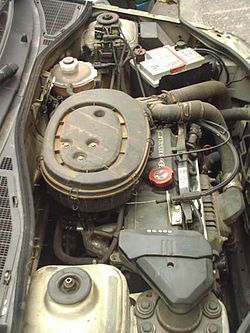
 E5F engine in a 1992 Renault Clio | |
| Overview | |
| Manufacturer | Renault |
| Also called | Renault E-Type engine |
| Production | 1988–2005 |
| Layout | |
| Configuration | I4 |
| Displacement |
|
| Cylinder bore | 75.8 mm (2.98 in) |
| Piston stroke | 64.9 mm (2.56 in) 77 mm (3.03 in) |
| Cylinder block material | Cast iron |
| Cylinder head material | Aluminum |
| Valvetrain | Overhead camshaft 8 valves |
| Combustion | |
| Fuel system | Carburetor, Single-point injection and Multipoint fuel injection |
| Fuel type | Gasoline |
| Cooling system | Water-cooled |
| Chronology | |
| Predecessor | Cléon-Fonte engine |
| Successor | DiET engine (Petrol) K engine (Diesel) |

The Renault Energy engine also known as "E engine" or "E-Type" (E for Energy) is an automotive gasoline four-stroke inline four cylinder internal combustion engine, with a sleeved water cooled cast iron block, equipped with 5 crankshaft bearings, an overhead camshaft driven by a toothed timing belt and an aluminum cylinder head with 8 overhead valves. Developed and produced by Renault in the late 1980s, the engine made its first appearance in the Renault 19.
History
[edit]In the late 1980s, the Cléon-Fonte engine still fitted to the R4, Super 5, R9, R11 and Express had become outdated with its lateral camshaft design. Competing brands were building more modern engines with overhead camshafts. The Cléon-Fonte engine had first appeared in 1962 on the Renault 8 and Renault Floride.
For the successor of the R9 and R11, the R19, Renault would develop a more modern engine. Renault modernized its old Cléon-Fonte motor with a new hemispheric cylinder head and an overhead camshaft, driven by a toothed timing belt, which appeared as the Energy in 1988. This new engine would go on to be used in the Clio 1, Mégane 1 and even Express. The Energy engine has also equipped the Renault 9 in Argentina, Colombia and Turkey.
However, at the launch of the Renault Twingo in 1993, Renault would be forced to continue production of the Cléon-Fonte engine because the "E engine", due to its hemispherical cylinder head and front exhaust, was too large to accommodate in the Twingo. The Energy (E7F) was gradually replaced with the D7F engine in 1996 on the Renault Clio, due to new standards of pollution control and lower fuel consumption required for more modern engines. The D7F engine simultaneously replaced the 1.2 Energy and the 1.2 Cléon-Fonte.[1]
The E7J was replaced by the K7J engine.
Cylinder dimensions and displacement
[edit]| Engine types | E5F — E7F | E6J — E7J |
|---|---|---|
| Bore | 75.8 mm (2.98 in) | |
| Stroke | 64.9 mm (2.56 in) | 77 mm (3.03 in) |
| Displacement | 1.2 L (1,171 cc) | 1.4 L (1,390 cc) |
Evolution Engine
[edit]The Energy engine evolved into the K engine that appeared on the Megane 1. The main difference is the machining of the cylinders since this engine has removable liners. The head of the Energy engine is kept on 8 valve versions. The K engine was also developed in 16-valve versions and was available as a diesel (K9K — 1.5 dCi).
ExF
[edit]The ExF displaces 1,171 cc (1.2 L; 71.5 cu in). The E5F is carbureted while the E7F has an electronically controlled single-point injection coupled to a catalytic converter. Output ranges between 40 and 44 kW (54 and 60 PS) depending on model year and application.
Applications:
- E5F
- 1991–1997 Renault Clio
- E7F
- 1988–1990 Renault R19
- 1991–1997 Renault Clio
ExJ
[edit]The ExJ displaces 1,390 cc (1.4 L; 84.8 cu in)
Applications:
- E6J (carbureted)
- 1988–1995 Renault R19
- 1991–1997 Renault Clio
- E7J (fuel injected)
- 1989– Renault Extra
- 1988–2000 Renault R19
- 1991–1997 Renault Clio
- 1996–1999 Renault Mégane
- –1988 Renault 9
- 1998–2001 Renault Kangoo
- 1997–2001 Renault Clio
- 2000–2003 Dacia SupeRNova
- 2003–2005 Dacia Solenza
References
[edit]- ^ « Cléon — Association RENAULT HISTOIRE » Association RENAULT HISTOIRE
Renault Energy engine
View on GrokipediaOverview and Design
Introduction
The Renault Energy engine, also known as the E-Type or E engine family, is a series of automotive gasoline four-stroke inline-four cylinder internal combustion engines produced by Renault.[5] These engines were designed to power compact and mid-size vehicles, with displacements ranging from 1.2 L to 1.7 L, marking a significant evolution in Renault's powertrain strategy with a focus on practical performance. Introduced in 1988, the Energy family debuted in the Renault 19 as a replacement for the larger-displacement variants of the Cléon-Fonte engine, offering improved refinement and modernity.[6] Production spanned from 1988 to the early 2000s, with some variants used until 2008 in select markets, during which the engines were installed in various models including the Renault Clio, Mégane, and Dacia Solenza, serving global markets until gradual phase-out in favor of newer designs.[7] At their core, Energy engines feature a water-cooled cast-iron block paired with an aluminum cylinder head, a single overhead camshaft (SOHC) configuration, 8 valves, and 5 main crankshaft bearings, prioritizing durability and thermal efficiency.[8] Tailored for economy cars, they emphasized reliability, enhanced fuel efficiency, and adherence to emerging emissions standards of the era, making them suitable for everyday urban and highway driving without excessive complexity.[5]Key Design Features
The Renault Energy engine employs a single overhead camshaft (SOHC) valvetrain with eight valves—two per cylinder—for balanced performance and efficiency in a compact inline-four configuration.[9] This design replaced the pushrod-operated Cléon-Fonte engines, offering improved breathing and reduced mechanical complexity while maintaining compatibility with everyday driving demands.[1] The engine block is constructed from durable cast iron, featuring wet cylinder liners that enhance longevity and allow for straightforward overhauls by facilitating liner replacement without full block machining.[7] It uses a conventional water-cooled system, with coolant circulation optimized for even temperature distribution across the block and head. Base designs omit balance shafts to prioritize simplicity and cost-effectiveness, though this results in noticeably higher vibrations at certain RPMs compared to successors like the K-Type family that incorporated them for smoother operation.[10] Fuel delivery evolved across variants to meet emissions and efficiency standards, starting with carburetors on early models like the E5F and E6J, progressing to single-point electronic injection on the E7F and E7J for better atomization and throttle response, and incorporating multipoint injection in select applications for precise fuel metering.[8] Compression ratios generally range from 9.2:1 to 9.8:1, tuned for compatibility with regular unleaded gasoline to balance power output and knock resistance without requiring premium fuels.[9]History and Development
Origins and Introduction
The Renault Energy engine family emerged in the mid-1980s as Renault sought to update its aging powertrain offerings amid growing environmental pressures in Europe, where concerns over acid rain drove the European Economic Community toward stricter vehicle emissions controls as precursors to the formal Euro standards.[11] These regulations, influenced heavily by German advocacy for limits on exhaust pollutants, compelled automakers like Renault to prioritize cleaner, more efficient designs to remain competitive in the compact car segment.[11] Development of the Energy engines aligned closely with the X-53 project for the Renault 19, initiated around 1984 and leveraging advanced computer-aided design and manufacturing tools to accelerate prototyping and testing.[12] The engines represented an evolutionary step from the long-serving Cléon-Fonte family, incorporating a single overhead camshaft (SOHC) layout in place of the older pushrod overhead valve configuration to enable better valve timing and overall refinement.[6] Primary goals focused on enhancing fuel efficiency and supporting compact transverse front-wheel-drive installations suitable for modern family hatchbacks, while the core engineering was conducted internally at Renault's Billancourt design center and Cléon engine production facility.[13] The Energy lineup debuted in production with the Renault 19's European launch in 1988, where the 1.4-liter E-type variant served as the entry-level petrol option, delivering 80 horsepower and marking a shift toward more economical powertrains for everyday motoring.[12] Initial reception highlighted the engines' notable improvements in fuel frugality and smooth delivery compared to prior Renault units, contributing to the 19's status as Europe's best-selling small family car in 1989 and 1990, though critics pointed to the base models' relatively modest performance for demanding drivers.[6]Production Timeline and Phase-Out
The Renault Energy engine entered production in 1988 alongside the debut of the Renault 19 model. [14] Manufacturing occurred primarily at Renault's Cléon plant in France, a key facility for the company's internal combustion engine production since 1958. [15] [13] Later versions incorporated mono-point fuel injection and catalytic converters between 1991 and 1996 to enhance efficiency and emissions performance. [1] Production peaked in the 1990s with widespread adoption in high-volume models such as the Clio and Mégane. The engine family began phase-out in 1996, with the 1.2 L variants (E5F and E7F) replaced by the D7F and the 1.4 L variants (E6J and E7J) succeeded by the K7J, driven by requirements for Euro 2 and Euro 3 emissions compliance and improved noise-vibration-harshness (NVH) levels. Limited applications persisted in export markets, including licensed assembly in Argentina, Turkey, and Colombia.Technical Specifications
Block and Cylinder Head
The Renault Energy engine utilizes a cast-iron cylinder block, offering strength, heat dissipation, and rebuildability for reliable performance in compact vehicles. It incorporates five main bearings to minimize vibrations and support torque loads. The cylinder head is fabricated from lightweight aluminum alloy, promoting efficient thermal management and reduced overall engine weight. It features cross-flow intake and exhaust ports to optimize airflow and combustion efficiency, along with a single overhead camshaft (SOHC) driven by a timing belt for precise valve timing in the 8-valve setup. Sealing between the block and head is achieved via a multi-layer steel gasket, designed to withstand elevated combustion pressures and temperatures while maintaining integrity over extended service intervals. The assembly is optimized for transverse installation in front-wheel-drive applications, with the intake manifold oriented forward and an optional integral exhaust manifold on select variants to improve space efficiency and exhaust gas recirculation.Dimensions and Displacements
The Renault Energy engine family, consisting of inline-four-cylinder configurations, utilizes a common bore diameter of 75.8 mm for its 1.2 L and 1.4 L variants, enabling modular design flexibility through stroke adjustments. The 1.2 L version (codes E5F and E7F) employs a stroke of 64.9 mm, while the 1.4 L version (codes E6J and E7J) features a stroke of 77 mm. The larger 1.6 L variant (code E7M) uses a 79.5 mm bore and 80.5 mm stroke.[16][17] Displacements are determined by the standard formula for inline-four engines: This yields 1,171 cc for the 1.2 L, 1,390 cc for the 1.4 L, and 1,598 cc for the 1.6 L variants. The cast-iron block design accommodates these geometric variations while maintaining structural integrity across the family.[16][17]| Variant | Bore (mm) | Stroke (mm) | Displacement (cc) |
|---|---|---|---|
| 1.2 L | 75.8 | 64.9 | 1,171 |
| 1.4 L | 75.8 | 77.0 | 1,390 |
| 1.6 L | 79.5 | 80.5 | 1,598 |
Engine Variants
1.2 L Variants (E5F and E7F)
The 1.2 L variants of the Renault Energy engine family, designated E5F and E7F, share a displacement of 1,171 cc achieved through a bore of 75.8 mm and a stroke of 64.9 mm. These inline-four, eight-valve engines feature an overhead camshaft design with a cast-iron block and aluminum head, emphasizing compactness and efficiency for entry-level applications. Both variants utilize a timing belt drive system requiring replacement every 60,000 km to maintain synchronization and prevent potential damage.[8][19] The E5F, introduced in 1988 as the base carbureted model, delivers power outputs ranging from 40 to 42 kW (54 to 57 PS) at 5,500 rpm, paired with torque of 85 to 90 Nm at 3,000 rpm. This configuration prioritizes fuel economy and simplicity, making it suitable for lightweight economy vehicles without catalytic converters in pre-1993 production runs. Compression ratios vary between 9.2 and 9.5, supporting operation on standard unleaded gasoline.[8][20][21] In 1991, the E7F superseded the E5F with a single-point electronic fuel injection system and integrated catalytic converter for improved emissions compliance starting from its launch. It produces 44 kW (60 PS) at 5,500 rpm and 92 Nm of torque at 3,000 rpm, offering a modest performance uplift while retaining the lightweight aluminum components for better responsiveness in compact chassis. Pre-catalyst E5F models persisted in some markets until 1993, after which all variants met evolving Euro 1 standards. These engines' design focused on durability and low maintenance, with the E7F's injection enhancing cold-start reliability and throttle response. They were commonly used in models like the Renault Clio and Twingo.[8][22][21]1.4 L Variants (E6J and E7J)
The 1.4 L variants of the Renault Energy engine, known as the E6J and E7J, serve as core options in the family, balancing modest performance with economical operation suitable for compact and mid-size vehicles. The E6J is the carbureted model with a displacement of 1,390 cc, introduced in 1989. It generates 59 kW (80 PS) at 5,750 rpm and 108 Nm of torque at 2,750 rpm.[4][3][23] The E7J, launched in 1992, employs multipoint fuel injection on the same 1,390 cc displacement for improved efficiency and emissions control. Power output varies from 55 kW (75 PS) to 58 kW (79 PS) at 5,750 rpm, with torque ranging from 105 Nm to 114 Nm at 2,750 rpm depending on calibration and market. Sub-variants such as the E7J 764 were adapted for export applications, often with adjusted tuning for local fuel standards.[24][25][3] Both variants utilize a timing belt for overhead camshaft drive, sharing the single overhead camshaft (SOHC) architecture of the Energy series with eight valves. Regular maintenance is essential, as the timing belt requires replacement every 80,000 km or five years to prevent failure, which can cause severe valve-piston interference damage in this interference engine design. Neglect often leads to common reliability issues, though the overall engine lifespan reaches about 200,000 km with proper care. These engines powered models such as the Renault 19 and first-generation Clio.[24][26]Applications and Performance
Vehicle Applications
The Renault Energy engine family found primary application in several Renault passenger cars and light commercial vehicles during the late 1980s and 1990s. The 1.4-liter variants, such as the carbureted E6J and fuel-injected E7J, powered the Renault 19 across all body styles (hatchback, sedan, and wagon) from its launch in 1988 until production ended in 1996. These same engines were fitted to the first-generation Renault Clio (1990-1998), serving as the base powerplant for entry-level trims in both hatchback and related commercial variants.[24] The Energy engines extended to the first-generation Renault Mégane lineup (1995-2002), where the E7J provided economical propulsion for the compact hatchback, sedan, and coupe models, particularly in European markets. In the utility segment, the Renault Express (also known as Rapid in some regions) utilized E6J and E7J units from 1991 to 2000, offering reliable performance for panel van and pickup configurations. Similarly, the first-generation Renault Kangoo (1997-2001) incorporated the E7J in select markets, including Europe and emerging economies, for its compact MPV and light van roles. Production of the Energy engine continued in select markets until 2005, despite phase-out in Europe by the mid-1990s.[24] Export and licensed production broadened the Energy engine's reach. In Argentina, the Renault 9 and 11 models received 1.4-liter Energy variants during the 1990s, supporting local assembly and adaptation for South American conditions. In Romania, Dacia integrated the E7J into the Nova and Supernova sedans from 1995 to 2000, marking an early technology transfer under Renault's ownership of the brand. Third-party applications were limited but notable within the Renault-Nissan alliance. The Dacia Solenza (2003-2005), a successor to the Supernova, employed the E7J 262 variant for its liftback body, providing affordable mobility in Eastern European markets.[24]Power Outputs and Fuel Systems
The Renault Energy engine family featured varying power outputs across its variants, tailored to different vehicle requirements while maintaining a focus on economy and reliability. The 1.2 L variants delivered modest performance suitable for entry-level models, with the E5F producing 40 kW (54 PS) at 5,500 rpm and 85 Nm of torque at 3,500 rpm, while the E7F offered a slight improvement to 44 kW (60 PS) at 5,750 rpm and 92 Nm at 3,500 rpm.[27][28] In the 1.4 L range, the E6J provided 59 kW (80 PS) at 5,750 rpm with 108 Nm at 2,750 rpm, and the E7J advanced to 55 kW (75 PS) at 5,500 rpm and 112 Nm at 2,800 rpm for enhanced mid-range pull.[4][24]| Variant | Displacement | Power (kW/PS) | Torque (Nm) | RPM (Power/Torque) |
|---|---|---|---|---|
| E5F | 1.2 L | 40/54 | 85 | 5,500 / 3,500 |
| E7F | 1.2 L | 44/60 | 92 | 5,750 / 3,500 |
| E6J | 1.4 L | 59/80 | 108 | 5,750 / 2,750 |
| E7J | 1.4 L | 55/75 | 112 | 5,500 / 2,800 |