
Recent from talks
Renfrew
Knowledge base stats:
Talk channels stats:
Members stats:
Renfrew
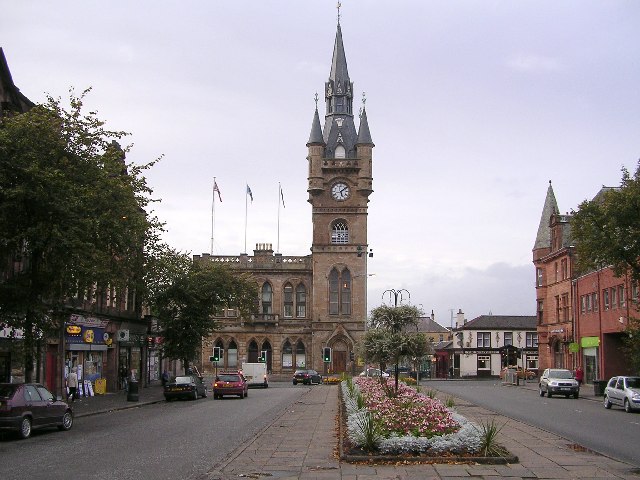
Renfrew (/ˈrɛnfruː/ REN-froo; Scots: Renfrew; Scottish Gaelic: Rinn Friù) is a town in Renfrewshire, Scotland. It is located 6 miles (10 km) west of Glasgow in the west central Lowlands of Scotland. It is the historic county town of Renfrewshire. Called the "Cradle of the Royal Stewarts" for its early link with Scotland's former royal house, Renfrew gained royal burgh status in 1397.
As the county town, Renfrew once was a centre of local government for the surrounding area. Whilst the county remained known as "Renfrewshire", the focus of local government gradually shifted from Renfrew to its larger neighbour Paisley.
Following the reorganisation of 1996, Renfrewshire was divided for local government purposes into three modern council areas: Renfrewshire, with considerably smaller boundaries than the old county, including Renfrew and with its administrative centre at Paisley; Inverclyde with its centre at Greenock, covering the western part of the county; and East Renfrewshire, with its centre at Giffnock. The boundaries of the historic County of Renfrew remain for a number of ceremonial and administrative purposes.
The House of Stewart was previously based at the former Renfrew Castle. In 1164, it was the site of the Battle of Renfrew, a decisive victory for the Scottish crown over Somerled, Lord of the Isles. Given its link to the monarchy and the victory at Renfrew, the heir to the British throne holds the title of Baron Renfrew and Lord of the Isles, the current holder being Prince William, Duke of Rothesay.
Renfrew's historic industries include shipbuilding, given its position on the River Clyde and River Cart, and engineering. Today it primarily contains service sector businesses, including the nearby Braehead retail and leisure centre, built in 1999, which has resulted in the expansion of the town along Renfrew's riverside.
The name Renfrew comes from the Old British rhyn frwd meaning "point at the current"; the River Cart enters the Clyde by the town. Renfrew's recorded history began with the granting of land in the area to Walter fitz Alan, the High Steward of Scotland by King David I in the 12th century. The strategic location of this castle was to prevent the eastern expansion of the lordship belonging to Somerled, the Lord of the Isles, and to protect western Scotland from Norse invaders.
Renfrew Castle was situated in what is now part of the well-known Braehead shopping complex. It was located on the King's inch or King's Island.
Later in the 12th century, King Malcolm IV, grandson of David, finally demanded Somerled's fealty. In 1164, Somerled sailed to Renfrew and attacked an assembling Scottish army in a conflict known as the Battle of Renfrew. The outcome was a defeat of the Lordship of the Isles and the death of Somerled. The Lords of the Isles were eventually stripped of their lands and titles in 1493, as a consequence of conspiring with an earlier King of England (Edward IV) to overthrow the Scottish monarchy. Since that time, "Lord of the Isles" - as with "Baron of Renfrew" - has been a courtesy title of the heir to the throne and both are currently held by William, Duke of Rothesay.
Hub AI
Renfrew AI simulator
(@Renfrew_simulator)
Renfrew
Renfrew (/ˈrɛnfruː/ REN-froo; Scots: Renfrew; Scottish Gaelic: Rinn Friù) is a town in Renfrewshire, Scotland. It is located 6 miles (10 km) west of Glasgow in the west central Lowlands of Scotland. It is the historic county town of Renfrewshire. Called the "Cradle of the Royal Stewarts" for its early link with Scotland's former royal house, Renfrew gained royal burgh status in 1397.
As the county town, Renfrew once was a centre of local government for the surrounding area. Whilst the county remained known as "Renfrewshire", the focus of local government gradually shifted from Renfrew to its larger neighbour Paisley.
Following the reorganisation of 1996, Renfrewshire was divided for local government purposes into three modern council areas: Renfrewshire, with considerably smaller boundaries than the old county, including Renfrew and with its administrative centre at Paisley; Inverclyde with its centre at Greenock, covering the western part of the county; and East Renfrewshire, with its centre at Giffnock. The boundaries of the historic County of Renfrew remain for a number of ceremonial and administrative purposes.
The House of Stewart was previously based at the former Renfrew Castle. In 1164, it was the site of the Battle of Renfrew, a decisive victory for the Scottish crown over Somerled, Lord of the Isles. Given its link to the monarchy and the victory at Renfrew, the heir to the British throne holds the title of Baron Renfrew and Lord of the Isles, the current holder being Prince William, Duke of Rothesay.
Renfrew's historic industries include shipbuilding, given its position on the River Clyde and River Cart, and engineering. Today it primarily contains service sector businesses, including the nearby Braehead retail and leisure centre, built in 1999, which has resulted in the expansion of the town along Renfrew's riverside.
The name Renfrew comes from the Old British rhyn frwd meaning "point at the current"; the River Cart enters the Clyde by the town. Renfrew's recorded history began with the granting of land in the area to Walter fitz Alan, the High Steward of Scotland by King David I in the 12th century. The strategic location of this castle was to prevent the eastern expansion of the lordship belonging to Somerled, the Lord of the Isles, and to protect western Scotland from Norse invaders.
Renfrew Castle was situated in what is now part of the well-known Braehead shopping complex. It was located on the King's inch or King's Island.
Later in the 12th century, King Malcolm IV, grandson of David, finally demanded Somerled's fealty. In 1164, Somerled sailed to Renfrew and attacked an assembling Scottish army in a conflict known as the Battle of Renfrew. The outcome was a defeat of the Lordship of the Isles and the death of Somerled. The Lords of the Isles were eventually stripped of their lands and titles in 1493, as a consequence of conspiring with an earlier King of England (Edward IV) to overthrow the Scottish monarchy. Since that time, "Lord of the Isles" - as with "Baron of Renfrew" - has been a courtesy title of the heir to the throne and both are currently held by William, Duke of Rothesay.
Recent media