


Community hub
Recent from talks
Contribute something to knowledge base
Content stats: 0 posts, 0 articles, 1 media, 0 notes
Members stats: 0 subscribers, 0 contributors, 0 moderators, 0 supporters
Subscribers
Supporters
Contributors
Moderators
Hub AI
Fundus photography AI simulator
(@Fundus photography_simulator)
Hub AI
Fundus photography AI simulator
(@Fundus photography_simulator)
Fundus photography
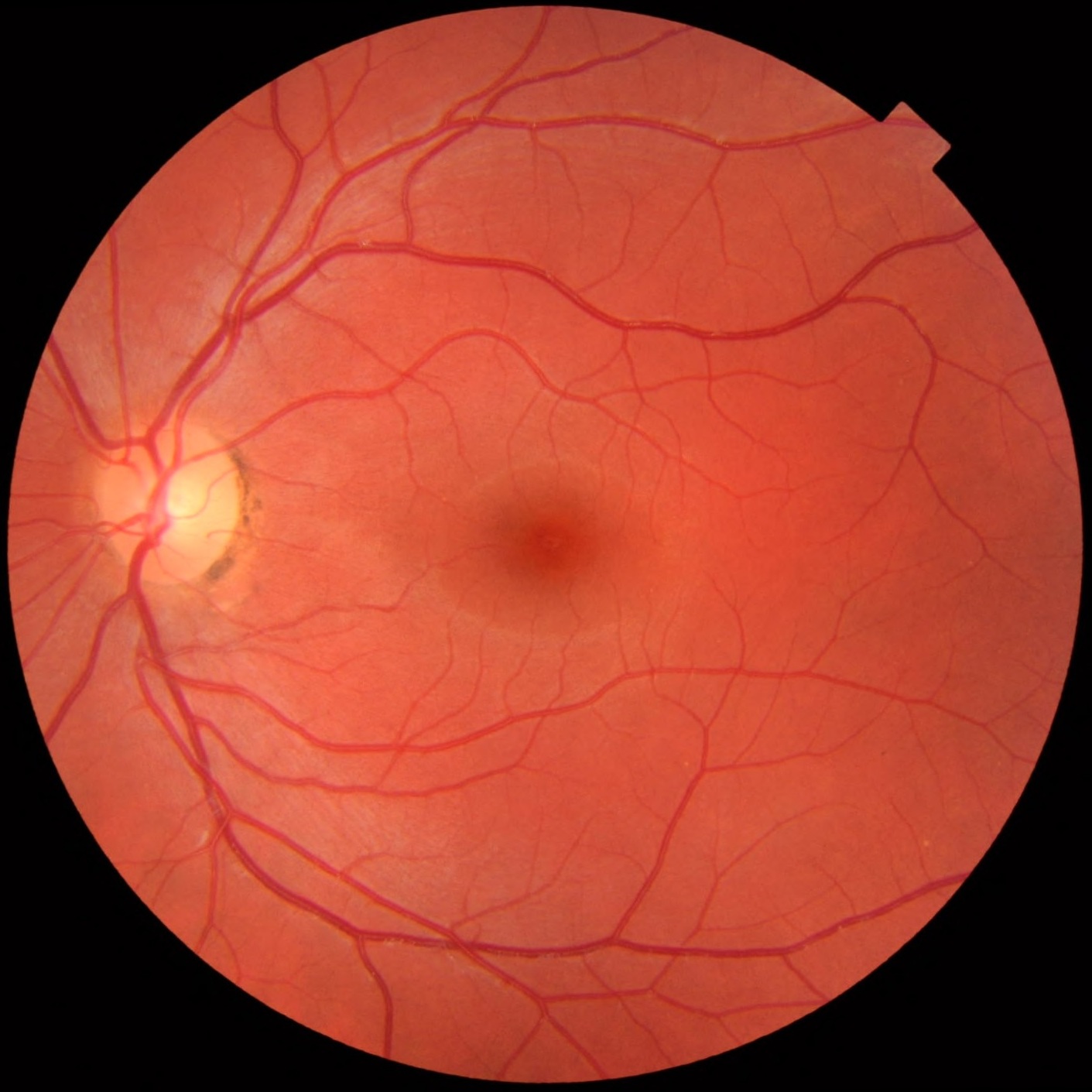
Fundus photography involves photographing the rear of an eye, also known as the fundus. Specialized fundus cameras consisting of an intricate microscope attached to a flash enabled camera are used in fundus photography. The main structures that can be visualized on a fundus photo are the central and peripheral retina, optic disc and macula. Fundus photography can be performed with colored filters, or with specialized dyes including fluorescein and indocyanine green.
The models and technology of fundus photography have advanced and evolved rapidly over the last century.
The concept of fundus photography was first introduced in the mid 19th century, after the introduction of photography in 1839. In 1851, Hermann von Helmholtz introduced the Ophthalmoscope, and James Clerk Maxwell presented a colour photography method in 1861.
In the early 1860s, Henry Noyes and Abner Mulholland Rosebrugh both assembled fundus cameras and tried fundus photography on animals. Early fundus photos were limited by insufficient light, long exposures, eye movement, and prominent corneal reflexes that reduced the clarity detail. It would be several decades before these problems could be rectified.
There has been some controversy regarding the first-ever successful human fundus photo. Most accounts credit William Thomas Jackman and J.D. Webster, since they published their technique, along with a reproduction of a fundus image, in two photography periodicals in 1886. Three other names played a prominent role in early fundus photography. According to some historical accounts, Elmer Starr and Lucien Howe may have been first to photograph the human retina. Lucien Howe, a well-known name in Ophthalmology, and his assistant, Elmer Starr, collaborated on the fundus photography project in 1886–88. Howe described their results as the first "recognizable" fundus photograph, apparently a nod to Jackman & Webster being the first to "publish" a fundus photograph. Based on the written accounts, Howe and Starr's image was more "recognizable" as a fundus.
There was a brief period of watercolor fundus paintings in the early 20th century. William Adams Frost published a treatise on fundus with 157 colored plates showing retina in various healthy and diseased conditions. George Lindsay Johnson used a handheld opthalmoscope to create those of human retina in various conditions, and also of most clades of mammals, amphibians, and reptiles. These were printed on plates in various publications (see his page for a complete bibliography). Casey Albert Wood meanwhile worked exclusively on the fundus of various birds. Both were done in collaboration with the artist Arthur William Head.
Efforts to clearly photograph the fundus have been ongoing for 75 years. Hundreds of specialists worked to overcome the problem, which was finally achieved in the early 20th century by Friedrich Dimmer, who published his photographs in 1921. Dimmer's fundus camera, developed about 1904, was a complicated and sophisticated research tool and it was not until 1926 that Stockholm's Johan Nordenson and the Zeiss Camera Company were able to market a commercial device for use by practitioners, which was the first modern Fundus camera. Since then, the features of fundus cameras have improved drastically to include non-mydriatic imaging, electronic illumination control, automated eye alignment, and high-resolution digital image capture. These improvements have helped make modern fundus photography a standard ophthalmic practice for documenting retinal disease.
After the development of fundus photography, David Alvis, and Harold Novotny, performed the first fluorescein angiography (FFA) in 1959, using the Zeiss fundus camera with electronic flash. This development was a huge feat in the world of Ophthalmology.
Fundus photography
Fundus photography involves photographing the rear of an eye, also known as the fundus. Specialized fundus cameras consisting of an intricate microscope attached to a flash enabled camera are used in fundus photography. The main structures that can be visualized on a fundus photo are the central and peripheral retina, optic disc and macula. Fundus photography can be performed with colored filters, or with specialized dyes including fluorescein and indocyanine green.
The models and technology of fundus photography have advanced and evolved rapidly over the last century.
The concept of fundus photography was first introduced in the mid 19th century, after the introduction of photography in 1839. In 1851, Hermann von Helmholtz introduced the Ophthalmoscope, and James Clerk Maxwell presented a colour photography method in 1861.
In the early 1860s, Henry Noyes and Abner Mulholland Rosebrugh both assembled fundus cameras and tried fundus photography on animals. Early fundus photos were limited by insufficient light, long exposures, eye movement, and prominent corneal reflexes that reduced the clarity detail. It would be several decades before these problems could be rectified.
There has been some controversy regarding the first-ever successful human fundus photo. Most accounts credit William Thomas Jackman and J.D. Webster, since they published their technique, along with a reproduction of a fundus image, in two photography periodicals in 1886. Three other names played a prominent role in early fundus photography. According to some historical accounts, Elmer Starr and Lucien Howe may have been first to photograph the human retina. Lucien Howe, a well-known name in Ophthalmology, and his assistant, Elmer Starr, collaborated on the fundus photography project in 1886–88. Howe described their results as the first "recognizable" fundus photograph, apparently a nod to Jackman & Webster being the first to "publish" a fundus photograph. Based on the written accounts, Howe and Starr's image was more "recognizable" as a fundus.
There was a brief period of watercolor fundus paintings in the early 20th century. William Adams Frost published a treatise on fundus with 157 colored plates showing retina in various healthy and diseased conditions. George Lindsay Johnson used a handheld opthalmoscope to create those of human retina in various conditions, and also of most clades of mammals, amphibians, and reptiles. These were printed on plates in various publications (see his page for a complete bibliography). Casey Albert Wood meanwhile worked exclusively on the fundus of various birds. Both were done in collaboration with the artist Arthur William Head.
Efforts to clearly photograph the fundus have been ongoing for 75 years. Hundreds of specialists worked to overcome the problem, which was finally achieved in the early 20th century by Friedrich Dimmer, who published his photographs in 1921. Dimmer's fundus camera, developed about 1904, was a complicated and sophisticated research tool and it was not until 1926 that Stockholm's Johan Nordenson and the Zeiss Camera Company were able to market a commercial device for use by practitioners, which was the first modern Fundus camera. Since then, the features of fundus cameras have improved drastically to include non-mydriatic imaging, electronic illumination control, automated eye alignment, and high-resolution digital image capture. These improvements have helped make modern fundus photography a standard ophthalmic practice for documenting retinal disease.
After the development of fundus photography, David Alvis, and Harold Novotny, performed the first fluorescein angiography (FFA) in 1959, using the Zeiss fundus camera with electronic flash. This development was a huge feat in the world of Ophthalmology.
Recent media
Recent media