Hubbry Logo
Optic discOptic discMain
Open search
Optic disc
Community hub
Optic disc
logo
8 pages, 0 posts
0 subscribers
Be the first to start a discussion here.
Optic disc
Optic disc
from Wikipedia
Optic disc
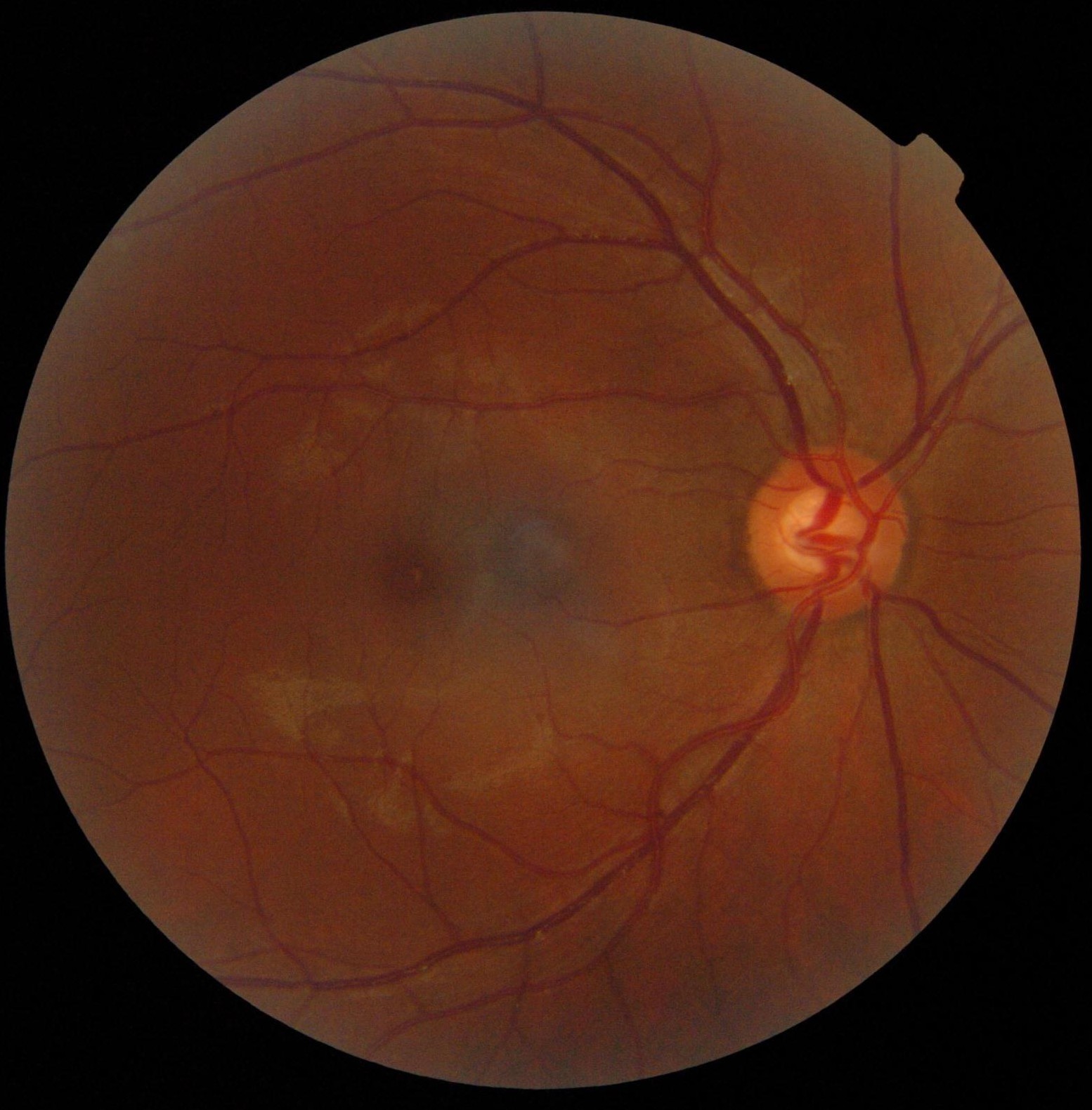
Ophthalmoscopy photograph showing the optic disc as a bright area on the right where blood vessels converge.
The terminal portion of the optic nerve and its entrance into the eyeball, in horizontal section.
Details
SynonymsOptic disk, optic disc, optic nerve head, blind spot, Mariotte blind spot, Mariotte's blind spot, optic papilla, discus nervi optici [TA], papilla nervi optici, porus opticus)
Identifiers
Latindiscus nervi optici
MeSHD009898
TA98A15.2.04.019
TA26788
FMA58634
Anatomical terminology

The optic disc or optic nerve head is the point of exit for ganglion cell axons leaving the eye. Because there are no rods or cones overlying the optic disc, it corresponds to a small blind spot in each eye.

The ganglion cell axons form the optic nerve after they leave the eye. The optic disc represents the beginning of the optic nerve and is the point where the axons of retinal ganglion cells come together. The optic disc in a normal human eye carries 1–1.2 million afferent nerve fibers from the eye toward the brain. The optic disc is also the entry point for the major arteries that supply the retina with blood, and the exit point for the veins from the retina.[1]

Structure

[edit]

The optic disc is located 3 to 4 mm to the nasal side of the fovea. It is a vertical oval, with average dimensions of 1.76mm horizontally by 1.92mm vertically.[2] There is a central depression, of variable size, called the optic cup. This depression can be a variety of shapes from a shallow indentation to a bean pot—this shape can be significant for diagnosis of some retinal diseases.

Function

[edit]

The optic disc or optic nerve head is the point of exit for ganglion cell axons leaving the eye. Because there are no rods or cones overlying the optic disc, it corresponds to a small blind spot in each eye.

Clinical significance

[edit]

Almost all eye structures can be examined with appropriate optical equipment and lenses. Using a modern direct ophthalmoscope gives a view of the optic disc using the principle of reversibility of light. A slit lamp biomicroscopic examination along with an appropriate aspheric focusing lens (+66D, +78D or +90D) is required for a detailed stereoscopic view of the optic disc and structures inside the eye.

A biomicroscopic exam can indicate the health of the optic nerve. In particular, the eye care physician notes the colour, cupping size (as a cup-to-disc ratio), sharpness of edge, swelling, hemorrhages, notching in the optic disc and any other unusual anomalies. It is useful for finding evidence corroborating the diagnosis of glaucoma and other optic neuropathies, optic neuritis, anterior ischemic optic neuropathy or papilledema (i.e. optic disc swelling produced by raised intracranial pressure), and optic disc drusen.

Women in an advanced stage of pregnancy with pre-eclampsia should be screened by an ophthalmoscopic examination of the optic disc for early evidence of a rise in intracranial pressure.

Pale disc

[edit]
Schematic diagram of the human eye, with the optic disc, or blind spot, at the lower left. Shown is a horizontal cross section of the right eye, viewed from above.

A normal optic disc is orange to pink in colour and may vary based on ethnicity.[3] A pale disc is an optic disc which varies in colour from a pale pink or orange colour to white. A pale disc is an indication of a disease condition.[citation needed]

Imaging

[edit]
Optic disc cross-sections imaged by an SD-OCT.

Traditional colour-film camera images are the reference standard in imaging, requiring an expert ophthalmic photographer, ophthalmic technician, optometrist or ophthalmologist for taking standardised pictures of the optic disc. Stereoscopic images offer an excellent investigative tool for serial follow-up of suspected changes in the hands of an expert optometrist or ophthalmologist.

Automated techniques have also been developed to allow for more efficient and less expensive imaging. Heidelberg retinal tomography (HRT), scanning laser polarimetry and optical coherence tomography are computerised techniques for imaging various structures of the eyes, including the optic disc. They quantify the nerve fiber layer of the disc and surrounding retina and statistically correlate the findings with a database of previously screened population of normals. They are useful for baseline and serial follow-up to monitor minute changes in optic disc morphology. Imaging will not provide conclusive evidence for clinical diagnosis however, and the evidence needs to be supplanted by serial physiological testing for functional changes. Such tests may include visual field charting and final clinical interpretation of the complete eye examination by an eye care physician. Ophthalmologists and optometrists are able to provide this service.

Blood flow in the retina and choroid in the optic disc region can be revealed non invasively by near-infrared laser Doppler imaging.[4] Laser Doppler imaging can enable mapping of the local arterial resistivity index, and the possibility to perform unambiguous identification of retinal arteries and veins on the basis of their systole-diastole variations, and reveal ocular hemodynamics in human eyes.[5] Furthermore, the Doppler spectrum asymmetry reveals the local direction of blood flow with respect to the optical axis. This directional information is overlaid on standard grayscale blood flow images to depict flow in the central artery and vein.[6]

A systematic review of 106 studies and 16,260 eyes compared the performance of the imaging techniques, and found that all three imaging tests performed very similarly when detecting for glaucoma.[7] The review found that in 1,000 patients subjected to imaging tests, with 200 having manifest glaucoma, the best imaging tests would miss 60 cases out of the 200 patients with glaucoma, and incorrectly refer 50 out of 800 patients without glaucoma.[7]

Abnormalities

[edit]
  • Megalopapilla: a non-progressive condition in which the optic disc is enlarged (diameter exceeding 2.1 mm) with no other morphological abnormalities.[8]
  • Morning glory disc anomaly: a unilateral congenital deformity resulting from failure of the optic nerve to completely form in utero.[9][10] The term was coined in 1970 by Kindler, noting a resemblance of the malformed optic nerve to the morning glory flower.[11]
  • Optic pit: congenital excavation of the optic disc resulting from a malformation during development of the eye.[12]
[edit]

Comparative anatomy

[edit]

The optic disc has different shapes among vertebrates. It may be circular, oval, reniform, triangular, or linear.[13][14][15] The linear form is the case for the squirrels, most birds, and the predaceous pikes, salmonoids, and percoids among the teleost fishes.[16]: 179 

Most squirrels have a very long and thin linear optic disc, placed horizontally and dorsally in the retina. This allows the squirrel to see the sky without blind spots. Generally, the brighter the environment that the squirrel is active in, the longer the optic disc. The flying squirrel Glaucomys volans is nocturnal, and has a circular optic disc at the center of the fundus.[16]: 180 

See also

[edit]

References

[edit]
[edit]
Revisions and contributorsEdit on WikipediaRead on Wikipedia
from Grokipedia
The optic disc, also known as the optic nerve head, is the intraocular portion of the visible on the fundus of the eye, formed by the convergence of approximately 1.2 million axons from retinal ganglion cells as they exit the to form the optic nerve. This structure is located nasally to the on the and measures about 1.5 mm in diameter, spanning an area of roughly 2.1–2.8 mm² in non-myopic individuals. Devoid of photoreceptors such as and cones, the optic disc creates a physiological blind spot in the , as no light detection occurs at this site. The optic disc's anatomy includes the neuroretinal rim, composed of axons and support glial cells, surrounding a central cup where the axons pass through the fenestrated scleral structure known as the lamina cribrosa. Axons remain unmyelinated within the eye until they traverse the lamina cribrosa, after which myelination begins, facilitating efficient transmission of visual signals to the brain. Functionally, it serves as the entry point for the , carrying afferent visual impulses from the to the and contributing to reflexes like pupillary light response and accommodation. Clinically, the optic disc is crucial for diagnosing ocular and neurological conditions; for instance, swelling () may indicate elevated , while cupping or rim thinning often signals due to progressive retinal nerve fiber loss. Variations in disc size or shape, such as tilted discs or congenital anomalies, can influence susceptibility to diseases like or non-arteritic . Imaging techniques, including , are commonly used to assess disc parameters for early detection of pathology.

Anatomy

Location and macroscopic features

The optic disc, also known as the optic nerve head, serves as the entry point where the optic nerve fibers converge and exit the retina to form the , transmitting visual signals to the . In the , it is positioned approximately 3 to 4 mm nasal to the , the region of highest , within the posterior pole of the eyeball. This location places the optic disc in the superonasal quadrant relative to the fovea when viewed in standard fundus orientation, contributing to its role as a fixed anatomical landmark in . Macroscopically, the optic disc typically presents as a circular or oval structure with a vertical of about 1.5 to 1.8 mm and a horizontal of 1.7 to 1.8 mm, though exact dimensions can vary slightly between individuals. Its appearance is characteristically pale or yellowish compared to the surrounding reddish , owing to the complete absence of photoreceptor cells ( and cones) in this region, which results in a lack of the pigmentation and vascular density seen elsewhere on the . The disc's surface features a central depression known as the optic cup, a physiologic excavation formed by the convergence of retinal fibers, surrounded by the neuroretinal rim—a peripheral band of tissue comprising the fiber layer, blood vessels, and supporting glial elements that arches over the head. In healthy individuals, the optic disc exhibits natural variability in size, with areas ranging from approximately 1.0 to 3.0 mm², influenced by factors such as age, , and ; larger discs are more common in myopic eyes, while smaller ones may occur in hyperopic or pediatric populations. The cup-to-disc ratio, which measures the proportion of the optic cup's diameter to the overall disc diameter, normally falls between 0.3 and 0.5 vertically, though values up to 0.7 can be physiologic without , reflecting individual differences in axonal packing and scleral canal architecture. This ratio provides a baseline for clinical assessment, as deviations may signal underlying conditions, but healthy variability underscores the importance of comparing inter-eye (typically less than 0.2) rather than absolute measurements alone.

Histological composition

The optic disc, also known as the optic papilla, lacks photoreceptor cells such as and cones, distinguishing it from the surrounding and rendering it insensitive to light. Instead, it is primarily composed of approximately 1.2 million unmyelinated axons originating from the cells, which converge to form the . These axons are supported by glial cells, including that provide structural and metabolic support, and responsible for myelination within the portion of the nerve. Fibroblasts and capillary-associated cells are also present, contributing to the and vascular interfaces. The histological structure of the optic disc is organized into distinct layers that facilitate the transition of retinal axons into the . The surface nerve fiber layer consists of bundled ganglion cell axons covered by an internal limiting membrane formed by , which separates the disc from the vitreous humor. Beneath this lies the prelaminar region, rich in glial and s. The key structural feature is the lamina cribrosa, a fenestrated sieve-like plate composed of collagenous and glial elements within the , through which the axons pass to exit the eye; it contains 200–300 perforations that allow for the orderly bundling of fibers. This layering ensures mechanical support and protection for the axons as they penetrate the . Blood supply to the optic disc is derived mainly from the short posterior ciliary arteries, which form the circle of Zinn-Haller to perfuse the laminar and retrolaminar regions, providing nutrients to the deeper axonal and glial tissues. Branches of the central retinal artery, which enters the disc nasally through the lamina cribrosa, supply the superficial nerve fiber layer but do not directly perfuse the central disc structure, contributing to its relatively avascular appearance compared to the retina. This dual but compartmentalized vascularization supports the disc's role as a transitional zone. Embryologically, the optic disc arises from the optic vesicle, an evagination of the during the fourth week of , which develops into the optic cup and stalk. The ventral aspect of the optic cup features the choroidal or embryonic fissure, a transient opening that permits the ingress of mesenchymal tissue and the hyaloid vasculature to nourish the developing lens and . Closure of this fissure by the seventh gestational week seals the optic stalk, forming the optic disc at the posterior pole of the globe; this process excludes choroidal capillaries from the central disc region, contributing to its avascularity and absence of photoreceptors.

Physiology

Role in visual signal transmission

The optic disc functions as the primary exit point for visual signals from the , where the axons of approximately 1.2 million retinal ganglion cells (RGCs) converge to form the . These axons originate from RGCs across the entire , carrying processed visual information in the form of action potentials that encode patterns of light and contrast. The convergence occurs in an organized manner, with axons from the and peripheral following arcuate and radial paths to bundle tightly at the disc, ensuring efficient transmission without significant signal loss at this junction. Within the retina, RGC axons remain unmyelinated to accommodate the thin retinal architecture, but myelination begins immediately after they pass through the lamina cribrosa at the optic disc. This transition to myelinated fibers, facilitated by in the , enables , dramatically increasing signal propagation speed from around 1-2 m/s in unmyelinated segments to over 10-20 m/s in myelinated portions. The result is rapid relay of visual impulses to central targets, critical for real-time perception. As the starting point of the central visual pathway, the optic disc integrates RGC axons into a cohesive bundle, setting the stage for partial of nasal retinal fibers at the downstream , which aligns inputs from both eyes for stereoscopic vision. This organization preserves retinotopic mapping, with upper and lower field fibers maintaining relative positions through the . The metabolic demands of these axons are substantial, driven by the energy-intensive processes of maintaining gradients and facilitating anterograde/retrograde transport of proteins, organelles, and trophic factors essential for RGC survival and function. Glial cells, including and surrounding the axons at and beyond the disc, provide critical metabolic support by shuttling lactate, , and other substrates via the astrocyte-neuron lactate shuttle and networks. This glial buffering meets the high ATP requirements—estimated at up to 75% of axonal energy for sodium-potassium activity—preventing bioenergetic failure during sustained visual processing.

Blind spot and perceptual filling-in

The blind spot, also known as the physiological , arises from the absence of photoreceptors at the optic disc, creating a region of functional blindness in the . This is typically located about 15 degrees temporal to the point of fixation and measures approximately 5 degrees horizontally by 7 to 10 degrees vertically. The presence of the blind spot can be demonstrated through perimetry tests, which systematically map sensitivity and reveal the absolute corresponding to the optic disc. In standard automated perimetry, such as the Humphrey Field Analyzer, stimuli are presented across the while the subject fixates on a central target, with the blind spot appearing as a consistent area of non-detection roughly 10 to 15 degrees temporal to fixation. Simple blind spot mapping experiments further illustrate this phenomenon; for instance, by holding a card with a central and a dot 6 inches to the right at arm's length, closing the left eye, and slowly bringing the card closer while fixating on the , the dot disappears when it aligns with the right eye's blind spot, confirming its location and size. Perceptual filling-in compensates for the blind spot by interpolating missing information from surrounding retinal activity into the , creating a seamless perceptual without of the gap. This involves neurons in the primary visual cortex (V1), particularly in deeper layers like layer 6, which respond to large stimuli extending over the blind spot, effectively treating the area as if it were stimulated by integrating signals from adjacent retinotopic regions. Such cortical ensures that stable visual features, like color and texture from nearby areas, are perceived as continuous across the . Evolutionarily, the blind spot represents a favoring neural efficiency, where converging ganglion cell axons into a single bundle at the disc allows compact transmission to the , at the minor cost of incomplete coverage that is mitigated by binocular overlap and mechanisms. This traces back to early eye evolution, prioritizing efficient wiring over eliminating the small .

Clinical Evaluation

Fundoscopic examination

Fundoscopic examination, also known as , is a fundamental clinical technique for visualizing the optic disc and posterior eye structures during routine eye assessments. Introduced by in 1851, the ophthalmoscope revolutionized by enabling direct observation of the living and optic disc, previously inaccessible without invasive methods. This method relies on coaxial illumination to produce a through the , allowing clinicians to inspect the optic disc's macroscopic features, such as its pinkish, circular appearance approximately 1.5 mm in diameter. Two primary techniques are employed: direct ophthalmoscopy and indirect ophthalmoscopy. Direct ophthalmoscopy uses a handheld instrument held close to the patient's eye (about 1-2 cm), providing an upright, magnified view (15x) of the central and optic disc, ideal for detailed assessment in settings. Indirect ophthalmoscopy, often performed binocularly with a 20D condensing lens and head-mounted , offers a wider (about 46-60 degrees) and but inverts the image; it is particularly useful for peripheral examination while still allowing optic disc evaluation. For enhanced magnification and stability in office settings, slit-lamp biomicroscopy with a 90D is commonly used, providing 0.76x magnification and a 76-degree field, enabling precise stereoscopic viewing of the optic disc without patient discomfort from close proximity. The procedure begins with patient preparation: the individual is positioned sitting or semi-reclined in a dimly lit room to facilitate dilation, which is achieved using mydriatic drops such as tropicamide (1%) to expand the to at least 4-5 mm for optimal visualization. The clinician then darkens the room further, instructs the patient to fixate on a distant target straight ahead, and approaches from the temporal side. Starting at arm's length, the ophthalmoscope's is aligned coaxially with the patient's to elicit the ; the examiner advances gradually, adjusting the lens dial for (0 diopters initially) and focusing on the optic disc by following the vessels nasally. Once located, the disc is systematically assessed for contour, color, and margins before pivoting the instrument to survey surrounding areas; the examination is repeated for the fellow eye. Documentation includes noting the cup-to-disc (C/D) , calculated as the diameter of the central physiologic cup divided by the total disc , typically ranging from 0.3 to 0.5 in healthy adults. In a normal fundoscopic view, the optic disc exhibits a sharp, well-defined rim with a creamy to yellowish-orange hue, reflecting its myelinated nerve fiber layer. Physiologic cupping appears as a shallow central depression, often more pronounced temporally, without notching or , and central vessels emerge from the cup's inferior nasal aspect before branching across the disc surface. These features confirm the disc's healthy architecture, with no blurring of margins or vessel anomalies, serving as a baseline for serial monitoring in clinical practice.

Advanced imaging techniques

Optical coherence tomography (OCT) provides high-resolution, cross-sectional imaging of the optic disc and surrounding , enabling precise measurement of the (RNFL) thickness, which typically ranges from 90 to 120 μm in healthy adults. This non-invasive technique uses low-coherence to generate layered images, facilitating quantitative assessment of RNFL thinning as an early indicator of . Scanning laser ophthalmoscopy (SLO) and offer detailed visualization and 3D mapping of the optic disc topography by employing confocal laser scanning to reduce out-of-focus and produce high-contrast en face images. These methods allow for stereoscopic reconstruction of disc elevation and peripapillary structures, aiding in the evaluation of disc morphology without pupil dilation in many cases. Fluorescein angiography assesses vascular perfusion and leakage at the optic disc by injecting intravenous fluorescein dye and capturing serial fundus to highlight choroidal and circulation patterns. This dynamic reveals filling defects, hyperfluorescence, or specific to disc vasculature, supporting diagnosis of ischemic or inflammatory conditions. Post-2020 advancements in AI-assisted OCT have enhanced early detection by automating RNFL analysis, achieving higher sensitivity than traditional methods through models that identify subtle structural changes. These algorithms integrate multimodal data for more accurate progression monitoring, reducing diagnostic variability in clinical settings.

Pathological Changes

Optic and

Optic atrophy, also known as optic pallor, refers to the end-stage morphological change in the optic disc resulting from the degeneration and loss of retinal ganglion cell axons in the . This condition arises primarily from acquired damage due to ischemia, compression, or toxic/metabolic insults, which trigger axonal degeneration and subsequent reactive . Ischemic causes include (AION), where reduced blood flow leads to infarction of the optic nerve head, while compressive etiologies involve tumors such as pituitary adenomas or meningiomas that mechanically impair . Toxic and metabolic factors, such as methanol poisoning or nutritional deficiencies, disrupt mitochondrial function and energy metabolism in ganglion cells, promoting and fiber loss. Clinically, optic atrophy manifests as a pale, whitish, or chalky disc on fundoscopic examination, often appearing shrunken with blurred margins due to gliotic scarring. A key feature is the increased cup-to-disc ratio, reflecting the excavation from preferential loss of fibers and support tissue, accompanied by attenuated vessels and visibility of the lamina cribrosa. In early stages, an acute phase may involve transient disc as a response to axonal , transitioning to chronic within 4-6 weeks as myelination fails and demyelination occurs, culminating in irreversible gliotic changes. The prognosis of optic atrophy is generally poor, with vision loss becoming irreversible once more than 50% of optic nerve fibers are lost, leading to progressive central scotomas and reduced . This degeneration is prominently linked to conditions like (LHON), a mitochondrial disorder with a prevalence of approximately 1:50,000, where mutations in mtDNA cause selective loss of papillomacular bundle fibers, resulting in bilateral sequential vision impairment. Advanced imaging, such as , can quantify axonal loss but does not alter the degenerative course.

Papilledema and swelling

Papilledema refers to the swelling of the optic disc resulting from elevated intracranial pressure (ICP), which transmits through the subarachnoid space surrounding the optic nerve sheath, leading to axonal stasis at the lamina cribrosa and backup of axoplasmic flow. This mechanical obstruction causes accumulation of axoplasm in the prelaminar and surface nerve fiber layers, resulting in disc elevation and edema. Characteristic signs include a hyperemic optic disc with blurred margins, peripapillary splinter hemorrhages, and venous engorgement. The severity is commonly graded using the Frisén scale, ranging from grade 0 (normal disc) to grade 5 (severe elevation with complete obscuration of vessels and obliteration of the optic cup). In acute , patients often experience transient visual obscurations and enlargement of the blind spot due to rapid ICP elevation, with symptoms typically resolving if pressure is promptly reduced. Chronic , however, can lead to progressive axonal damage and secondary optic , risking permanent defects and central vision loss if untreated. Papilledema signals urgent need for evaluation of underlying intracranial , such as tumors, which account for approximately 44% of non-idiopathic cases in clinical series. Assessment often involves advanced techniques to identify the cause.

Disorders

Congenital anomalies

Congenital anomalies of the optic disc encompass a range of structural malformations arising during early ocular embryogenesis, primarily due to disruptions in the closure of the embryonic optic fissure or mesenchymal development. These defects, present from birth, can manifest unilaterally or bilaterally and often result in varying degrees of , enlarged blind spots, or field defects. Key examples include optic disc , morning glory syndrome, and optic disc pit, each with distinct morphological features and potential complications. Optic disc coloboma appears as a keyhole-shaped excavation, typically inferiorly located, stemming from the incomplete closure of the embryonic optic fissure between the 5th and 7th weeks of gestation. This failure leads to a gap in the optic nerve head, choroid, and retina, with an estimated prevalence of approximately 9 per 100,000 children. It is frequently associated with CHARGE syndrome, a multisystem disorder occurring in approximately 1 in 10,000 live births, where colobomas affect the optic nerve in 75-90% of cases. Morning glory syndrome is characterized by a funnel-shaped excavation of the optic disc, incorporating central and a white fibrous tissue tuft, surrounded by radial vessels and peripapillary pigmentary changes that evoke the appearance of a flower. This rare anomaly, with an estimated prevalence of 2.6 per 100,000 individuals, arises from primary mesenchymal defects or incomplete posterior scleral canal formation during development. A significant risk is , occurring in about 38% of cases due to subretinal fluid accumulation or retinal breaks, particularly involving the posterior pole. The optic disc pit presents as a solitary, ovoid, grey-white herniation, usually occupying one-eighth to one-quarter of the disc area in the inferotemporal quadrant, resulting from localized tissue or schisis in the head. With a of approximately 1 in 11,000, this congenital defect often remains asymptomatic initially but progresses to serous maculopathy in 30-50% of cases, manifesting as , schisis, or cystoid edema that reduces to around 20/70. Genetic underpinnings of these anomalies frequently involve mutations in key transcription factors regulating ocular development. Heterozygous mutations in the gene, numbering over 500 identified variants that cause , are implicated in optic disc by disrupting early eye morphogenesis and fissure closure. Similarly, mutations contribute to and morning glory syndrome, often alongside or , through impaired neuroectodermal differentiation, as evidenced in post-2010 genotype-phenotype studies.

Acquired conditions

Acquired conditions affecting the optic disc typically arise from environmental, vascular, inflammatory, or pressure-related factors in adulthood, leading to structural changes such as cupping, swelling, or that impair visual . Primary open-angle glaucoma (POAG) represents a common acquired , where chronic elevation of causes progressive death of cells and their axons, resulting in characteristic cupping and enlargement of the optic disc cup. This structural alteration, often visible on fundoscopy as increased cup-to-disc ratio, reflects the loss of neural tissue and is a hallmark of glaucomatous damage. POAG affects approximately 1.9% of individuals over 40 years , with global prevalence estimates reaching 3.5% in populations aged 40-80 years. Early detection through monitoring disc changes is crucial, as untreated progression can lead to irreversible vision loss. Non-arteritic anterior ischemic optic neuropathy (NAION) is another key acquired disorder, characterized by sudden, painless vision loss due to ischemia from vascular occlusion in the short posterior ciliary arteries supplying the head. This results in acute , followed by pallor and as the evolves, often affecting individuals over 50 with vascular risk factors like or . The annual incidence of NAION is estimated at 2-10 cases per 100,000 population aged 50 and older , making it the most frequent acute in this demographic. Unlike arteritic forms, NAION lacks , and its disc changes underscore the vulnerability of the to hypoperfusion. Optic neuritis constitutes an inflammatory acquired condition involving demyelination of the optic nerve, frequently presenting with unilateral vision loss, pain on eye movement, and either disc swelling (papillitis) or a normal appearance (retrobulbar). It is often the inaugural event in (MS), a , with the optic disc serving as a visible site of in anterior cases. According to the Optic Neuritis Treatment Trial (ONTT), approximately 30% of patients with isolated develop clinically definite MS within 5 years, with risks rising to 50% by 15 years, particularly if brain MRI shows lesions at onset. Treatment with high-dose corticosteroids accelerates recovery but does not alter long-term MS risk. Since 2020, post-infection has emerged as a acquired complication linked to severe , manifesting as ischemic or inflammatory damage to the optic disc, potentially through direct viral effects, storms, or thromboembolic events. Reports indicate this occurs in some severe cases, often with disc or observed on , though the exact incidence remains unclear as of 2025; highlighting the virus's neurotropic potential. These cases, documented in post-2020 literature, typically follow hospitalization and may resolve with supportive care, though some result in persistent visual deficits.

Comparative Anatomy

In mammals

In mammals, the optic disc serves as a consistent photoreceptor-free zone where axons converge to form the , creating a physiological blind spot due to the absence of light-sensitive cells. This avascular region, lacking capillaries and , appears pale or pinkish on fundoscopy and is structurally similar across and , with diameters typically ranging from 193 µm in mice to about 1.7 mm in monkeys. In contrast, herbivores like exhibit a relatively larger optic disc proportional to their expansive eye size—up to 50-80 vessels emanating from it—to support a panoramic exceeding 350 degrees, adapting to and predator detection needs. Myelination of optic nerve axons occurs post-laminar in most mammals, beginning immediately after the axons pass through the lamina cribrosa, which enhances signal conduction efficiency in larger neural tracts. This pattern is particularly pronounced in cetaceans such as whales, where the optic nerve features unusually thick sheaths and lower axonal packing density compared to terrestrial mammals. Variations in optic disc appearance arise from pigmentation differences, notably in , where reduced in the and increases visibility of underlying choroidal vessels around and at the disc margins, as observed in albino rodents and other breeds. This can alter fundoscopic views, making the disc appear more vascularized than in pigmented counterparts. Functionally, adaptations like the in carnivores such as cats help minimize the perceptual impact of the blind spot; the reflective tapetum enhances low-light sensitivity elsewhere, effectively offsetting the non-photosensitive disc region through improved overall retinal efficiency.

In non-mammalian vertebrates

In non-mammalian vertebrates, the optic disc exhibits significant structural diversity, reflecting adaptations to varied visual ecologies and retinal demands across , amphibians, reptiles, and birds. Unlike the more uniform configuration in mammals, these groups often feature modifications in the optic nerve head where retinal ganglion cell axons converge and exit the , influenced by the absence of vascularization in the and reliance on alternative nutrient supply mechanisms. In many teleost fish, such as the (Tinca tinca) and (Carassius auratus), the optic disc is present but lacks a lamina cribrosa, the supportive scleral structure typical in mammals; instead, an elevated concentration of glial cells, including Müller cells and , organizes the exiting axons around the , forming a transitional zone between the and . These glial elements, strongly expressing GFAP and S100 proteins, guide new axons through the vitreal nerve fiber layer, turning sharply to enter the nerve, which supports continuous growth and regeneration in these species. axons often course intra-retinally in bundles before converging at the disc, minimizing disruption to photoreceptors in the avascular . Birds display a prominent optic disc overlaid by the , a highly vascularized, pigmented structure that projects into the vitreous humor and provides essential nourishment to the otherwise avascular , addressing its exceptionally high metabolic requirements for sustained during flight and foraging. In like the (Struthio camelus), the pecten arises directly from the optic disc as a vaned type with primary, secondary, and tertiary lamellae containing capillaries up to 20 µm in diameter, while in diurnal birds such as ducks (Anas platyrhynchos), pigeons (Columba livia), turkeys (Meleagris gallopavo), and starlings (Sturnus vulgaris), it forms a pleated configuration with 12–22 folds, featuring smaller vessels (11–14 µm) and a blood- barrier via tight junctions. This arrangement enhances oxygen and nutrient delivery, with pigmentation aiding in light absorption to reduce glare. Among reptiles, the optic disc varies, often associated with the conus papillaris, a vascular convolute originating from the ventro-temporal head and extending into the vitreous to supply the avascular inner . In lacertilian like Lacerta viridis and Anguis fragilis, the conus receives autonomic innervation via nerve bundles accompanying blood vessels at the entry, supporting retinal metabolism; however, it is absent or functionless in , crocodilians, and most snakes, where the optic disc remains a simple convergence point for axons exiting ventrally and temporally. Myelination patterns around the disc are variable, with some species showing adaptations for low-light vision, though snakes lack the conus and rely on choroidal circulation. Amphibians, such as frogs (Rana pipiens and Rana catesbeiana), possess an optic disc where axons converge before entering the , facilitating regeneration after injury, a capability linked to the disc's glial support and minimal structural barriers. The disc's configuration supports topographic mapping to the optic tectum, with axons exhibiting orderly arrangement despite potential misrouting during regrowth. Evolutionarily, the optic disc's development is tied to the emergence of a centralized in jawed vertebrates (gnathostomes), as evidenced by placoderm fossils (~400 million years ago) like Murrindalaspis from , which preserve eye capsules with distinct optic nerve foramina and cartilaginous eyestalks, indicating a fully formed exit point for axons absent in earlier jawless forms like osteostracans. This centralization likely enhanced visual processing efficiency in early aquatic predators.

References

Add your contribution
Related Hubs
User Avatar
No comments yet.