


Community hub
Recent from talks
Contribute something to knowledge base
Content stats: 0 posts, 0 articles, 1 media, 0 notes
Members stats: 0 subscribers, 0 contributors, 0 moderators, 0 supporters
Subscribers
Supporters
Contributors
Moderators
Hub AI
Retromandibular vein AI simulator
(@Retromandibular vein_simulator)
Hub AI
Retromandibular vein AI simulator
(@Retromandibular vein_simulator)
Retromandibular vein
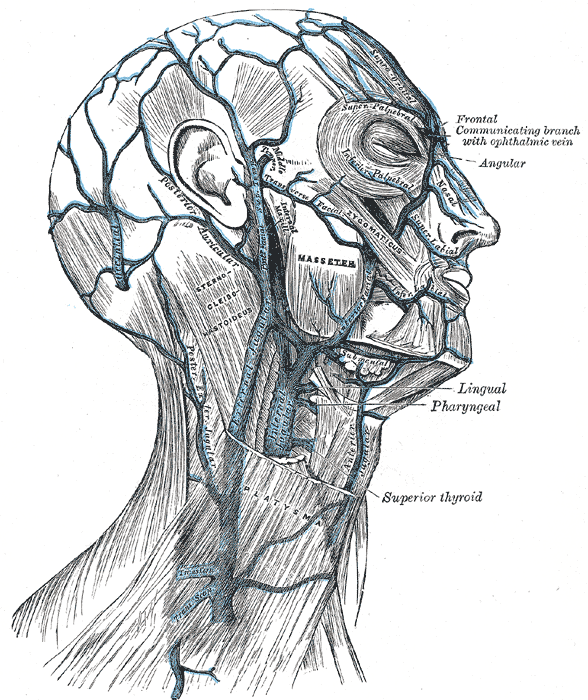
The retromandibular vein (temporomaxillary vein, posterior facial vein) is a major vein of the face. It is formed within the parotid gland by the confluence of the maxillary vein, and superficial temporal vein. It descends in the gland and splits into two branches upon emerging from the gland. Its anterior branch then joins the (anterior) facial vein forming the common facial vein, while its posterior branch joins the posterior auricular vein forming the external jugular vein.
The retromandibular vein is formed within the parotid gland by the confluence of the maxillary vein, and superficial temporal vein.
It descends inside parotid gland, superficial to the external carotid artery (but beneath the facial nerve), between the sternocleidomastoideus muscle and ramus of mandible.[citation needed] It emerges from the parotid gland inferiorly, then immediately divides into two branches:
The retromandibular vein provides venous drainage to the superior cranium, and significant drainage to the ear.
Parrot's sign is a sensation of pain when pressure is applied to the retromandibular region.[citation needed]
 This article incorporates text in the public domain from page 646 of the 20th edition of Gray's Anatomy (1918)
Retromandibular vein
The retromandibular vein (temporomaxillary vein, posterior facial vein) is a major vein of the face. It is formed within the parotid gland by the confluence of the maxillary vein, and superficial temporal vein. It descends in the gland and splits into two branches upon emerging from the gland. Its anterior branch then joins the (anterior) facial vein forming the common facial vein, while its posterior branch joins the posterior auricular vein forming the external jugular vein.
The retromandibular vein is formed within the parotid gland by the confluence of the maxillary vein, and superficial temporal vein.
It descends inside parotid gland, superficial to the external carotid artery (but beneath the facial nerve), between the sternocleidomastoideus muscle and ramus of mandible.[citation needed] It emerges from the parotid gland inferiorly, then immediately divides into two branches:
The retromandibular vein provides venous drainage to the superior cranium, and significant drainage to the ear.
Parrot's sign is a sensation of pain when pressure is applied to the retromandibular region.[citation needed]
This article incorporates text in the public domain from page 646 of the 20th edition of Gray's Anatomy (1918)
Recent media
Recent media