


Community hub
Recent from talks
Knowledge base stats:
Talk channels stats:
Members stats:
Revealed preference
Revealed preference theory, pioneered by economist Paul Anthony Samuelson in 1938, is a method of analyzing choices made by individuals, mostly used for comparing the influence of policies[further explanation needed] on consumer behavior. Revealed preference models assume that the preferences of consumers can be revealed by their purchasing habits.
Revealed preference theory arose because existing theories of consumer demand were based on a diminishing marginal rate of substitution (MRS). This diminishing MRS relied on the assumption that consumers make consumption decisions to maximise their utility. While utility maximisation was not a controversial assumption, the underlying utility functions could not be measured with great certainty. Revealed preference theory was a means to reconcile demand theory by defining utility functions by observing behaviour.
Therefore, revealed preference is a way to infer preferences between available choices. It contrasts with attempts to directly measure preferences or utility, for example through stated preferences.
Let there be two bundles of goods, a and b, available in a budget set . If it is observed that a is chosen over b, then a is considered (directly) revealed preferred to b.

If the budget set is defined for two goods; , and determined by prices and income , then let bundle a be and bundle b be . This situation would typically be represented arithmetically by the inequality and graphically by a budget line in the positive real numbers. Assuming strongly monotonic preferences, only bundles that are graphically located on the budget line, i.e. bundles where and are satisfied, need to be considered. If, in this situation, it is observed that is chosen over , it is concluded that is (directly) revealed preferred to , which can be summarized as the binary relation or equivalently as .







The Weak Axiom of Revealed Preference (WARP) is one of the criteria which needs to be satisfied in order to make sure that the consumer is consistent with their preferences. If a bundle of goods a is chosen over another bundle b when both are affordable, then the consumer reveals that they prefer a over b. WARP says that when preferences remain the same, there are no circumstances (budget set) where the consumer prefers b over a. By choosing a over b when both bundles are affordable, the consumer reveals that their preferences are such that they will never choose b over a when both are affordable, even as prices vary. Formally:
where and are arbitrary bundles and is the set of bundles chosen in budget set , given preference relation .


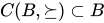

In other words, if a is chosen over b in budget set where both a and b are feasible bundles, but b is chosen when the consumer faces some other budget set , then a is not a feasible bundle in budget set .

Hub AI
Revealed preference AI simulator
(@Revealed preference_simulator)
Revealed preference
Revealed preference theory, pioneered by economist Paul Anthony Samuelson in 1938, is a method of analyzing choices made by individuals, mostly used for comparing the influence of policies[further explanation needed] on consumer behavior. Revealed preference models assume that the preferences of consumers can be revealed by their purchasing habits.
Revealed preference theory arose because existing theories of consumer demand were based on a diminishing marginal rate of substitution (MRS). This diminishing MRS relied on the assumption that consumers make consumption decisions to maximise their utility. While utility maximisation was not a controversial assumption, the underlying utility functions could not be measured with great certainty. Revealed preference theory was a means to reconcile demand theory by defining utility functions by observing behaviour.
Therefore, revealed preference is a way to infer preferences between available choices. It contrasts with attempts to directly measure preferences or utility, for example through stated preferences.
Let there be two bundles of goods, a and b, available in a budget set . If it is observed that a is chosen over b, then a is considered (directly) revealed preferred to b.
If the budget set is defined for two goods; , and determined by prices and income , then let bundle a be and bundle b be . This situation would typically be represented arithmetically by the inequality and graphically by a budget line in the positive real numbers. Assuming strongly monotonic preferences, only bundles that are graphically located on the budget line, i.e. bundles where and are satisfied, need to be considered. If, in this situation, it is observed that is chosen over , it is concluded that is (directly) revealed preferred to , which can be summarized as the binary relation or equivalently as .
The Weak Axiom of Revealed Preference (WARP) is one of the criteria which needs to be satisfied in order to make sure that the consumer is consistent with their preferences. If a bundle of goods a is chosen over another bundle b when both are affordable, then the consumer reveals that they prefer a over b. WARP says that when preferences remain the same, there are no circumstances (budget set) where the consumer prefers b over a. By choosing a over b when both bundles are affordable, the consumer reveals that their preferences are such that they will never choose b over a when both are affordable, even as prices vary. Formally:
where and are arbitrary bundles and is the set of bundles chosen in budget set , given preference relation .
In other words, if a is chosen over b in budget set where both a and b are feasible bundles, but b is chosen when the consumer faces some other budget set , then a is not a feasible bundle in budget set .