Hubbry Logo
search
logo

Revealed preference

logo
Community Hub0 Subscribers
Read side by side
from Wikipedia

Revealed preference theory, pioneered by economist Paul Anthony Samuelson in 1938,[1][2] is a method of analyzing choices made by individuals, mostly used for comparing the influence of policies[further explanation needed] on consumer behavior. Revealed preference models assume that the preferences of consumers can be revealed by their purchasing habits.

Revealed preference theory arose because existing theories of consumer demand were based on a diminishing marginal rate of substitution (MRS). This diminishing MRS relied on the assumption that consumers make consumption decisions to maximise their utility. While utility maximisation was not a controversial assumption, the underlying utility functions could not be measured with great certainty. Revealed preference theory was a means to reconcile demand theory by defining utility functions by observing behaviour.

Therefore, revealed preference is a way to infer preferences between available choices. It contrasts with attempts to directly measure preferences or utility, for example through stated preferences.

Definition and theory

[edit]
If bundle a is revealed preferred over bundle b in budget set B, then the WARP says that bundle b cannot be revealed preferred over bundle a in any budget set B'. This would be equally true had b been located anywhere else on or below the blue line. The bundle c will not violate WARP even if it is chosen in budget set B', because it is not on or below the blue line of affordable choices at the time of the observed choice of a.

Let there be two bundles of goods, a and b, available in a budget set . If it is observed that a is chosen over b, then a is considered (directly) revealed preferred to b.

Two-dimensional example

[edit]

If the budget set is defined for two goods; , and determined by prices and income , then let bundle a be and bundle b be . This situation would typically be represented arithmetically by the inequality and graphically by a budget line in the positive real numbers. Assuming strongly monotonic preferences, only bundles that are graphically located on the budget line, i.e. bundles where and are satisfied, need to be considered. If, in this situation, it is observed that is chosen over , it is concluded that is (directly) revealed preferred to , which can be summarized as the binary relation or equivalently as .[3]

The Weak Axiom of Revealed Preference (WARP)

[edit]

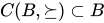
The Weak Axiom of Revealed Preference (WARP) is one of the criteria which needs to be satisfied in order to make sure that the consumer is consistent with their preferences. If a bundle of goods a is chosen over another bundle b when both are affordable, then the consumer reveals that they prefer a over b. WARP says that when preferences remain the same, there are no circumstances (budget set) where the consumer prefers b over a. By choosing a over b when both bundles are affordable, the consumer reveals that their preferences are such that they will never choose b over a when both are affordable, even as prices vary. Formally:
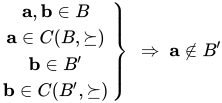
where and are arbitrary bundles and is the set of bundles chosen in budget set , given preference relation .

In other words, if a is chosen over b in budget set where both a and b are feasible bundles, but b is chosen when the consumer faces some other budget set , then a is not a feasible bundle in budget set .

Completeness: The Strong Axiom of Revealed Preferences (SARP)

[edit]

The strong axiom of revealed preferences (SARP) is equivalent to WARP, except that the choices A and B are not allowed to be either directly or indirectly revealed preferable to each other at the same time. Here A is considered indirectly revealed preferred to B if C exists such that A is directly revealed preferred to C, and C is directly revealed preferred to B. In mathematical terminology, this says that transitivity is preserved. Transitivity is useful as it can reveal additional information by comparing two separate bundles from budget constraints.

It is often desirable in economic models to prevent such "loops" from happening, for example in order to model choices with utility functions (which have real-valued outputs and are thus transitive). One way to do so is to impose completeness on the revealed preference relation with regards to the choices at large, i.e. without any price considerations or affordability constraints. This is useful because when evaluating {A,B,C} as standalone options, it is directly obvious which is preferred or indifferent to which other. Using the weak axiom then prevents two choices from being preferred over each other at the same time; thus it would be impossible for "loops" to form.

Another way to solve this is to impose SARP, which ensures transitivity. This is characterised by taking the transitive closure of direct revealed preferences and require that it is antisymmetric, i.e. if A is revealed preferred to B (directly or indirectly), then B is not revealed preferred to A (directly or indirectly).

These are two different approaches to solving the issue; completeness is concerned with the input (domain) of the choice functions; while the strong axiom imposes conditions on the output.

Generalised Axiom of Revealed Preference (GARP)

[edit]
The dataset illustrates a budget constraint in which there are two consumption bundles a and b. Both bundles achieve utility maximisation, violating the SARP, but satisfying GARP.

The Generalised axiom of revealed preference (GARP) is a generalisation of SARP. It is the final criteria required so that constancy may be satisfied to ensure consumers preferences do not change.

This axiom accounts for conditions in which two or more consumption bundles satisfy equal levels of utility, given that the price level remains constant. It covers circumstances in which utility maximisation is achieved by more than one consumption bundle.[4]

A set of data satisfies GARP if implies not .[5] This establishes that if consumption bundle is revealed preferred to , then the expenditure necessary to acquire bundle given that prices remain constant, cannot be more than the expenditure necessary to acquire bundle .[6]

To satisfy GARP, a dataset must also not establish a preference cycle. Therefore, when considering the bundles {A,B,C}, the revealed preference bundle must be an acyclic order pair as such, If and , then and thus ruling out “preference cycles” while still holding transitivity.[4]

As GARP is closely related to SARP, it is very easy to demonstrate that each condition of SARP can imply GARP, however, GARP does not imply SARP. This is a result of the condition in which GARP is compatible with multivalued demand functions, whereas SARP is only compatible with single valued demand functions. As such, GARP permits for flat sections within indifference curves, as stated by Hal R Varian (1982).[5]

Afriat's Theorem

[edit]

Afriat's Theorem, introduced by economist Sydney Afriat in 1967, extends GARP by proving that a finite dataset of observed choices can be explained by a utility function.[7] Specifically, it states that a set of price vectors pi and quantity vectors xi (for i = 1, 2, ..., n) satisfies GARP if and only if there exists a continuous, increasing, and concave utility function u(x) such that each xi maximizes u(x) under the budget constraint pi · xpi · xi.[8]

The theorem provides a practical test: if GARP holds, there exist utility levels ui and positive weights λi satisfying the inequalities ui - ujλj (pj · (xi - xj)) for all i, j.[7] These Afriat inequalities allow construction of the utility function directly from the data, unlike earlier axioms like SARP, which only prove existence for infinite datasets.[9] For instance, if two bundles both maximize utility at the same budget (as in the GARP figure), Afriat's Theorem ensures a utility function exists, even where SARP fails.[8] This result is widely used in econometrics to test rationality and build preferences from empirical data.[10]

Applications

[edit]

Revealed preference theory has been used in numerous applications, including college rankings in the U.S.[11][12]

Criticism

[edit]

Several economists criticised the theory of revealed preferences for different reasons.

  1. Stanley Wong claimed that revealed preference theory was a failed research program.[13] In 1938 Samuelson presented revealed preference theory as an alternative to utility theory,[1] while in 1950, Samuelson took the demonstrated equivalence of the two theories as a vindication for his position, rather than as a refutation.
  2. If there exist only an apple and an orange, and an orange is picked, then one can definitely say that an orange is revealed preferred to an apple. In the real world, when it is observed that a consumer purchased an orange, it is impossible to say what good or set of goods or behavioural options were discarded in preference of purchasing an orange. In this sense, preference is not revealed at all in the sense of ordinal utility.[14]
  3. The revealed preference theory assumes that the preference scale remains constant over time. Were this not the case all that can be stated is that an action, at a specific point of time, reveals part of a person's preference scale at that time. There is no warrant for assuming that it remains constant from one point of time to another. The "revealed preference" theorists assume constancy in addition to consistent behaviour ("rationality"). Consistency means that a person maintains a transitive order of rank on his preference scale (if A is preferred to B and B is preferred to C, then A is preferred to C). But the revealed preference procedure does not rest on this assumption so much as on an assumption of constancy—that an individual maintains the same value scale over time. While the former might be called irrational, there is certainly nothing irrational about someone's value scales changing through time. It is claimed that no valid theory can be built on a constancy assumption.[15]
  4. The inability to define or measure preferences independently of 'revealed-preferences' leads some authors to see the concept as a tautological fallacy. See, inter alia, Amartya Sen’s critiques in a series of articles: “Behaviour and the concept of preference” (Sen 1973), “Rational Fools: A Critique of the Behavioural Foundations of Economic Theory” (Sen 1977), “Internal Consistency of Choice” (Sen 1993), “Maximization and the Act of Choice” (Sen 1997), and his book 'Rationality and Freedom' (Sen 2002).

See also

[edit]

Notes

[edit]

References

[edit]
[edit]
Revisions and contributorsEdit on WikipediaRead on Wikipedia
from Grokipedia
Revealed preference theory is a method in microeconomics for inferring an individual's preferences from their observed choices under budget constraints, without relying on unobservable concepts like utility functions.[1] It assumes that a consumer's selection of one bundle of goods over another affordable alternative reveals a preference for the chosen bundle, providing a basis for analyzing demand behavior empirically.[1] Pioneered by economist Paul Samuelson in his 1938 paper, the theory emerged as an operational alternative to ordinal utility analysis, emphasizing observable market data such as prices, incomes, and quantities purchased.[1] Samuelson introduced the foundational Weak Axiom of Revealed Preference (WARP), which states that if a bundle xx is chosen when another bundle yy is affordable (i.e., xx is directly revealed preferred to yy), then yy cannot be chosen when xx is affordable in a subsequent observation.[1] This axiom ensures basic consistency in choices and serves as a testable restriction on consumer behavior.[2] In 1948, Samuelson formalized the framework further in a paper coining the term "revealed preference" and deriving consumption theorems from it, such as the symmetry of the Slutsky matrix under integrability conditions.[3] Subsequent developments extended the theory: Houthakker (1950) proposed the Strong Axiom of Revealed Preference (SARP), which generalizes WARP to the transitive closure of the revealed preference relation, ruling out cycles in preferences to ensure rationalizability by a complete preorder.[2] Afriat (1967) introduced the Generalized Axiom of Revealed Preference (GARP), accommodating nonsingle-valued demand functions and providing necessary and sufficient conditions for data to be consistent with utility maximization by a locally nonsatiated, continuous utility function.[2] These axioms have become central to nonparametric tests of consumer rationality.[4] Revealed preference theory has broad applications in empirical economics, including the analysis of household expenditure surveys to detect inconsistencies in choice data and to recover bounds on welfare measures like compensating variation.[2] It underpins modern techniques in demand estimation, experimental economics, and policy evaluation, such as assessing market power or consumer surplus without assuming specific functional forms for preferences.[2] Despite criticisms regarding its assumptions of perfect rationality and full observability, the theory remains a cornerstone for bridging theoretical models with real-world data.[4]

Overview

Definition

Revealed preference theory provides a framework for inferring consumer preferences exclusively from observable choices made under varying budget constraints, eschewing the need for introspective utility representations. Central to this approach is the observation that if a consumer selects a particular bundle of goods A when another bundle B is also affordable at the prevailing prices and income, then A is directly revealed preferred to B, indicating that the consumer values A at least as highly as B in that context. This inference rests on the premise that choices reflect genuine optimization by the consumer.[2][1] Direct revealed preference captures straightforward comparisons from a single choice scenario, where the affordability of the unchosen bundle is assessed against the budget at that moment. In contrast, indirect revealed preference extends this logic through transitive chains across multiple observations, incorporating adjustments such as changes in income or relative prices that compensate for variations in affordability, thereby revealing broader preference orderings. These distinctions enable a more nuanced reconstruction of preferences from empirical data.[2][5] The theory relies on foundational microeconomic elements, including budget constraints that delineate the feasible set of consumption bundles given market prices and the consumer's income, as well as choice sets representing the alternatives available for selection. It presumes agents are rational and self-interested, maximizing their well-being subject to these constraints. A key assumption is that such choices faithfully disclose underlying preferences, contingent on the agent possessing complete information about the options and operating free from distorting external factors like uncertainty or coercion.[2][5][1] This method relates to utility theory by offering a behavioral foundation for preference analysis, allowing empirical validation of consistency without presupposing a specific utility form.[2]

Historical background

The concept of revealed preference was introduced by Paul Samuelson in 1938 as a means to operationalize consumer theory by relying solely on observable choices, addressing the limitations of ordinal utility theory, particularly its inability to facilitate interpersonal comparisons of utility.[6] In his seminal paper, Samuelson proposed deriving demand behavior directly from budget constraints and observed expenditures, eschewing unobservable psychological constructs.[1] This approach was further formalized in his 1948 work, where he explicitly defined revealed preference in terms of consumer choices under varying prices and incomes, establishing a foundation for testing consistency in behavior without invoking utility functions.[3] Samuelson's framework drew on earlier influences in economic theory, notably Vilfredo Pareto's emphasis in the 1920s on analyzing consumer behavior through observable market actions rather than subjective valuations.[6] Pareto's ordinalist perspective, articulated in his Manual of Political Economy, shifted focus toward empirical verifiability in welfare and demand analysis.[7] Similarly, Eugen Slutsky's 1915 contributions on demand equations provided a mathematical basis for decomposing price effects into substitution and income components, influencing Samuelson's integration of observable demand responses into preference revelation.[6] Following Samuelson's innovations, Hendrik Houthakker extended the theory in 1950 by introducing the Strong Axiom of Revealed Preference (SARP), which incorporated transitive chains of direct revelations to ensure consistency with utility maximization under broader conditions.[8] This development addressed potential cycles in preference relations that the original Weak Axiom overlooked. A pivotal advancement came in 1967 with Sidney Afriat's theorem, which demonstrated that finite datasets satisfying generalized consistency conditions could be rationalized by a nonsatiated, continuous utility function, enabling constructive proofs and empirical applications.[9] By the mid-20th century, revealed preference theory gained widespread adoption in welfare economics, where it facilitated ordinal comparisons of consumer welfare based on behavioral data, bridging observable choices with policy evaluations.[6] In demand analysis, it supported nonparametric testing of rationality axioms, as exemplified by Hal Varian's 1982 framework for recovering bounds on utility and elasticities from expenditure observations, transforming it into a cornerstone of empirical microeconomics.

Core Concepts

Fundamental principles

Revealed preference theory infers consumer preferences directly from observed choices made under budget constraints, providing a foundation for understanding demand behavior without relying on ad hoc assumptions about utility functions. Central to this approach is the idea that choices reveal preferences: if a consumer selects bundle $ x $ when bundle $ y $ is affordable (i.e., $ p \cdot y \leq m $, where $ p $ is the price vector and $ m $ is income), then $ x $ is revealed preferred to $ y $. This principle, introduced by Paul Samuelson, shifts the focus from introspective utility to observable behavior, enabling empirical testing of economic rationality.[3] In formal terms, the theory employs standard notation for the consumer's problem: consumption bundles are elements $ x \in \mathbb{R}^n_{++} $, prices are $ p \in \mathbb{R}^n_{++} $, and income is $ m > 0 $, with the demand function $ x(p, m) $ denoting the chosen bundle that maximizes preferences subject to the budget constraint $ p \cdot x \leq m $. This setup assumes the consumer faces a budget set $ B(p, m) = { z \in \mathbb{R}^n_{++} \mid p \cdot z \leq m } $ and selects $ x(p, m) \in B(p, m) $. The notation facilitates analysis of how choices vary with prices and income, forming the basis for consistency checks across observations.[3] A foundational assumption is local nonsatiation, which posits that preferences are such that, for any bundle $ x $ and any $ \epsilon > 0 $, there exists a bundle $ y $ with $ | y - x | < \epsilon $ that is strictly preferred to $ x $. This ensures consumers always prefer more to less locally within feasible sets, implying full expenditure of income and ruling out satiation points, which is essential for rationalizing choices with nonsatiated utility functions. Local nonsatiation underpins the theory's ability to link observed demands to well-behaved preferences, preventing trivial rationalizations of inconsistent data.[10] Choice consistency requires that the dataset of observed choices $ { (p^t, m^t, x^t) }_{t=1}^T $ can be rationalized by a preference relation $ \succsim $ that is complete (every pair of bundles is comparable), transitive (if $ x \succsim y $ and $ y \succsim z $, then $ x \succsim z $), and continuous (the sets $ { z \mid z \succsim x } $ and $ { z \mid x \succsim z } $ are closed for all $ x $). Such a relation ensures that each chosen $ x^t $ is preferred to all other bundles in its budget set $ B(p^t, m^t) $, allowing the data to be interpreted as outcomes of utility maximization. Continuity guarantees that small changes in bundles do not lead to discontinuous preference jumps, supporting the existence of continuous utility representations.[11][3] Revealed preference offers a non-parametric alternative to cardinal or ordinal utility theory by testing whether choice data are consistent with maximization of some unknown utility function, rather than estimating specific functional forms. Unlike parametric approaches that assume shapes like Cobb-Douglas or CES utilities, it uses only the ordinal structure of choices to verify rationality, making it robust for empirical demand analysis and welfare evaluations. This framework bridges behavioral observations to theoretical predictions without interpersonal utility comparisons or explicit utility derivation.[11]

Two-dimensional example

In the two-good case, consider commodities x1x_1 and x2x_2 with respective prices p1p_1 and p2p_2, and the consumer's income mm. The budget constraint is given by p1x1+p2x2=mp_1 x_1 + p_2 x_2 = m, which traces a straight line in the nonnegative orthant with vertical intercept m/p2m/p_2, horizontal intercept m/p1m/p_1, and slope p1/p2-p_1/p_2.[12][10] Suppose the consumer faces prices pA=(p1A,p2A)p^A = (p_1^A, p_2^A) and income mAm^A, choosing bundle A=(x1A,x2A)A = (x_1^A, x_2^A) on the budget line. This choice reveals that AA is directly preferred to any other affordable bundle BB satisfying p1Ax1B+p2Ax2BmAp_1^A x_1^B + p_2^A x_2^B \leq m^A, as the consumer could have selected BB but did not.[2] The set of such bundles BB forms the budget set, a convex triangular region bounded by the axes and the budget line. The directly revealed preferred set to AA—all bundles revealed inferior to AA—is this budget set excluding AA itself, assuming nonsatiation where more is always better.[10] Now consider a second observation at prices pB=(p1B,p2B)p^B = (p_1^B, p_2^B) and income mBm^B, where the consumer chooses bundle C=(x1C,x2C)C = (x_1^C, x_2^C). This reveals CC directly preferred to bundles in its budget set. If CC lies within the budget set at pA,mAp^A, m^A (i.e., p1Ax1C+p2Ax2CmAp_1^A x_1^C + p_2^A x_2^C \leq m^A), then AA is indirectly revealed preferred to CC. Graphically, the overall revealed preferred set expands as the union of these convex budget sets, forming a stepwise convex region below the relevant budget lines, indicating bundles inferior to the chosen points.[2][10] To interpret consistency, suppose instead that AA lies within the budget set at pB,mBp^B, m^B while CC lies within the set at pA,mAp^A, m^A. The budget lines cross such that each chosen bundle is affordable under the other's prices, creating mutual revealed preference (AA preferred to CC and CC to AA). This inconsistency implies the observed choices cannot be rationalized by any underlying preference relation, as no single convex upper contour set can accommodate both revelations without contradiction.[10] In the graphical plane, such a crossing highlights the non-convexity or violation in the inferred preference structure, underscoring the need for choices to align without cycles for rationalizability.[2]

Axiomatic Framework

Weak Axiom of Revealed Preference (WARP)

Introduced by Paul Samuelson in 1938 as the foundational consistency requirement in revealed preference theory, the Weak Axiom of Revealed Preference (WARP) ensures that observed choices from a finite dataset do not exhibit direct contradictions and can be rationalized by some preference relation. WARP stipulates that if a consumer selects bundle $ x $ over another affordable bundle $ y $ (i.e., $ x $ is chosen at prices $ p $ and income $ m $ where $ p \cdot x \leq m $ and $ p \cdot y \leq m $ with $ x \neq y $), then $ y $ cannot be selected when $ x $ is affordable at alternative prices $ p' $ and income $ m' $ (i.e., it cannot hold that $ p' \cdot y \leq m' $ and $ p' \cdot x \leq m' $ with $ y $ chosen). This pairwise condition captures the minimal rationality needed to avoid immediate inconsistencies in choice behavior.[1] In mathematical terms, consider a finite dataset of $ T $ observations where bundle $ x^t $ is chosen at prices $ p^t $ and income $ m^t = p^t \cdot x^t $ (assuming budget exhaustion). WARP is satisfied if, for all distinct observations $ s, t \in {1, \dots, T} $,
psxtpsxs    ptxsptxt, p^s \cdot x^t \leq p^s \cdot x^s \quad \implies \quad p^t \cdot x^s \geq p^t \cdot x^t,
with the implication becoming strict (i.e., $ > $) whenever $ x^s \neq x^t $ and the premise holds with equality only if the bundles coincide. This formulation, as articulated by Varian (1982), ensures the direct revealed preference relation—where $ x^t $ is directly revealed preferred to $ x^s $ if $ p^t \cdot x^s \leq p^t \cdot x^t $—remains asymmetric. WARP's interpretation lies in its role as a safeguard against cycles of length two in the direct revealed preference relation, thereby establishing basic coherence in choices without demanding higher-order properties like transitivity. As formalized by Richter (1966), this prevents scenarios where one choice directly contradicts another, such as selecting $ x $ when $ y $ is cheaper and later selecting $ y $ when $ x $ is cheaper, which would imply inconsistent preferences. For visual intuition in simple cases, WARP aligns with the condition that chosen bundles do not fall strictly inside the budget sets revealed by prior choices, as seen in two-dimensional examples.[13] A sketch of WARP's assurance of weak consistency proceeds as follows: Define the direct revealed preference relation $ R^D $ such that $ x^i R^D x^j $ if $ p^i \cdot x^j \leq p^i \cdot m^i $ and $ x^i \neq x^j $. WARP directly enforces asymmetry on $ R^D $ (if $ x^i R^D x^j $, then not $ x^j R^D x^i $), which is necessary for rationalization by any complete and transitive preference ordering that is locally nonsatiated, as symmetric relations would allow satiation or indifference inconsistencies incompatible with observed strict choices. This pairwise asymmetry yields a weakly consistent ordering by excluding direct reversals, though longer cycles remain possible without additional axioms. Richter (1966) demonstrates that this structure supports the existence of a preference relation rationalizing the data under WARP, provided no further violations occur.[13]

Strong Axiom of Revealed Preference (SARP)

The Strong Axiom of Revealed Preference (SARP) extends the foundational ideas of revealed preference theory by imposing conditions that guarantee the consistency of consumer choices across multiple observations, particularly by preventing cycles in the preference relation. Introduced by Houthakker in 1950, SARP requires that if a sequence of choices reveals a chain of direct preferences from one bundle to another, the reverse cannot hold, even indirectly. This axiom ensures that the overall revealed preference relation is acyclic, thereby supporting the rationalization of observed data by a transitive and complete preference ordering.[14] SARP builds directly on the Weak Axiom of Revealed Preference (WARP) but strengthens it to address transitivity in multi-step preference chains. While WARP only prohibits direct contradictions between pairs of choices—such as choosing bundle A over B at one budget while later choosing B over A when both are affordable—SARP implies WARP but is not implied by it, as WARP alone permits cycles involving more than two bundles. This additional requirement makes SARP necessary for strict transitivity in the revealed preference relation, ensuring that preferences can be represented by a strictly increasing utility function without inconsistencies.[15] Formally, SARP states that the transitive closure of the direct revealed preference relation must be asymmetric. Let $ R $ denote direct revealed preference, where bundle $ x $ is directly revealed preferred to $ y $ (written $ x R y $) if $ x $ is chosen when $ y $ is affordable. The revealed preference relation $ R^0 $ is then the transitive closure of $ R $, meaning $ x R^0 y $ if there exists a chain $ x = x^0 R x^1 R \cdots R x^k = y $ for some $ k \geq 1 $. SARP holds if for all distinct bundles $ x $ and $ y $, $ x R^0 y $ implies not $ y R^0 x $, preventing any cycles in the preference structure.[15] A classic violation of SARP occurs in a three-bundle cycle, illustrating the failure of transitivity. Suppose observations show bundle A chosen when B is affordable ($ A R B ),thenBchosenwhenCisaffordable(), then B chosen when C is affordable ( B R C ),andfinallyCchosenwhenAisaffordable(), and finally C chosen when A is affordable ( C R A $). This creates the chain $ A R^0 C $ via $ A R B R C $, but also $ C R^0 A $, violating the asymmetry of the transitive closure and indicating that no transitive utility function can rationalize the data. Such cycles highlight how SARP detects inconsistencies that WARP might overlook.[14]

Generalized Axiom of Revealed Preference (GARP)

Introduced by Sidney N. Afriat in 1967 (with the term 'GARP' coined by Hal R. Varian in 1982), the Generalized Axiom of Revealed Preference (GARP) extends the revealed preference framework to allow for the rationalization of observed choices by concave, monotonic utility functions, accommodating multi-dimensional budgets and potential flat regions in indifference curves.[16] Formally, consider a dataset of observations consisting of price vectors $ p^i $ and chosen bundles $ x^i $ for $ i = 1, \dots, n $, where each $ x^i $ is affordable under budget $ p^i \cdot x^i $. Define the direct revealed preference relation $ R^0 $ such that $ x^{i_1} R^0 x^{i_2} $ if $ p^{i_1} \cdot x^{i_2} \leq p^{i_1} \cdot x^{i_1} $. The transitive closure of $ R^0 $ yields the revealed preference relation $ R $. GARP holds if, for any chain $ x^{i_1} R^0 x^{i_2} R^0 \dots R^0 x^{i_k} $ (implying $ x^{i_1} R x^{i_k} $), it follows that $ p^{i_k} \cdot x^{i_1} \geq p^{i_k} \cdot x^{i_k} $, with equality if and only if equality holds throughout the chain (i.e., no strict revealed preference along the path).[15] This axiom captures key features essential for broader applicability in empirical demand analysis: it permits weak (non-strict) preferences, allowing multiple bundles to be equally optimal at the same prices, which aligns with nonsatiated and locally nonsatiated preferences; it ensures the absence of cycles in the revealed preference relation that would contradict utility maximization; and it is both necessary and sufficient for the existence of a continuous, concave, and monotonic utility function that rationalizes the data, thereby supporting convex preferences. Unlike stricter conditions, GARP accommodates convexity in the upper contour sets of the utility function without requiring transitivity to be enforced solely through strict inequalities.[15] In contrast to the Strong Axiom of Revealed Preference (SARP), which demands no cycles in the strict revealed preference relation and assumes single-valued demand functions with strict transitivity, GARP relaxes these to handle demand correspondences and "flat" indifference regions, making it more suitable for datasets with repeated price observations or approximate equalities. This generalization broadens the scope for testing real-world consumer behavior under concave utility representations. Computationally, GARP can be verified efficiently using graph-theoretic algorithms: construct a directed graph where nodes represent observations and edges denote direct revealed preference ($ x^i R^0 x^j $), compute the transitive closure via methods like Warshall's algorithm to identify indirect relations, and check for violations by ensuring no edge from $ x^j $ to $ x^i $ exists where $ x^i R x^j $ and $ p^j \cdot x^i > p^j \cdot x^j $. Such algorithms run in polynomial time, facilitating empirical implementation on large datasets.[15]

Theoretical Results

Afriat's theorem

Afriat's theorem, formulated by Sidney N. Afriat in 1967, establishes a fundamental equivalence in revealed preference theory: a finite dataset of consumer choices—consisting of observed prices $ p^i > 0 $ and quantities $ x^i \geq 0 $ for $ i = 1, \dots, n $—satisfies the Generalized Axiom of Revealed Preference (GARP) if and only if it can be rationalized by a locally nonsatiated, concave, and continuous utility function.[16] This result generalizes earlier characterizations based on the Strong Axiom of Revealed Preference (SARP) to allow for concave utility representations, which are more flexible and align with standard assumptions in consumer theory.[16] The theorem's core is expressed through the Afriat inequalities: the dataset satisfies GARP if and only if there exist real numbers $ U^i $ (representing utility levels) and positive scalars $ \lambda^i > 0 $ (marginal utilities of income) such that, for all pairs $ i, j $,
UjUi+λipi(xjxi). U^j \leq U^i + \lambda^i p^i \cdot (x^j - x^i).
These linear inequalities capture the concavity condition at the observed bundles, ensuring that no choice violates the revealed preference relations implied by GARP.[16][17] The inequalities offer a constructive interpretation, enabling the recovery of a piecewise linear concave utility function that rationalizes the data. Specifically, one can define the utility at any bundle $ x $ as the infimum over supporting hyperplanes:
U(x)=infi=1,,n{Ui+λipi(xxi)}, U(x) = \inf_{i=1,\dots,n} \left\{ U^i + \lambda^i p^i \cdot (x - x^i) \right\},
which is concave, continuous, and strictly increasing (under nonsatiation), with each observed $ x^i $ achieving the maximum subject to the budget $ p^i \cdot x \leq p^i \cdot x^i $.[17] This construction directly builds the rationalizing utility from solutions to the inequalities, solvable via linear programming.[18] The proof proceeds in two directions. Necessity arises from the properties of a concave, nonsatiated utility: at each chosen bundle $ x^i $, the subgradient includes $ \lambda^i p^i $, yielding the inequality via the definition of concavity. Sufficiency involves solving the system of inequalities to obtain the $ U^i $ and $ \lambda^i $, then verifying that the constructed $ U(x) $ is nonsatiated and concave, and that it maximizes at each $ x^i $ on its budget set, thereby satisfying GARP.[16][17]

Extensions to risk and uncertainty

Extensions of revealed preference theory to settings involving risk have focused on deriving testable implications for von Neumann-Morgenstern expected utility, particularly through stochastic revealed preference conditions that ensure no arbitrage opportunities in choices over lotteries. Under risk, where outcomes are governed by objective probabilities, the Strong Axiom of Revealed Objective Expected Utility requires that balanced sequences of choices exhibit a risk-neutral downward-sloping demand property, meaning that as the probability-weighted prices of lotteries adjust, chosen bundles do not violate monotonicity in a manner inconsistent with expected utility maximization.[19] This axiom builds on the classical framework by incorporating convex preferences and risk-neutral pricing, where effective prices are scaled by state probabilities, allowing empirical tests to reject expected utility if choices imply arbitrage, such as selecting a dominated lottery over a stochastically superior one.[19] Seminal work by Echenique and Saito (2015) establishes that data are rationalizable by objective expected utility if and only if they satisfy this axiom, providing a nonparametric foundation for assessing von Neumann-Morgenstern preferences in risky environments.[19][20] Intertemporal extensions adapt the Generalized Axiom of Revealed Preference (GARP) to dynamic choices by considering time-separable utilities, where decisions across periods must satisfy consistency conditions akin to no-cycles in revealed preferences over time-indexed bundles. In these models, GARP is generalized using balanced sequences that account for discounting, ensuring that choices over consumption streams can be rationalized by exponentially discounted utility functions without intertemporal arbitrage.[19] For instance, the Strong Axiom of Revealed Exponentially Discounted Utility posits that for sequences where the sum of delay times in one choice exceeds that in another, the revealed demands remain downward-sloping under a common discount factor δ ∈ (0,1], testing for time-consistent preferences.[19] Echenique, Saito, and Tserenjigmid (2020) prove that data satisfy this axiom if and only if they are rationalizable by such utilities, extending earlier results like Browning (1989) on nonparametric dynamic utility to richer intertemporal datasets.[19][21] These developments, reviewed in Chambers and Echenique (2020), highlight how revealed preference can verify time-separability without assuming specific functional forms.[19] Under uncertainty, where probabilities are subjective, revealed preference theory incorporates models like subjective expected utility with acyclic conditions to test for consistency, often extending to ambiguity aversion through non-additive measures. The Strong Axiom of Revealed Subjective Expected Utility requires doubly balanced sequences—adjusting for subjective beliefs across states—to exhibit downward-sloping demands, assuming risk aversion to derive testable restrictions on belief formation and utility.[19] Echenique and Saito (2015) show that choices are rationalizable by subjective expected utility if and only if this axiom holds, allowing for incomplete information without objective probabilities.[19][20] To address ambiguity aversion, where decision-makers distort probabilities to reflect uncertainty, extensions include revealed preference tests for Choquet expected utility and max-min expected utility, imposing acyclicity on capacity measures that capture non-additive beliefs. Demuynck and Staner (2024) develop such a test, which rejects ambiguity-neutral models if choices violate monotonicity under multiple priors, building on Gilboa and Schmeidler (1989) for max-min setups and Schmeidler (1989) for Choquet capacities.[22] Recent theoretical advances, as of 2025, have refined tests for risk-averse behaviors by focusing on linear probability-prize tradeoffs, linking revealed preference directly to concavity in von Neumann-Morgenstern utility. Breig and Feldman (2025) propose conditions where choices over lotteries with varying maximum prizes must yield weakly increasing selected prizes for expected utility consistency, and for risk-averse expected utility, prizes must be bounded (e.g., at most half the maximum) with no variation across identical maximum-prize budgets, ensuring concavity without arbitrage.[23] Their theorems demonstrate that such tradeoffs rationalizes risk aversion if choices align with decreasing marginal utility over probabilistic outcomes, providing sharper nonparametric tests than prior stochastic frameworks.[23] This approach has implications for empirical rejection rates, showing low consistency with risk-averse utility in tasks like the Bomb Risk Elicitation Task.[23]

Applications

Consumer demand analysis

Revealed preference theory provides a nonparametric framework for deriving properties of consumer demand functions analogous to those from the Slutsky equation, without relying on the existence of an underlying utility function. If a finite dataset of observed prices, incomes, and chosen bundles satisfies the Generalized Axiom of Revealed Preference (GARP), the implied Slutsky substitution matrix is symmetric and negative semi-definite at those observation points. This ensures that cross-price substitution effects are symmetric (e.g., the effect of a price change in good ii on the demand for good jj equals the reverse) and that own-price effects are non-positive, reflecting the substitution and income components of demand changes. These results, derived directly from the axioms of rational choice, offer a testable foundation for demand analysis in static goods markets. In welfare evaluation, revealed preference methods facilitate the computation of bounds on key measures such as compensating variation (CV) and equivalent variation (EV), which quantify the monetary impact of price changes on consumer well-being. Using the sets of bundles revealed preferred or worse than the observed choices, Varian (1982) developed procedures to construct the minimal expenditure required to achieve a given utility level, yielding tight lower and upper bounds on CV and EV as the differences between these expenditures at initial and final prices. For example, the CV for a price increase is bounded by the additional income needed to afford a revealed preferred bundle under new prices, avoiding parametric utility assumptions and enabling robust assessments of surplus changes. This approach has proven essential for non-experimental data where direct utility measurement is infeasible. Revealed preference has practical policy applications in testing market efficiency and evaluating the effects of price changes on consumer surplus. By checking if demand data satisfies axioms like GARP, analysts can verify whether observed choices align with rational utility maximization, indicating efficient resource allocation in markets; violations suggest inefficiencies or behavioral anomalies. In policy settings, such as assessing the welfare impact of taxes or subsidies, the theory provides bounds on surplus losses or gains from price shifts, helping quantify deadweight losses without assuming specific demand forms. These tools support evidence-based decisions in areas like antitrust regulation or environmental pricing. Early applications of revealed preference emerged in post-World War II consumer demand studies, leveraging household budget data from large-scale surveys conducted in the late 1940s and 1950s. Researchers applied the theory's axioms to test the consistency of expenditure patterns across households, revealing insights into demand structures under varying prices and incomes; for instance, Houthakker's work used such data to validate and extend the strong axiom, demonstrating its empirical relevance in analyzing real consumption choices. These studies marked a shift toward nonparametric empiricism in economics, influencing subsequent demand system estimations.

Empirical econometrics

In empirical econometrics, revealed preference axioms, particularly the Generalized Axiom of Revealed Preference (GARP), are tested non-parametrically on observational data to assess whether choices are consistent with utility maximization without imposing parametric forms on preferences. Algorithms, such as those developed by Varian, check for GARP violations by examining whether observed consumption bundles satisfy the necessary and sufficient conditions for rationalizability, often using graph-theoretic methods to detect cycles in revealed preference relations.[24] To evaluate the statistical power of these tests, bootstrap methods resample the data to estimate the probability of rejecting rationality under the null hypothesis, as pioneered in applications to household expenditure surveys.[24] Efficiency indices quantify the degree to which data deviate from perfect rationality, providing measures of how closely observed behavior approximates rational preferences. Afriat-based efficiency indices, such as the Critical Cost Efficiency Index (CCEI), compute the minimal adjustment to expenditures or quantities needed to restore GARP consistency, with values closer to 1 indicating fewer violations.[25] These indices are derived from Afriat's inequalities, which construct concave utility functions bounding the data when rationality holds.[26] Empirical studies often report average CCEI values around 0.95-0.99 for household data, suggesting small but pervasive inefficiencies. Computational tools facilitate these analyses on large datasets. The R package revealedPrefs implements efficient algorithms for GARP testing, efficiency index calculation, and simulation of rationalizable datasets, enabling researchers to handle high-dimensional consumption data. Case studies illustrate these methods in practice. In food consumption analysis, Blundell, Browning, and Crawford applied nonparametric GARP tests to British Family Expenditure Survey data from the 1980s, finding that while aggregate data often satisfy rationality, individual household choices show modest violations, with CCEI values averaging 0.97.[27] Cherchye, De Rock, and Vermeulen have tested collective household rationality using revealed preference methods, providing nonparametric characterizations consistent with utility maximization in multi-person households.[1] For fuel consumption, a study on vehicle fuel efficiency using U.S. EPA and manufacturer datasets from the 2000s-2010s employed revealed preference tests to validate rationality postulates, identifying bounded deviations where observed choices align with cost-minimizing behavior in 85% of cases after adjusting for measurement error.[28]

Intertemporal and behavioral contexts

In intertemporal choice, revealed preference methods have been applied to test models of time preferences using data from savings and consumption behaviors. Researchers have developed nonparametric tests to distinguish between exponential discounting, which assumes time-consistent preferences, and hyperbolic discounting, which accommodates dynamic inconsistency observed in empirical data. For instance, in analyses of household savings patterns, these tests reveal that hyperbolic models often better explain observed choices, such as increasing impatience over shorter delays, without imposing parametric assumptions on utility functions.[21] A 2020 review highlights how such revealed preference characterizations enable welfare evaluations in policy contexts like retirement savings plans, where violations of exponential discounting inform interventions to mitigate present bias.[29] Behavioral extensions of revealed preference theory address bounded rationality by relaxing classical axioms to incorporate psychological factors, such as limited cognitive capacity or heuristic decision-making. Post-2010 developments include models that integrate satisficing behavior, where agents select options meeting an aspiration level rather than optimizing, leading to weakened versions of the Weak Axiom of Revealed Preference (WARP) that allow for menu-dependent choices.[30] These extensions have been linked to prospect theory by testing for reference-dependent preferences and loss aversion in choice data, revealing how observed inconsistencies arise from non-EU frameworks under uncertainty.[31] Such relaxed axioms facilitate empirical identification of boundedly rational processes in consumer data, emphasizing procedural rationality over global optimization. In experimental economics, revealed preference tests under uncertainty have uncovered systematic violations akin to the Allais paradox, where choices violate the independence axiom of expected utility theory. Laboratory experiments with incentivized tasks, such as lottery selections, demonstrate that subjects' revealed preferences exhibit common-ratio effects, preferring certain outcomes over risky ones in ways inconsistent with rational axioms, thus supporting behavioral models like cumulative prospect theory.[32] These findings highlight how uncertainty amplifies framing effects, with revealed preference analysis providing a nonparametric benchmark to quantify deviations from rationality in controlled settings. As of 2025, the Group for the Advancement of Revealed Preferences (GARP) has advanced empirical behavioral studies through collaborative initiatives, including workshops on dynamic and psychological applications of revealed preference. Their May 2025 workshop in Bruges on new advances in family economics included sessions on revealed preference analysis in household consumption decisions.[33]

Criticisms and Limitations

Theoretical shortcomings

One key theoretical shortcoming of revealed preference theory lies in its foundational assumption of transitivity, which posits that consumer preferences form a transitive ordering. This assumption fails when empirical observations reveal intransitive cycles, where a preference for A over B, B over C, and C over A emerges under certain conditions, as demonstrated in experimental settings. Such intransitivities challenge the core rationality postulate underlying the theory, as they indicate that observed choices may not consistently reflect a transitive preference relation. Another limitation stems from the assumption of local nonsatiation, which requires that consumers always prefer more of a good to less, implying no upper bound on satisfaction or "bliss points" where additional consumption yields no further utility. This overlooks real-world scenarios involving satiation, habit formation, or diminishing marginal utility beyond a certain threshold, rendering the theory inapplicable to preferences with optimal consumption levels. For instance, in cases of luxury goods or environmental constraints, more consumption may not align with revealed choices if bliss points exist. Revealed preference theory also faces parametric limitations, as it provides only a nonparametric test for consistency with utility maximization without identifying a unique utility representation. Multiple distinct utility functions—differing in form, such as linear versus concave—can rationalize the same set of observed choices, necessitating additional structural assumptions to distinguish between them. This non-uniqueness hampers precise inference about underlying preferences, limiting the theory's ability to specify functional forms without supplementary parametric modeling. Furthermore, the theory inherits ordinality issues from traditional utility frameworks, precluding interpersonal comparisons of welfare or preferences across individuals. Since revealed preferences yield only ordinal rankings for a single decision-maker, aggregating or comparing utilities between agents requires cardinal assumptions that the theory does not support, thus restricting its use in distributional or social welfare analysis.

Empirical and behavioral challenges

Empirical tests of revealed preference axioms, particularly the Generalized Axiom of Revealed Preference (GARP), often encounter challenges from measurement errors in budget and expenditure data, leading to apparent rejections that may not reflect true behavioral inconsistencies. Household surveys, such as those from the 1990s, frequently exhibit noise in reported prices, incomes, and consumption quantities due to recall biases, rounding, or aggregation issues, which can generate false violations of GARP. For instance, nonparametric tests on U.S. household data from that era showed rejections partly attributable to such errors rather than non-optimization, as even small perturbations in data can induce cycles in revealed choices.[34][35] Behavioral economics highlights systematic deviations from revealed preference axioms driven by psychological factors, notably prospect theory's emphasis on loss aversion and reference dependence, which undermine the assumption of consistent utility maximization. Kahneman and Tversky's framework demonstrates that individuals overweight losses relative to gains and exhibit framing effects, causing choices to violate transitivity and other axioms underlying GARP, as seen in experimental settings from the 2000s onward where subjects repeatedly cycled preferences based on gain-loss framing. These violations persist in real-world contexts, where loss aversion leads to status quo biases that prevent revealed preferences from forming a complete, transitive ordering, challenging the predictive power of standard revealed preference models.[36][37] Endogeneity poses another practical hurdle, as unobserved factors influencing choices—such as advertising exposure or social influences—correlate with observed budgets and expenditures, biasing inferences about underlying preferences. In revealed preference analysis, this correlation invalidates the exogeneity assumption of prices and incomes, leading to spurious rejections of axioms like GARP when choices are shaped by these hidden variables rather than pure optimization. For example, marketing interventions can shift demand in ways that mimic irrationality in the data, requiring instrumental variable corrections to disentangle true preferences from endogenous effects.[38][39] Recent literature from 2020 to 2025 critiques the prevalence of revealed preference cycles in consumer survey data, where sequential choices form intransitive loops that standard tests cannot rationalize without invoking noise or errors, prompting calls for hybrid models integrating stochastic elements or behavioral adjustments. Surveys reveal these cycles more frequently under dynamic conditions, such as varying information sets, suggesting that pure revealed preference approaches over-reject rationality and that combining them with structural or latent variable models better captures observed inconsistencies. This shift emphasizes the need for flexible frameworks that accommodate partial consistency rather than strict axiom adherence.[40][41]

References

User Avatar
No comments yet.