Hubbry Logo
Rex BarneyRex BarneyMain
Open search
Rex Barney
Community hub
Rex Barney
logo
8 pages, 0 posts
0 subscribers
Be the first to start a discussion here.
Rex Barney
Rex Barney
from Wikipedia

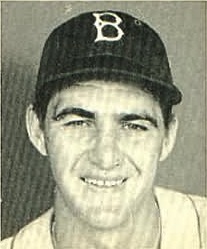
Rex Edward Barney (December 19, 1924 – August 12, 1997) was an American Major League Baseball pitcher for the Brooklyn Dodgers in 1943 and from 1946 through 1950.

Key Information

As a teenage phenom, Barney was signed by the Dodgers at the age of 18, in 1943. He pitched 45 innings that year.

Enlisting in the Army in 1943, Barney eventually served in Europe, receiving two Purple Hearts and the Bronze Star Medal.[1]

Barney returned to the majors in 1946. He was one of the hardest throwers in the league but struggled with wildness early in his career. In 1948, however, he gained control of his fastball and had his greatest season; he won 15 games and finished second in the National League with 138 strikeouts. The highlight was hurling a no-hitter against the New York Giants on September 9. He had to sit through a one-hour rain delay and showers in the 7th, 8th, and 9th innings to finish the game. The next season, Barney pitched semi-effectively while suffering lingering effects from a leg injury suffered while sliding into second base.

Barney appeared in 3 games in the 1947 World Series – starting and losing the fifth game[2] – against the New York Yankees. He got knocked out early in his 1949 World Series start, also against the Yankees, after just 223 innings. In 1950, he walked 48 batters in just 33 innings and never played in the majors again. He ended his career with a 35–31 record and a 4.31 earned run average.

After his retirement as a player, Barney briefly worked as a broadcaster, calling games for Mutual radio in 1958. That same year he also teamed with Al Helfer to call several Philadelphia Phillies games on New York station WOR-TV, helping to fill that city's void of National League baseball following the departure of the Dodgers and Giants to the West Coast.[3]

Barney also teamed with Ted Patterson in 1982 and 1983 to cablecast 16 Baltimore Orioles games per year on the SuperTV channel.

See also

[edit]

References

[edit]
[edit]
Revisions and contributorsEdit on WikipediaRead on Wikipedia
from Grokipedia
Rex Barney is an American professional baseball pitcher known for his exceptional velocity and his time with the Brooklyn Dodgers in Major League Baseball during the 1940s. Born in Omaha, Nebraska, on December 19, 1924, Barney debuted with the Dodgers in 1943 before serving in World War II, returning to pitch from 1946 to 1950. His fastball was legendary, often cited as one of the fastest of his era, leading to high strikeout totals but also frequent walks due to wildness. He achieved a career highlight by pitching a no-hitter against the New York Giants in 1948. Arm injuries ultimately shortened his playing career, forcing retirement after the 1950 season. Following his playing days, Barney remained connected to baseball as the longtime public address announcer for the Baltimore Orioles from 1969 until his death on August 12, 1997, becoming a beloved figure in the team's history.

Early life

Childhood and family

Rex Edward Barney was born on December 19, 1924, in Omaha, Nebraska, on a bitterly cold winter night when temperatures reached twenty degrees below zero. According to his mother's account, he was born in the hospital elevator on the way to the delivery room after his father was unable to start their old Model T Ford to rush her to the hospital. He was the youngest of four children born to Marie and Eugene Spencer Barney. His father worked for the Union Pacific Railroad for forty-five years, eventually becoming a general foreman, which required him to leave home on Sunday nights and ride the rails throughout the week before returning on Fridays. Barney's older siblings were sisters Beatrice and Bernice, and brother Ted.

High school athletics

Rex Barney attended Creighton Preparatory School, a Catholic boys' school in Omaha, Nebraska, where he starred in both basketball and baseball. Basketball was his strongest sport, and he led the team to two state championships while earning all-state honors. He was a three-year starter on the basketball squad and received particular recognition for his contributions on the court during his senior year. On the baseball diamond, Barney pitched as a tall, angular 6-foot-3, 185-pound right-hander known for striking out batters in large numbers, though he displayed the wildness common among young hurlers. Creighton Prep won the state baseball tournament in two of his four years at the school. Barney credited much of his development to coach Maurice "Skip" Palrang, described as one of Nebraska's greatest high school coaches, who oversaw multiple sports at Creighton Prep. Scouts from the Detroit Tigers, St. Louis Cardinals, New York Yankees, and Brooklyn Dodgers began watching him as early as his sophomore year. In the spring of 1943, shortly before his induction into the Army, Barney signed a professional contract with the Brooklyn Dodgers for a $2,500 bonus.

Military service

World War II experience

Rex Barney enlisted in the United States Army in September 1943 and served with the Fourth and Sixth Armored Divisions of General George S. Patton's Third Army, engaging in combat across France and Germany. During his service, he commanded a lead tank in advance positions, drawing enemy fire throughout the day. Barney was wounded by German shrapnel in his leg and back, receiving two Purple Hearts for these injuries, and was also awarded a Bronze Star. On one occasion, while in his tank, Barney encountered General Patton when a Jeep pulled alongside; Patton asked where the front line was, and Barney replied that "the front of this tank is the front." Patton responded that it was "too goddamn close for me" and ordered him to carry on before departing. Barney was discharged after the war and returned to the Brooklyn Dodgers for spring training in 1946.

Baseball career

Signing, debut, and wartime interruption

Rex Barney signed a contract with the Brooklyn Dodgers in the spring of 1943 for a $2,500 bonus, with $500 paid upfront and the remaining $2,000 contingent on his return from military service and his ability to resume his baseball career. He reported to the Durham Bulls of the Class B Piedmont League in May 1943 and made his professional debut in relief on June 4, 1943, against the Norfolk Tars. At Durham, he compiled a 4–6 record with a 3.00 ERA, 71 strikeouts, and 51 walks over 81 innings. In late July 1943, Barney was promoted to the Montreal Royals of the International League, the Dodgers' top farm club, where he appeared in four games with a 0–1 record, 2.45 ERA, and 18 strikeouts in 22 innings. Barney was called up to the major leagues and made his MLB debut with the Brooklyn Dodgers on August 18, 1943, at age 18. His first major-league pitch hit Chicago Cubs leadoff hitter Eddie Stanky squarely in the middle of the back. During the remainder of the 1943 season, he appeared in nine games (eight starts) and posted a 2–2 record over 45.1 innings with a 6.35 ERA. His early career was interrupted when he entered the Army in September 1943. Barney returned to the Dodgers in the spring of 1946 after his military service and recorded a 2–5 mark that season.

Postwar peak and no-hitter

After returning from military service, Rex Barney achieved his postwar peak with the Brooklyn Dodgers during the 1947 and 1948 seasons. In 1947, he posted a 5–2 record in limited regular-season action while struggling with control. In the 1947 World Series, Barney started Game 5 against the New York Yankees at Ebbets Field on October 4; he struck out Joe DiMaggio with the bases loaded in the first inning but issued nine walks in 4.2 innings pitched and took the loss in a 2–1 defeat. Barney's finest year came in 1948, when he recorded a 15–13 record with a 3.10 ERA (fifth in the National League), 138 strikeouts (second in the NL), and four shutouts across 246.2 innings. His performance reflected significant control improvement, as he struck out 138 batters while walking 122—a notable advance from his earlier wildness. On August 18, he threw a one-hitter in a 1–0 complete-game victory over the Philadelphia Phillies. The highlight of his career arrived on September 9, 1948, when Barney pitched a no-hitter against the New York Giants at the Polo Grounds, securing a 2–0 victory; after a rocky first inning, he retired the last 20 batters in order while throwing 116 pitches with 41 balls.

World Series appearances and decline

In 1949, Barney posted a 9-8 record with a 4.41 ERA across 38 appearances, including 20 starts and 140.2 innings pitched, during which he struck out 80 batters but issued 89 walks. He started Game 5 of the World Series against the New York Yankees, allowing five earned runs on three hits and six walks in 2⅔ innings before being removed, taking the loss in a 10-6 defeat that enabled the Yankees to clinch the series four games to one. The following year, persistent control problems severely limited his role, as he appeared in only 20 games with one start, compiling a 2-1 record and a 6.42 ERA over 33.2 innings while walking 48 batters against 23 strikeouts. Barney's struggles continued into the minor leagues, where he was optioned to Fort Worth of the Texas League in 1951 and walked 39 batters in just 14 innings across five appearances. In 1952, assigned to the St. Paul Saints of the American Association, he pitched only three innings in four games, posting a 51.00 ERA, walking 14 batters, and allowing 17 earned runs before his professional career concluded at age 28. Control issues, including a high walk rate that often exceeded his strikeouts, and the lingering effects of a broken ankle sustained late in 1948 contributed to his rapid decline after a peak that included a no-hitter the prior year. Across his major league tenure, Barney finished with a 35-31 record, an ERA of 4.31 to 4.34 depending on calculation, 336 strikeouts, and 410 walks.

Broadcasting career

Early broadcasting roles

After retiring from baseball at age twenty-eight, Rex Barney contemplated suicide while viewing himself as a has-been. He found direction by recalling Dodgers broadcaster Red Barber's compliment from years earlier, praising his pleasing radio voice and suggesting he pursue broadcasting after his playing career ended. This prompted Barney to enter the field, beginning a gradual climb through a series of modest radio positions. Barney's early broadcasting work included stints in his hometown of Omaha, at a 250-watt station in Vero Beach, Florida, play-by-play announcing at WCAW in Charleston, West Virginia, and calling the Game-of-the-Day for the Mutual Broadcasting System. In 1958, following the Dodgers' and Giants' relocation to the West Coast and the resulting void for National League coverage in New York, WOR-TV hired Barney to team with Al Helfer in broadcasting National League games to the local audience. With assistance from Lee MacPhail, then general manager of the Baltimore Orioles, Barney moved to Baltimore and began hosting a sports talk show in 1965, where he soon became a celebrity in his adopted city. In 1982 and 1983, Barney served as color analyst alongside Ted Patterson on play-by-play for 16 Baltimore Orioles games per year cablecast on the SuperTV channel.

Baltimore Orioles public address announcer

Rex Barney served as the public address announcer for the Baltimore Orioles from 1974 until his death in 1997, a tenure that spanned 24 seasons and made him one of the most recognizable voices in Baltimore sports. He announced games at Memorial Stadium for most of his time in the role and became the inaugural public address announcer at Oriole Park at Camden Yards when the stadium opened in 1992, continuing through the 1997 season. His distinctive, booming delivery and theatrical flair turned him into a beloved local celebrity whose voice provided a comforting continuity for fans during games. Barney was particularly known for his signature elongated "THANK Youuuu" when addressing the crowd or acknowledging applause, a phrase so iconic that it was incorporated into the title of his autobiography. He also delighted fans by declaring "Give that fan a contract" after impressive catches or plays made by spectators in the stands, adding a playful and engaging element to his announcements. Former Orioles pitcher and broadcaster Mike Flanagan described Barney's reassuring presence as "almost like a security blanket" for the Baltimore faithful. In 1993, Barney co-authored his autobiography Rex Barney's Thank Youuuu for 50 Years in Baseball from Brooklyn to Baltimore, which chronicled his journey through the sport and highlighted his enduring connection to the Orioles as their public address voice. His long tenure and unique style cemented his status as an essential part of the Orioles game-day experience for more than two decades.

Film and television appearances

On-screen credits

Rex Barney's on-screen credits in film and television are limited, consisting mainly of appearances as himself drawn from his baseball career and one later voice contribution. He is credited as Self - Brooklyn Dodgers Pitcher in the 1949 World Series (TV Series, 1949), reflecting his participation in the televised event as an active player. He has similar credits as Self - Brooklyn Dodgers Pitcher in multiple episodes of the 1947 World Series (TV Mini Series, 1947). In a later television appearance, Barney provided the voice for a character named Rex Barney in one episode of Homicide: Life on the Street (TV Series, 1993–1999) in 1997, marking a brief cameo likely tied to his status as a Baltimore sports figure. These credits underscore the narrow scope of his screen work, primarily self-appearances or voice-over roles rather than fictional acting performances.

Personal life

Marriages and family

Rex Barney married Beverly Duda, a high-school acquaintance from Omaha, on May 1, 1947, in Brooklyn. The couple had two children, Christine and Kevin, before their marriage ended in divorce. Barney's second marriage was to Carole Bennett, a schoolteacher in Baltimore. This marriage also ended in divorce.

Health challenges

In his later years, Rex Barney endured several serious health setbacks while continuing his long tenure as the Baltimore Orioles' public address announcer. He suffered a mild stroke in June 1983 in Baltimore, which required hospitalization but from which he recovered sufficiently to resume his duties at the microphone two months later for the team's world championship season. Barney then experienced a heart attack in 1991. The following year, in May 1992, he had his right leg amputated below the knee due to circulation problems associated with diabetes. After missing six weeks and 17 home games following the amputation, he returned to his role despite the physical challenges.

Death and legacy

Passing and recognitions

Rex Barney died on August 12, 1997, at the age of 72 in Baltimore, Maryland, though some sources list the date as August 11. He was found dead in his home by a friend. Reliable sources indicate he died of an apparent heart attack. Barney was buried at Lorraine Park Cemetery in Woodlawn, Maryland. Barney was inducted into the Baltimore Orioles Hall of Fame in 1991 in recognition of his extensive career as the team's public address announcer from 1969 until his death.
Add your contribution
Related Hubs
User Avatar
No comments yet.