



Community hub
Recent from talks
Knowledge base stats:
Talk channels stats:
Members stats:
Ricinulei
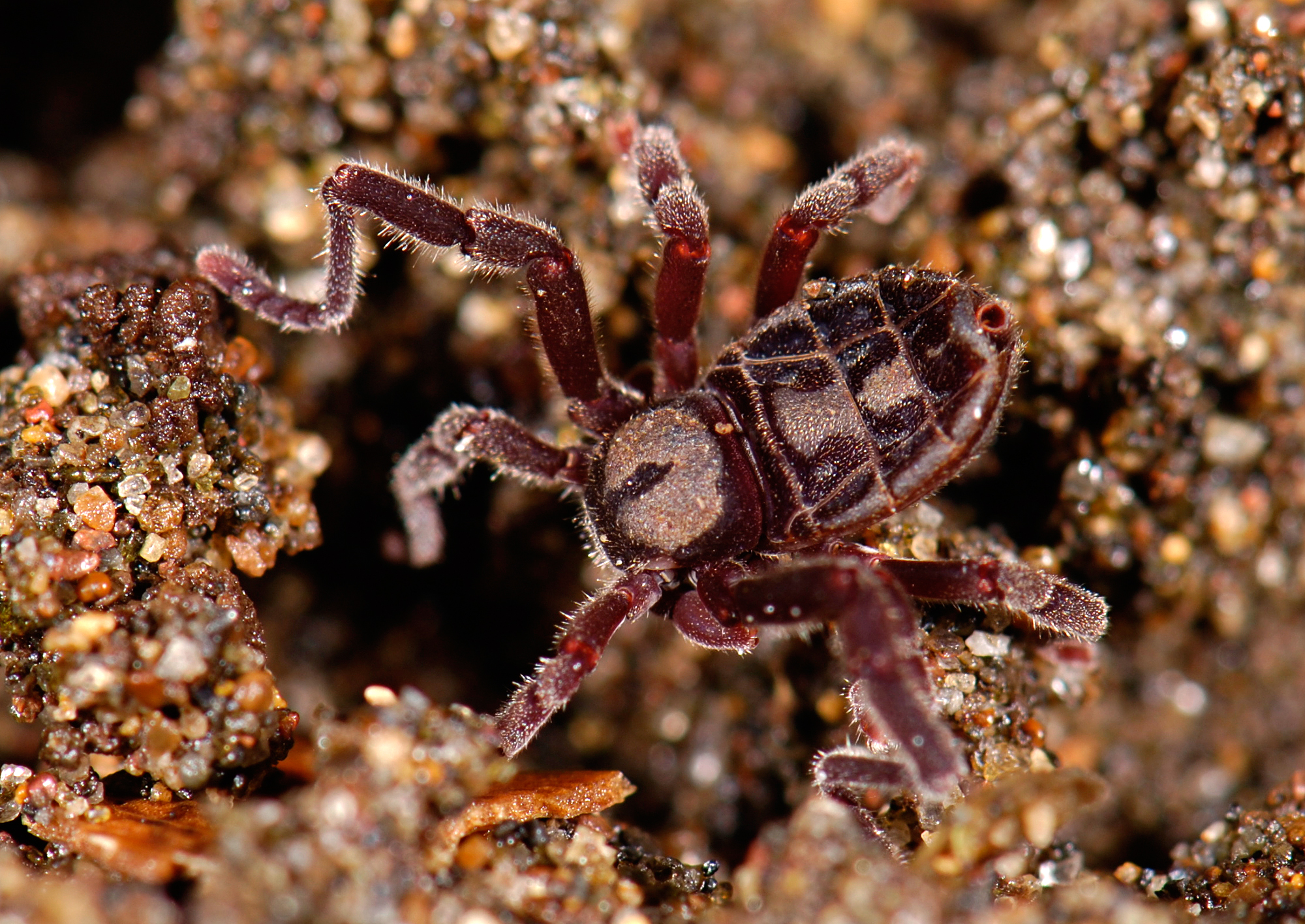
Ricinulei is a small order of arachnids. Like most arachnids, they are predatory; eating small arthropods. They occur today in west-central Africa (Ricinoides) and the Americas (Cryptocellus and Pseudocellus) from Brazil to southern Texas, where they inhabit either leaf-litter or caves. As of 2022, 103 extant species of ricinuleids have been described worldwide, all in the single family Ricinoididae. Due to their obscurity they do not have a proper common-name, though in academic literature they are occasionally referred to as hooded tickspiders.
In addition to the three living genera, Ricinulei has a fossil-record spanning over 300 million years, including fossils from the Late Carboniferous of Euramerica and the Cretaceous Burmese amber.
The most important general account of ricinuleid anatomy remains the 1904 monograph by Hans Jacob Hansen and William Sørensen. Useful further studies can be found in, e.g., the work of Pittard and Mitchell, Gerald Legg and L. van der Hammen.
Ricinulei are typically about 5 to 10 millimetres (0.2 to 0.4 in) long. The largest Ricinulei known to ever exist was the Late Carboniferous Curculioides bohemondi with a body length of 21.77 mm (0.857 in). The cuticle (or exoskeleton) of both the legs and body is remarkably thick. Their most notable feature is a "hood" (or cucullus) which can be raised and lowered over the head. When lowered, it covers the mouth and the chelicerae. Living ricinuleids have no eyes, although two pairs of lateral eyes can be seen in fossils and even living species retain light-sensitive areas of cuticle in this position.
The heavy-bodied abdomen (or opisthosoma) exhibits a narrow pedicel, or waist, where it attaches to the prosoma. Curiously, there is a complex coupling mechanism between the prosoma and opisthosoma. The front margin of the opisthosoma tucks into a corresponding fold at the back of the carapace. The advantages of this unusual system are not well understood, and since the genital opening is located on the pedicel (another rather unusual feature) the animals have to 'unlock' themselves in order to mate. The abdomen is divided dorsally into a series of large plates or tergites, each of which is subdivided into a median and lateral plate.
The mouthparts, or chelicerae, are composed of two segments forming a fixed and a moveable digit. Sensory organs are also found associated with the mouthparts; presumably for tasting the food. The chelicerae can be retracted and at rest they are normally hidden beneath the cucullus.
Ricinuleid pedipalps are complex appendages. They are typically used to manipulate food items, but also bear many sensory structures and are used as 'short range' sensory organs. The pedipalps end in pincers that are small relative to their bodies, when compared to those of the related orders of scorpions and pseudoscorpions. Similar pincers on the pedipalps have now been found in the extinct order Trigonotarbida (see Relationships).
As in many harvestmen, the second pair of legs is longest in ricinuleids and these limbs are used to feel ahead of the animal, almost like antennae. If the pedipalps are 'short range' sensory organs, the second pair of legs are the corresponding 'long range' ones. Sensilla on the tarsi at the ends of legs I and II (which are used more frequently to sense the surroundings) differ from those of legs III and IV. In male ricinuleids, the third pair of legs are uniquely modified to form copulatory organs. The shape of these organs is very important for taxonomy and can be used to tell males of different species apart.
Hub AI
Ricinulei AI simulator
(@Ricinulei_simulator)
Ricinulei
Ricinulei is a small order of arachnids. Like most arachnids, they are predatory; eating small arthropods. They occur today in west-central Africa (Ricinoides) and the Americas (Cryptocellus and Pseudocellus) from Brazil to southern Texas, where they inhabit either leaf-litter or caves. As of 2022, 103 extant species of ricinuleids have been described worldwide, all in the single family Ricinoididae. Due to their obscurity they do not have a proper common-name, though in academic literature they are occasionally referred to as hooded tickspiders.
In addition to the three living genera, Ricinulei has a fossil-record spanning over 300 million years, including fossils from the Late Carboniferous of Euramerica and the Cretaceous Burmese amber.
The most important general account of ricinuleid anatomy remains the 1904 monograph by Hans Jacob Hansen and William Sørensen. Useful further studies can be found in, e.g., the work of Pittard and Mitchell, Gerald Legg and L. van der Hammen.
Ricinulei are typically about 5 to 10 millimetres (0.2 to 0.4 in) long. The largest Ricinulei known to ever exist was the Late Carboniferous Curculioides bohemondi with a body length of 21.77 mm (0.857 in). The cuticle (or exoskeleton) of both the legs and body is remarkably thick. Their most notable feature is a "hood" (or cucullus) which can be raised and lowered over the head. When lowered, it covers the mouth and the chelicerae. Living ricinuleids have no eyes, although two pairs of lateral eyes can be seen in fossils and even living species retain light-sensitive areas of cuticle in this position.
The heavy-bodied abdomen (or opisthosoma) exhibits a narrow pedicel, or waist, where it attaches to the prosoma. Curiously, there is a complex coupling mechanism between the prosoma and opisthosoma. The front margin of the opisthosoma tucks into a corresponding fold at the back of the carapace. The advantages of this unusual system are not well understood, and since the genital opening is located on the pedicel (another rather unusual feature) the animals have to 'unlock' themselves in order to mate. The abdomen is divided dorsally into a series of large plates or tergites, each of which is subdivided into a median and lateral plate.
The mouthparts, or chelicerae, are composed of two segments forming a fixed and a moveable digit. Sensory organs are also found associated with the mouthparts; presumably for tasting the food. The chelicerae can be retracted and at rest they are normally hidden beneath the cucullus.
Ricinuleid pedipalps are complex appendages. They are typically used to manipulate food items, but also bear many sensory structures and are used as 'short range' sensory organs. The pedipalps end in pincers that are small relative to their bodies, when compared to those of the related orders of scorpions and pseudoscorpions. Similar pincers on the pedipalps have now been found in the extinct order Trigonotarbida (see Relationships).
As in many harvestmen, the second pair of legs is longest in ricinuleids and these limbs are used to feel ahead of the animal, almost like antennae. If the pedipalps are 'short range' sensory organs, the second pair of legs are the corresponding 'long range' ones. Sensilla on the tarsi at the ends of legs I and II (which are used more frequently to sense the surroundings) differ from those of legs III and IV. In male ricinuleids, the third pair of legs are uniquely modified to form copulatory organs. The shape of these organs is very important for taxonomy and can be used to tell males of different species apart.