


Community hub
Recent from talks
Contribute something
Nothing was collected or created yet.
Trigonotarbida
View on Wikipedia
| Trigonotarbida Temporal range: Late Silurian to Early Permian
| |
|---|---|

| |
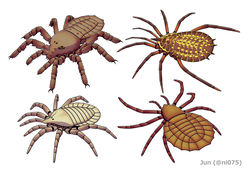
| Palaeocharinus rhyniensis, Eophrynus prestvicii, Trigonotarbus johnsoni and Maiocercus celticus | |
Scientific classification 
| |
| Kingdom: | Animalia |
| Phylum: | Arthropoda |
| Subphylum: | Chelicerata |
| Class: | Arachnida |
| Order: | †Trigonotarbida Petrunkevitch, 1949 |
| Families | |
| Synonyms | |
| |
The order Trigonotarbida is a group of extinct arachnids whose fossil record extends from the late Silurian to the early Permian (Pridoli to Sakmarian).[1][2][3] These animals are known from several localities in Europe and North America, as well as a single record from Argentina. Trigonotarbids can be envisaged as spider-like arachnids, but without silk-producing spinnerets. They ranged in size from a few millimetres to a few centimetres in body length and had segmented abdomens (opisthosoma), with the dorsal exoskeleton (tergites) across the backs of the animals' abdomens, which were characteristically divided into three or five separate plates.[1] Probably living as predators on other arthropods, some later trigonotarbid species were quite heavily armoured and protected themselves with spines and tubercles.[4] About seventy species are currently known, with most fossils originating from the Carboniferous coal measures.
Historical background
[edit]
The first trigonotarbid was described in 1837 from the coal measures of Coalbrookdale in England by the famous English geologist Dean William Buckland.[5] He believed it to be a fossil beetle and named it Curculoides prestvicii. A much better preserved example was later discovered from Coseley near Dudley; also in the English West Midlands conurbation. Described in 1871 by Henry Woodward,[6] he correctly identified it as an arachnid and renamed it Eophrynus prestvicii—whereby the genus name comes from ἠώς (eos, meaning 'dawn'), and Phrynus, a genus of living whip spider (Amblypygi). Woodward subsequently described another trigonotarbid, Brachypyge carbonis, from the coal measures of Mons in Belgium;[7] although this fossil is known only from its abdomen and was initially mistaken for those of a crab.
A new arachnid order
[edit]
In 1882, the German zoologist Ferdinand Karsch described a number of fossil arachnids from the coal measures of Neurode in Silesia (now Poland), including one he named Anthracomartus voelkelianus in honour of Herr Völkel, the foreman of the mine where it was discovered.[9] This species was raised to a new, extinct, arachnid order which Karsch called Anthracomarti. The name is derived from ἄνθραξ (anthrax), the Greek word for coal. A number of other fossils which would eventually be placed in Trigonotarbida were discovered around this time. Hanns Bruno Geinitz described Kreischeria wiedei from the coal measures of Zwickau in Germany,[10] although he interpreted it as a fossil pseudoscorpion. Johann Kušta described Anthracomartus krejcii[11] from Rakovník in the Czech Republic, and published further descriptions in a number of subsequent papers.[12][13][14] In 1884, Samuel Hubbard Scudder described Anthracomartus trilobitus from Fayetteville, Arkansas—the first trigonotarbid from North America.[15]
Relationships
[edit]
| |||||||||||||||||||||||||||||||||||||||
| Internal phylogeny of Pantetrapulmonata, showing position of Trigonotarbita and possible relationship with Ricinulei.[16][17] Extinct taxa indicaded by '†'. |
Early studies tended to confuse trigonotarbids with other living or extinct groups of arachnids; particularly harvestmen (Opiliones). Petrunkevitch's division of the trigonotarbids into two, unrelated, orders was noted above. In detail, he divided the arachnids into suborders based on the width of the division between the two parts of the body (the prosoma and opisthosoma). Anthracomartida and another extinct order, Haptopoda, were grouped into a subclass Stethostomata defined by a broad division of the body and downward-hanging mouthparts. Trigonotarbida was placed in its own subclass Soluta and defined as having a division of the body which was variable in width. Petrunkevitch's scheme was largely followed in subsequent studies of fossil arachnids.
Pantetrapulmonata
[edit]In the 1980s, Bill Shear and colleagues[18] carried out an important study on well preserved Mid Devonian trigonotarbids from Gilboa, New York. They questioned whether it was appropriate to define a group of animals on a variable character state and carried out the first cladistic analysis of fossil and living arachnids. They showed that trigonotarbids are closely related to a group of arachnids which have gone under various names (Caulogastra, Arachnidea, etc.), but for which the name Tetrapulmonata has become most widespread.[19] Members of the Tetrapulmonata include spiders (Araneae), whip spiders (Amblypygi), whip scorpions (Uropygi) and shorttailed whipscorpion (Schizomida) and, together with trigonotarbids, share characters like two pairs of book lungs and similar mouthparts with fangs operating rather like a pocket knife.[20] In a 2007 study of arachnid relationships, the Shear et al. hypothesis was largely supported and a group Pantetrapulmonata was proposed which comprises Trigonotarbida + Tetrapulmonata.[21] This has since been corroborated in more recent cladistic analyses.[22][23][24][25]
Trigonotarbids and ricinuleids
[edit]
_(cropped).jpg)
In 1892, Ferdinand Karsch suggested that the rare and rather bizarre-looking ricinuleids (Ricinulei) were the last living descendants of the trigonotarbids.[26] A similar hypothesis was reintroduced by Dunlop,[16] who pointed out distinct similarities and possible sister group relationship between these arachnid groups. Both have opisthosomal tergites divided into median and lateral plates and both have a complicated coupling mechanism between the prosoma and the opisthosoma which 'locks' the two halves of the body together. Although cladistic analysis has tended to recover ricinuleids in their traditional position closely related to mites and ticks, further discoveries have revealed that the tip of the pedipalp ends in a small claw in both trigonotarbids and ricinuleids.[17][27] If the hypothesis is true, ricinuleids, despite the lack of tetrapulmonate key characters (e.g. book lungs), may represent part of the pantetrapulmonate clade alongside trigonotarbids as well.[16][17][20]
Internal relationships
[edit]The first cladistic analysis of the trigonotarbids was published in 2014.[8] This recovered the families Anthracomartidae, Anthracosironidae, and Eophrynidae as monophyletic. In contrast Trigonotarbidae, Aphantomartidae, Palaeocharinidae, and Kreischeriidae were not. Two clades were consistently recovered with strong support—(Palaeocharinus (Archaeomartidae + Anthracomartidae)), and Lissomartus as sister group the 'eophrynid assemblage' (Aphantomartus (Alkenia (Pseudokreischeria (Kreischeria (Eophrynus + Pleophrynus))))).
Description
[edit]

Trigonotarbids superficially resemble spiders, but can be easily recognised by having tergites on the dorsal side of the opisthosoma divided into median and lateral plates.[28] This character is shared with ricinuleids (Ricinulei) (see also Ricinulei#Relationships). As in other arachnids, the body is divided into a prosoma (or cephalothorax) and opisthosoma (or abdomen). Body length ranges from a couple of millimetres up to about 5 cm (2.0 in).[29]
Prosoma
[edit]The prosoma is covered by the carapace and always bears a pair of median eyes.[1] In the probably basal families Palaeocharinidae, Anthracomartidae[30] – and perhaps also Anthracosironidae – there is an additional pair of lateral eye tubercles which, at least in palaeocharinids,[31] appear to have borne a series of individual lenses. In this sense palaeocharinids seem to be in the process of reducing a compound eye.[32] Anterior margin of the carapace protrude into a projection referred to as clypeus.[22]
The chelicerae are of the "pocket-knife" type consisting of a basal segment and a sharp, curving fang.[1] The chelicerae are described as paleognathic: the fangs are held parallel to one another, like those of mesothele and mygalomorph spiders, but the chelicerae hang downwards like those of araneomorph spiders.[33] There is no evidence in well-preserved fossils for the opening of a venom gland, thus trigonotarbids were probably not venomous. The chelicerae may have been slightly retractable into the prosoma. Well-preserved palaeocharinids show evidence for a small, slit-like mouth with an upper lip (a labrum or rostrum) and a lower lip (or labium).[34] Inside the mouth there is some sort of filtering system formed from hairs or platelets which strongly suggests that trigonotarbids (like spiders and many other arachnids) could eat only preorally digested, liquified prey.[34]
The pedipalps have the typical arachnid structure with a coxa, trochanter, femur, patella, tibia and tarsus. They are pediform, i.e. they look like small legs and were not highly modified.[35] There is no evidence for a special sperm transfer device as in the modified palpal organ of male spiders. In at least the palaeocharinids and anthracomartids the tip of the pedipalp is modified into a small chela (claw) formed from the tarsal claw (or apotele) and a projection from the tarsus. As mentioned above, a very similar arrangement is seen at the end of the pedipalp in Ricinulei.[17][27]
The walking legs again follow the typical arachnid plan with a coxa, trochanter, femur, patella, tibia, metatarsus and tarsus.[1] The coxae surround a single sternum. In well preserved palaeocharinids there is a ring, or annulus, around the trochanter–femur joint which may be the remains of an earlier leg segment.[35] The legs are largely unmodified, although in Anthracosironidae the forelegs are quite large and spiny,[36] presumably to help catch prey. The legs end in three claws, two large ones and a smaller median claw.[35]
Opisthosoma
[edit]

The opisthosoma is largely suboval in outline with a flatten dorsal surface.[35] It compose of 12 segments, with some of them had undergone degrees of fusion or reduction, hence the previous misinterpretation of around 8 to 11 segments.[20] Tergite of the first segment partially covered by the posterior margin of preceding carapace, forming a complicated coupling mechanism known as 'locking ridge'.[1][20] Tergites of segment 2 to 8 (segment 9 in some species) were all laterally divided into 3 plates (one median and two lateral), with those of segment 2 and 3 fused to each other in most species.[20] However, the corresponding tergites of the family Anthracomartidae are further subdivided into 5 plates.[30] The last 3 segments are usually only visible from the ventral side,[1] with the 2 final segments constricted into a tiny ring-like section known as pygidium.[20]
Ventral side of opisthosomal segment 2 to 9 covered by series of lung-bearing opercula (2 and 3) and curved sternites (4 to 9).[1][20] The first segment apparently lacking any ventral plates. Just like other lung-bearing arachnids (scorpion and tetrapulmonate), the book lungs of trigonotarbids formed by layers of trabecula-bearing lamellae, which is a feature adapted to a terrestrial, air-breathing lifestyle.[37] A pair of ventral sacs located between the posterior operculum and following sternite had been observed in some species.[38][4][20]
Paleobiology
[edit]In July 2014 scientists used computer-based techniques to re-create a possible walking gait for the animal.[39][35] A subsequent review article suggested by comparison with mites, with presumably similar lifestyle and environment, a metachronal rather than alternating leg coordination was more likely.[40] Subsequent work by the researchers behind the initial publication[35] used simulation approaches to assess the efficiency of a range of gaits using an updated trigonotarbid model.[41]
Included taxa
[edit]As of 2020, 70 valid species had been included under Trigonotarbida as follows:[3]
- Palaeotarbus Dunlop, 1999
- Palaeotarbus jerami (Dunlop, 1996) – Late Silurian, England
- Palaeocharinidae Hirst, 1923
- Aculeatarbus Shear, Selden & Rolfe, 1987
- Aculeatarbus depressus Shear, Selden & Rolfe, 1987 – Mid Devonian, United States
- Gelasinotarbus Shear, Selden & Rolfe, 1987
- Gelasinotarbus bifidus Shear, Selden & Rolfe, 1987 – Mid Devonian, United States
- Gelasinotarbus bonamoae Shear, Selden & Rolfe, 1987 – Mid Devonian, United States
- Gelasinotarbus heptops Shear, Selden & Rolfe, 1987 – Mid Devonian, United States
- Gelasinotarbus reticulatus Shear, Selden & Rolfe, 1987 – Mid Devonian, United States
- Gigantocharinus Shear, 2000
- Gigantocharinus szatmaryi Shear, 2000 – Late Devonian, United States
- Gilboarachne Shear, Selden & Rolfe, 1987
- Gilboarachne griersoni Shear, Selden & Rolfe, 1987 – Mid Devonian, United States
- Palaeocharinus Hirst, 1923
- Palaeocharinus calmani Hirst, 1923 – Early Devonian, Scotland
- Palaeocharinus hornei Hirst, 1923 – Early Devonian, Scotland
- Palaeocharinus kidstoni Hirst, 1923 – Early Devonian, Scotland
- Palaeocharinus rhyniensis Hirst, 1923 – Early Devonian, Scotland
- Palaeocharinus scourfieldi Hirst, 1923 – Early Devonian, Scotland
- Palaeocharinus tuberculatus Fayers, Dunlop & Trewin, 2005 – Early Devonian, Scotland
- Spinocharinus Poschmann & Dunlop, 2011
- Spinocharinus steinmeyeri Poschman & Dunlop, 2011 - Devonian, Bürdenbach
- Archaeomartidae Haase, 1890
- Archaeomartus Størmer, 1970
- Archaeomartus levis Størmer, 1970 - Devonian, Alken an der Mosel
- Anthracomartidae Haase, 1890
- synonyms
- = Promygalidae Frič, 1904
- = Brachypygidae Pocock, 1911
- = Coryphomartidae Petrunkevitch, 1945
- = Pleomartidae Petrunkevitch, 1945
- Anthracomartus Karsch, 1882
- synonyms
- = Brachylycosa Frič, 1904
- = Cleptomartus Petrunkevitch, 1949
- = Coryphomartus Petrunkevitch, 1945
- = Cryptomartus Petrunkevitch, 1945
- = Oomartus Petrunkevitch, 1953
- = Perneria Frič, 1904
- = Pleomartus Petrunkevitch, 1945
- = Promygale Frič, 1901
- Anthracomartus bohemica (Frič, 1901) – Late Carboniferous, Czech Republic
- Anthracomartus carcinoides (Frič, 1901) – Late Carboniferous, Czech Republic
- synonyms
- = Promygale rotunda Frič, 1901
- = Perneria salticoides Frič, 1904
- synonyms
- Anthracomartus elegans Frič, 1901 – Late Carboniferous, Czech Republic
- Anthracomartus hindi Pocock, 1911 – Late Carboniferous, England
- synonyms
- = Cleptomartus hangardi Guthörl, 1965
- = Cryptomartus meyeri Guthörl, 1964
- = Cleptomartus planus Petrunkevitch, 1949
- = Cryptomartus rebskei Brauckmann, 1984
- synonyms
- Anthracomartus granulatus Frič, 1904 – Late Carboniferous, Poland
- Anthracomartus janae (Opluštil, 1986) – Late Carboniferous, Czech Republic
- Anthracomartus kustae Petrunkevitch, 1953 – Late Carboniferous, Czech Republic
- Anthracomartus minor Kušta, 1884 – Late Carboniferous, Czech Republic
- synonym
- = Anthracomartus socius Kušta, 1888
- synonym
- Anthracomartus nyranensis (Petrunkevitch, 1953) – Late Carboniferous, Czech Republic
- Anthracomartus palatinus Ammon, 1901 – Late Carboniferous, Germany
- Anthracomartus priesti Pocock, 1911 – Late Carboniferous, England
- synonyms
- = Anthracomartus denuiti Pruvost, 1922
- = Cleptomartus plautus Petrunkevitch, 1949
- synonyms
- Anthracomartus radvanicensis (Opluštil, 1985) – Late Carboniferous, Czech Republic
- Anthracomartus triangularis Petrunkevitch, 1913 – Late Carboniferous, Canada
- Anthracomartus trilobitus Scudder, 1884 – Late Carboniferous, United States
- Anthracomartus voelkelianus Karsch, 1882 – Late Carboniferous, Poland
- synonyms
- Brachypyge Woodward, 1878
- Brachypyge carbonis Woodward, 1878 – Late Carboniferous, Belgium
- Maiocercus Pocock, 1911
- Maiocercus celticus (Pocock, 1902) – Late Carboniferous, Europe
- synonym
- = Maiocercus orbicularis Gill, 1911
- synonym
- Maiocercus celticus (Pocock, 1902) – Late Carboniferous, Europe
- Anthracosironidae Pocock, 1903
- Anthracosiro Pocock, 1903
- Anthracosiro fritschii Pocock, 1903 – Late Carboniferous, Europe
- synonym
- = Anthracosiro elongatus Waterlot, 1934
- synonym
- Anthracosiro woodwardi Pocock, 1903 – Late Carboniferous, Europe
- synonyms
- = Anthracosiro corsini Pruvost, 1926
- = Anthracosiro latipes Gill, 1909
- synonyms
- Anthracosiro fritschii Pocock, 1903 – Late Carboniferous, Europe
- Arianrhoda Dunlop & Selden, 2004
- Arianrhoda bennetti Dunlop & Selden, 2004 – Early Devonian, Wales
- Vratislavia Frič, 1904
- Vratislavia silesica (Roemer, 1878) - Carboniferous, Silesia
- Trigonotarbidae Petrunkevitch, 1949
- Trigonotarbus Pocock, 1911
- Trigonotarbus arnoldi Petrunkevitch, 1955 – Late Carboniferous, France
- Trigonotarbus johnsoni Pocock, 1911 – Late Carboniferous, England
- Trigonotarbus stoermeri Schultka, 1991 – Early Devonian, Germany
- Lissomartidae Dunlop, 1995
- Lissomartus Petrunkevitch, 1949
- Lissomartus carbonarius (Petrunkevitch, 1913) – Late Carboniferous, United States
- Lissomartus schucherti (Petrunkevitch, 1913) – Late Carboniferous, United States
- Aphantomartidae Petrunkevitch, 1945
- synonym
- = Trigonomartidae Petrunkevitch, 1949
- Alkenia Størmer, 1970
- Alkenia mirabilis Størmer, 1970 - Devonian, Alken an der Mosel
- Aphantomartus Pocock, 1911
- synonyms
- = Trigonomartus Petrunkevitch, 1913
- = Phrynomartus Petrunkevitch, 1945a
- Aphantomartus areolatus Pocock, 1911 – Early/Late Carboniferous, Europe
- synonyms
- = Aphantomartus pococki Pruvost, 1912
- = Trigonomartus dorlodoti Pruvost, 1930
- = Eophrynus waechteri Guthörl, 1938
- = ?Trigonomartus pruvosti van der Heide, 1951
- = ?Brachylycosa manebachensis Müller, 1957
- synonyms
- Aphantomartus ilfeldicus (Scharf, 1924) – Permian, Germany
- Aphantomartus pustulatus (Scudder, 1884) – Late Carboniferous, Europe, North America
- synonyms
- = ?Kreischeria villeti Pruvost, 1912
- = Cleptomartus plötzensis Simon, 1971
- synonyms
- synonyms
- Kreischeriidae Haase, 1890
- Anzinia Petrunkevitch, 1953
- Anzinia thevenini (Pruvost, 1919) – Late Carboniferous, France
- Gondwanarache Pinto & Hünicken, 1980
- Gondwanarache argentinensis Pinto & Hünicken, 1980 – Late Carboniferous, Argentina
- Hemikreischeria Frič, 1904
- Hemikreischeria geinitzi (Thevenin, 1902) – Late Carboniferous, France
- Kreischeria Geinitz, 1882
- Kreischeria wiedei Geinitz, 1882 – Late Carboniferous, Germany
- Pseudokreischeria Petrunkevitch, 1953
- Pseudokreischeria pococki (Gill, 1924) – Late Carboniferous, England
- synonym
- = Eophrynus varius Petrunkevitch, 1949
- synonym
- Pseudokreischeria pococki (Gill, 1924) – Late Carboniferous, England
- Eophrynidae Karsch, 1882
- synonym
- = Hemiphrynidae Frič, 1904
- Eophrynus Woodward, 1871
- Eophrynus prestvicii (Buckland, 1837) – Late Carboniferous, England
- Eophrynus udus Brauckmann, Koch & Kemper, 1985 – Late Carboniferous, Germany
- Nyranytarbus Harvey & Selden, 1995
- synonym
- Hemiphrynus Frič, 1901
- Nyranytarbus hofmanni (Frič, 1901) – Late Carboniferous, Czech Republic
- Nyranytarbus longipes (Frič, 1901) – Late Carboniferous, Czech Republic
- synonym
- Petrovicia Frič, 1904
- Petrovicia proditoria Frič, 1904 – Late Carboniferous, Czech Republic
- Planomartus Petrunkevitch, 1953
- Planomartus krejcii (Kušta, 1883) – Late Carboniferous, Czech Republic
- synonym
- = Anthracomartus affinis Kušta, 1885
- synonym
- Planomartus krejcii (Kušta, 1883) – Late Carboniferous, Czech Republic
- Pleophrynus Petrunkevitch, 1945a
- Pleophrynus verrucosus (Pocock, 1911) – Late Carboniferous, UK, United States
- synonym
- = Eophrynus warei Dix & Pringle, 1930
- = Pleophrynus ensifer Petrunkevitch, 1945a
- = Eophrynus jugatus Ambrose & Romano, 1972
- synonym
- Pleophrynus verrucosus (Pocock, 1911) – Late Carboniferous, UK, United States
- Pocononia Petrunkevitch, 1953
- Pocononia whitei (Ewing, 1930) – Early Carboniferous, United States
- Somaspidion Jux, 1982
- Somaspidion hammapheron Jux, 1982
- Stenotrogulus Frič, 1904
- synonyms
- = Cyclotrogulus Frič, 1904
- = Pseudoeophrynus Příbyl, 1958
- Stenotrogulus salmii (Stur, 1877) – Late Carboniferous, Czech Republic
- synonyms
- = Cyclotrogulus sturii Frič, 1904 [non Hasse, 1890]
- = Pseudoeophrynus ostraviensis Příbyl, 1958
- synonyms
- synonyms
- Family uncertain
- Aenigmatarbus Poschmann, Dunlop, Bértoux & Galtier, 2016
- Aenigmatarbus rastelli Poschmann, Dunlop, Bértoux & Galtier, 2016 - Carboniferous, Graissessac, France
- Namurotarbus Poschmann & Dunlop, 2010
- Namurotarbus roessleri (Dunlop & Brauckmann, 2006) - Carboniferous, Hagen-Vorhalle
- synonyms
- = Archaeomartus roessleri Dunlop & Brauckmann, 2006
- synonyms
- Namurotarbus roessleri (Dunlop & Brauckmann, 2006) - Carboniferous, Hagen-Vorhalle
- Permotarbus Dunlop & Rößler, 2013
- Permotarbus schuberti Dunlop & Rößler, 2013 Permian, Chemnitz
- Tynecotarbus Hradská & Dunlop, 2013
- Tynecotarbus tichaveki Hradská & Dunlop, 2013 - Carboniferous, Týnec
- Anthracophrynus Andrée, 1913
- Anthracophrynus tuberculatus Andrée, 1913 – Late Carboniferous, Germany
- Areomartus Petrunkevitch, 1913
- Areomartus ovatus Petrunkevitch, 1913 - Carboniferous, West Virginia
- 'Eophrynus' scharfi Scharf, 1924 – Early Permian, Germany
- Aphantomartus Pocock, 1911
- Aphantomartus woodruffi (Scudder, 1893) - Carboniferous, Rhode Island
- Anthracomartus buchi (Goldenberg, 1873) – Late Carboniferous, Germany
- Anthracomartus hageni (Goldenberg, 1873) – Late Carboniferous, Germany
- Elaverimartus pococki Petrunkevitch, 1953 – Late Carboniferous, Scotland
- Eurymartus latus Matthew, 1895 – Late Carboniferous, Canada
- ?Eurymartus spinulosus Matthew, 1895 – Late Carboniferous, Canada
References
[edit]- ^ a b c d e f g h Garwood, Russell J.; Dunlop, Jason A. (2010). "Fossils Explained: Trigonotarbids". Geology Today. 26 (1): 34–37. doi:10.1111/j.1365-2451.2010.00742.x. S2CID 247708509. Retrieved June 12, 2015.
- ^ Dunlop, J. A.; Rößler, R. (2013-08-01). "The youngest trigonotarbid Permotarbus schuberti n. gen., n. sp. from the Permian Petrified Forest of Chemnitz in Germany". Fossil Record. 16 (2): 229–243. Bibcode:2013FossR..16..229D. doi:10.5194/fr-16-229-2013. ISSN 2193-0074.
- ^ a b Dunlop, J. A., Penney, D. & Jekel, D. 2020. A summary list of fossil spiders and their relatives. In World Spider Catalog. Natural History Museum Bern, online at http://wsc.nmbe.ch, version 20.5
- ^ a b Dunlop, Jason; Garwood, Russell (2014). "Tomographic reconstruction of the exceptionally preserved trigonotarbid arachnid Eophrynus prestvicii". Acta Palaeontologica Polonica. doi:10.4202/app.2012.0032.
- ^ William Buckland (1837). Treatise IV. Geology and mineralogy with reference to natural theology. The Bridgewater treatises on the power, wisdom and goodness of God as manifested in the creation. (2nd ed.). London: William Pickering.
- ^ H. Woodward (1871). "On the discovery of a new and very perfect Arachnide from the ironstone of the Dudley Coal-field". Geological Magazine. 8 (9): 1–4. Bibcode:1871GeoM....8..385W. doi:10.1017/s0016756800192817. S2CID 128850722.
- ^ H. Woodward (1878). "Discovery of the remains of a fossil crab (Decapoda–Bracyura) in the Coal Measures of the Environs of Mons, Belgium". Geological Magazine. new series. 2 (5): 433–436. doi:10.1017/S0016756800152616. S2CID 129112886.
- ^ a b Jones, Fiona; Dunlop, Jason A.; Friedman, Matthew; Garwood, Russell J. (2014). "Trigonotarbus johnsoni Pocock, 1911, revealed by X-ray computed tomography, with a cladistic analysis of the extinct trigonotarbid arachnids". Zoological Journal of the Linnean Society. 172 (1): 49–70. doi:10.1111/zoj.12167.
- ^ F. Karsch (1882). "Ueber ein neues Spinnenthier aus der Schlesischen Steinkohle und die Arachnoiden überhaupt". Zeitschrift der Deutschen Geologischen Gesellschaft (in German). 34: 556–561.
- ^ H. B. Geinitz (1882). "Kreischeria wiedei, ein Pseudoskorpion aus der Steinkohlenformation von Zwickau". Zeitschrift der Deutschen Geologischen Gesellschaft (in German). 34: 238–242.
- ^ Johann Kušta (1883). "Anthracomartus krejcii, eine neue Arachnide aus dem Böhmischen Karbon". Sitzungsberichte der Königlich Böhmischen Gesellschaft der Wissenschaften, Mathematisch-Naturwissenschaftliche Klasse (in German). 1883: 7.
- ^ Johann Kušta (1884). "Neue Arachniden aus der Steinkohlenformation von Rakonitz". Sitzungsberichte der Königlich Böhmischen Gesellschaft der Wissenschaften, Mathematisch-Naturwissenschaftliche Klasse (in German). 1884: 398–401.
- ^ Johann Kušta (1885). "Neue fossile Arthropoden aus dem Noeggarathienschiefer von Rakonitz". Sitzungsberichte der Königlich Böhmischen Gesellschaft der Wissenschaften, Mathematisch-Naturwissenschaftliche Klasse (in German). 1885: 1–7.
- ^ Johann Kušta (1888). "O nových arachnidech z karbonu Rakovnického. (Neue Arachniden aus der Steinkohlenformation bei Rakonitz)". Sitzungsberichte der Königlich Böhmischen Gesellschaft der Wissenschaften, Mathematisch-Naturwissenschaftliche Klasse (in Czech). 1888: 194–208.
- ^ Samuel H. Scudder (1884). "A contribution to our knowledge of Paleozoic Arachnida". Proceedings of the American Academy of Arts and Sciences. 20: 13–22. doi:10.2307/25138764. hdl:2027/hvd.32044107176828. JSTOR 25138764.
- ^ a b c Jason A. Dunlop (1996). "Evidence for a sister group relationship between Ricinulei and Trigonotarbida" (PDF). Bulletin of the British Arachnological Society. 10 (6): 193–204.
- ^ a b c d Jason A. Dunlop, Carsten Kamenz and Giovanni Talarico (2009). "A fossil trigonotarbid arachnid with a ricinuleid-like pedipalpal claw". Zoomorphology. 128 (4): 305–313. doi:10.1007/s00435-009-0090-z. S2CID 6769463.
- ^ William A. Shear, Paul A. Selden, W. D. I. Rolfe, Patricia M. Bonamo & James D. Grierson (1987). "New terrestrial arachnids from the Devonian of Gilboa, New York". American Museum Novitates (2901): 1–74. hdl:2246/5166.
{{cite journal}}: CS1 maint: multiple names: authors list (link) - ^ Jeffrey W. Shultz (1990). "Evolutionary morphology and phylogeny of Arachnida". Cladistics. 6 (1): 1–38. doi:10.1111/j.1096-0031.1990.tb00523.x. PMID 34933471. S2CID 85410687.
- ^ a b c d e f g h Dunlop, Jason A.; Lamsdell, James C. (2017). "Segmentation and tagmosis in Chelicerata". Arthropod Structure & Development. 46 (3): 395–418. doi:10.1016/j.asd.2016.05.002. ISSN 1467-8039. PMID 27240897 – via academia.edu.
- ^ Jeffrey W. Shultz (2007). "A phylogenetic analysis of the arachnid orders based on morphological characters". Zoological Journal of the Linnean Society. 150 (2): 221–265. doi:10.1111/j.1096-3642.2007.00284.x.
- ^ a b Garwood, Russell J.; Dunlop, Jason A. (2014). "Three-dimensional reconstruction and the phylogeny of extinct chelicerate orders". PeerJ. 2 e641. doi:10.7717/peerj.641. PMC 4232842. PMID 25405073.
- ^ Garwood, Russell J.; Dunlop, Jason A.; Selden, Paul A.; Spencer, Alan R. T.; Atwood, Robert C.; Vo, Nghia T.; Drakopoulos, Michael (2016). "Almost a spider: a 305-million-year-old fossil arachnid and spider origins". Proceedings of the Royal Society B: Biological Sciences. 283 (1827) 20160125. doi:10.1098/rspb.2016.0125. ISSN 0962-8452. PMC 4822468. PMID 27030415.
- ^ Wang, Bo; Dunlop, Jason A.; Selden, Paul A.; Garwood, Russell J.; Shear, William A.; Müller, Patrick; Lei, Xiaojie (2018). "Cretaceous arachnid Chimerarachne yingi gen. et sp. nov. illuminates spider origins". Nature Ecology & Evolution. 2 (4): 614–622. Bibcode:2018NatEE...2..614W. doi:10.1038/s41559-017-0449-3. ISSN 2397-334X. PMID 29403075. S2CID 4239867.
- ^ Garwood, Russell J.; Dunlop, Jason A.; Knecht, Brian J.; Hegna, Thomas A. (2017). "The phylogeny of fossil whip spiders". BMC Evolutionary Biology. 17 (1): 105. Bibcode:2017BMCEE..17..105G. doi:10.1186/s12862-017-0931-1. ISSN 1471-2148. PMC 5399839. PMID 28431496.
- ^ Ferdinand Karsch (1892). "Ueber Cryptostemma Guèr. als einziger recenter Ausläufer der fossilen Arachnoideen-Ordnung Meridogastra Thor". Berliner Entomologische Zeitschrift (in German). 37 (1): 25–32. doi:10.1002/mmnd.18920370108.
- ^ a b Russell Garwood, Jason A. Dunlop & Mark D. Sutton (2009). "High-fidelity X-ray micro-tomography reconstruction of siderite-hosted Carboniferous arachnids". Biology Letters. 5 (6): 841–844. doi:10.1098/rsbl.2009.0464. PMC 2828000. PMID 19656861.
- ^ Fayers, Stephen R.; Dunlop, Jason A.; Trewin, Nigel H. (2005). "A new early Devonian trigonotarbid arachnid from the Windyfield chert, Rhynie, Scotland". Journal of Systematic Palaeontology. 2 (4): 269–284. Bibcode:2005JSPal...2..269F. doi:10.1017/S147720190400149X. S2CID 140706387 – via edoc.hu-berlin.de.
- ^ Rößler, Ronny; Dunlop, Jason A. (1997). "Redescription of the largest trigonotarbid arachnid – Kreischeria wiedei (Geinitz, 1882) from the Upper Carboniferous of Zwickau, Germany". Paläontologische Zeitschrift. 71 (3–4): 237–245. Bibcode:1997PalZ...71..237R. doi:10.1007/BF02988493. S2CID 129447249.
- ^ a b Garwood, Russell J.; Dunlop, Jason A. (2011). "Morphology and systematics of anthracomartidae (Arachnida: Trigonotarbida)". Palaeontology. 54 (1): 145–161. Bibcode:2011Palgy..54..145G. doi:10.1111/j.1475-4983.2010.01000.x. ISSN 0031-0239. S2CID 83897592 – via academia.edu.
- ^ Hirst, Stanley; Maulik, S. (1926). "On some arthropod remains from the Rhynie Chert (Old Red Sandstone)". Geological Magazine. 63 (2): 69–71. Bibcode:1926GeoM...63...69H. doi:10.1017/S0016756800083692. S2CID 129777833.
- ^ Miether, Sebastian T.; Dunlop, Jason A. (2016). "Lateral eye evolution in the arachnids". Arachnology. 17 (2): 103–119. doi:10.13156/arac.2006.17.2.103. ISSN 2050-9928. S2CID 89428386 – via bioone.org.
- ^ Dunlop, J.A. (1997). Palaeozoic arachnids and their significance for arachnid phylogeny (PDF). 16th European Colloquium of Arachnology. Siedlce, PL: Wydawnictwo Wyzszej Skoly Rolniczo-Pedagogicznej. pp. 65–82. Retrieved 2016-03-19 – via european-arachnology.org.
- ^ a b Dunlop, Jason A. (1994). "Comparative anatomy of filtration mechanisms in tetrapulmonate arachnids (Trigonotarbida, Araneae, Amblypygi, Uropygi, and Schizomida)". Bulletin of the British Arachnological Society. 9: 267–273.
- ^ a b c d e f Garwood, Russell J.; Dunlop, Jason A. (July 2014). "The walking dead: Blender as a tool for paleontologists with a case study on extinct arachnids". Journal of Paleontology. 88 (4): 735–746. Bibcode:2014JPal...88..735G. doi:10.1666/13-088. ISSN 0022-3360. S2CID 131202472. Retrieved 21 July 2015 – via academia.edu.
- ^ Pocock, R.I. (1903). "A new Carboniferous arachnid". Geological Magazine. Decade 4. 10 (6): 247–251. Bibcode:1903GeoM...10..247P. doi:10.1017/S001675680011252X. S2CID 128408478 – via zenodo.org.
- ^ Kamenz, Carsten; Dunlop, Jason A.; Scholtz, Gerhard; Kerp, Hans; Hass, Hagen (2008-04-23). "Microanatomy of early Devonian book lungs". Biology Letters. 4 (2): 212–215. doi:10.1098/rsbl.2007.0597. ISSN 1744-9561. PMC 2429929. PMID 18198139.
- ^ Fayers, Stephen R.; Dunlop, Jason A.; Trewin, Nigel H. (2005). "A new early Devonian trigonotarbid arachnid from the Windyfield Chert, Rhynie, Scotland" (PDF). Journal of Systematic Palaeontology. 2 (4): 269–284. Bibcode:2005JSPal...2..269F. doi:10.1017/S147720190400149X. ISSN 1477-2019. S2CID 140706387 – via core.ac.uk.
- ^ Amos, Jonathan (9 July 2014). "Ancient arachnid 'walks again'". BBC News. British Broadcasting Corporation. Retrieved 9 July 2014 – via bbc.co.uk/news.
- ^ Weihmann, Tom; Goetzke, Hanns Hagen; Günther, Michael (November 2015). "Requirements and limits of anatomy-based predictions of locomotion in terrestrial arthropods with emphasis on arachnids". Journal of Paleontology. 89 (6): 980–990. Bibcode:2015JPal...89..980W. doi:10.1017/jpa.2016.33. S2CID 86908527.
- ^ McLean, Callum (2017). The simulation of the walking gait of the extinct Trigonotarbid arachnid (MPhil thesis). University of Manchester.