Hubbry Logo
Rima AriadaeusRima AriadaeusMain
Open search
Rima Ariadaeus
Community hub
Rima Ariadaeus
logo
8 pages, 0 posts
0 subscribers
Be the first to start a discussion here.
Rima Ariadaeus
Rima Ariadaeus
from Wikipedia
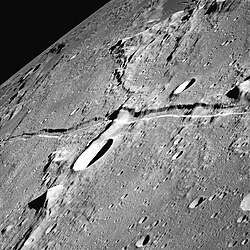
Rima Ariadaeus as photographed from Apollo 10. The crater to the south of the rille in the left half of the image is Silberschlag. The dark patch at the top right is the floor of the crater Boscovich.
The structure area in selenochromatic format (Si).[1]
Oblique view also from Apollo 10, with Ariadaeus crater in lower left and Rima Ariadaeus extending to the horizon.

Rima Ariadaeus is a linear rille on the lunar surface, situated at coordinates 6°24′N 14°00′E / 6.4°N 14.0°E / 6.4; 14.0. Measuring approximately 5 km (3.1 mi) in width and spanning a length of 300 km (186.4 mi), it stretches between Mare Tranquillitatis and Mare Vaporum.[2][3]

Formation

[edit]

Some scientists think that the linear rilles might have formed after large impact events, while others believe that the rilles were formed as a surface manifestation of deep-seated dike systems when the Moon was still volcanically active. Rima Ariadaeus is thought to have been formed when a section of the Moon's crust sank down between two parallel fault lines (making it a graben or fault trough).[4] Rima Ariadaeus shows no trace of associated volcanism and is thus considered to be an end member of the sequence where only pure faulting is involved i.e. a linear rille.[5]

Age

[edit]

The ridges crossing the rille trough of Rima Ariadaeus and the surrounding plains units have been offset by the trough, proving that the ridges are older than the faults. Some craters are cut off by the faults and are, therefore, older. Other craters lie on the wall of the trough and are younger than the faulting. The faulting must be relatively young because so few craters appear to be younger than the faults, and because the edges of the trough appear to be crisp and little affected by slumping and other mass wasting.[5]

The Moon split claim

[edit]

An Apollo mission photograph of this 300-kilometer-long rille has been used as evidence by the Muslim online community in support of the Islamic account of the Splitting of the Moon. Astronomer Paul Groot of Radboud University, refutes this claim, pointing out that the rille does not encircle the entire surface of the Moon and arguing that its formation is related to the impact that formed the Tycho crater, which is located to the lower right of the feature in the orientation of the photo.[6] NASA notes that the rille is similar to geological faults on Earth and states:

My recommendation is to not believe everything you read on the internet. Peer-reviewed papers are the only scientifically valid sources of information out there. No current scientific evidence reports that the Moon was split into two (or more) parts and then reassembled at any point in the past.

— Brad Bailey, NASA Lunar Science Institute, Staff Scientist, June 21, 2010[7]

References

[edit]
[edit]
Revisions and contributorsEdit on WikipediaRead on Wikipedia
from Grokipedia
Rima Ariadaeus is a linear rille on the nearside of the , classified as a tectonic that extends approximately 247 km in length from 4.87° S to 7.67° N and 9.53° E to 17.47° E , centered at 6.48° N, 13.44° E. Nestled between the basaltic plains of to the southeast and Mare Vaporum to the northwest, it represents one of the Moon's most prominent fault systems, with widths varying from about 1 to 5 km and a typical of around 350 m. This feature was officially named by the (IAU) in 1961 after the nearby Ariadaeus, a 10-km-wide structure to its east, reflecting Latin nomenclature rooted in ancient chronology. High-resolution images from NASA's Camera (LROC) have revealed its well-developed morphology, characterized by symmetric troughs with steep walls and flat floors, indicative of similar to those on . Formation models suggest it originated from normal faulting driven by regional stresses, potentially linked to the emplacement of nearby mare basalts, volcanic dike intrusions, or desurfacing following large impact events like the formation of the Imbrium basin. Mechanical modeling indicates fault dips of 55° to 75° and displacements up to 450 m, with the structure's depth extending several kilometers into the lunar crust under assumed elastic properties ( of 100 GPa). Rima Ariadaeus holds significance for understanding lunar , as its linear orientation provides insights into the Moon's post-mare tectonic evolution. It has been studied through comparative analyses with terrestrial grabens, highlighting shared characteristics in fault mechanics and morphology that inform models of planetary crustal deformation. Ongoing research using LROC and Lunar Orbiter Laser Altimeter (LOLA) data continues to refine its stratigraphic context and potential as a site for future robotic or human exploration, given its accessibility and representation of lunar fault systems.

Overview and Location

Geographical Position

Rima Ariadaeus is located on the nearside of the at center coordinates of 6.48° N and 13.44° E . This positioning places it within the lunar highlands, spanning from approximately 4.87° S to 7.67° N in and 9.53° E to 17.47° E in . The rille extends for about 250 km in a predominantly east-west orientation, forming a linear feature that runs straight across the terrain. It lies nestled between the basaltic plains of to the south and Mare Vaporum to the north, marking a transitional zone in the highland region. At its eastern terminus, Rima Ariadaeus approaches the rim of , a small with a diameter of 10.4 km. The western end of the rille draws near the northern boundary of , where the highland terrain meets the mare's edge.

Nomenclature and Discovery

Rima Ariadaeus derives its name from the adjacent lunar crater Ariadaeus, following the International Astronomical Union's (IAU) convention of naming linear features after nearby prominent craters. The designation was officially adopted by the IAU in as part of its standardized system. The crater Ariadaeus, in turn, honors Philip III Arrhidaeus of Macedonia (c. 358–317 BCE), listed in the as a chronologer. The crater's name was approved by the IAU in , drawing from the Latinized form of his name. The feature itself was first documented in the pioneering selenographic maps of the 17th century, marking the onset of systematic lunar . Selenographia by (1647) and Almagestum Novum by (1651) contributed to early depictions of lunar surface details, including linear features. In Riccioli's system, such linear valleys were classified as rimae (singular rima), from the Latin word for "chasm" or "fissure," a terminology retained by the IAU. The precise cataloging of Rima Ariadaeus as a rille occurred within the refined IAU framework developed after the Apollo missions (1969–1972), which provided high-resolution imagery to confirm and standardize thousands of lunar features.

Physical Characteristics

Dimensions and Morphology

Rima Ariadaeus measures approximately 247 km in length, with widths varying from about 1 to 5 km. Its depth varies along its extent, with a typical relief of around 350 m ranging up to 500 meters, reflecting the graben's topographic profile. These dimensions position it as one of the prominent linear rilles on the lunar nearside, extending between the maria Tranquillitatis and Vaporum. The rille exhibits a linear morphology, characterized by straight, parallel fault scarps that define its boundaries. It maintains a predominantly east-west orientation but features a slight southward bend at its eastern terminus near Crater Ariadaeus. The structure is interrupted midway by a transverse mountain ridge, which it cross-cuts, indicating the rille's relative youth compared to some surrounding terrain. The floor of Rima Ariadaeus is relatively flat, with defined contacts at the walls suggesting well-preserved margins and limited modification since formation. It contains minor debris in the form of occasional small craters and subtle ridges, including scattered pits visible in high-resolution imagery. These features underscore the rille's crisp edges and overall structural integrity.

Surrounding Geological Context

Rima Ariadaeus borders the northern margin of to the southeast, where dark basaltic plains dominate, and the southern edge of Mare Vaporum to the northwest, creating a stark contrast between the rille's highland setting and the surrounding low-albedo materials. This positioning embeds the feature within a transitional zone of lunar terrain, where the smooth, volcanic-flooded basins abut rugged, elevated highlands composed primarily of impact-derived materials. The rille intersects older tectonic ridges and sinuous rilles in its vicinity, notably crossing a pre-existing ridge that it displaces, indicating its formation postdates some local structural elements. To the west, it approaches Rima Hyginus, part of an en echelon fault system, while nearby craters such as Ariadaeus mark its eastern terminus, with the overall area influenced by radial lineaments associated with the Imbrium basin. The surrounding terrain consists of Fra Mauro Formation-like highlands, characterized by hummocky, ejecta-blanket deposits from the Imbrium impact, rich in anorthositic rocks that form the light-colored, elevated plains. Evidence of fault offsets is evident in the adjacent basaltic units of the maria, where the rille's scarps disrupt and lower the coherent surfaces, with offsets varying based on underlying rock strength—reaching heights of several hundred meters in smoother areas.

Geological Formation and Evolution

Formation Mechanisms

Rima Ariadaeus is a classic example of a lunar , formed through that resulted in the of the crustal block between two parallel normal faults. This process accommodates horizontal extension by allowing downward movement along the fault planes, producing a linear trough with steep walls and a relatively flat floor. The morphology reflects cumulative slip on the bounding faults, with displacement varying along the structure due to fault growth and interaction. The extensional stresses driving this formation are primarily attributed to lithospheric flexure induced by the loading of dense mare basalts in nearby basins, such as and Mare Vaporum, which caused isostatic adjustment and tangential tension in the surrounding highlands. Post-emplacement cooling and contraction of the mare basalts further contributed to localized extension, while broader lunar processes, including early interior and stresses from basin-forming impacts like those creating , likely played supporting roles. There is debate on the precise mechanism, with some studies proposing a primarily tectonic origin driven by these stresses, while others suggest involvement of magmatic dike intrusions that induced the faulting without surface . Notably, there is no evidence of volcanic infilling or associated eruptive features, distinguishing Rima Ariadaeus from sinuous rilles, which are primarily volcanic channels. Stratigraphic evidence supports a post-highland tectonic episode for the graben's development, as the faults offset and displace older ridges and subsidiary rilles in the region, such as segments of Rima Hyginus. This superposition indicates that faulting occurred after the formation of these pre-existing structures, consistent with an Imbrian-age extensional event following the emplacement of highland materials.

Age and Chronology

The age of Rima Ariadaeus has been determined through a combination of stratigraphic superposition and crater size-frequency distribution (CSFD) analyses, primarily using high-resolution imagery from the (LRO) Camera (LROC). Stratigraphically, Rima Ariadaeus is younger than the surrounding highland ridges and plains units, as it crosscuts and offsets these older features, altering their morphology in places such as the central segment of the rille. Conversely, the rille is older than small impact craters superimposed on its floor, indicating post-formation , as well as any minor transverse features like secondary ridges that bridge the trough, which overlie the rille walls. These superposition relationships establish a relative placing the rille's formation after the development of pre-existing highland terrain but before the accumulation of recent or small craters. CSFD methods, applied to surfaces crosscut by the rille and its floor using LROC Wide Angle Camera (WAC) mosaics and Narrow Angle Camera (NAC) images, provide quantitative constraints on absolute age. Units truncated by Rima Ariadaeus yield model ages of approximately 3.8 Ga, 3.6 Ga, and 3.3 Ga, establishing a maximum formation age for the rille of around 3.3 Ga (based on a model interpreting the feature as dike-induced), consistent with late to early Eratosthenian periods (3.8–1.1 Ga). The relatively low density of craters larger than 100 m on the rille floor further supports its relative youth compared to older highland units, with minimal superposition by Eratosthenian or Copernican-age impacts.

Tectonic and Scientific Significance

Role in Lunar Tectonics

Rima Ariadaeus exemplifies the extensional tectonic features known as grabens on the , formed through faulting driven by lithospheric stresses following the emplacement of dense mare basalts in adjacent basins such as and Mare Vaporum. These stresses arise from mascon loading, where the added mass of basaltic fills causes flexural bending and extension in surrounding highlands, producing linear troughs like this 247-km-long rille. In the broader context of lunar , such grabens highlight the shift from early extensional regimes—linked to volcanic loading and early crustal adjustment—to later global contraction due to planetary cooling after mare volcanism ceased around 3 billion years ago. Scientific analysis of Rima Ariadaeus provides insights into lunar stress fields and potential seismicity, with its segmented structure and measured displacements (up to ~1000 m) indicating localized extension that could accommodate ongoing crustal deformation. Models incorporating mascon-induced stresses near the feature suggest it records radial extension patterns tied to basin flexure, while associated mass wasting and boulder tracks imply recent seismic activity capable of triggering shallow moonquakes. This evidence supports the view that the Moon's interior remains dynamically active, with grabens like Rima Ariadaeus serving as indicators of persistent tectonic processes under current tidal and thermal stresses. Research on Rima Ariadaeus has leveraged data from the Apollo missions and the (LRO) to refine models of lunar interior dynamics, including lithospheric thickness and fault mechanics. High-resolution LRO imagery has revealed fault offsets and , enabling finite element simulations that distinguish purely tectonic origins from volcanic influences and quantify crustal strain. Comparisons to terrestrial grabens, such as those in the , underscore similarities in fault geometry and displacement profiles, aiding interpretations of the Moon's tectonic evolution without .

Comparisons to Other Lunar Features

Rima Ariadaeus, as a linear rille formed by tectonic extension, contrasts with sinuous rilles such as Rima Hyginus, which exhibit meandering paths indicative of volcanic origins. While Rima Ariadaeus stretches straight for approximately 247 km across the boundary between and Mare Vaporum, reflecting fault-controlled subsidence without significant curvature, Rima Hyginus meanders for about 220 km in a similar highland-mare transition zone near the Montes Haemus, likely resulting from collapsed lava tubes or channeled lava flows during the period. Both features occupy regions influenced by mare volcanism, but Rima Ariadaeus lacks the source vents and dark mare infill typical of sinuous rilles like Hyginus, emphasizing its purely structural rather than effusive development. In comparison to other lunar grabens, such as Vallis Alpes, Rima Ariadaeus is notably longer and straighter, though narrower and shallower. Vallis Alpes, a prominent traversing the Montes Alpes, measures about 166 km in length and up to 10 km in width with depths reaching 2 km, featuring a sinuous rille on its basalt-flooded floor that suggests partial volcanic modification. Rima Ariadaeus, by contrast, maintains a 1-5 km width and around 500 m depth over its extent, with no internal rilles or mare flooding, highlighting a simpler fault-bounded morphology without the complex topographic relief of Vallis Alpes. Both share extensional tectonic origins linked to regional crustal stresses, but Rima Ariadaeus's uniformity underscores less interaction with surrounding highlands compared to the mountain-bisecting Vallis Alpes. Earth analogs to Rima Ariadaeus include extensional grabens in the , such as those in the , where normal faulting produces elongated depressions amid thinned crust, albeit under atmospheric conditions that promote absent on the . Studies comparing lunar grabens like Rima Ariadaeus to terrestrial features, including Basin and Range faults, reveal similarities in fault spacing and overlap ratios (around 3-6 for both), indicating shared mechanics of fault propagation and linkage during extension. However, lunar examples exhibit lower maximum displacement-to-length ratios (approximately 0.002) than their Earth counterparts (up to 0.05), reflecting the Moon's lack of erosional modification and isostatic rebound, which preserves sharper, less degraded profiles in a vacuum environment.

Observation and Cultural Aspects

Visibility and Imaging History

Rima Ariadaeus is best observed from during the waxing phase of the , approximately six days after new Moon, when the terminator illuminates its length with shadows that highlight its linear form. Its narrow width requires stable atmospheric conditions, or "good seeing," to resolve details effectively. Visible in small telescopes of 100-150 mm at moderate magnifications around 60x, it appears as a straight groove extending from Mare Vaporum toward . The feature was first mapped using 19th-century ground-based telescopes as part of early systematic lunar surveys, though specific attributions to individual astronomers like Johann Hieronymus Schröter remain tied to broader selenographic efforts. Detailed orbital imaging began with the Apollo missions; captured a high-oblique view in May 1969, revealing its tectonic linearity across the highlands. High-resolution imaging advanced significantly with the (LRO), launched in 2009, whose Narrow Angle Camera (NAC) produced detailed views showing the rille's 5 km width and disruptions to pre-existing terrain. Operated by NASA's Goddard Space Flight Center (GSFC), LRO's ongoing dataset from 2009 to the present has enabled precise mapping and stereo analysis. In 2025, ground-based efforts continued with a high-resolution capture from Parsec Observatory in on July 31, demonstrating the rille's full 247 km extent under favorable conditions. Modern observations have been enhanced by amateur astrophotography, utilizing accessible equipment like Maksutov-Cassegrain telescopes and CMOS cameras to produce stacked images rivaling professional quality. These contributions, combined with professional arrays at GSFC, have democratized access to fine details, such as subtle fault offsets along the rille's path.

The Moon Splitting Controversy

The pseudoscientific claim linking Rima Ariadaeus to the Islamic of the 's splitting originated in interpretations of photographs from NASA's Apollo missions and (LRO), which depict the feature's linear appearance as a supposed 247 km fissure resulting from a catastrophic division of the . This notion aligns with the Quranic account in Surah Al-Qamar (54:1–2), describing the cleaving in two as a sign performed by the in the CE, with proponents arguing that the rille represents physical evidence of the event's aftermath, where the halves rejoined, leaving a on the lunar surface. Scientific consensus, however, categorically refutes this interpretation, attributing Rima Ariadaeus to natural geological processes rather than any miraculous or catastrophic rupture. officials, including Lunar Science Institute coordinator Brad Bailey, have explained that the feature is a linear rille—a narrow depression formed by volcanic or tectonic activity—and emphasized that no evidence from lunar samples or orbital data indicates the was ever split into two parts and reassembled. Paul Groot of Radboud University has similarly dismissed the claim, noting that the rille spans only a fraction of the lunar surface (about 247 km in length) and does not form a complete circumferential split, while analogous faults appear across the without suggesting global disruption; analyses of Apollo mission rock samples and the Moon's overall further confirm the absence of any such ancient cataclysmic event. Since the , the controversy has proliferated in online discussions and self-published books seeking to validate religious narratives through space imagery, often recirculating the same misinterpreted photos. Counterarguments in reports and geological reviews through 2025 have consistently reinforced the feature's status as a typical tectonic structure, underscoring the importance of distinguishing from established lunar science.

References

Add your contribution
Related Hubs
User Avatar
No comments yet.