
Recent from talks
Rishabhanatha
Knowledge base stats:
Talk channels stats:
Members stats:
Rishabhanatha
Rishabhanatha (Devanagari: ऋषभनाथ), also Rishabhadeva (Devanagari: ऋषभदेव, Ṛṣabhadeva), Rishabha (Devanagari: ऋषभ, Ṛṣabha) or Ikshvaku (Devanagari: इक्ष्वाकु, Ikṣvāku), is the first tirthankara (Supreme preacher) of Jainism. He was the first of twenty-four teachers in the present half-cycle of time in Jain cosmology and called a "ford maker" because his teachings helped one cross the sea of interminable rebirths and deaths. The legends depict him as having lived millions of years ago. He was the spiritual successor of Sampratti Bhagwan, the last Tirthankara of the previous time cycle. He is also known as Ādinātha (lit. 'first Lord'), as well as Aadishvara (first Jina), Yugadideva (first deva of the yuga), Prathamarajeshwara (first God-king) and Nabheya (son of Nabhi). He is also known as Ikshvaku, establisher of the Ikshvaku dynasty. Along with Mahavira, Parshvanatha, Neminatha, and Shantinatha, Rishabhanatha is one of the five Tirthankaras that attract the most devotional worship among the Jains.
According to traditional accounts, he was born to king Nabhi and queen Marudevi in the north Indian city of Ayodhya, also called Vinita. He had two wives, Sumangalā and Sunandā. Sumangalā is described as the mother of his ninety-nine sons (including Bharata) and one daughter, Brahmi. Sunandā is depicted as the mother of Bahubali and Sundari. The sudden death of Nilanjana, one of the dancers sent by Indra in his courtroom, reminded him of the world's transitory nature, and he developed a desire for renunciation.
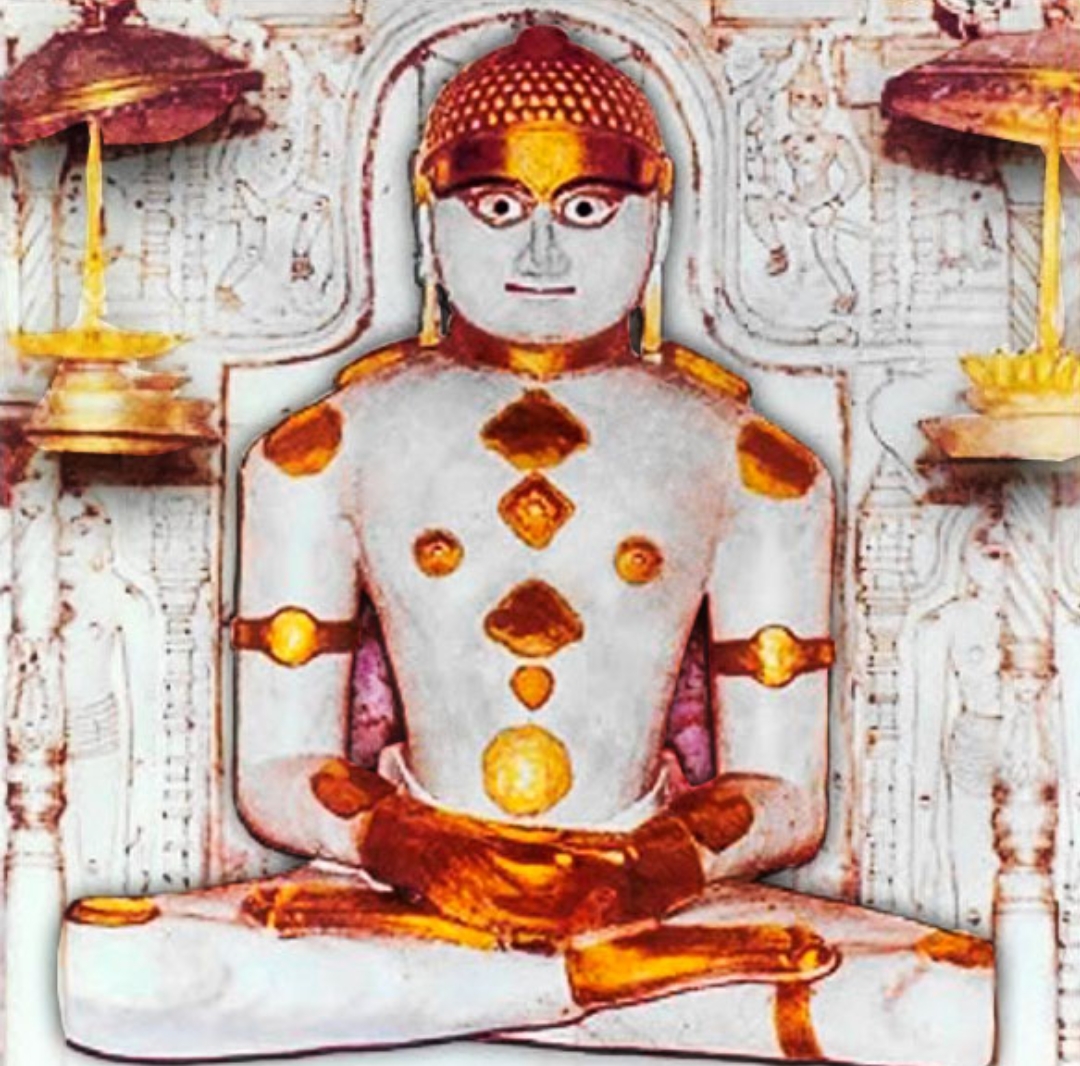
After his renunciation, the legends as described in major Jain texts such as Hemachandra's Trishashti-Shalakapurusha-Charitra and Adinathcharitra written by Acharya Vardhamansuri state Rishabhanatha travelled without food for 400 days. The day on which he got his first ahara (food) is celebrated by Jains as Akshaya Tritiya. In devotion to Rishabhanatha, Śvetāmbara Jains perform a 400-day-long fast, in which they consume food on alternating days. This religious practice is known as Varshitap. The fast is broken on Akshaya Tritiya. He attained Moksha on Mount Ashtapada. The text Adi Purana by Jinasena, Aadesvarcharitra within the Trishashti-Shalakapurusha-Charitra by Hemachandra are accounts of the events of his life and teachings. His iconography includes ancient idols such as at Kulpak Tirth and Palitana temples as well as colossal statues such as Statue of Ahimsa, Bawangaja and those erected in Gopachal hill. His icons include the eponymous bull as his emblem, the Nyagrodha tree, Gomukha (bull-faced) Yaksha, and Chakreshvari Yakshi.
Rishabhanatha is known by many names including Adinatha, Adishwara, Yugadeva and Nabheya. Ādi purāṇa, a major Jain text records the life accounts of Rishabhanatha as well as ten previous incarnations according to the Digambara tradition. For Rishabhanatha's biography in accordance with the Śvetāmbara tradition is found in several texts such as Hemachandra's Trishashti-Shalakapurusha-Charitra and Adinathcharitra written by Acharya Vardhamansuri. Jain tradition associates the life of a tirthankara to five auspicious events called the pancha kalyanaka. These include garbha (mother's pregnancy), janma (birth), diksha (initiation), kevalyagyana (omniscience) and moksha (liberation).
According to Jain cosmology, the universe does not have a temporal beginning or end. Its "Universal History" divides the cycle of time into two halves (avasarpiṇī and utsarpiṇī) with six aras (spokes) in each half, and the cycles keep repeating perpetually. Twenty-four Tirthankaras appear in every half, the first Tirthankara founding Jainism each time after the destruction of dharma at the end of each half cycle of time. This is similar to, but not completely the same as the idea of destruction of dharma at the end of Kali Yuga in Hindu mythology. In the present time cycle, Rishabhanatha is credited as being the first tīrthaṅkara. Usually, all the tīrthaṅkaras are born in the fourth spoke of the half cycle. However, Rishabhanatha is an exception as he was born at the end of the third half (known as sukhamā-dukhamā erā).
Rishabhanatha is said to be the founder of Jainism in the present Avsarpini (a time cycle) by all sub-traditions and sects of Jainism. Jain chronology places Rishabhanatha in historical terms, as someone who lived millions of years ago. He is believed to have been born 10224 years ago and lived for a span of 8,400,000 purva (592.704 × 10¹⁸ years). His height is described in the Jain texts to be 500 bows (1312 ells), or about 4920 feet/1500 meters. Such descriptions of non-human heights and age are also found for the next 21 Tirthankaras in Jain texts and according to Kristi Wiley – a scholar at University of California Berkeley known for her publications on Jainism. Most Indologists and scholars consider all the first 22 of 24 Tirthankaras to be prehistorical, or historical and a part of Jain mythology. However, among Jain writers and some Indian scholars, some of the first 22 Tirthankaras are considered to reflect historical figures, with a few conceding that the inflated biographical statistics are mythical.
According to Sarvepalli Radhakrishnan, a professor of comparative religions and philosophy at Oxford who later became the second President of India, there is evidence to show that Rishabhdeva was being worshipped by the first century BCE. The Yajurveda mentions the names of three Tirthankaras – Rishabha, Ajitanatha and Arishtanemi, states Radhakrishnan, and "the Bhāgavata Purāṇa endorses the view that Rishabha was the founder of Jainism".
Rishabhanatha was born to Nabhi and Marudevi, the king and queen of Ayodhya, on the ninth day of the dark half of the month of Chaitra (caitra krişna navamĩ). His association to Ayodhya makes it a sacred town for Jains, as it is in Hinduism for the birth of Rama. In Jain tradition, the birth of a tirthankara is marked by 14 auspicious dreams of the mother. These are believed to have been seen by Marudevi on the second day of Ashadha (a month of the Jain calendar) krishna (the new moon). The dreams signified the birth of a chakravartin or a tirthankara, according to the supposed explanation by Indra to Marudevi.
Hub AI
Rishabhanatha AI simulator
(@Rishabhanatha_simulator)
Rishabhanatha
Rishabhanatha (Devanagari: ऋषभनाथ), also Rishabhadeva (Devanagari: ऋषभदेव, Ṛṣabhadeva), Rishabha (Devanagari: ऋषभ, Ṛṣabha) or Ikshvaku (Devanagari: इक्ष्वाकु, Ikṣvāku), is the first tirthankara (Supreme preacher) of Jainism. He was the first of twenty-four teachers in the present half-cycle of time in Jain cosmology and called a "ford maker" because his teachings helped one cross the sea of interminable rebirths and deaths. The legends depict him as having lived millions of years ago. He was the spiritual successor of Sampratti Bhagwan, the last Tirthankara of the previous time cycle. He is also known as Ādinātha (lit. 'first Lord'), as well as Aadishvara (first Jina), Yugadideva (first deva of the yuga), Prathamarajeshwara (first God-king) and Nabheya (son of Nabhi). He is also known as Ikshvaku, establisher of the Ikshvaku dynasty. Along with Mahavira, Parshvanatha, Neminatha, and Shantinatha, Rishabhanatha is one of the five Tirthankaras that attract the most devotional worship among the Jains.
According to traditional accounts, he was born to king Nabhi and queen Marudevi in the north Indian city of Ayodhya, also called Vinita. He had two wives, Sumangalā and Sunandā. Sumangalā is described as the mother of his ninety-nine sons (including Bharata) and one daughter, Brahmi. Sunandā is depicted as the mother of Bahubali and Sundari. The sudden death of Nilanjana, one of the dancers sent by Indra in his courtroom, reminded him of the world's transitory nature, and he developed a desire for renunciation.
After his renunciation, the legends as described in major Jain texts such as Hemachandra's Trishashti-Shalakapurusha-Charitra and Adinathcharitra written by Acharya Vardhamansuri state Rishabhanatha travelled without food for 400 days. The day on which he got his first ahara (food) is celebrated by Jains as Akshaya Tritiya. In devotion to Rishabhanatha, Śvetāmbara Jains perform a 400-day-long fast, in which they consume food on alternating days. This religious practice is known as Varshitap. The fast is broken on Akshaya Tritiya. He attained Moksha on Mount Ashtapada. The text Adi Purana by Jinasena, Aadesvarcharitra within the Trishashti-Shalakapurusha-Charitra by Hemachandra are accounts of the events of his life and teachings. His iconography includes ancient idols such as at Kulpak Tirth and Palitana temples as well as colossal statues such as Statue of Ahimsa, Bawangaja and those erected in Gopachal hill. His icons include the eponymous bull as his emblem, the Nyagrodha tree, Gomukha (bull-faced) Yaksha, and Chakreshvari Yakshi.
Rishabhanatha is known by many names including Adinatha, Adishwara, Yugadeva and Nabheya. Ādi purāṇa, a major Jain text records the life accounts of Rishabhanatha as well as ten previous incarnations according to the Digambara tradition. For Rishabhanatha's biography in accordance with the Śvetāmbara tradition is found in several texts such as Hemachandra's Trishashti-Shalakapurusha-Charitra and Adinathcharitra written by Acharya Vardhamansuri. Jain tradition associates the life of a tirthankara to five auspicious events called the pancha kalyanaka. These include garbha (mother's pregnancy), janma (birth), diksha (initiation), kevalyagyana (omniscience) and moksha (liberation).
According to Jain cosmology, the universe does not have a temporal beginning or end. Its "Universal History" divides the cycle of time into two halves (avasarpiṇī and utsarpiṇī) with six aras (spokes) in each half, and the cycles keep repeating perpetually. Twenty-four Tirthankaras appear in every half, the first Tirthankara founding Jainism each time after the destruction of dharma at the end of each half cycle of time. This is similar to, but not completely the same as the idea of destruction of dharma at the end of Kali Yuga in Hindu mythology. In the present time cycle, Rishabhanatha is credited as being the first tīrthaṅkara. Usually, all the tīrthaṅkaras are born in the fourth spoke of the half cycle. However, Rishabhanatha is an exception as he was born at the end of the third half (known as sukhamā-dukhamā erā).
Rishabhanatha is said to be the founder of Jainism in the present Avsarpini (a time cycle) by all sub-traditions and sects of Jainism. Jain chronology places Rishabhanatha in historical terms, as someone who lived millions of years ago. He is believed to have been born 10224 years ago and lived for a span of 8,400,000 purva (592.704 × 10¹⁸ years). His height is described in the Jain texts to be 500 bows (1312 ells), or about 4920 feet/1500 meters. Such descriptions of non-human heights and age are also found for the next 21 Tirthankaras in Jain texts and according to Kristi Wiley – a scholar at University of California Berkeley known for her publications on Jainism. Most Indologists and scholars consider all the first 22 of 24 Tirthankaras to be prehistorical, or historical and a part of Jain mythology. However, among Jain writers and some Indian scholars, some of the first 22 Tirthankaras are considered to reflect historical figures, with a few conceding that the inflated biographical statistics are mythical.
According to Sarvepalli Radhakrishnan, a professor of comparative religions and philosophy at Oxford who later became the second President of India, there is evidence to show that Rishabhdeva was being worshipped by the first century BCE. The Yajurveda mentions the names of three Tirthankaras – Rishabha, Ajitanatha and Arishtanemi, states Radhakrishnan, and "the Bhāgavata Purāṇa endorses the view that Rishabha was the founder of Jainism".
Rishabhanatha was born to Nabhi and Marudevi, the king and queen of Ayodhya, on the ninth day of the dark half of the month of Chaitra (caitra krişna navamĩ). His association to Ayodhya makes it a sacred town for Jains, as it is in Hinduism for the birth of Rama. In Jain tradition, the birth of a tirthankara is marked by 14 auspicious dreams of the mother. These are believed to have been seen by Marudevi on the second day of Ashadha (a month of the Jain calendar) krishna (the new moon). The dreams signified the birth of a chakravartin or a tirthankara, according to the supposed explanation by Indra to Marudevi.
Recent media