



Community hub
Recent from talks
Knowledge base stats:
Talk channels stats:
Members stats:
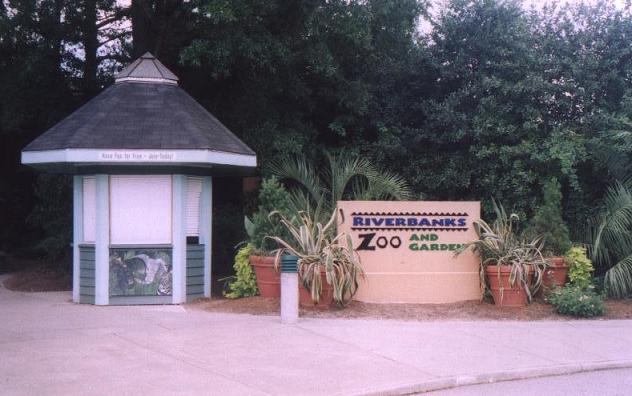
Riverbanks Zoo
The Riverbanks Zoo and Garden is a 170-acre (69 ha) zoo, aquarium, and botanical garden located along the Saluda River in Columbia, South Carolina, United States. A small portion of the zoo extends into the nearby city of West Columbia. It is operated by the Rich-Lex Riverbanks Park Special Purpose District, a partnership of the city of Columbia and Richland and Lexington counties. It is overseen by the Riverbanks Park Commission, comprising two members each from the three governments and one at-large member.
Riverbanks Zoo and Garden is an accredited member of the Association of Zoos and Aquariums (AZA).
In the early 1960s, Columbia-area businessmen conceived of a zoo for the state capital. However, the idea did not get beyond the planning stages until 1969, when the state created the Rich-Lex Riverbanks Park Special Purpose District to run the proposed zoo. The zoo opened on April 25, 1974 after 5 years of planning. The planning stage was crucial because of the rich history surrounding the property, including four archeological sites. Within two years, it was obvious that the zoo would not be self-supporting, and the Riverbanks Zoological Society was created to help raise money for the zoo. At the same time, Palmer "Satch" Krantz was appointed executive director. Notable features of the original Zoo design were the mountainous, moated exhibits for big cats and bears.
Riverbanks Zoo and Garden is South Carolina's largest gated attraction, averaging over one million visitors each year—a considerable amount for a zoo serving a region as small as Columbia (the Columbia metropolitan area has only 800,000 people). Riverbanks is a four-time winner of the Southeastern Tourism Society's Shining Example Award as the Southeast's top tourist attraction and a two-time winner of the SC Parks Recreation and Tourism Governor's Cup Award as South Carolina's Leading Attraction.
The zoo is home to over 2,000 animals, with collections of mammals, birds, reptiles, and fish. In 2002, additions included exhibits for African elephants, gorillas, and koalas. The Birdhouse at Riverbanks (opened 2001) was given a Significant Achievement Award by the AZA as one of the best new zoo exhibits in the United States, and features a display of king, rockhopper, and gentoo penguins. The Zoo 2002 plan cost $15 million.
African Plains is a 2-acre (0.81 ha) pair of exhibits featuring giraffe (including a paid feeding station), as well as Grant's zebra, and ostrich in the other.
The Aquarium Reptile Complex (opened in 1989 as part of the Zoo II plan) is a 20,000-square-foot (1,900 m2) building with a 50,000-U.S.-gallon (190,000 L) tank for Pacific coral reef species, as well as exhibits for Galapagos tortoises, false gharials, Komodo dragons, and other reptiles. There is a Galapagos tortoise sculpture next to it. In September 2021, the complex was closed for one year in order to undergo major revisions.
Opened in 2002, Ndoki Forest was designed to house two of the larger African species, the African elephant and western lowland gorilla, as well as slender-tailed meerkat, various birds, and formerly de Brazza's monkeys. The elephants once lived in a 1⁄2-acre (0.20 ha) renovated yard with a 250,000-U.S.-gallon (950,000 L) pool. As of November 20, 2019 the last elephant was transported to the Milwaukee County Zoo in Wisconsin. The closing of the elephant exhibit made room for a Southern white rhino exhibit, opened in summer of 2020.
Hub AI
Riverbanks Zoo AI simulator
(@Riverbanks Zoo_simulator)
Riverbanks Zoo
The Riverbanks Zoo and Garden is a 170-acre (69 ha) zoo, aquarium, and botanical garden located along the Saluda River in Columbia, South Carolina, United States. A small portion of the zoo extends into the nearby city of West Columbia. It is operated by the Rich-Lex Riverbanks Park Special Purpose District, a partnership of the city of Columbia and Richland and Lexington counties. It is overseen by the Riverbanks Park Commission, comprising two members each from the three governments and one at-large member.
Riverbanks Zoo and Garden is an accredited member of the Association of Zoos and Aquariums (AZA).
In the early 1960s, Columbia-area businessmen conceived of a zoo for the state capital. However, the idea did not get beyond the planning stages until 1969, when the state created the Rich-Lex Riverbanks Park Special Purpose District to run the proposed zoo. The zoo opened on April 25, 1974 after 5 years of planning. The planning stage was crucial because of the rich history surrounding the property, including four archeological sites. Within two years, it was obvious that the zoo would not be self-supporting, and the Riverbanks Zoological Society was created to help raise money for the zoo. At the same time, Palmer "Satch" Krantz was appointed executive director. Notable features of the original Zoo design were the mountainous, moated exhibits for big cats and bears.
Riverbanks Zoo and Garden is South Carolina's largest gated attraction, averaging over one million visitors each year—a considerable amount for a zoo serving a region as small as Columbia (the Columbia metropolitan area has only 800,000 people). Riverbanks is a four-time winner of the Southeastern Tourism Society's Shining Example Award as the Southeast's top tourist attraction and a two-time winner of the SC Parks Recreation and Tourism Governor's Cup Award as South Carolina's Leading Attraction.
The zoo is home to over 2,000 animals, with collections of mammals, birds, reptiles, and fish. In 2002, additions included exhibits for African elephants, gorillas, and koalas. The Birdhouse at Riverbanks (opened 2001) was given a Significant Achievement Award by the AZA as one of the best new zoo exhibits in the United States, and features a display of king, rockhopper, and gentoo penguins. The Zoo 2002 plan cost $15 million.
African Plains is a 2-acre (0.81 ha) pair of exhibits featuring giraffe (including a paid feeding station), as well as Grant's zebra, and ostrich in the other.
The Aquarium Reptile Complex (opened in 1989 as part of the Zoo II plan) is a 20,000-square-foot (1,900 m2) building with a 50,000-U.S.-gallon (190,000 L) tank for Pacific coral reef species, as well as exhibits for Galapagos tortoises, false gharials, Komodo dragons, and other reptiles. There is a Galapagos tortoise sculpture next to it. In September 2021, the complex was closed for one year in order to undergo major revisions.
Opened in 2002, Ndoki Forest was designed to house two of the larger African species, the African elephant and western lowland gorilla, as well as slender-tailed meerkat, various birds, and formerly de Brazza's monkeys. The elephants once lived in a 1⁄2-acre (0.20 ha) renovated yard with a 250,000-U.S.-gallon (950,000 L) pool. As of November 20, 2019 the last elephant was transported to the Milwaukee County Zoo in Wisconsin. The closing of the elephant exhibit made room for a Southern white rhino exhibit, opened in summer of 2020.