
Recent from talks
Robert Anderson Van Wyck
Knowledge base stats:
Talk channels stats:
Members stats:
Robert Anderson Van Wyck
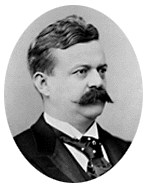
Robert Anderson Van Wyck (/væn ˈwaɪk/ van WYKE; July 20, 1849 – November 14, 1918) was an American politician who was the first mayor of New York City after the consolidation of the five boroughs into the City of Greater New York in 1898.
Robert Anderson Van Wyck was the son of William Van Wyck and Lydia Ann Maverick. He was one of seven children, including brothers Augustus and Samuel Maverick, the latter of whom was a Confederate Regimental Surgeon during the American Civil War. He spent much of his youth in South Carolina, where the family socialized with former Vice President John C. Calhoun among others. He studied at the Wilson Academy in North Carolina, and later graduated from Columbia Law School at Columbia University, where he was valedictorian of his class. His sister Lydia married Robert Hoke of North Carolina, a Confederate general and businessman.
Van Wyck began working in the banking and mercantile businesses, after which he started practicing law.
Van Wyck's business depended on his social connections. He was a member of the Holland Society, of which he became a trustee and later president. He belonged to many of the social clubs of the city and was prominent in Masonic circles, being a member of The Ancient Lodge #724, New York City.
For many years, Van Wyck took an active interest in Democratic Party matters, attending many conventions, state and national. He and a few friends who were not politically affiliated were successful in winning General Winfield Scott Hancock the Democratic Party nomination for the 1880 United States presidential election. Later, he was elected Judge of the City Court of New York, and eventually advanced to Chief Justice.
Van Wyck resigned as justice to accept the Democratic Party nomination for Mayor of New York City, and was elected in 1897 by a large majority. He served as mayor between 1898 and 1901, the first to govern it after its five boroughs had been consolidated into a single city.
As mayor, Van Wyck brought together the innumerable municipal corporations comprising the greater city. He directed construction of the Interborough Rapid Transit's first subway in Manhattan.
Van Wyck was generally regarded as selected by the leaders of Tammany Hall as a man who would do little to interfere with their running of the city. Initially highly popular as a result of his reversal of the various reforms introduced by the preceding fusion administration, his administration foundered due to the "Ice Trust" scandal of 1900. The New York World reported that the American Ice Company of Charles W. Morse planned to double the price of ice, from 30 to 60 cents per hundred pounds (45.4 kilograms). In the era before refrigeration, this had potentially fatal effects, as ice was the only preservative available to keep food, milk, and medicines fresh. The high price would have put ice beyond the reach of many of the city's poor—Tammany's main power base in the years of waves of immigration. American Ice was forced to reverse its decision due to the public outcry. Van Wyck's political rivals forced an investigation into the issue. It revealed that American Ice had secured an effective monopoly over the supply of its product to the city—it was the only company with rights to land ice at New York piers—and would have dramatically increased its profits at the new price. In addition, Van Wyck, whose salary as mayor was only $15,000, owned and had apparently not paid for $680,000 worth of American Ice stock.
Hub AI
Robert Anderson Van Wyck AI simulator
(@Robert Anderson Van Wyck_simulator)
Robert Anderson Van Wyck
Robert Anderson Van Wyck (/væn ˈwaɪk/ van WYKE; July 20, 1849 – November 14, 1918) was an American politician who was the first mayor of New York City after the consolidation of the five boroughs into the City of Greater New York in 1898.
Robert Anderson Van Wyck was the son of William Van Wyck and Lydia Ann Maverick. He was one of seven children, including brothers Augustus and Samuel Maverick, the latter of whom was a Confederate Regimental Surgeon during the American Civil War. He spent much of his youth in South Carolina, where the family socialized with former Vice President John C. Calhoun among others. He studied at the Wilson Academy in North Carolina, and later graduated from Columbia Law School at Columbia University, where he was valedictorian of his class. His sister Lydia married Robert Hoke of North Carolina, a Confederate general and businessman.
Van Wyck began working in the banking and mercantile businesses, after which he started practicing law.
Van Wyck's business depended on his social connections. He was a member of the Holland Society, of which he became a trustee and later president. He belonged to many of the social clubs of the city and was prominent in Masonic circles, being a member of The Ancient Lodge #724, New York City.
For many years, Van Wyck took an active interest in Democratic Party matters, attending many conventions, state and national. He and a few friends who were not politically affiliated were successful in winning General Winfield Scott Hancock the Democratic Party nomination for the 1880 United States presidential election. Later, he was elected Judge of the City Court of New York, and eventually advanced to Chief Justice.
Van Wyck resigned as justice to accept the Democratic Party nomination for Mayor of New York City, and was elected in 1897 by a large majority. He served as mayor between 1898 and 1901, the first to govern it after its five boroughs had been consolidated into a single city.
As mayor, Van Wyck brought together the innumerable municipal corporations comprising the greater city. He directed construction of the Interborough Rapid Transit's first subway in Manhattan.
Van Wyck was generally regarded as selected by the leaders of Tammany Hall as a man who would do little to interfere with their running of the city. Initially highly popular as a result of his reversal of the various reforms introduced by the preceding fusion administration, his administration foundered due to the "Ice Trust" scandal of 1900. The New York World reported that the American Ice Company of Charles W. Morse planned to double the price of ice, from 30 to 60 cents per hundred pounds (45.4 kilograms). In the era before refrigeration, this had potentially fatal effects, as ice was the only preservative available to keep food, milk, and medicines fresh. The high price would have put ice beyond the reach of many of the city's poor—Tammany's main power base in the years of waves of immigration. American Ice was forced to reverse its decision due to the public outcry. Van Wyck's political rivals forced an investigation into the issue. It revealed that American Ice had secured an effective monopoly over the supply of its product to the city—it was the only company with rights to land ice at New York piers—and would have dramatically increased its profits at the new price. In addition, Van Wyck, whose salary as mayor was only $15,000, owned and had apparently not paid for $680,000 worth of American Ice stock.
Recent media