Hubbry Logo
Robert HokeRobert HokeMain
Open search
Robert Hoke
Community hub
Robert Hoke
logo
8 pages, 0 posts
0 subscribers
Be the first to start a discussion here.
Robert Hoke
Robert Hoke
from Wikipedia

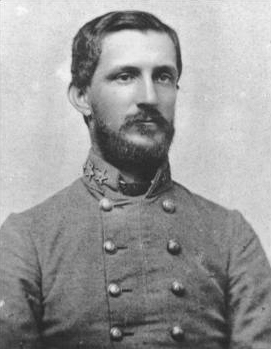
Robert Frederick Hoke (May 27, 1837 – July 3, 1912) was a Confederate major general during the American Civil War. He was present at one of the earliest battles, the Battle of Big Bethel, where he was commended for coolness and judgment. Wounded at Chancellorsville, he recovered in time for the defense of Petersburg and Richmond. His brigade distinguished itself at Cold Harbor (June 1864), acknowledged by Grant as his most costly defeat. Hoke was later a businessman and railroad executive.

Key Information

Early life and career

[edit]

Robert Frederick Hoke was born in Lincolnton, North Carolina, the son of Michael and Frances Burton Hoke. He had a younger sister Mary. Their father was a lawyer, orator, and unsuccessful Democratic nominee for Governor of North Carolina in 1844. Michael Hoke died shortly after losing that election.[1] His death "had lasting effects" on Robert Hoke's political viewpoint.

The son disliked politics and avoided involvement, later rejecting the offer of the governor's position. Robert Hoke was educated at the Pleasant Retreat Academy. He next studied at the Kentucky Military Institute, graduating in 1854. Hoke returned to Lincolnton, where he managed various family business interests for his widowed mother, including a cotton mill and iron works.[2]

Civil War service

[edit]

1861–63

[edit]

With North Carolina's secession from the Union, Hoke at age 24 enlisted in Company K of the 1st North Carolina Infantry Regiment (6 months) and was commissioned as a second lieutenant. Within months, he was promoted to captain and was commended for "coolness, judgment and efficiency" in D. H. Hill's report of the Battle of Big Bethel.[3] He was subsequently promoted to major in September.[2]

Following the reorganization of the 6-month term North Carolina troops, Hoke was appointed as the lieutenant colonel of the 33rd North Carolina Infantry Regiment. He was cited for his gallantry at the Battle of New Bern in March 1862, where he assumed command of the regiment following the capture of its colonel, C. M. Avery. He led the 33rd throughout the Peninsula Campaign as a part of Lawrence O. Branch's brigade. Hoke was promoted to colonel before the Northern Virginia Campaign and fought at the Second Battle of Bull Run, in addition to the Maryland Campaign at the Battle of Antietam.[4]

Upon Colonel Avery's return from captivity, Hoke was assigned as commander of the 21st North Carolina Infantry Regiment in Isaac Trimble's brigade in Jubal Early's division. Hoke commanded the brigade at the Battle of Fredericksburg and helped repulse an attack by Union forces under Maj. Gen. George G. Meade.

Hoke was promoted to brigadier general on January 17, 1863,[4] and assigned permanent command of Trimble's brigade, which was composed of five North Carolina regiments. He was severely wounded defending Marye's Heights while the majority of the armies fought at the Battle of Chancellorsville and was sent home to recuperate. Command of his brigade passed to Col. Isaac E. Avery. Hoke missed the rest of the year's campaigns.

1864–65

[edit]

Hoke resumed command of his brigade at Petersburg, Virginia, in January 1864, and led it to North Carolina, where he organized attacks on New Bern and Plymouth. In February, troops under Hoke's command executed twenty two Union soldiers of the 2nd North Carolina Union Volunteer Infantry Regiment by hanging at Kinston, North Carolina.[5] These men had been captured in the Battle of New Bern, and were found to have previously served in North Carolina Partisan Ranger units. General George Pickett ordered that they should be court martialed for desertion from the Confederate Army, and the subsequent hangings were carried out by the 54th Regiment, North Carolina Troops of Hoke's brigade. In the Battle of Plymouth on April 17, Hoke captured a garrison of 2,834 Union soldiers.[3] The Confederate Congress voted May 17 to extend its thanks for the action of Hoke and his men at Plymouth.[6] Hoke was promoted to major general on April 23, 1864 (ranking from April 20),[3] and was given command of what was called Hoke's Division in the Department of North Carolina and Southern Virginia.[4] He and his troops were summoned to Virginia in May when the Union Army of the James threatened Richmond and Petersburg.[2] Given command of six brigades of infantry, Hoke served with distinction in several actions, including the Battle of Cold Harbor, where his division played an important role in stopping several Union attacks.

In December, Hoke's division was sent to North Carolina when the state was threatened by Union forces. Hoke fought at the defense of Fort Fisher on January 13–15, 1865. He also fought in the Carolinas campaign and the Battle of Bentonville, where he repulsed several attacks by forces under Maj. Gen. William T. Sherman before overwhelming numbers began to push the Confederates back.[2]

Hoke surrendered along with Joseph E. Johnston's army at Bennett Place near Durham and was paroled on May 1, 1865. He was pardoned by the U.S. government on June 14, 1865.[7]

Postbellum activities

[edit]
Hoke in later years

Marriage and family

[edit]

Hoke developed Northern ties when on January 7, 1869, he married Lydia Van Wyck, who was of a prominent political family from New York City. One of his brothers-in-law, Robert Van Wyck, was Mayor of New York City and another, Augustus Van Wyck, was an unsuccessful candidate for Governor of New York, losing to Theodore Roosevelt.

The Hokes had six children. Their son Michael Hoke became a famous orthopedist in Atlanta, Georgia and a founder of the Shriner's Children Hospital.

Later career

[edit]

After the war, Hoke returned to civilian life and engaged in various businesses, including insurance and gold mining. He became principal owner of an iron mine near Chapel Hill, North Carolina, and another one in Mitchell County. He also served as the director of the North Carolina Railroad for many years. Railroad construction was creating new networks across the South, and new opportunities for business.[2]

Hoke owned a resort and a bottled water company at Lithia Springs in Lincoln County. Such areas were popular summer retreats.[8]

With his success in the war and business, politicians tried to recruit Hoke to office, even offering him the position of governor of the state. He declined, having permanently turned away from politics as a child after his father's death. His nephew Hoke Smith served as secretary of the interior, and then as governor and a senator from Georgia.

Hoke died in Raleigh, North Carolina, and was buried with full military honors in Raleigh's Oakwood Cemetery.

Legacy and honors

[edit]

See also

[edit]

Notes

[edit]

References

[edit]

Further reading

[edit]
[edit]
Revisions and contributorsEdit on WikipediaRead on Wikipedia
from Grokipedia
Robert Frederick Hoke (May 27, 1837 – July 3, 1912) was a Confederate during the , recognized for his swift promotions and effective leadership in multiple campaigns. Born in , to Michael and Frances Burton Hoke, he graduated from the Kentucky Military Institute in 1854 before entering Confederate service as a in the 1st upon 's . Hoke participated in early engagements like the , where his gallantry earned commendation, and advanced rapidly to major within months, later commanding regiments through the Seven Days Battles, Second Manassas, and Sharpsburg. His most notable achievement came in 1864 at the Battle of Plymouth, where his forces, supported by naval elements, captured a Union garrison of approximately 3,000 soldiers, leading to his promotion as the youngest in the Confederate Army at age 27. Recalled to , he served under until shifting to command Confederate troops in and participating in the war's final phases. Following the Confederate surrender in 1865, Hoke returned to civilian pursuits, investing in gold and iron mining, insurance, railroads, and other industries, emerging as a leading industrialist in Reconstruction-era despite health challenges that curtailed his political ambitions, such as a gubernatorial bid he withdrew due to illness. Hoke County, established in 1911, bears his name in recognition of his military and civic contributions.

Early Life and Pre-War Activities

Family Background and Upbringing

Robert Frederick Hoke was born on May 27, 1837, in Lincolnton, , the son of Michael Hoke and Frances Burton Hoke. The Hoke family traced its roots to German immigrants who arrived in colonial around 1752, establishing a presence in the region through military and civic roles. His father, Colonel Michael Hoke (1810–1844), served in local and died on September 9, 1844, in Charlotte, leaving the family when Robert was seven years old. Frances Burton Hoke, who outlived her husband until 1868, managed the household thereafter in Lincolnton, a modest known for its and agricultural economy. Hoke grew up in this community amid a family of professionals and officers, with siblings including brothers , Marcus, and George, fostering an environment shaped by early loss and regional Southern traditions. His upbringing emphasized self-reliance following his father's death, though specific details of daily life or formal home education remain sparsely documented in primary records.

Education and Initial Career

Hoke received his early education at local schools in Lincolnton, North Carolina. He subsequently attended the Kentucky Military Institute in Frankfort, from which he graduated in 1854 at age 17. Following his graduation, Hoke returned to Lincolnton to assist his widowed mother, Frances Burton Hoke, in managing the family's businesses, which included a cotton mill and iron works in Lincoln County. Despite his military institute training, he gained no formal military experience during this period and focused on these industrial enterprises until the outbreak of the Civil War in 1861.

Confederate Military Service

Early Engagements and Rapid Promotions (1861–1862)

Upon the outbreak of the Civil War, Hoke enlisted on April 25, 1861, as a in Company K of the 1st Infantry. He participated in the on June 10, 1861, the first major engagement of the war, where his unit engaged Union forces under near ; Hoke was commended by D. H. Hill for his "coolness, judgment, and efficiency" in action. By August 1, 1861, Hoke transferred to the 33rd North Carolina Infantry as a major, followed by promotion to lieutenant colonel on January 17, 1862. In the Battle of New Bern on March 14, 1862, Hoke's regiment faced a Union amphibious assault led by Brigadier General Ambrose Burnside, resulting in a Confederate defeat and the capture of Colonel Clarkson M. Avery; Hoke then assumed temporary command of the 33rd North Carolina. Under his leadership, the regiment fought in the Peninsula Campaign, including the Battle of Hanover Court House on May 27, 1862, where Confederate forces under Major General Joseph E. Johnston repelled a Union probe by Brigadier General Fitz John Porter, and the Seven Days Battles from June 25 to July 1, 1862, which halted Major General George B. McClellan's advance on Richmond. Hoke continued commanding the 33rd during the , contributing to the Confederate victory at the Second Battle of Manassas from August 28 to 30, 1862, where General Robert E. Lee's army defeated John Pope's forces. On August 5, 1862, he received promotion to colonel of the 21st Infantry but remained with the 33rd through the Maryland Campaign, fighting at the Battle of Sharpsburg (Antietam) on September 17, 1862, in Trimble's Brigade of Jubal A. Early's division, where his unit helped defend the Sunken Road against repeated Union assaults. Later that year, commanding the 21st at the on December 13, 1862, Hoke repulsed a Union attack on Marye's Heights, earning praise from Early and for his brigade's steadfast defense against overwhelming numbers. These engagements demonstrated Hoke's tactical acumen, facilitating his swift rise from junior officer to field-grade command within 18 months.

Divisional Command and Key Battles (1863)

In January 1863, Robert Hoke received a permanent promotion to in the Confederate Army, effective January 17, and assumed command of what became known as Hoke's Brigade within Jubal A. Early's division of the Second Corps, . The brigade consisted primarily of regiments, including the 6th, 21st, and 43rd , with the 54th later attached, totaling around 1,500-2,000 effectives at the start of the year's campaigns. This assignment marked Hoke's transition to independent field command, leveraging his prior regimental experience in earlier engagements like Second Manassas and Antietam. Hoke's brigade played a pivotal role in the Chancellorsville campaign, particularly in the subsidiary action at the Second Battle of Fredericksburg (also known as the Battle of Marye's Heights) on May 3-4, 1863. Positioned on the Confederate left under Early's division, Hoke's troops helped repel advances by Major General John Sedgwick's VI Corps, launching counterattacks that pushed back Union forces on the heights and prevented a breakthrough toward Fredericksburg. During the fighting, Hoke sustained a severe shoulder wound while leading his men in defense of Marye's Heights, forcing him to relinquish command and undergo extended recovery in North Carolina; the injury sidelined him for approximately seven months. With Hoke absent due to his wound, his brigade proceeded to the on July 1-3, 1863, under temporary leadership of Colonel Isaac E. Avery, participating in assaults on as part of Early's division. The unit suffered heavy casualties, with around 600 killed, wounded, or captured, but Hoke himself took no direct part in the engagement. Following partial recovery by late summer, Hoke was reassigned to rear-area operations in central and , where he conducted expeditions against deserters, outlaw bands, and Unionist insurgents in the Appalachian counties, restoring order amid growing internal dissent but without major pitched battles. These duties underscored the Confederacy's straining resources, as Hoke's forces focused on suppressing domestic threats rather than frontline combat.

Major Generalship and Late-War Campaigns (1864–1865)

Hoke received promotion to major general on April 23, 1864, with a date of rank from April 20, making him the youngest officer to achieve that rank in the Confederate States Army at age 26. He assumed command of a division in the Department of North Carolina and Southern Virginia, initially tasked with operations against Union forces under Benjamin F. Butler in the Bermuda Hundred area. In the , Hoke's division played a pivotal role at the from May 12 to 16, 1864, where approximately 18,000 Confederate troops, including seven brigades under Hoke, assaulted Union entrenchments, forcing Butler's larger force of 39,000 to withdraw and effectively bottling up the . This success allowed Beauregard to detach Hoke's division to reinforce Robert E. Lee's at Cold Harbor in early June 1864, where Hoke's troops helped repel Ulysses S. Grant's assaults, contributing to heavy Union casualties exceeding 12,000 in the Confederate defensive victory. By June 15, 1864, Hoke's division arrived at Petersburg just as Grant launched initial assaults on the thinly held Confederate lines; Hoke's forces, numbering around 14,000, reinforced the defenses alongside Bushrod Johnson's division, blunting the Union attacks and securing the city for the ensuing nine-month . During the , Hoke's division held the northern sector of the lines, including positions adjacent to the July 30 mine explosion at the , where his troops maintained their sector amid the chaos of the failed Union offensive that resulted in over 3,800 Union casualties. As Union pressure mounted through late 1864, Hoke's division remained entrenched at Petersburg, participating in defensive operations such as the action along the Darbytown Road. In early 1865, with Sherman's threatening, the division was transferred to , where it reinforced defenses around Wilmington and ; despite fierce fighting from January 13 to 15, fell to Union amphibious assault, opening the port. Hoke's veterans then joined Joseph E. Johnston's consolidated forces for the on March 19–21, 1865, the last major Confederate offensive east of the Mississippi, where approximately 20,000 Confederates, including Hoke's division positioned north of the Goldsboro Road, initially surprised and engaged Sherman's 60,000 troops before withdrawing after sustaining around 3,000 casualties. Hoke surrendered with Johnston's army at near Durham Station on April 26, 1865, ending major Confederate resistance in the Carolinas.

Post-War Business and Personal Life

Industrial and Railroad Enterprises

After the American Civil War, Robert Hoke pursued industrial ventures centered on mining and manufacturing, leveraging North Carolina's mineral resources to rebuild his fortunes. He developed iron mines and operated ironworks in Lincoln, Orange, and Mitchell counties, including acquiring the Cranberry Iron Mine in Mitchell County in 1867 and incorporating the Cranberry Iron and Coal Company in 1873 to extract and process ore. Hoke also engaged in gold mining, initially panning in the western North Carolina mountains following the loss of family holdings during the conflict. These enterprises reflected his shift to entrepreneurial activities amid Reconstruction-era economic challenges, with Hoke becoming a principal owner of iron furnaces to capitalize on regional demand for metals. In the railroad sector, Hoke served as a director of the Railroad Company for nearly two decades, from 1893 until his death in 1912, and was elected chairman of its board in 1893. This role positioned him to influence infrastructure development in the state, aligning with broader efforts to expand rail networks for and resource transport. His involvement extended to other business interests, including , though and rail directorships formed the core of his industrial footprint.

Marriage, Family, and Declined Political Offers

Hoke married Ann Van Wyck, sister of mayor Robert T. Van Wyck, on January 7, 1869, in . The couple had six children, including Michael Hoke (1869–1944), who became a pioneering orthopedic in , Georgia, and a founder of the . Lydia outlived Hoke, dying in 1915. Despite his status as one of 's most celebrated Confederate veterans, Hoke consistently avoided political office, preferring private business pursuits over . He rejected multiple honors proffered by state Democrats, most notably declining the governorship of when it was effectively offered to him in the late or early amid party efforts to leverage his popularity for electoral success. This aversion stemmed from his personal disinterest in politics, which he viewed as incompatible with his post-war focus on industrial enterprises like mining and railroads.

Political Involvement and Racial Views

Opposition to Reconstruction

Following the , Robert Frederick Hoke aligned with North Carolina's Conservative Party, which evolved into the Democratic Party and actively resisted Radical Reconstruction policies enforced by the Republican state government under Governor William W. Holden. These policies included expanded voting rights for freedmen, federal military oversight, and efforts to redistribute political power, which Conservatives viewed as punitive impositions disrupting traditional Southern . Hoke's affiliation reflected broader opposition among former Confederates to what they perceived as corrupt governance reliant on and Northern interference, as evidenced by the party's platform emphasizing restoration of white Democratic control and limits on federal authority. In 1870, amid escalating tensions including the Kirk-Holden War—where state militias clashed over alleged activities—Hoke was urged by party leaders to seek the Democratic gubernatorial nomination as a war hero capable of unifying opposition to Holden's administration. He declined, prioritizing recovery from war wounds and business ventures, though his prestige bolstered Conservative morale in their successful campaign to oust Republicans, securing the governorship for Tod R. Caldwell's opponent and effectively terminating Reconstruction in by 1871. This Democratic resurgence curtailed black political participation through measures like poll taxes and literacy tests in subsequent years, aligning with Hoke's implicit support for restoring pre-war hierarchies without his direct involvement. Hoke later served multiple terms in the (1879, 1883, 1885, 1887, 1901), advocating agricultural and industrial policies under unchallenged Democratic dominance.

Support for Democratic Restoration in North Carolina

Following the , North Carolina underwent Reconstruction under Republican administrations, which Democrats criticized as corrupt, debt-ridden, and dominated by external influences including federal military oversight and enfranchised freedmen. Hoke, identifying as a Democrat, aligned with the party's push to restore pre-war social and political structures emphasizing white leadership and . His stature as a major Confederate general provided symbolic weight to Democratic appeals, rallying veteran support against perceived Republican excesses such as increased taxation and public debt accumulation under governors William W. Holden (1868–1871) and Tod R. Caldwell (1871–1874). Despite this alignment, Hoke eschewed active campaigning or office-seeking, shaped by his early aversion to after his father's death from shortly after nomination as the Democratic gubernatorial in 1844. Democrats nonetheless leveraged his in their redemption efforts, viewing ex-Confederate heroes like Hoke as emblems of resistance to Reconstruction. The party gained the in 1870, curbing Republican initiatives, and secured full restoration with Zebulon B. Vance's gubernatorial victory on November 7, 1876, by a margin of 112,584 votes to Republican Thomas Settle's 100,399, ending federal-backed reforms and reestablishing Democratic dominance. Hoke's implicit endorsement through party loyalty contributed to this shift without personal involvement, prioritizing industrial pursuits like mining and railroading over electoral roles.

Death and Legacy

Final Years and Death

In his later years, Robert Hoke resided primarily in , having largely retired from his extensive business interests in mining, insurance, and railroads, where he had previously served as a director of the North Carolina Railroad Company for many years. He maintained a low public profile, consistent with his longstanding aversion to politics, though he took an active role in Confederate veterans' organizations, reflecting his enduring commitment to comrades from the war. Hoke spent his final days surrounded by family; he had married Lydia Van Wyck in 1869, and the couple had six children, including son Michael Hoke, who became a noted orthopedic . On July 3, 1912, at the age of 75, Hoke died in Raleigh. He was buried in Oakwood Cemetery in the city.

Assessment as a Confederate Leader

Robert Frederick Hoke earned a reputation as a highly capable Confederate division commander, distinguished by rapid promotions and successes in key engagements despite entering the war without prior military experience beyond brief academy training. Promoted to on April 20, 1864, at age 26—the youngest in the Confederate Army—Hoke demonstrated tactical skill and leadership in operations like the capture of , on the same date, where his forces seized a Union of approximately 3,000 troops along with artillery and supplies. His brigade's role at Cold Harbor in early 1864 contributed significantly to the Confederate defensive victory, repulsing Union assaults and earning commendations for steadfastness under fire. Confederate Army commander regarded Hoke favorably, expressing satisfaction with his elevation to while noting reluctance to lose his services absent an accompanying division command, a reflection of Hoke's proven reliability in the . Earlier, at Big Bethel on June 10, 1861, division commander D. H. Hill praised Hoke's "coolness, judgement and efficiency" as a young officer, foreshadowing his ascent from second lieutenant in the 1st to command by late 1862. and similarly commended his performance at Fredericksburg in December 1862, where Hoke's 21st repelled a Union advance. These evaluations highlight Hoke's strengths in infantry handling, initiative in combined operations—as at Plymouth, integrating army and naval elements—and resilience, though severe wounding at Chancellorsville in May 1863 temporarily sidelined him. Hoke's late-war service in , defending in January 1865 and fighting at Bentonville in March 1865, further evidenced his competence amid deteriorating Confederate logistics and manpower shortages, sustaining organized resistance until Joseph E. Johnston's surrender on April 26, 1865. Historians attribute his effectiveness to personal bravery and adaptability rather than strategic innovation, positioning him as a solid executor of orders in Lee's hierarchy, though opportunities for higher command were limited by youth, injuries, and the war's trajectory. Postwar biographies reinforce this view, portraying Hoke as Lee's "modest warrior," valued for reliability over flashiness in a command structure strained by attrition.

Honors, Memorials, and Contemporary Debates

, was formed in 1911 from portions of and Robeson counties and named in honor of Robert F. Hoke for his military service during the Civil War and subsequent leadership in the state's railroad industry. The county seat, Raeford, reflects ongoing recognition of his contributions to 's development. Several memorials commemorate Hoke's military career, including the General Robert Hoke Monument erected in 1920 near Kinston in Lenoir County, marking his command during the in March 1865; the monument was sponsored by the , , and Historical Commission. A monument to Hoke's North Carolina Brigade stands on the , southeast of the town along East Confederate Avenue, honoring the unit's actions in July 1863. Multiple state historical markers in reference Hoke, such as one at his Lincolnton birthplace noting his promotion to after the 1864 Battle of Plymouth, and others detailing his roles in battles like Forks Road near Wilmington. The Robert F. Hoke Chapter #78 of the , based in , bears his name and has maintained artifacts like the "Fame" statue, relocated in 2021 to a private site amid local discussions over public Confederate symbols. Contemporary debates over Confederate honors have included North Carolina's 2015 law restricting removals of monuments on public property, which protected sites like the Kinston Hoke monument, listed as extant in surveys of such symbols. While broader efforts post-2020 protests led to relocations of some memorials, Hoke-specific sites, including his county namesake and Kinston monument, have faced no documented removal or renaming campaigns as of 2024, contrasting with more contested figures whose symbols were targeted. Assessments of Hoke's legacy emphasize his tactical competence as a division commander under and , with limited focus on racial views beyond his documented opposition to Reconstruction-era policies favoring African American political participation.

References

Add your contribution
Related Hubs
User Avatar
No comments yet.