Recent from talks
Nothing was collected or created yet.
Robert Bray
View on WikipediaThis article needs additional citations for verification. (November 2020) |
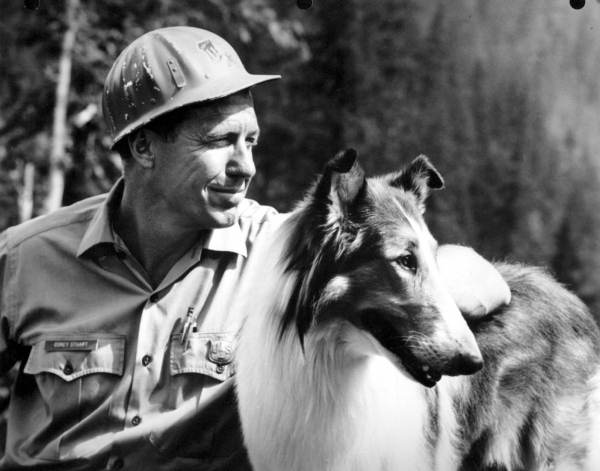
Robert E. Bray (October 23, 1917 – March 7, 1983)[1] was an American film and television actor known for playing the forest ranger Corey Stuart in the CBS series Lassie, He also starred in Stagecoach West and as Mike Hammer in the movie version of Mickey Spillane's novel My Gun Is Quick (1957).
Key Information
Early life
[edit]Born in Kalispell, Montana, Bray's family moved to Seattle when he was ten years of age. After graduating from Lincoln High School, he worked as a lumberjack and ranch hand. At the age of 20 his family moved to Hollywood where he worked as a grip for United Artists.
In 1942 he enlisted in the U.S. Marine Corps where he served as a drill instructor and in the South Pacific rising to the rank of Master Sergeant[5]
Career
[edit]Bray entered films in 1946 under contract to RKO.[citation needed] He appeared in B Westerns like 1949's Rustlers. In the 1950s, the then freelancing actor appeared in a varied number of roles including the 1952 episode "Thunder Over Inyo" of the syndicated western television series The Adventures of Kit Carson.
In 1954, he portrayed bandit Emmett Dalton in an episode of Jim Davis's syndicated western Stories of the Century. That same year, he guest-starred in Reed Hadley's CBS crime drama, The Public Defender. On December 4, 1955, he was cast as petroleum pioneer Pattillo Higgins in "Spindletop – The First Great Texas Oil Strike (January 10, 1901)" on the CBS history series, You Are There, the story of the origin of the Texas oil industry.
In 1958, he starred in Never Love a Stranger, a film adaptation of a Harold Robbins novel.
Bray guest-starred in the episode "Obituary" of NBC's western series, Jefferson Drum, starring Jeff Richards, and in the 1959 episode "The Trouble with Tolliver" of the ABC western drama, The Man from Blackhawk.
He appeared twice on ABC's The Life and Legend of Wyatt Earp.
Bray was cast as Carl the Bus Driver in Bus Stop with Marilyn Monroe (1956) and as detective Mike Hammer in My Gun Is Quick (1957). Other roles were on NBC's western anthology series, Frontier and on the syndicated series City Detective and State Trooper.
Early in 1960, Bray was cast as Tom Byson in the episode "Three Graves" of the NBC western series, Riverboat.
In the 1960–1961 television season, Bray played Simon Kane in the ABC series Stagecoach West. The Western comprised 38 one-hour episodes.
He starred in three episodes of NBC's western Laramie between 1960 and 1963. He appeared in three episodes of CBS's Perry Mason. In 1959 he played private detective and murder victim Carl Davis in "The Case of the Foot-Loose Doll." In the 1962 episode, "The Case of the Angry Astronaut," he had the role of title character and defendant Mitch Heller; and in 1963 he portrayed wealthy murder victim Martin Walden (Episode 180, "The Case of the Potted Planter"). He also guest-starred in NBC's Temple Houston (TV series), Overland Trail, and The Loretta Young Show. He appeared in four episodes of CBS's anthology suspense series Alfred Hitchcock Presents between 1958 and 1961.
In 1963, he guest starred on Gunsmoke as Gib Dawson, a settler who marries a Comanche woman and has to deal with the racial hatred from others because of it in the episode "Shona" (S8E22). He also appeared as an Army Commander in "The Twilight Zone" S5 E10 "The 7th is Made Up of Phantoms" which aired 12/4/1963.
Bray portrayed forest ranger Corey Stuart starting in Season 11 of Lassie.[6] He was written out of the series in Season 15 as a victim of a forest fire where his character was sent away to a hospital, never to return.[7]
Selected filmography
[edit]- Sunset Pass (1946) – Bank Clerk (uncredited)
- Crack Up (1946) – Man with Drunk (uncredited)
- Dick Tracy vs. Cueball (1946) – Steve (uncredited)
- Vacation in Reno (1946) – Police Guard in Bank (uncredited)
- The Falcon's Adventure (1946) – Doorman (uncredited)
- San Quentin (1946) – Saunders, a Gunman (uncredited)
- Banjo (1947) – Policeman (uncredited)
- Honeymoon (1947) – Bridegroom (uncredited)
- Desperate (1947) – Policeman with Lieutenant Ferrari (uncredited)
- Seven Keys to Baldpate (1947) – Policeman (uncredited)
- Crossfire (1947) – Military Policeman (uncredited)
- The Bachelor and the Bobby-Soxer (1947) – Official at Airline Gate (uncredited)
- Dick Tracy Meets Gruesome (1947) – Sergeant (uncredited)
- Wild Horse Mesa (1947) – Tex
- The Judge Steps Out (1947) – Truck Driver (uncredited)
- If You Knew Susie (1948) – Reporter (uncredited)
- Western Heritage (1948) – Henchman Pike
- Mr. Blandings Builds His Dream House (1948) – Workman (uncredited)
- Fighting Father Dunne (1948) – Classroom Instructor (uncredited)
- Arizona Ranger (1948) – Jasper Todd
- Guns of Hate (1948) – Rocky
- Return of the Bad Men (1948) – 'The Youngers': John Younger
- Blood on the Moon (1948) – Bart Daniels
- Indian Agent (1948) – Nichols
- Gun Smugglers (1948) – Henchman Dodge
- Brothers in the Saddle (1949) – Henchman Polk Lynch
- Rustlers (1949) – Henchman Hank
- Stagecoach Kid (1949) – Henchman Clint
- The Clay Pigeon (1949) – Gunsel Blake
- Strange Bargain (1949) – Detective McTay
- Johnny Holiday (1949) – Policeman (uncredited)
- The Great Missouri Raid (1951) – Charlie Pitts
- Law of the Badlands (1951) – Benson
- Warpath (1951) – Major Comstock
- Overland Telegraph (1951) – Steve, Henchman
- Man from the Black Hills (1952) – Ed Roper
- The Gunman (1952) – Tom Jamison
- One Minute to Zero (1952) – (uncredited)
- Fargo (1952) – Ed Murdock
- Feudin' Fools (1952) – Private Eye
- Back at the Front (1952) – Military Police Corporal (uncredited)
- The Lusty Men (1952) – Fritz (uncredited)
- Voodoo Tiger (1952) – Major Bill Green
- The Maverick (1952) – Corporal Johnson
- Seminole (1953) – Captain Sibley (uncredited)
- The Neanderthal Man (1953) – Tim Newcomb, cattle rancher (uncredited)
- The Marshal's Daughter (1953) – Anderson
- Main Street to Broadway (1953) – Lawyer in Fantasy Sequence
- Vigilante Terror (1953) – Gene Smith
- Bad for Each Other (1953) – Trooper at Mine Accident Scene (uncredited)
- Ride Clear of Diablo (1954) – Jackson, Ranch Hand (uncredited)
- Rose Marie (1954) – Mountie (uncredited)
- Arrow in the Dust (1954) – Cavalry Corporal (uncredited)
- The Yellow Tomahawk (1954) – Lieutenant Banion
- Drums Across the River (1954) – Sheriff Ed Crockett (uncredited)
- The Caine Mutiny (1954) – Court-Martial Board Member (uncredited)
- Francis Joins the WACS (1954) – Military Police Sergeant Kreuger (uncredited)
- Shield for Murder (1954) – Detective (uncredited)
- Big House, U.S.A. (1955) – Ranger McCormick
- The Steel Jungle (1956) – Police Lieutenant Soberman
- Bus Stop (1956) – Carl
- The Accursed (1957) – Major Shane
- The Wayward Bus (1957) – Morse
- My Gun is Quick (1957) – Mike Hammer
- Alfred Hitchcock Presents (1958) (Season 4 Episode 8: "Safety for the Witness") - Lieutenant Flannery
- Never Love a Stranger (1958) – 'Silk' Fennelli
- Never So Few (1959) – Colonel Fred Parkson
- Alfred Hitchcock Presents (1960) (Season 5 Episode 19: "Not the Running Type") - Sergeant/Captain Ernest Fisher
- Alfred Hitchcock Presents (1960) (Season 5 Episode 36: "Letter of Credit") - Henry Taylor Lowden
- Alfred Hitchcock Presents (1961) (Season 7 Episode 12: "A Jury of Her Peers") - Sheriff Henry Peters
- Fiend of Dope Island (1961) – David
- The Alfred Hitchcock Hour (1962) (Season 1 Episode 3: "Night of the Owl") - Lieutenant Hank Ames
- A Gathering of Eagles (1963) – Lieutenant Colonel Gales
- The Twilight Zone (1963) (Season 5 Episode 10: "The 7th Is Made Up of Phantoms") - Captain Dennet
References
[edit]- ^ a b c "Robert Bray birth and death 2". allmovie.com. Retrieved October 26, 2023.
- ^ a b "Robert Bray death". UPI. Retrieved October 26, 2023.
- ^ "Robert Bray birthplace". Turner Classic Movies. Retrieved December 8, 2023.
- ^ "Intelius People Search – Public Records, Background Checks & More". Archived from the original on March 1, 2008. Retrieved January 24, 2008.
- ^ p.52 Aaker, Everett Television Western Players, 1960-1975: A Biographical Dictionary McFarland 30 May 2017
- ^ Terrace, Vincent (January 10, 2014). Encyclopedia of Television Shows, 1925 through 2010, 2d ed. McFarland. p. 582. ISBN 978-0-7864-8641-0. Retrieved June 17, 2021.
- ^ Lassie Star
External links
[edit]- Robert Bray at IMDb
Robert Bray
View on GrokipediaEarly life
Birth and family background
Robert Bray was born on October 23, 1917, in Kalispell, Montana, to homesteading parents Jerome Oliver Bray and Anne Elvina Ceder.[6][1] The Bray family resided in the rural Flathead Valley, where they engaged in homesteading on a ranch, embodying the rugged pioneer lifestyle of early 20th-century Montana.[4][5] This environment of vast landscapes, livestock tending, and self-reliant labor fostered Bray's enduring love for the outdoors from an early age. Bray grew up in a family that included at least two brothers, Jack Bray and James Oliver Bray, contributing to a close-knit household shaped by the challenges and simplicities of frontier ranching.[6][7] The dynamics of this upbringing emphasized hard work, family cooperation, and a profound connection to nature, elements that would subtly inform his later personal interests.Education and initial employment
At the age of ten, Bray's family relocated from Montana to Seattle, Washington, where he adapted to urban life and completed his secondary education.[7] He graduated from Lincoln High School in Seattle, marking the end of his formal schooling.[5] Following high school, Bray took on physically demanding jobs in the Pacific Northwest, working as a lumberjack and ranch hand, which honed his rugged capabilities.[7] These early manual labor roles provided him with practical experience in outdoor and strenuous work environments.[5] In the early 1940s, Bray moved to Hollywood, California, where he worked as a grip and carpenter at United Artists Studios, contributing to set construction and rigging on various productions.[7][5] His background in physical labor from the Northwest proved advantageous in these technical roles, building a foundation for his eventual transition into acting.[7]Military service
Enlistment and training
In 1942, at the age of 25, Robert Bray enlisted in the U.S. Marine Corps, motivated by a strong sense of patriotic duty as the nation mobilized for World War II following the attack on Pearl Harbor.[7] Born in 1917 in Kalispell, Montana, Bray had been working in Hollywood as a studio carpenter in the early 1940s, but chose to interrupt his civilian career to join the fight against Axis powers.[7] Bray's prior experience as a lumberjack after high school graduation had built exceptional physical strength and endurance, which directly aided his adaptation to the demanding physical requirements of Marine Corps training.[7] This rugged background from his youth in Montana, including time as a cowboy and member of the Civilian Conservation Corps, equipped him well for the rigors of boot camp and initial military exercises.[7] After completing basic training, Bray served as a drill instructor, tasked with instilling discipline, marching precision, and combat readiness in incoming recruits at stateside Marine facilities. His role involved rigorous oversight of physical drills, weapons handling, and tactical maneuvers, drawing on his own fitness to lead by example and enforce the high standards of the Corps. Through exemplary performance in these early duties, Bray rose steadily in rank, ultimately achieving the position of Master Sergeant, a testament to his leadership and reliability within the enlisted structure.[7] This advancement occurred during his initial phases of service, highlighting his rapid progression in a branch known for its emphasis on merit and toughness.[7]World War II deployment
Bray was deployed to the South Pacific theater in 1943 as part of the United States Marine Corps' efforts in World War II. He engaged in heavy combat operations across the region, contributing to the Allied island-hopping strategy that systematically captured Japanese-held islands from Guadalcanal onward.[5] Throughout his service from 1943 to 1945, Bray faced intense frontline duties in the Pacific campaign, including assaults on fortified positions amid challenging jungle and island environments. His role involved direct participation in maneuvers that supported the broader advance toward the Japanese home islands.[4] Bray received an honorable discharge in 1946 at the rank of master sergeant, marking the end of his active military deployment.[5]Acting career
Entry into Hollywood
Following his discharge from the U.S. Marine Corps in 1946 after serving in the South Pacific during World War II, Robert Bray returned to Hollywood to pursue a career in acting. His prior experience as a studio carpenter in the early 1940s had given him familiarity with the industry, facilitating his transition.[7] Bray signed a contract with RKO Pictures later that year, marking his formal entry into professional filmmaking.[5] The studio promoted him as the "next Gary Cooper," leveraging his tall, rugged physique honed by military service to position him for leading-man potential.[5] He began with small bit parts and uncredited roles, often in low-budget productions such as early Westerns, where his physical presence suited supporting characters.[7] These opportunities were typical for newcomers but limited his visibility in the competitive postwar landscape.Film roles and Westerns
Bray began his film career in 1946 after signing a seven-year contract with RKO Pictures, where studio executives marketed him as the "next Gary Cooper" due to his tall, rugged physique and Montana roots. However, over the next three years, he was cast predominantly in supporting roles within the studio's low-budget productions, including several B-Westerns alongside star Tim Holt, such as The Arizona Ranger (1948) and Guns of Hate (1948), as well as police procedurals like Dick Tracy vs. Cueball (1946). His RKO tenure emphasized quick, uncredited or minor parts that honed his skills as a reliable character actor, though the contract was terminated early in 1949 amid the studio's shifting priorities.[7] Following his release from RKO, Bray transitioned to freelance work and solidified his presence in the Western genre, appearing in over a dozen films that capitalized on his authoritative screen presence. In Rustlers (1949), a typical B-Western directed by Lesley Selander, he portrayed the henchman Hank, a role that showcased his ability to embody tough, morally ambiguous frontiersmen in fast-paced oaters produced by RKO's successors. Other notable Western contributions included supporting turns in Blood on the Moon (1948) as a cattleman opposite Robert Mitchum, Return of the Bad Men (1948) alongside Randolph Scott, The Outcasts of Poker Flat (1952) as a gambler in the adaptation of Bret Harte's story, and The Last Wagon (1956), where he played a sergeant escorting Apache prisoners in Delmer Daves' tense survival drama. These roles established Bray as a staple in the declining but enduring Western cycle of the early 1950s, often depicting lawmen, ranch hands, or antagonists in narratives exploring frontier justice and moral ambiguity. Beyond Westerns, Bray's mid-1950s film work diversified into character-driven dramas, reflecting his evolution from genre player to versatile supporting actor. He earned praise for his grounded portrayal of Carl, the affable bus driver, in Joshua Logan's Bus Stop (1956), providing comic relief and stability amid the romantic turmoil of Marilyn Monroe's chanteuse character. In 1958, Bray took on the gangster "Silk" Fennelli in Never Love a Stranger, a gritty adaptation of Harold Robbins' novel directed by Robert Stevens, marking one of his rare forays into urban crime fiction with a cast including Steve McQueen in an early role. These performances highlighted Bray's range, allowing him to contribute memorably to higher-profile productions while maintaining ties to the Westerns that defined much of his cinematic output.Television appearances and leads
Bray transitioned to television in the 1950s, leveraging his rugged screen persona from films to portray authoritative figures in Westerns and dramas. One of his prominent starring roles was as Simon Kane, a tough stagecoach driver and widower raising his son, in the ABC Western series Stagecoach West, which aired from 1960 to 1961 and consisted of 38 episodes co-starring Wayne Rogers and Richard Eyer.[8][9] Later, from 1964 to 1968, Bray took on the recurring lead role of forest ranger Corey Stuart in Lassie on CBS, beginning in season 11; in this capacity, he appeared in over 100 episodes, guiding the collie through wilderness adventures focused on conservation and rescue operations.[10][11] Bray also made notable guest appearances across anthology and Western series, including as Gib Dawson in the 1963 Gunsmoke episode "The Jailer," where he depicted a settler facing racial prejudice after marrying a Comanche woman. He featured in three Perry Mason episodes between 1959 and 1963, playing characters such as Carl Davis in "The Case of the Foot-Loose Doll," Mitch Heller in "The Case of the Angry Astronaut," and Martin Walden in "The Case of the Potted Planter."[12][13][14] Additionally, Bray appeared in four episodes of Alfred Hitchcock Presents from 1958 to 1961, including roles as Lieutenant Flannery in "Safety for the Witness" and Captain Beecham in "Not the Running Type," showcasing his versatility in suspenseful narratives.[15][16] He guest-starred as Captain Dennet in the 1963 Twilight Zone episode "The 7th Is Made Up of Phantoms," involving time-bending war games at Little Bighorn.[17] Earlier, in the 1957 film My Gun Is Quick, Bray portrayed hard-boiled detective Mike Hammer investigating a murder tied to a mysterious woman.[18]Personal life
Marriages and children
Robert Bray had multiple marriages throughout his life. His first marriage was to Edith Rebecca Colbert on June 23, 1938; the union produced one child and ended in divorce on March 19, 1941.[7] His second marriage was to Evelyn Pauline Jonas on August 3, 1941; it produced three children and ended in divorce, the date of which is not specified in records.[7] He later married Betty Hannon on December 2, 1947, a relationship that lasted until their divorce on June 19, 1951.[7] Bray married Joan Loretta Graydon on November 4, 1960, in San Bernardino, California; they divorced in July 1968 after eight years together.[7][6] His next marriage was to Dorothy Ann Harnisch (also known as Dorothy A. Dekiewit) on January 1, 1972, ending in divorce in April 1973.[7] Records indicate a possible subsequent marriage, as Bray was survived by his wife at the time of his death in 1983, though her identity remains unconfirmed in public sources.[2] Bray was the father of six children from his marriages. Among those identified are Cheryl Jeanne Bray, Curtis Lee Bray, Francis Howard Bray, and Alice Ann Bray (later Powell); the names of the remaining two children are not detailed in available biographical records.[7] His demanding acting schedule, particularly during the height of his television career, occasionally strained family stability, contributing to the challenges in his personal relationships.[7][2]Hobbies and retirement
Following his departure from acting in 1968, Robert Bray retired to Bishop, California, in the Sierra Nevada Mountains, where he sought a quieter life amid the natural surroundings reminiscent of his Montana upbringing.[7] This relocation allowed him to immerse himself in outdoor pursuits that had long been part of his personal interests.[5] Bray's hobbies centered on activities that highlighted his affinity for nature and craftsmanship, including fly fishing, hunting, and model duck carving.[5] As an all-around sportsman shaped by his early years on a Montana homestead, he particularly enjoyed these endeavors in the High Sierras, a region where he had previously filmed many Westerns.[5] These pastimes provided a fulfilling contrast to his Hollywood career, emphasizing self-reliance and appreciation for the outdoors.[19] In his retirement years, Bray maintained an active and mobile lifestyle, frequently cruising around Bishop in his Winnebago motorhome with his dog, Lady, embracing the freedom of travel and companionship in the scenic landscape.[4] This period marked a return to the simple pleasures he valued, free from the demands of the entertainment industry.[5]Death
Health issues and passing
On March 7, 1983, Bray suffered a fatal heart attack at his home in Bishop, California, at the age of 65.[2][20] He had been feeling poorly all morning but refused to seek medical attention.[2] Authorities initially described the incident as an apparent heart attack, with an autopsy scheduled to confirm the exact cause.[2] Subsequent reports verified the death as resulting from myocardial infarction.[21] Bray was survived by his wife and six children.[2] The immediate aftermath involved private family arrangements, with no public funeral services announced.[20]Memorial and aftermath
Following Bray's death, his body was cremated, and his ashes were scattered at Zuma Beach in California.[1][7] Public notice of his passing appeared in wire service reports, including a United Press International obituary that highlighted his career contributions and noted the circumstances of his death at home in Bishop, California.[2] No formal memorial services or plaques have been documented, and details regarding the family's handling of his estate remain private. Bray's legacy endures primarily through retrospectives on his television work, where he is frequently recognized as a key figure in the later seasons of Lassie for portraying forest ranger Corey Stuart from 1964 to 1968, a role that showcased his affinity for animals and contributed to the series' enduring appeal.[1] This portrayal, drawn from his broader career in westerns and character roles, continues to be cited in discussions of classic American television ensembles.[5]Selected filmography
Feature films
Robert Bray appeared in numerous feature films throughout the 1940s and 1950s, often in supporting roles as lawmen, henchmen, or military figures in Westerns, film noirs, and dramas. His cinematic credits spanned genres, with a focus on character parts that highlighted his rugged screen presence.- Rustlers (1949): Bray portrayed Hank, a henchman working for the villainous cattle rustlers, contributing to the film's tense confrontations in this RKO Western directed by Lesley Selander.
- The Thing from Another World (1951): As a captain, Bray appeared as a supporting military officer arriving with the relief team to respond to the alien threat at a remote Arctic research station, in Howard Hawks' influential science fiction thriller.[22]
- The Caine Mutiny (1954): Bray appeared as a board member during the court-martial proceedings, a minor but pivotal role in Edward Dmytryk's adaptation of the Herman Wouk novel exploring naval discipline and mutiny.
- Bus Stop (1956): In Joshua Logan's romantic drama, Bray played Carl, the affable bus driver who facilitates the story's chance encounters among passengers, including the central romance between Marilyn Monroe and Don Murray.[23]
- My Gun Is Quick (1957): Bray starred as the hard-boiled private detective Mike Hammer in this film noir adaptation of Mickey Spillane's novel, navigating corruption and murder in a gritty urban investigation.
- The Wayward Bus (1957): As Morse, a passenger on a stranded bus, Bray depicted a stoic everyman entangled in interpersonal dramas during Victor Vicas' adaptation of John Steinbeck's novel about human frailties.
- Never Love a Stranger (1958): Bray took on the role of "Silk" Fennelli, a gangster figure in Robert Stevens' crime drama exploring ambition and betrayal in New York City's underworld.
- Never So Few (1959): In John Sturges' World War II action film, Bray played Colonel Fred Parkson, a commanding officer supporting OSS operations in Burma alongside Frank Sinatra's lead.
- A Gathering of Eagles (1963): Bray portrayed Lieutenant Colonel Gales, a strategic air force officer in Delbert Mann's military drama about SAC base operations and personal sacrifices.
