Hubbry Logo
SpindletopSpindletopMain
Open search
Spindletop
Community hub
Spindletop
logo
8 pages, 0 posts
0 subscribers
Be the first to start a discussion here.
Spindletop
Spindletop
from Wikipedia

Spindle
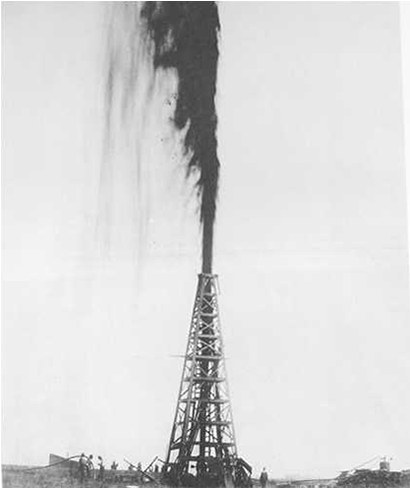
Black-and-white photograph of an oil gusher derrick with a gusher of oil shooting from the top
The Lucas gusher at Spindletop, January 10, 1901: This was the first major gusher of the Texas oil boom.
Lucas Gusher, Spindletop Oil Field is located in Texas
Lucas Gusher, Spindletop Oil Field
Lucas Gusher, Spindletop Oil Field is located in the United States
Lucas Gusher, Spindletop Oil Field
Location3 mi south of Beaumont, Texas on Spindletop Ave.
Coordinates30°1′12″N 94°4′31″W / 30.02000°N 94.07528°W / 30.02000; -94.07528
Area1,130.4 acres (457.5 ha)
Built1901 (1901)
NRHP reference No.66000818[1]
Significant dates
Added to NRHPNovember 13, 1966
Designated NHLNovember 13, 1966
Gulf Coast oil fields (left) and Spindletop oil lease map (right)

Spindletop is an oil field located in the southern portion of Beaumont, Texas, in the United States. The Spindletop dome was derived from the Louann Salt evaporite layer of the Jurassic geologic period.[2] On January 10, 1901, a well at Spindletop struck oil ("came in"). The Spindletop gusher blew for 9 days at a rate estimated at 100,000 barrels (16,000 m3) of oil per day.[3] Gulf Oil and Texaco, now part of Chevron Corporation, were formed to develop production at Spindletop.[4] The Spindletop discovery led the United States into the oil age. Prior to Spindletop, oil was primarily used for lighting and as a lubricant. Because of the quantity of oil discovered, burning petroleum as a fuel for mass consumption suddenly became economically feasible.

The frenzy of oil exploration and the economic development it generated in the state became known as the Texas oil boom. The United States soon became the world's leading oil producer.

History

[edit]

Pattillo Higgins sought a source of natural gas for his brickyard and envisioned producing oil and gas from Sour Spring Mound, convinced it was an anticline. The eventual oil field would be called Spindletop, after a hill one mile to the east, and four miles south of Beaumont. The hill had the appearance of a spindle due to trees on its hilltop (cimas de boneteros, "tops of spindle-trees"). The mound was famous for its gas seeps, which Higgins lit for his Baptist Sunday school class. In August 1892, George W. O'Brien, George W. Carroll, Pattillo Higgins, and J.F. Lanier formed the Gladys City Oil, Gas, and Manufacturing Company to do exploratory drilling. The company tried drilling two test wells, but ran into trouble trying to penetrate below 300 feet (90 m), encountering a quicksand-like formation. Higgins quit the venture in 1896.[5][6][7]

Pattillo Higgins then teamed with Captain Anthony F. Lucas, the leading expert in the U.S. on salt-dome formations. Lucas made a lease agreement in 1899 with the Gladys City Company and a subsequent agreement with Higgins. Lucas drilled to 575 feet (180 m) before running out of money. He secured additional funding from John H. Galey, James M. Guffey, and Andrew Mellon of Pittsburgh, and the Guffey Petroleum Company was formed. Yet, the deal left Lucas with only an eighth share, and Higgins with nothing.[8][7]: 76–77, 147, 186 [5]: 29 

Lucas and Galey employed the Hamill brothers for the drilling, while Galey picked the well site on land leased from the Beaumont Pasture Company. This tract of land was near the top of Sour Spring Mound. The well was spudded on 27 October 1900. At 160 feet (50 m), they hit the quicksands that had stopped earlier efforts. A solution consisted of driving an eight-inch casing pipe through the sand over the next 20 days, with a four-inch "wash pipe" to flush out the sand from the bottom of the hole with water. At around 250 feet (80 m), Lucas improvised a check valve to prevent the increased gas pressure from forcing sand into the casing, enabling them to reach a depth of 445 feet (140 m), and past the 285-foot (90 m) thick quicksand formation. At a depth of 645 feet (200 m), they adopted eighteen-hour shifts for continuous operations, drilling during the day, and keeping circulation going at night, to prevent a gas blowout. In early December, they hit a pocket of coarse water sand, when they adopted another innovation, mixing mud into the water which prevented the "heavier" water from dissipating into the sand. This drilling mud stabilized the hole, and soon they were drilling into a clay formation called gumbo. At 800 feet (240 m) they reached limestone, and on 9 December, oil started showing up in the slush pit. The oil was coming from a 35-foot (10 m) thick oil sand at a depth of 870 feet (270 m). Yet, that oil sand was too soft and fine to develop at that time, and Caroline Lucas convinced Galey to continue drilling to 1,200 feet (370 m), per contract. On Christmas Eve, they landed six-inch pipe below the sand at 880 feet (270 m), then enjoyed the holiday, returning New Year's Day. They hit another gas pocket, which forced water and mud out of the hole for ten minutes. Then, at 960 feet (290 m), they reached a sulphur layer, followed by more layers of limestone. On 10 January, they needed to replace the dull fishtail drill bit. While lowering the pipe down the hole, they only got to about 35 joints of pipe, or about 700 feet (210 m), before a low rumble sent mud, and then drill stem out of the hole. This was followed by silence, an explosion of more mud and gas, more silence, a flow of oil, and then a loud roar. On January 10, 1901, at a depth of 1,139 ft (347 m), what is known as the Lucas Gusher or the Lucas Geyser blew oil over 150 feet (50 m) in the air at a rate of 100,000 barrels per day (16,000 m3/d) (4,200,000 gallons). Nine days passed before the well was brought under control using a Christmas Tree devised by the Hamills.[3][7]: 78–81, 89, 93–110 [5]: 29–31 

By late June, there were 13 gushers on Spindletop. These included those by David R. Beatty on 26 March, the Heywood Brothers Oil Company, two more from the J.M. Guffey Company, and the Higgins Oil and Fuel Company on 18 April.[7]: 129–132  Then in July 1901, the Hogg-Swayne Syndicate leased 15 acres from J.M. Guffey.[5]: 33 

Spindletop was the largest gusher the world had seen and catapulted Beaumont into an oil-fueled boomtown. Beaumont's population of 10,000 tripled in 3 months and eventually rose to 50,000.[9] Speculation led land prices to increase rapidly. By the end of 1902, more than 500 companies had been formed and 285 wells were in operation.[3]

Spindletop produced 17,420,949 barrels of oil in 1902, but only half that much in 1903 as production declined. Yet Spindletop inspired wildcatting along the Gulf Coastal Plain. Significant salt dome oil fields included Sour Lake and Saratoga in 1902, Batson Prairie in 1903, the Humble oil field in 1905, and the Goose Creek Oil Field in 1908.[5]: 41–43 [7]: 159–160 

Standard Oil, which then had a monopoly or near-monopoly on the petroleum industry in the eastern states, was prevented from moving aggressively into the new oilfield by state antitrust laws. Populist sentiment against Standard Oil was particularly strong at the time of the Spindletop discovery. In 1900, an oil-products marketing company affiliated with Standard Oil had been banned from the state for its cutthroat business practices. Although Standard built refineries in the area, it was unable to dominate the new Gulf Coast oil fields the way it had in the eastern states. As a result, a number of startup oil companies at Spindletop, such as Texaco and Gulf Oil, grew into formidable competitors to Standard Oil.[10]

Production at Spindletop began to decline rapidly after 1902, and the wells produced only 10,000 barrels per day (1,600 m3/d) by 1904.[3] Unfortunately the developers had signed a 20-year contract to sell 25,000 barrels per day at $0.25 per barrel to Shell Oil. When the price climbed above $0.35 per barrel, the operation was stressed and Mellon who had lent money for Spindle Top's development took control of the company, won a lawsuit allowing Mellon to renege on the contract, and in 1907, created Gulf Oil. On November 14, 1925, the Yount-Lee Oil Company brought in its McFaddin No. 2 at a depth around 2,500 feet (800 m), sparking a second boom, which culminated in the field's peak production year of 1927, during which 21 million barrels (3.3 GL) were produced.[3][5]: 128  Spindletop continued as a productive source of oil until about 1936. Stripper wells continue producing to this day. It was then mined for sulfur from the 1950s to about 1975.[11]

Spindletop-Gladys City Boomtown Museum

[edit]
Left-The Spindletop-Gladys City Boomtown Museum. Right-Spindletop Park, the actual location of the famous well. This obscure park is 1.5 miles from Gladys City where the Spindletop marker, monument & museum are located.
A replica of the Lucas Spindletop Gusher that gushes water on occasion

In 1976, Lamar University dedicated the Spindletop-Gladys City Boomtown Museum to preserve the history of the Spindletop oil gusher era in Beaumont. The museum features an oil derrick and many reconstructed Gladys City building interiors furnished with authentic artifacts from the Spindletop boomtown period.[12]

The Lucas Gusher Monument is located at the museum. The monument, erected at the wellhead in July, 1941, was moved to the Spindletop-Gladys City Museum after it became unstable due to ground subsidence. According to an article by Nedra Foster, LS in the July/August, 2000 issue of the Professional Surveyor Magazine, the monument was originally located within 4 ft of the site of the Spindletop well.[13]

Today, the wellhead is marked at Spindletop Park by a flagpole flying the Texas flag. It is located about 1.5 miles south of the museum, off West Port Arthur Road/Spur 93. The site includes a viewing platform with information placards, about a quarter-mile from the flagpole. The wellhead site is in the middle of swampland on private land and is not accessible. Directions to the park and viewing platform are available at the museum.[citation needed]

See also

[edit]

References

[edit]
[edit]
Revisions and contributorsEdit on WikipediaRead on Wikipedia
from Grokipedia
Spindletop is an oil field located on a formation south of Beaumont in eastern . The site gained prominence on January 10, 1901, when the Lucas Gusher—a well drilled by Croatian-born mining engineer Anthony F. Lucas in collaboration with local promoter and self-taught geologist Pattillo Higgins—erupted, initially producing an estimated 100,000 barrels of oil per day. This uncontrolled flow shot crude oil more than 100 feet into the air and continued for nine days before capping, marking the first major gusher in the and demonstrating the vast potential of salt dome reservoirs. Spindletop's output revolutionized petroleum extraction, propelling from negligible production in 1900 to over 17 million barrels from the field alone in 1902—94 percent of the state's total—and vaulting the ahead of as the global leader in oil output. The discovery catalyzed the , birthing multinational companies such as the (later ) and , while transforming Beaumont into a chaotic that drew tens of thousands seeking fortune amid rapid infrastructure growth and economic upheaval. However, unchecked drilling led to rapid depletion, with production plummeting after peak yields due to waste and reservoir damage, underscoring early lessons in sustainable extraction amid the era's fervor for unchecked output.

Geological Context

Salt Dome Formation and Structure

The Spindletop exemplifies diapiric intrusion in the Gulf Coast region, originating from the Jurassic Louann Salt Formation, an extensive layer deposited during the Callovian stage of the . This salt, characterized by its low density relative to overlying sediments, underwent buoyant rise under differential loading from accumulating younger strata, piercing through and Tertiary formations to form a steep-sided, anticlinal structure. The process deformed adjacent sediments, generating radial faults and stratigraphic traps that facilitated the accumulation and retention of hydrocarbons migrating from deeper source rocks. Situated in , the Spindletop dome possesses a circular salt core roughly 1 mile in diameter, with a relatively flat-topped profile and steep flanks indicative of rapid upward mobilization. The structure pierces overlying sediments to shallow subsurface levels, attaining minimum depths of approximately 700 feet to the cap rock and 1,200 feet to the underlying salt stock, thereby elevating the dome's crest near the surface compared to regional basin depths. The cap rock, a sequence of , , and cavernous formed by dissolution and recrystallization at the salt-sediment interface, overlies the core and enhances impermeability, while peripheral faulting created localized traps in flanking sands. Subsequent subsurface analysis via core samples from early wells substantiated the dome's sealing efficacy, revealing hydrocarbons confined within porous intervals of the cap rock and fault-bounded reservoirs at depths around 1,100 feet, where and fault juxtaposition prevented vertical leakage. These empirical observations, corroborated by later seismic profiling, delineated the diapir's boundaries and confirmed the causal role of salt intrusion in generating the structural highs and barriers essential for entrapment.

Hydrocarbon Trap and Pre-Discovery Indicators

The Spindletop created a structural hydrocarbon trap by piercing and deforming overlying Tertiary sediments, forming anticlinal folds and impermeable seals that prevented lateral migration of buoyant oil and gas. Hydrocarbons originated from kerogen-rich shales in the Eocene to source rocks of the northern Gulf Coast basin, where burial and heating generated that migrated vertically along salt-related faults and fractures due to density differences, entering porous carrier beds before accumulating against the dome's flanks and cap. The primary trap at Spindletop resided in the —a 100- to 200-foot-thick sequence of cavernous, fractured (derived from the Edwards Formation), , and directly overlying the Louann Salt core—where oil filled vugs and fractures sealed by overlying impermeable layers. Secondary reservoirs occurred in high-porosity, lens-shaped sandstones of the Eocene Yegua Formation and younger Oligocene-Miocene sands draped along the dome flanks, contributing to the field's volume through similar migration and trapping dynamics. Initial recoverable reserves in these zones totaled an estimated 20 to 30 million barrels, based on early production data from the caprock and flanks. Pre-discovery surface indicators were subtle and primarily geological rather than direct hydrocarbon manifestations. The site featured a low, circular mound (Spindletop Hill), rising 10 to 15 feet above the surrounding Beaumont Prairie, characteristic of shallow-piercing salt domes that alter local topography through halokinesis. This elevation often correlates with subsurface salt influence, potentially fostering anomalous vegetation rings of salt-tolerant species or barren halos from minor seepage, though no major oil seeps were documented directly at the hill—unlike nearby areas such as Sour Lake. Compared to other Gulf Coast salt dome fields, Spindletop's trap was distinctive for its highly productive , which yielded massive volumes due to exceptional fracturing and (up to 20-30% in cavernous zones), whereas most domes proved barren in caprock and relied on Yegua or Frio flank sands for hydrocarbons. This anomaly likely stemmed from focused migration pathways along the dome's steep flanks, concentrating oil in the cap before flank reservoirs.

Exploration and Drilling Efforts

Pattillo Higgins' Vision and Early Surveys

Pattillo Higgins, a self-taught geologist operating in , identified Spindletop Hill's potential for oil in the late 1880s, reasoning from surface indicators such as escaping gas, hot springs, and oil seeps that hydrocarbons were likely trapped adjacent to the underlying . These empirical signs, observed during local outings and noted as early as 1865 by associate George W. O'Brien, contrasted with contemporary geological skepticism that Gulf Coast salt domes contained only sulfur rather than petroleum reservoirs. In August 1892, Higgins incorporated the Gladys City Oil, Gas, and Company with partners including George W. O'Brien, George W. Carroll, Emma E. John, and J. F. Lanier, leasing acreage around the 114-foot-high hill to conduct exploratory drilling and establish a planned manufacturing hub named after his student, Gladys Bingham. As treasurer and general manager, Higgins directed initial geological reconnaissance emphasizing the dome's structural trap for migrated oil, funded entirely through private investments without reliance on government subsidies. From 1893, the company undertook three shallow efforts using cable-tool rigs, reaching limited depths but striking gas shows and minor oil traces without achieving commercial flow, due to unstable sands and equipment limitations inherent to the method. These failures, culminating in dry holes by 1896, eroded investor confidence and led to Higgins' resignation amid board disputes in 1895, though he retained a promotional stake and continued advocating for deeper tests based on the site's persistent seepage evidence. Undeterred, Higgins placed targeted advertisements in trade journals between 1896 and 1899 seeking expert drillers familiar with salt formations, attracting responses including from Anthony F. Lucas, a Croatian-born engineer with practical knowledge of Gulf Coast salt domes from operations. On June 20, 1899, Lucas secured a for 663 acres at Spindletop through direct negotiations with the Gladys City Company and Higgins, who earned a 10 percent interest, underscoring the efficacy of individual networking and contractual incentives in advancing high-risk exploration.

Anthony Lucas' Operations and Technological Trials

Anthony F. Lucas, a Croatian-born mining engineer experienced in drilling from European operations, commenced at Spindletop in June 1900 using a steam-powered cable-tool rig on a 663-acre lease south of . This method, involving a heavy bit suspended on a cable and repeatedly dropped to fracture rock, allowed initial progress through surface sands but proved inadequate for deeper unstable formations. By October 6, 1900, the well reached 575 feet, encountering traces of oil and shallow gas shows amid thickening salt layers and , yet halted as tools became irretrievably lost in the unconsolidated material, exemplifying the limitations of cable-tool rigs in handling lost circulation without fluid support. To overcome these barriers, Lucas, drawing on his prior rotary drilling expertise from Austrian salt domes, secured investment from Pittsburgh partners James M. Guffey and John H. Galey, who in late 1900 engaged brothers Al and Curt Hamill—seasoned rotary drillers from —for the operation. On October 27, 1900, they spudded a new well using a rotary rig, which employed a circulating system to stabilize the borehole and remove cuttings, adapting European-style fishtail and cone bits hardened for the dome's cap rock. This shift addressed cable-tool failures by enabling penetration through via mud-weighted fluids that prevented collapse and tool loss, though empirical trials persisted with frequent bit wear and stuck pipe incidents requiring on-site improvisations like reinforced casing and bit redesigns. Further adaptations involved iterative testing of drilling mud compositions to combat lost circulation into porous salt intervals, with Lucas and the Hamill team empirically refining viscosities and additives from local clays to maintain pressure balance without regulatory oversight, relying solely on mechanical ingenuity. These trials, grounded in direct of formation responses rather than theoretical models, progressively deepened the well toward 1,000 feet by early January 1901, surmounting the hard cap rock that had thwarted prior efforts and positioning the operation for hydrocarbon penetration. Such hands-on causal learning from failures underscored the transition from percussive to drilling paradigms in challenging Gulf Coast .

The Discovery Gusher

The January 10, 1901 Strike

On January 10, 1901, at 10:30 a.m., the Lucas No. 1 well at Spindletop, drilled to a depth of 1,139 feet, experienced a sudden as the entered a high- zone. After a brief period of quiet following the penetration, mud began to surge upward, followed by gas, and then a massive column of oil erupted from the , shooting approximately 150 feet into the air. The initial flow rate exceeded 100,000 barrels per day, far surpassing any prior output and demonstrating the immense . The eruption resulted from penetrating porous reservoirs saturated with oil and gas, trapped around the margins of the underlying structure, where accumulated hydrostatic and gas pressures had built up over geological time without modern containment measures like blowout preventers, which were not yet invented. The , formed by the upward intrusion of Louann Salt, created an impermeable core that focused migratory hydrocarbons into flanking sands under high confinement, leading to the explosive release upon breaching. The uncontrolled discharge rapidly formed pools of crude oil across the site, coating the surrounding landscape and necessitating immediate efforts to manage the flow, including flaring excess to mitigate explosion risks. Capping proved challenging due to the ; crews attempted to fit valves and inject heavy mud over multiple days, finally succeeding after nine days of continuous eruption as pressures partially equalized.

Initial Production Surge and Capping Challenges

The Lucas No. 1 well at Spindletop erupted on January 10, 1901, unleashing an uncontrolled gusher estimated at 100,000 barrels of per day, shooting crude over 100 feet into the air and dwarfing contemporary U.S. production levels, which averaged approximately 173,000 barrels daily prior to the strike. This initial surge represented more than half of the nation's total output, highlighting the reservoir's immense pressure and volume while posing immediate challenges in to prevent and hazards. Capping efforts required improvised techniques under high-pressure conditions, succeeding after nine days on January 19, 1901, when the flow was finally brought under control and directed into production. Once stabilized, the well's output was quantified at sustained rates approaching 100,000 barrels per day, enabling systematic measurement and the rapid initiation of nearby drilling operations to exploit the field. Subsequent wells, including the Beatty No. 1 gusher on , 1901, accelerated field development, with at least six producing wells operational by September 1901, collectively elevating Spindletop's output and demonstrating the reservoir's scale through observed flow rates and early pressure data. The field's partial-year production in 1901 totaled about 3.59 million barrels, underscoring the surge's magnitude before depletion effects emerged.

Boomtown Expansion

Rapid Infrastructure Buildout

Following the January 10, 1901, gusher, the Spindletop site underwent swift physical development as private capital responded to high oil prices and production potential, erecting multiple derricks and storage facilities to capture output from initial wells. By September 1901, at least six productive wells operated on Gladys City Company leases, necessitating on-site tankage and basic containment structures amid daily flows exceeding 100,000 barrels from the uncapped Lucas well alone. Tent cities proliferated adjacent to drilling operations to the influx of workers, with tens of thousands converging on the field and Beaumont area within months. Gladys City, originally platted by Pattillo Higgins as an orderly manufacturing hub, rapidly evolved into a core outpost with saloons, hotels, and rudimentary commercial buildings to support field personnel and leaseholders. Local refineries emerged in Beaumont and nearby ports like Port Arthur to handle the field's high-sulfur sour crude, employing early techniques despite processing inefficiencies from the oil's composition. These facilities, alongside storage tanks, formed the nucleus of industrial processing, drawing on proximate lumber and iron supplies via expanded rail spurs connecting to Beaumont. Private ventures funneled over $235 million into oil infrastructure in 1901, prioritizing pipelines to tidewater terminals at and Port Arthur to enable barge and ship exports, thereby mitigating pervasive waste from wagon hauls and evaporation. Initial transport lags resulted in substantial spills, including vast surface pools from the nine-day Lucas , though systematic curtailed broader losses as production scaled to 3.5 million barrels that year. This buildout exemplified market-driven logistics, with over 500 corporations registering in Beaumont by 1902 to exploit the dome's reserves.

Population Influx and Economic Frenzy

The discovery triggered a massive influx of people to Beaumont, swelling its population from around 9,000 to 50,000 within months as laborers, drillers, and speculators arrived to capitalize on the oil abundance. This migration reflected direct market incentives, with individuals responding to signals of high-value resource extraction opportunities without centralized planning or subsidies. Speculative fervor dominated the local economy, as wildcatters and investors from across the bid aggressively for drilling leases, driving prices for previously inexpensive land—often $10 per acre—to extremes like $900,000 for comparable tracts or $200,000 for single-acre lots in unregulated auctions. This bidding war exemplified unbridled entrepreneurial response to perceived abundance, prioritizing rapid claims over . The rush led to over-drilling, with production surging to over 17 million barrels in 1902 alone, flooding the market and crashing oil prices to a low of 3 cents per barrel by the following year due to insufficient for and . Over 500 oil-related companies formed in Beaumont by mid-1902, amplifying the glut through parallel private initiatives. Private wealth creation ensued via these transactions, with an estimated $235 million invested in Texas oil that year and multimillion-dollar deals routine among local banks and operators; Pattillo Higgins, an early promoter, amassed millionaire status from his Spindletop stakes, underscoring how individual foresight and market dynamics generated prosperity independent of state intervention.

Technological Innovations

Advancements in Rotary Drilling

The rotary drilling technique, successfully implemented by Anthony F. Lucas at Spindletop in 1900, overcame the limitations of cable-tool methods, which relied on percussive hammering and struggled with the unconsolidated sands and hard cap rock of Gulf Coast salt domes. Lucas's steam-powered rotary rig used a double-pronged fishtail bit that rotated continuously under downward pressure from added drill-collar weight, enabling steady advancement through abrasive formations where prior cable-tool efforts had stalled at shallow depths after months of intermittent operation. This shift prioritized mechanical abrasion over impact, achieving penetration rates that cable tools could not match in such geologies, as evidenced by the Spindletop well's progress to over 1,000 feet in under four months despite frequent bit wear. A critical on-site came from the Hamill brothers—Curtis, Al, and their crew—who addressed borehole instability in the loose sands by substituting -laden for in the circulation system. This drilling , derived from nearby ponds and mixed with freshwater, formed a on the walls to prevent , while its suspended cuttings for removal and exerted hydrostatic to counter formation , thereby mitigating hazards during high-pressure encounters. Such practical engineering, refined through trial amid Spindletop's challenges, established mud circulation as a standard practice, enhancing safety and efficiency in rotary operations across permeable reservoirs. The Spindletop success accelerated rotary refinements, culminating in Howard R. Hughes Sr.'s 1909 two-cone roller bit, which replaced fixed fishtail designs with independently rotating cones bearing hardened steel teeth for rock crushing and gouging. This innovation, patented amid the post-gusher boom's demand for durable tools, extended bit longevity from mere feet of progress to hundreds, while compatible with mud systems for better cooling and cleaning. By enabling deeper, faster drilling in varied lithologies, these engineering solutions—grounded in empirical adaptations rather than prior theory—propelled rotary's national dominance, supplanting cable tools in most U.S. fields by 1930 and underpinning Gulf Coast production expansions.

Pipeline and Refining Developments

The rapid production surge at Spindletop necessitated immediate infrastructure to handle volumes exceeding 100,000 barrels per day initially, prompting the construction of pipelines to nearby refineries and railheads. The first pipelines to tidewater were laid in 1901, linking the field to Port Arthur approximately 20 miles southeast, where deeper water access facilitated barge and ship loading. By 1902, multiple operators, including the (predecessor to ), completed lines to rail stations at and Nederland, and extended to Port Arthur, enabling transport of crude without reliance on costly teamster wagons or temporary storage pits. These early lines, often using or early piping, addressed the logistical pressures of high-volume flow, with field output reaching 17.4 million barrels in 1902 alone. Gulf Refining Company, formed amid the boom, invested heavily in refining capacity suited to Spindletop's high-sulfur, low-grade crude, establishing a major facility at Port Arthur by 1903 through processes that separated , , and nascent fractions. This refinery, built on J.M. Guffey Petroleum assets, processed the sour oil that challenged existing Eastern technologies, yielding marketable products despite corrosion risks from content. The scaled quickly, with over 500 miles of pipelines in the Beaumont-Port Arthur vicinity by 1904, supporting export via the and rail to domestic markets. These developments, driven by private capital without subsidies, stabilized supply chains and lowered costs, directly enabling the automotive era's fuel demands by flooding markets with affordable from Gulf Coast refining. The engineering focus on durable, high-capacity lines and adaptive set precedents for handling salt-dome crudes, influencing subsequent Gulf Coast operations.

Economic Impacts

Short-Term Wealth Creation

The Spindletop oil field's production escalated dramatically following the January 10, 1901, gusher, reaching an annual peak of 17.5 million barrels in 1902—equivalent to nearly 94 percent of Texas's total output that year and surpassing all prior U.S. discoveries in scale. This volume, driven by over 285 active wells within the first year and more than 500 -related companies operating in the Beaumont area by 1902, enabled lessees to extract substantial value through royalties and sales, even as uncontrolled drilling flooded the market. Operators like the J.M. Guffey Petroleum Company, which secured prime leases including the core Higgins tract, amassed fortunes from high-output wells, illustrating how private property rights and speculative leasing incentivized swift resource capitalization in an unregulated environment. Oil prices collapsed from approximately $2 per barrel pre-Spindletop to under $0.25—and as low as $0.03 by late —due to the glut, yet the field's output compensated for lessees with low extraction costs and minimal demands, yielding net gains that created numerous millionaires among landowners and drillers. This dynamic underscored free-market mechanisms, where competitive maximized short-term fiscal returns from the salt-dome before depletion set in, prioritizing volume over price stability. The employment surge further amplified local wealth circulation, as thousands of workers—drawn to the site for , hauling, and support roles—earned wages well above the era's national average of about $1.50 daily, stimulating in Beaumont through heightened spending on goods and services. Despite the price crash prompting some operators to curtail production or consolidate holdings, the overall volume-driven sustained a frenzy of value extraction, setting precedents for boom-cycle profitability in ventures.

Formation of Major Oil Companies

The J.M. Guffey Petroleum Company, which controlled significant leases at Spindletop following the January 1901 strike, reorganized in late 1901 into entities that evolved into Corporation. Investors led by James M. Guffey capitalized on the field's initial output to fund refining and pipeline infrastructure, establishing Gulf Refining Company in to process Spindletop crude. This structure enabled rapid scaling, with incorporating formally by 1907 and leveraging Spindletop-derived capital to expand into integrated operations across production, transportation, and marketing. Similarly, the Texas Company—later rebranded —was incorporated on May 26, 1902, in Beaumont by and associates, drawing on capital and leases tied to Spindletop promoter Patillo Higgins' early ventures. firm acquired Higgins' interests and focused on transporting and refining high volumes of Spindletop oil, initially shipping crude by pipeline to Port Arthur for export. This integration of field assets propelled the company to build refineries and tankers, establishing it as a vertically structured enterprise independent of eastern dominance. Standard Oil entered Spindletop operations belatedly in 1903 by constructing a to process local crude, after initially declining opportunities amid perceptions of untapped potential. While facing antitrust pressures that culminated in its 1911 dissolution—yielding subsidiaries like Magnolia Petroleum with Spindletop ties—the involvement spurred competitive advancements in efficiency and market access, countering monopoly concerns through localized . Spindletop's 1902 output of over 17 million barrels, comprising 94% of production, furnished capital for statewide exploration, birthing firms like (predecessor to Exxon) and Sun Oil that collectively dominated integrated oil activities. By 1920, these Spindletop-origin entities contributed to producers controlling a substantial share of U.S. output, fostering a decentralized industry structure.

Social and Cultural Shifts

Demographic Changes in Beaumont Area

The population of , stood at approximately 9,000 residents in early 1901 prior to the Spindletop discovery on , 1901. Within months, this figure tripled to around 30,000 by March 1901, driven by a rapid influx of voluntary migrants including oilfield laborers, engineers, and speculators attracted by employment opportunities and prospecting leases. The surge continued, pushing the transient population to an estimated 50,000 by mid-1901, as workers arrived from established oil regions such as and , alongside locals from nearby fields like Corsicana, transforming the lumber-dependent town into a classic hub of opportunistic mobility. This demographic expansion was markedly transient, with the peak population in 1902 reflecting the field's initial gusher-era output of over 17 million barrels annually, but production plummeted to about 10,000 barrels per day by 1904 amid rapid depletion, prompting widespread out-migration. By the 1910 U.S. , Beaumont's enumerated population had stabilized at 21,591—roughly half the boomtime estimate—evidenced by reduced economic activity and departing leaseholders, though exact turnover lacks comprehensive record aggregation beyond anecdotal accounts of emptied tent cities and boarding houses. The voluntary nature of these shifts underscored causal links to resource availability, with migrants reallocating to emerging fields rather than permanent settlement. Initial workforce demographics skewed heavily male, comprising roughnecks, drillers, and wildcatters in makeshift camps that prioritized single laborers over families due to the hazardous, nomadic conditions of early rotary operations. As like pipelines and refineries developed in 1901–1902, some engineers and lease managers relocated with dependents, fostering gradual family integrations and rudimentary community formations, though the overall gender imbalance persisted amid the boom's short lifespan. This evolution from transient male enclaves to partial familial stability aligned with wage incentives exceeding $5 per day for skilled workers, drawing secondary migrations without coercive elements.

Influence on American Entrepreneurship

The Spindletop discovery on January 10, 1901, epitomized the wildcatter model of American entrepreneurship, characterized by individuals investing personal capital in high-risk exploratory drilling amid uncertain geological prospects. Joseph S. Cullinan, an experienced oilman from Pennsylvania, relocated to Beaumont post-gusher and co-founded the Texas Fuel Company in 1902, which later became Texaco; he launched ten affiliated enterprises to handle exploration, production, refining, pipelines, and marketing of Texas crude. Cullinan's initiatives, including a pipeline linking Spindletop to Gulf Coast refineries, underscored self-reliant adaptation to supply gluts and market demands, transforming localized windfalls into scalable operations without reliance on established Eastern monopolies. This event catalyzed a verifiable of venture formation, with over 500 and land companies establishing operations in Beaumont by early , many funded by boom-era profits and speculative leasing. Approximately 285 active wells and hundreds of new firms emerged within the first year, fostering a competitive where independent operators outpaced initial incumbents through rapid iteration on and . Such proliferation—yielding at least 200 enduring or influential ventures from initial profits—directly contributed to the U.S. supplanting as the world's leading producer by , accelerating the pivot from pre-industrial fuels like to petroleum-based . Spindletop's outcomes reinforced a cultural of risk-tolerant among entrepreneurs, evident in the biographies of wildcatters who prioritized empirical over bureaucratic oversight, influencing 20th-century pioneers in independent refining and distribution. This model countered narratives of centralized dependency by demonstrating causal links between decentralized speculation and industrial scaling, as surviving firms like those under Cullinan's umbrella expanded nationwide without government subsidies.

Resource Depletion and Revival

Early 1900s Decline

The rapid proliferation of wells at Spindletop, exceeding 500 by mid-1902, accelerated depletion by intensifying drawdown across the shallow primary oil zones. This over-exploitation, driven by competitive without spacing regulations, extracted an estimated 17.5 million barrels in 1902 alone, representing the field's annual peak. By February 1904, daily production had plummeted to 10,000 barrels per day—roughly 10% of the initial field-wide peaks exceeding 100,000 barrels per day from the 1901 gusher and subsequent wells—due to the exhaustion of accessible hydrocarbons in the unconsolidated sands. This decline continued into 1905, with output stabilizing under 20,000 barrels per day amid diminishing returns from the over-drilled reservoirs. The causal mechanism involved excessive withdrawal rates that promoted uneven drainage, coning of underlying water from adjacent aquifers into production intervals, and premature pressure collapse, as inferred from contemporaneous well logs documenting sharp drops in oil cuts and rising water production. Economically, the output crash triggered rig shutdowns and mass layoffs among the thousands of workers drawn to Beaumont during the boom, transforming the transient oil camps and support infrastructure into semi-abandoned ghost towns by 1905. Population in the Beaumont area, which had surged to over 50,000 in 1901, contracted sharply as transient labor departed, yet widespread destitution was mitigated by the redirection of surviving capital and expertise to proximate fields like Sour Lake and Batson, sustaining regional oil investment flows.

1920s Secondary Recovery

In the mid-1920s, following two decades of depletion from the initial shallow reservoirs, operators at Spindletop pursued revival through targeted drilling into previously untapped deeper formations on the field's flanks. Speculation by geologist Marrs McLean and oilman Miles F. Yount focused on the potential of Marginulina sands encircling the at depths exceeding 5,000 feet, where seismic and structural analysis indicated residual hydrocarbons beyond the exhausted crestal zones. The breakthrough occurred on November 13, 1925, when Yount-Lee Oil Company's McFadden No. 2 well struck oil at 5,400 feet on the southwest flank, confirming extensive productive sands overlooked in earlier vertical drilling confined to the dome's apex. This initiated a wave of flank development, with operators employing rotary rigs adapted for directional control and deeper penetration to access these peripheral reservoirs, which yielded lighter crude under primary pressure without immediate need for artificial lift in many cases. By 1926, southwest flank expansion accelerated, driving daily output from negligible levels to sustained highs. Production surged to an annual peak of 21 million barrels in 1927, averaging over 57,000 barrels per day across the field, surpassing the 1902 record from the original boom despite fewer wells. Over the subsequent five years, flank sands contributed approximately 60 million barrels, elevating cumulative field output to around 100 million barrels by 1930. These efforts demonstrated causal efficacy of flank-targeted exploration in structures, informing subsequent practices in Gulf Coast fields by prioritizing geophysical mapping over blind wildcatting to prolong primary recovery phases.

Environmental Considerations

Waste from Uncontrolled Flows

The Lucas No. 1 well at Spindletop erupted on January 10, 1901, producing an uncontrolled gusher that flowed for nine days at an estimated rate of 100,000 barrels per day before being capped on January 19. This initial outburst resulted in approximately 900,000 barrels of oil spilling uncontrollably into the air and onto the ground, as no adequate storage or containment infrastructure existed in the Beaumont area at the time. The high-pressure nature of the , unprecedented in prior U.S. experience, overwhelmed available , leading to this spillage without effective prevention measures. Field-wide operations exacerbated waste through additional uncontrolled flows, leaks, and flaring, as rapid of over 500 wells by mid-1901 outpaced and capacity. Excess production was often burned off or allowed to seep into the , contributing to environmental and resource loss amid the frenzy. Historical accounts document tremendous waste from such practices, though precise field totals remain estimates due to limited contemporaneous records; the initial gusher alone represented a notable fraction of early output before adaptations like levees and hasty tank construction were improvised. These inefficiencies stemmed from the absence of high-pressure control technologies, yet operators' swift engineering responses—developing capping methods and early flow restrictors—limited prolonged losses and accelerated innovations in , including precursors to modern blowout preventers. Relative to the field's peak output exceeding 17 million barrels in , such waste constituted a minor proportion of recoverable value, prioritizing rapid commercialization over cautious delays that might have forfeited the discovery's momentum.

Long-Term Site Management

Following the depletion of primary reserves in the early 1900s and secondary recovery in the , the Spindletop field's long-term management shifted toward well plugging, site stabilization, and regulatory oversight by the Railroad Commission (RRC), which enforces standards for capping abandoned wells to prevent leaks and . By the mid-20th century, including efforts in the , operators conducted systematic plugging of non-producing wells using and mechanical seals, aligning with state requirements that prefigured modern EPA groundwater protection protocols, such as monitoring for or migration. Today, the site sustains marginal oil production from remaining active leases, operated by entities like Energy Transfer Spindletop LLC, with output far below historical peaks but sufficient for ongoing economic viability amid enhanced recovery techniques. In 2025, proposals for include the Golden Triangle Storage Spindletop Expansion Project, which plans to develop four new caverns adding 30.75 billion cubic feet of working gas capacity, leveraging the field's depleted reservoirs for underground to address regional demand surges. Environmental stewardship has emphasized containment and monitoring, with no documented major spills or uncontrolled releases since the initial 1901 gusher, as verified through RRC compliance records and federal assessments for storage expansions. tests under state oversight indicate minimal persistence, countering unsubstantiated claims of enduring , while surface reclamation has supported recovery, evidenced by the integration of portions of the site into public parks with restored native vegetation and habitats.

Historical Legacy

Catalyst for U.S. Oil Dominance

The Spindletop discovery on January 10, 1901, initiated a dramatic expansion in U.S. crude oil production, elevating annual output from approximately 63 million barrels in 1900 to around 442 million barrels by 1920. This growth stemmed directly from the field's unprecedented yields, with the Lucas Gusher alone producing over 100,000 barrels per day initially, spurring widespread drilling and the formation of more than 500 oil companies by the end of 1902. The resulting abundance lowered oil prices from about $2 per barrel to under 25 cents, facilitating the mass adoption of automobiles and technologies that defined the early . By eclipsing Russia's dominance in global oil exports—previously centered on the fields—Spindletop positioned the as the world's foremost producer, achieving roughly 60% of global output by the eve of . This shift fostered energy self-sufficiency, reducing vulnerability to foreign supplies and enabling industrial expansion without import constraints. The event underscored the efficacy of private risk capital in resource development, as individual investors and entrepreneurs mobilized billions in equivalent value through rapid field capitalization, outstripping the slower paces seen in state-directed efforts like Mexico's oil sector post-1938 nationalization. Such market incentives drove technological advancements in and , cementing U.S. leadership in the era.

Commemorative Efforts and Museums

The Spindletop-Gladys City Boomtown Museum, established in 1976 and administered by in , recreates the Gladys City boomtown through 14 replica buildings stocked with original artifacts from the late 19th and early 20th centuries, depicting the social and economic dynamics of the 1901 oil strike. The site includes four derricks, among them a mechanical replica of the Lucas Gusher constructed in 2001 that simulates the eruption via water spouts during demonstrations. These exhibits emphasize the rapid industrialization and entrepreneurial activity spurred by the discovery, providing visitors with tangible insights into the era's innovations without interpretive distortions. Commemorative initiatives trace back to a pink granite erected in 1941 near the original well site to mark the significance of the Spindletop field in launching modern petroleum production. In 1951, the Spindletop Fiftieth Anniversary, Inc. coordinated events celebrating the gusher's impact on U.S. energy infrastructure. The sustains these traditions via the annual Drillers Reunion held around January 10, featuring gusher reenactments, period crafts, and interactive displays that attract roughly 15,000 visitors per year to explore the factual sequence of drilling breakthroughs and expansion. Recent preservation activities in the 2020s incorporate archival integrations, such as Texas Archive of the Moving Image footage screened during the 124th anniversary event on January 11, 2025, underscoring the gusher's role in advancing rotary drilling techniques and salt dome exploration methods. These efforts prioritize primary-source documentation of technological causality over narrative overlays, fostering education on the empirical drivers of the Texas oil industry's formative success.

References

Add your contribution
Related Hubs
User Avatar
No comments yet.