Recent from talks
Nothing was collected or created yet.
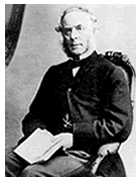
Robert Fortune
View on Wikipedia
Robert Fortune (16 September 1812 – 13 April 1880)[1] was a Scottish botanist, plant hunter and traveller, best known for introducing around 250 new ornamental plants, mainly from China, but also Japan, into the gardens of Britain, Australia, and North America. He also played a role in the development of the tea industry in India in the 19th century. He also imported Japanese chestnuts into the United States, which led to the introduction of chestnut blight to the country 24 years after his death.[2]
Key Information
Life
[edit]Fortune was born in 1812 in the small settlement or "fermtoun" of Kelloe in the parish of Edrom, Berwickshire.[3] After completing his apprenticeship, he was then employed at Moredun House, just to the south of Edinburgh, before then moving on to the Royal Botanic Garden Edinburgh. In 1840, he and his family moved to London to take up a position at the Horticultural Society of London's garden at Chiswick. Following the Treaty of Nanking in 1842, in early 1843, he was commissioned by the Horticultural Society to undertake a three-year plant collection expedition to southern China.[4]

His travels resulted in the introduction to Europe, Australia, and North America of many flowers and plants. His most famous accomplishment was the successful introduction, although it was not the first by any means, of Chinese tea plants (Camellia sinensis), along with skilled tea makers, from China to India in 1848 on behalf of the British East India Company. Robert Fortune worked in China for several years in the period from 1843 to 1861.

Similar to other European travellers of the period, such as Walter Medhurst, Fortune disguised himself as a Chinese merchant during several, but not all, of his journeys beyond the newly established treaty port areas. Not only was Fortune's purchase of tea plants reportedly forbidden by the Chinese government of the time, but his travels were also beyond the allowable day's journey from the European treaty ports. Fortune travelled to some areas of China that had seldom been visited by Europeans, including remote areas of Fujian, Guangdong, and Jiangsu provinces.
Fortune employed many means to obtain plants and seedlings from local tea growers, although this was some 150 years before international biodiversity laws recognised state ownership of such natural resources. He is also known for his use of Nathaniel Bagshaw Ward's portable Wardian cases to sustain the plants. It is also widely reported that he took skilled workers on contract to India who would facilitate the production of tea in the plantations of the East India Company. With the exception of a few plants that survived in established Indian gardens, most of the Chinese tea plants Fortune introduced in the northwestern provinces of India perished. The other reason for the failure in India was that the British preference and fashion was for a strong dark tea brew, which was best made from the local Assam subspecies (Camellia sinensis var. assamica) and not the selection that Fortune had made in China. The technology and knowledge that was brought over from China was, however, instrumental in the later flourishing of the Indian tea industry in Assam and Sri Lanka.[5][6]
In subsequent journeys, he visited Formosa (Taiwan) and Japan, and described the culture of the silkworm and the manufacture of rice. He introduced many trees, shrubs, and flowers to the West, including the cumquat, a climbing double yellow rose ('Fortune's Double Yellow' (syn. Gold of Ophir) which proved a failure in England's climate), and many varieties of tree peonies, azaleas and chrysanthemums. A climbing white rose that he brought back from China in 1850, believed to be a natural cross between Rosa laevigata and R. banksiae, was dubbed R. fortuniana (syn. R. fortuneana) in his honour. This rose, too, proved a failure in England, preferring warmer climates. Today, both of these roses are still widely grown by antique rose fanciers in mild winter regions. Rosa fortuniana also serves as a valuable rootstock in Australia and the southern regions of the United States.
He related his travels in a series of books. He died in London in 1880, and is buried in Brompton Cemetery.
Legacy
[edit]Fortune is credited with the introduction of a large number of plants, shrubs, and trees to Europe from China.[7] In 1913, botanists Rehder and E.H.Wilson named a plant genus from China, with one species, Fortunearia sinensis,[8] in his honour.[9]
Plants named after Robert Fortune
[edit]- Arundinaria fortunei
- Berberis fortunei
- Cephalotaxus fortunei
- Cyrtomium fortunei
- Euonymus fortunei
- Hosta fortunei
- Keteleeria fortunei
- Osmanthus × fortunei Carrière (O. fragrans × O. heterophyllus)
- Paulownia fortunei
- Pleioblastus fortunei
- Rhododendron fortunei
- Rosa fortuniana
- Saxifraga fortunei Hook.
- Trachycarpus fortunei (has synonym Chamaerops fortunei)
Publications
[edit]- Three Years' Wandering in the Northern Provinces of China, A Visit to the Tea, Silk, and Cotton Countries, with an account of the Agriculture and Horticulture of the Chinese, New Plants, etc. (1847, John Murray) Excerpt China Heritage Quarterly No. 29 (March 2012) ISSN 1833-8461 .
- A Journey To The Tea Countries Of China; Including Sung-Lo And The Bohea Hills; With A Short Notice Of The East India Company's Tea Plantations In The Himalaya Mountains. (1852, John Murray) Excerpt China Heritage Quarterly.
- Two visits to the tea countries of China and the British tea plantations in the Himalaya: with a narrative of adventures, and a full description of the culture of the tea plant, the agriculture, horticulture, and botany of China (1853, John Murray; LCCN 04-32957; National Library: CAT10983833)
- A Residence Among the Chinese; Inland, On the Coast and at Sea; being a Narrative of Scenes and Adventures During a Third Visit to China from 1853 to 1856, including Notices of Many Natural Productions and Works of Art, the Culture of Silk, &c. (1857, John Murray)
- Yedo and Peking; A Narrative of a Journey to the Capitals of Japan and China, with Notices of the Natural Productions, Agriculture, Horticulture and Trade of those Countries and Other Things Met with By the Way (1863, John Murray)
References and further reading
[edit]- Mather, Jeffrey. (2010). "Botanising in a Sinocentric world: Robert Fortune's travels in China". Studies in Travel Writing, 14(3), 257–270. https://doi.org/10.1080/13645145.2010.500099
- Sarah Rose. For All the Tea in China: How England Stole the World's Favorite Drink and Changed History. Viking: 2010. ISBN 0670021520
- Watt, Alistair, Robert Fortune, A Plant Hunter in the Orient. Royal Botanic Gardens, Kew: 2017. ISBN 1842466194 (distributed by the University of Chicago Press)
In Fiction
[edit]Robert Fortune features as a character in Sara Sheridan's novel The Secret Mandarin (2009)
Notes
[edit]- This article incorporates text from a publication now in the public domain: Chisholm, Hugh, ed. (1911). "Fortune, Robert". Encyclopædia Britannica (11th ed.). Cambridge University Press.
- ^ Chisholm, Hugh, ed. (1911). . Encyclopædia Britannica (11th ed.). Cambridge University Press.
- ^ Tredici, Peter Del (1 September 2017). "The introduction of Japanese plants into North America". The Botanical Review. 83 (3): 215–253.
- ^ Boulger, George Simonds (1889). . Dictionary of National Biography. Vol. 20. pp. 50–51.
- ^ Lu, Di (2026). "Rethinking the Legitimacy of British Botanizing in Late Qing China (1840-1912)". Journal of British Studies. 65: e9. doi:10.1017/jbr.2026.10188.
- ^ Fan, Fa-ti (2004), British Naturalists in Qing China: Science, Empire, and Cultural Encounter, Cambridge: Harvard University Press, pp. 82–3, ISBN 0-674-01143-0. 2009 pbk edition
- ^ Cox, EM (1945), Plant-hunting in China: A History of Botanical Exploration in China and the Tibetan Marches, London: Scientific Book Guild, p. 89.
- ^ Bretschneider, Emil (1935), History of European botanical discoveries in China, Leipzig: KF Koehlers antiquarium.
- ^ "Fortunearia sinensis Rehder & E.H.Wilson | Plants of the World Online | Kew Science". Plants of the World Online. Retrieved 10 September 2021.
- ^ Quattrocchi, Umberto (2000). CRC World Dictionary of Plant Names, Volume II, D–L. Boca Raton, Florida: CRC Press. ISBN 978-0-8493-2676-9.
- ^ International Plant Names Index. Fortune.
External links
[edit]- The China Vintage Hour Robert Fortune's Wanderings in China (Part 1) YouTube video.
- The China Vintage Hour Robert Fortune's Wanderings in China (Part 2) YouTube video.
- Plant Explorers: Robert Fortune (1812-80)
- Dreijährige Wanderungen in den Nord-Provinzen von China (German)
- "Dwarf Trees" from Robert Fortune's Books
- Mark O'Neill, Robert Fortune, the Scottish Botanist Who Stole the Tea of China The Foreign Correspondents' Club, Hong Kong. YouTube
- Works by Robert Fortune at LibriVox (public domain audiobooks)

- Digitised papers of Robert Fortune, held at the Royal Horticultural Society's Lindley Library. RHS Digital Collections
Robert Fortune
View on GrokipediaEarly Life
Childhood and Education in Scotland
Robert Fortune was born on 16 September 1812 in the rural settlement of Kelloe, within the parish of Edrom near Duns in Berwickshire, Scotland (now part of the Scottish Borders).[6] [3] He came from a modest working-class family; his father, Thomas Fortune, was employed in the gardens of the Kelloe estate, while his mother was Agnes Ridpath, and he was one of nine children.[7] Growing up in this agrarian environment provided early exposure to local flora through countryside walks and familial involvement in estate gardening, fostering a self-directed curiosity about plants despite the absence of advanced resources.[8] Fortune received only basic schooling in the local parish before leaving education at a young age to enter practical horticulture.[6] [3] Around age 13, he began an apprenticeship as a gardener, gaining hands-on experience in plant cultivation and maintenance, which built on his innate observational skills in botany.[6] This period marked the foundation of his expertise, emphasizing empirical knowledge over theoretical study, as he progressed from rural tasks to more structured roles. In his late teens or early twenties, Fortune relocated to the Edinburgh area, securing employment that advanced his training, including time at the Royal Botanic Garden Edinburgh under the guidance of curator William McNab, a rigorous horticulturist who oversaw the garden from 1820 to 1845.[9] [10] McNab's demanding oversight honed Fortune's skills in plant propagation and classification, preparing him for institutional roles without formal academic credentials.[5] This phase in Edinburgh solidified his transition from self-taught rural enthusiast to professional gardener, reliant on mentorship and direct practice rather than university-level instruction.Initial Horticultural Training
In 1839, Robert Fortune joined the Royal Botanic Garden in Edinburgh as a gardener, where he quickly demonstrated proficiency in plant propagation techniques and taxonomic classification under the supervision of curator William McNab.[3][6] His aptitude for these skills led to rapid advancement within the institution, earning McNab's endorsement for higher responsibilities.[5] By 1842, Fortune transferred to the Royal Horticultural Society's garden at Chiswick, London, appointed as superintendent of the hothouse department.[3] In this role, he oversaw the cultivation and cataloging of exotic plant collections, refining curatorial methods essential for maintaining diverse species in controlled environments.[6] His practical expertise extended to entomology, applying observational knowledge of insect behaviors to inform early pest management strategies in greenhouse settings, though formal publications on these topics emerged later.[11]Professional Career in Britain
Employment at Edinburgh and London Horticultural Society
In 1839, Fortune joined the Royal Botanic Garden in Edinburgh as an assistant gardener, where he gained experience in plant cultivation and taxonomy under the supervision of regius keeper William McNab.[1][5] This position involved hands-on work with diverse species, honing his skills in propagation and maintenance of botanical collections, which were essential for his later administrative roles.[8] In 1842, Fortune relocated to London and was appointed superintendent of the hothouse department at the Horticultural Society's gardens in Chiswick, overseeing the propagation and care of exotic plants, including recent imports from Asia.[3][5] His duties encompassed managing indoor collections, experimenting with acclimatization techniques to adapt foreign species to British conditions, and ensuring the health of specimens in controlled environments such as greenhouses.[12][13] Fortune collaborated closely with John Lindley, the society's assistant secretary and professor of botany, whose endorsement facilitated his rapid advancement and involvement in curatorial decisions.[14][15] These responsibilities in propagating and evaluating imported plants directly informed the society's selection of Fortune for specialized fieldwork, as his expertise in handling delicate exotics demonstrated his suitability for overseeing live shipments and initial establishments in British nurseries.[9][16]Early Botanical Contributions
Fortune relocated to London in 1840 to take up a position at the Horticultural Society of London's garden at Chiswick, where he advanced to superintendent of the hothouse department in 1842, just prior to his first expedition.[3] In this role, he managed the propagation and cultivation of ornamental plants under controlled conditions in forcing houses, enabling year-round growth and preparation of specimens for the society's exhibitions and trials.[1] As an entomologist, Fortune documented insects impacting British horticultural collections, informing practical measures to safeguard plants from pests in domestic settings.[11] His expertise in these areas demonstrated the society's trust in his abilities, as evidenced by his rapid promotion and selection for international collecting duties.[3]Expeditions to Asia
First Expedition to China (1842-1844)
In 1842, shortly after the Treaty of Nanking concluded the First Opium War, Robert Fortune was commissioned by the Royal Horticultural Society to undertake a plant-collecting expedition to China, departing Britain that September and arriving in [Hong Kong](/page/Hong Kong) the following January.[17][3] His mandate focused on gathering ornamental and useful plants from regions newly accessible to foreigners, primarily in the northern and eastern provinces such as Zhili, Shandong, and Zhejiang, where he traveled by junk and overland routes amid lingering anti-foreign hostilities.[18] Fortune's itinerary involved extensive fieldwork in temple gardens, wild mountains, and rural nurseries, yielding collections of approximately 150 species, including prized peonies (Paeonia spp.), dwarf pines (Pinus spp.), azaleas, and variegated evergreens like Bambusa and Thuja.[11] These acquisitions emphasized horticultural novelties suited for British gardens, with seeds and cuttings documented in his subsequent account Three Years' Wanderings in the Northern Provinces of China.[19] Challenges abounded, including confrontations with suspicious local officials who enforced edicts against foreign intrusion into interior regions, as well as physical perils such as bandit attacks, piracy on coastal voyages, typhoons, and bouts of fever that nearly proved fatal.[4] By late 1845, Fortune arranged shipments of live specimens back to Britain via sailing vessels, packing roots in damp moss and enclosing smaller plants in glazed wooden cases positioned on deck for ventilation, which achieved higher survival rates than prior expeditions despite the six-month sea journey.[11] Upon his return in 1846, the viable introductions, including early forms of weigela and double yellow roses, enriched the Society's collections and spurred interest in Chinese flora, though many specimens succumbed to transit stresses or acclimatization failures.[20] This expedition laid foundational knowledge of Chinese horticulture without delving into commercial staples like tea, which remained restricted.[18]Tea Acquisition Mission (1848-1851)
In 1848, following the Treaty of Nanking (1842) which granted British access to Chinese ports, the British East India Company commissioned Robert Fortune to procure tea plants, seeds, and manufacturing expertise to establish cultivation outside China.[2] The mission, funded at £1,000 annually plus expenses, aimed to break China's monopoly on tea production amid rising British demand and the Opium Wars' economic strains.[2] Fortune departed Britain in October 1848, arriving in Hong Kong by December, and proceeded inland to tea-growing regions despite risks from local unrest and export bans on live plants.[21] The expedition unfolded in phases, beginning with seed and plant collection in the Wuyi Mountains of Fujian province, the epicenter of black tea (Bohea) production.[2] Fortune targeted high-quality varieties, gathering thousands of seeds and young plants from remote gardens, often navigating treacherous terrain and bribing locals for access.[22] A pivotal observation during this phase revealed that green and black teas derived from the same species, Camellia sinensis, differing only in processing—fermentation for black tea versus steaming and firing for green—debunking the prevailing European belief in distinct plant species.[2][21] This insight, verified through direct examination of cultivation sites, underscored processing as the key variable rather than botany.[23] Subsequently, Fortune shifted to recruiting skilled artisans, hiring approximately a dozen Chinese tea workers and their families to relocate and impart processing techniques.[2] In total, he smuggled out over 20,000 tea plants and seeds, packed in protective cases to sustain viability during sea transit.[7] These were shipped via junk vessels to avoid detection, reaching Calcutta in 1850.[22] Upon arrival in India, the consignment supported pilot plantations in the Himalayan foothills, including sites near Darjeeling and in Assam.[21] Initial establishment faced severe challenges, with mortality rates exceeding 90% due to unsuitable soil, climate mismatches, and transplant shock, though select survivors adapted after propagation efforts.[23] The recruited artisans oversaw early processing trials, applying Chinese methods to Indian-grown leaves, yielding the first experimental black teas by 1851.[2] Fortune returned to Britain in 1851, having delivered actionable intelligence on cultivation and manufacture.[7]Subsequent Trips to China and Japan (1850s)
Fortune's third expedition to China, commencing in March 1853 and extending to December 1856, targeted additional tea plant collections and black tea production expertise from provinces such as Fujian and Jiangxi, alongside explorations of the silk industry in areas including Shanghai, Ningbo, Zhejiang, Canton, Formosa, and the hinterlands.[14] He dispatched thousands of tea seedlings to experimental plantations in India's northwest provinces and recruited manufacturers skilled in black tea processing.[14] During this journey, Fortune gathered camellias of Chinese origin, introducing them to England shortly after 1850, which enriched European ornamental collections.[24] He also documented and collected the conifer Cunninghamia lanceolata (China fir), an economically valuable timber tree, from the Tiantai Mountains south of Ningbo, facilitating its propagation in Western horticulture.[25] These acquisitions, transported via innovative Wardian cases, were distributed to British institutions and nurseries, bolstering collections of ornamental and utilitarian species without reliance on prior methods from earlier voyages.[14] In 1861, during his final Asian journey from October 1860 to January 1862, Fortune traveled to Japan—then newly accessible to Westerners after Commodore Perry's expeditions—collecting from Nagasaki, Yokohama, Kanagawa, and Edo (Tokyo), before proceeding to northern China sites like Tientsin and Peking.[26] Operating under strict Tokugawa shogunate regulations, including samurai oversight that confined foreigners to treaty ports and limited inland access, he gathered Japanese trees, shrubs, and ornamentals such as azaleas and maples, adapting collection techniques to local constraints like seasonal blooms and guarded nurseries.[27] These specimens, shipped live to English nurserymen via Cape and Suez routes, introduced diverse hardy evergreens and deciduous varieties to Western gardens, emphasizing aesthetic and potential economic value.[26]Methods and Techniques
Use of Disguises and Espionage Tactics
To circumvent Qing dynasty prohibitions restricting foreigners to coastal treaty ports and barring access to interior tea-producing regions, Robert Fortune employed elaborate disguises during his 1848–1851 expedition sponsored by the British East India Company.[2] He adopted the attire and appearance of a high-ranking mandarin official, including shaving the front of his head, attaching a false queue braid, and donning silk robes, boots, and a fur-trimmed cap to blend into Chinese society.[2] Accompanied by a hired interpreter and native servants posing as his entourage, this masquerade enabled him to travel undetected into restricted districts such as those around Hangzhou and the Wuyi Mountains, areas where foreign presence was punishable by imprisonment or execution under edicts enforcing China's tea export monopoly.[2][14] Fortune supplemented personal infiltration with a network of recruited native agents, primarily local tea workers and coolies, whom he bribed or incentivized to procure seeds, plants, and processing intelligence covertly.[2] These agents operated under misdirection tactics, such as transporting specimens in unmarked crates disguised as everyday goods or routing them through intermediary villages to avoid imperial customs patrols.[2] By leveraging these proxies, Fortune evaded direct scrutiny while scaling operations; for instance, he coordinated the clandestine shipment of thousands of tea seedlings via hired junks, bypassing official oversight that confined legitimate trade to Canton.[28] These espionage methods facilitated direct observation of tea manufacturing secrets, revealing that green and black teas derived from the same Camellia sinensis species, with the distinction arising from processing: black tea underwent oxidation (then termed "fermentation") through bruising leaves and exposure to air, unlike the steaming halt for green varieties.[14] Such insights, unattainable through open trade, allowed Fortune to document factory techniques—including leaf firing and sorting—that underpinned China's quality control, enabling replication in Assam and Darjeeling plantations and eroding the state's monopoly on technical knowledge.[2][14]Innovations in Plant Transportation
Robert Fortune significantly advanced the transportation of live plants during his expeditions by adopting and refining the use of Wardian cases, sealed glass enclosures invented by Nathaniel Bagshaw Ward in 1829 that functioned as miniature greenhouses, maintaining a self-sustaining humid environment for extended sea voyages. Prior to their widespread application, traditional open-air or boxed shipments exposed plants to salt spray, temperature fluctuations, and desiccation, resulting in survival rates often below 10 percent, with many arriving "dead as door nails," as noted by contemporary importers. Fortune began employing these cases during his first expedition to China (1842–1844), sending multiple shipments of seedlings and cuttings back to England, where they demonstrated markedly higher viability compared to earlier methods.[29][30] Fortune's innovations extended to hybrid packing techniques within and alongside Wardian cases, incorporating damp moss to retain soil moisture and charcoal for drainage and to inhibit fungal growth, which he tested iteratively on return vessels from Chinese ports to destinations including England and India. These methods achieved survival rates exceeding 90 percent—contrasting sharply with pre-Wardian figures—by shielding plants from voyage hardships while allowing controlled ventilation adjustments upon inspection. His empirical refinements, derived from trial shipments, emphasized compact soil balls around roots packed in moss, minimizing transplant shock and enabling bulk transport without excessive weight or breakage.[29][31][32] This approach transformed global botany by facilitating reliable live plant exports over seeds alone, which often failed to germinate due to dormancy or viability loss during transit, thereby accelerating the establishment of exotic species in new climates and reducing dependency on unpredictable propagation. Fortune's success with Wardian cases in conveying thousands of specimens underscored their causal role in expedition outcomes, influencing subsequent collectors and commercial horticulture by prioritizing enclosed, ecosystem-mimicking transport over ad hoc coverings.[33][30]Major Achievements
Introduction of Tea Cultivation to India
In 1848, the British East India Company commissioned Robert Fortune to procure tea plants, seeds, and manufacturing expertise from China to establish cultivation in India, amid efforts to counterbalance the costly opium trade. During his mission from 1848 to 1851, Fortune smuggled out approximately 20,000 tea seedlings and seeds using Wardian cases for preservation during sea transport, along with eight Chinese artisans skilled in plucking, withering, rolling, fermenting, and firing processes. These materials arrived in India in 1851 and were initially planted in the Himalayan foothills, including sites near Darjeeling and in government nurseries at Calcutta and Saharanpur, where the Chinese Camellia sinensis var. sinensis variety proved adaptable to cooler, higher altitudes unlike the indigenous Assam variety.[2][23][7] Fortune's direct observations in China's Wuyi Mountains revealed that green and black teas derive from the same Camellia sinensis plant, with differences arising solely from processing: green tea underwent steaming to prevent oxidation followed by rapid firing, while black tea involved withering, bruising to initiate enzymatic fermentation, and slower drying. This debunked prior Western misconceptions, propagated by Chinese exporters, that distinct plant species accounted for the varieties, and enabled Indian cultivators to replicate black tea methods under the Chinese workers' supervision. The imported artisans trained local labor in these techniques, facilitating the first experimental black tea productions from Fortune's plants by the mid-1850s.[2][4] By the late 1850s, the initial shipments had yielded self-sustaining nurseries, with propagated saplings distributed to private estates in Darjeeling and the Dooars, yielding viable harvests that confirmed the viability of large-scale cultivation. India's commercial tea output, negligible before 1850, expanded rapidly thereafter; experimental gardens produced over 500,000 plants from Fortune's stock by 1860, contributing to national production surpassing 10,000 tons annually by the 1880s and rivaling China's black tea volumes by 1900 through exports to Britain and beyond. This propagation success stemmed directly from the high survival rate of Wardian-case shipments—estimated at 80-90%—and the integration of Chinese processing knowledge, which lowered dependency on imported tea and shifted regional economies toward plantation agriculture.[34][2][35]Other Plant Introductions and Horticultural Impacts
Fortune introduced approximately 250 species of plants to Britain, encompassing a wide array of ornamentals and fruit-bearing trees sourced primarily from China, which diversified Western horticultural offerings beyond tea cultivation.[7] These collections, gathered during his expeditions in the 1840s and 1850s, included species previously unknown or unavailable in European gardens, such as various chrysanthemums, peonies, and rhododendrons, totaling 269 introductions within those genera alone.[36] His selections emphasized hardy, adaptable varieties suited to temperate climates, facilitating their propagation in nurseries. Among the notable non-tea introductions were ornamental shrubs like Jasminum polyanthum, a fragrant climbing vine, and species of Magnolia and Weigela, alongside fruit crops such as the kumquat (Citrus japonica), which he successfully transported live in 1846.[37] The loquat (Eriobotrya japonica), valued for its evergreen foliage and edible fruit, also entered Western cultivation through his efforts, expanding options for subtropical fruit trees in milder European regions.[7] These plants demonstrated robust adaptation, with many thriving in British soils after acclimatization at sites like the Royal Horticultural Society's gardens. The influx of these species significantly invigorated the British nursery trade, introducing over 200 novel cultivars that became fixtures in ornamental gardening and stimulated commercial propagation.[38] Plants such as Weigela florida evolved into garden staples, prized for their spring blooms and ease of cultivation, thereby broadening public access to exotic aesthetics and fostering a market for hardy Chinese flora in Europe and North America.[3] Fortune's concurrent entomological observations enhanced the practical value of his collections, as he documented insect pests interacting with host plants in China, providing early insights that informed quarantine protocols and reduced losses during transcontinental shipments.[11] This integration of pest biology with botany underscored the causal links between environmental factors and plant health, aiding long-term horticultural sustainability.[18]Writings and Publications
Key Books and Articles
Three Years' Wanderings in the Northern Provinces of China (1847) originated from Fortune's initial expedition, detailing excursions through regions like Kuangtung, Fukien, Chekiang, and Shanghai, with emphasis on tea, silk, and cotton industries alongside descriptions of native plants, agriculture, and horticultural practices.[19] The volume includes illustrations of botanical specimens and notes on species suitable for Western cultivation, contributing early systematic records of Chinese flora's diversity and adaptability.[39] Its botanical value lies in cataloging over 100 new introductions, such as camellias and rhododendrons, with practical observations on propagation that informed subsequent horticultural experiments.[3] A Journey to the Tea Countries of China (1852) draws from targeted explorations of Sung-Lo and Bohea Hills, elucidating tea plant varieties, harvesting techniques, and processing methods—including diagrams of leaf rolling and fermentation stages—previously guarded as trade secrets.[40] Botanically, it documents Camellia sinensis cultivars' morphological differences and environmental requirements, enabling replication of Chinese yields in non-native soils, while appending assessments of nascent Himalayan plantations.[41] The work's precision in detailing soil types, shading practices, and pest management provided empirical foundations for global tea agronomy. Yedo and Peking: A Narrative of a Journey to the Capitals of Japan and China (1863) compiles observations from later travels, contrasting Japanese and Chinese botanical gardens, ornamental trees, and fruit cultivation in urban settings like Tokyo (Yedo) and Beijing.[26] It highlights species such as dwarfed pines and maples prized for bonsai-like forms, with notes on grafting and training techniques that advanced Western conifer and deciduous tree husbandry.[42] Fortune authored extensive articles for the Gardeners' Chronicle throughout the 1840s–1860s, originating from expedition dispatches and offering cultivation protocols for imported species, including soil amendments for acid-loving plants and greenhouse adaptations for subtropical imports. These pieces emphasized empirical trial data on germination rates and hybrid vigor, enhancing the periodical's role in disseminating actionable horticultural knowledge.[14]Influence on Botanical Literature
Fortune's publications provided some of the earliest reliable, observation-based depictions of Chinese and Japanese flora, countering prevalent European misconceptions derived from second-hand reports or ornamental imports. For instance, his travels revealed that green and black teas were produced from the same plant species, Camellia sinensis, differentiated primarily by processing methods rather than distinct botanical origins, a finding that resolved taxonomic confusion in Western horticulture.[43] This empirical correction, detailed in works like Three Years' Wanderings in the Northern Provinces of China (1847), shifted botanical discourse toward verifiable field data over speculative classifications.[18] His writings served as primary sources for later scholarly compilations, notably influencing Emil Bretschneider's History of European Botanical Discoveries in China (1898), which systematically cataloged Fortune's documented collections of over 190 species and varieties, integrating them into broader narratives of East Asian plant exploration.[14] By emphasizing habitat-specific details—such as altitude, soil composition, and seasonal rainfall's role in species viability—Fortune's accounts fostered a causal framework in botanical literature, enabling more precise predictions of acclimatization outcomes in non-native regions like India and Britain.[18] These practical insights, drawn from direct causation rather than analogy, guided subsequent plant hunters in replicating successful transport and cultivation techniques, as evidenced by references in expedition planning for regions mirroring China's diverse microclimates.[44] Fortune's focus on reproducible environmental linkages elevated horticultural texts beyond descriptive catalogs, prioritizing factors like moisture retention and frost tolerance that determined survival rates during long-distance shipments.[18]Personal Life
Family and Relationships
Fortune married Jane Penny, the daughter of Henry Penny of Swinton, in Edinburgh on 3 October 1838.[6] The couple had several children, including daughters Helen Jane Fortune and Alice Durie Fortune, and sons John Lindley Fortune and Thomas Fortune.[45] While Fortune undertook multiple extended expeditions to China and other regions between 1842 and 1861, his wife and children remained in Britain, residing variously in Chelsea and later at 7 Gilston Road in London from 1857 onward.[16] His remuneration from the Horticultural Society of London and subsequent private commissions, along with income from plant sales and writings, primarily sustained the family during these separations.[6] No accounts of marital discord or personal scandals involving Fortune and his family appear in period records or biographies.[17]Health, Later Years, and Death
Following his return from a final expedition to China and Japan between 1860 and 1862, Fortune retired from overseas plant-hunting expeditions, as the cumulative physical demands of his prior travels—spanning nearly two decades and involving repeated exposure to fevers, harsh climates, and arduous overland treks—had left him in declining health.[46] Despite these rigors, which included multiple bouts of illness during his missions, he demonstrated notable resilience by maintaining productivity in Britain rather than withdrawing entirely from professional engagement.[46][14] Settling in Chelsea, London, Fortune devoted his later years to authorship, producing articles for horticultural journals on topics such as plant cultivation techniques and tea production methods derived from his fieldwork.[14] He also served as a sought-after consultant on tea expertise for international inquiries and contributed to the nursery trade and the Royal Horticultural Society, leveraging his practical knowledge to advise on acclimatization and commercial propagation without resuming fieldwork.[14] Fortune died on 13 April 1880 at his residence on Gilston Road in South Kensington, London, aged 67. He was buried in Brompton Cemetery, West Brompton.[47]Legacy
Economic and Agricultural Transformations
Fortune's procurement of tea seeds, plants, and manufacturing techniques from China between 1848 and 1851 enabled the British East India Company to establish commercial tea plantations in India, fundamentally disrupting China's longstanding monopoly on global tea supply.[23][48] This shift initiated large-scale cultivation in regions like Assam and Darjeeling, where production transitioned from experimental plots in the 1850s—yielding negligible commercial output—to 197 million pounds annually by 1900.[49] Indian tea exports, starting at 183 tons in 1853, surged to 6,700 tons by 1870 and 35,274 tons by 1885, generating substantial revenue for the British Empire through taxation and trade.[50] The influx of Indian tea eroded China's dominance in export markets; British tea imports from China plummeted from 96% of total supply in 1866 to just 10% by 1903, as production diversified away from Chinese sources.[51] While this contracted China's tea export revenues—previously accounting for over 70% of London's tea auctions in 1879—the global increase in supply drove down prices, making tea more accessible and spurring consumption worldwide.[52] In the United Kingdom, per capita tea consumption rose from 1.1 pounds in 1820 to 5.9 pounds by 1900, reflecting broader affordability and demand growth facilitated by competitive production.[52] In Assam and Darjeeling, tea cultivation transformed local economies into export-oriented hubs, fostering infrastructure development, labor migration, and employment in planting, processing, and transport sectors under British-Indian management.[53] By the late 19th century, these plantations supported thousands of workers and positioned tea as a key cash crop, contributing to regional prosperity and imperial fiscal stability without reliance on Chinese monopolistic controls.[54]Scientific and Cultural Contributions
Fortune's expeditions yielded empirical evidence that green and black teas originated from the same plant species, Camellia sinensis, with differences arising solely from post-harvest processing rather than distinct botanical varieties, a finding that debunked earlier assumptions of separate species and refined taxonomic distinctions within the Theaceae family.[2][43] This observation, documented during his 1843 travels, supported revisions to Linnaean classifications by providing direct morphological and cultivational data from native Chinese habitats, influencing subsequent botanical nomenclature for tea and related camellias.[2] His collections and descriptions advanced broader botanical taxonomy by introducing over 120 previously undocumented or poorly understood species and varieties from China, including ornamental camellias and conifers, which European taxonomists used to expand systematic catalogs of Asian flora.[55] These efforts emphasized empirical observation over speculative morphology, contributing to more precise delineations in genera like Camellia and Pyrus.[11] Culturally, Fortune's publications, such as Three Years' Wanderings in the Northern Provinces of China (1847), offered primary eyewitness accounts of indigenous horticultural practices and floral diversity, serving as foundational references for 19th-century Western botanists studying East Asian ecosystems.[19][18] These works popularized Chinese garden aesthetics and plant forms in Europe, integrating elements like asymmetrical layouts and exotic evergreens into Victorian landscape design, thereby bridging Eastern empirical gardening knowledge with Western ornamental traditions.[56] Long-term, the viable C. sinensis varieties Fortune transported in Wardian cases provided genetic stock for hybrid breeding programs, enabling the development of resilient cultivars adapted to non-native climates through crosses with indigenous Assam types, which underpin modern global tea biodiversity.[57][58]Controversies: Imperialism, Espionage, and Monopoly-Breaking
Fortune's clandestine operations in China, particularly his 1848–1851 mission for the British East India Company, involved disguising himself as a Mandarin official to access prohibited tea-growing regions, procuring approximately 20,000 tea plants and seeds, and recruiting Chinese artisans to reveal processing methods previously guarded as state secrets.[2][21] These actions, enabled by post-Treaty of Nanking access following the First Opium War (1839–1842), have drawn accusations of espionage and imperialism, with detractors framing them as theft of indigenous knowledge that undermined China's economic dominance and artisanal livelihoods.[59][2] Such critiques, prevalent in postcolonial analyses, portray Fortune's work as cultural appropriation and an extension of British coercive trade practices, including the opium-for-tea imbalance that precipitated the Opium Wars, where Britain exported Indian opium to offset massive tea import deficits exceeding £3 million annually by the 1830s.[60] However, China's tea monopoly relied on imperial edicts prohibiting plant exports and enforcing secrecy through eunuch oversight and capital punishments, creating artificial scarcity rather than market-driven property rights; Fortune's circumvention thus addressed protectionist barriers, akin to historical knowledge transfers like the Byzantine smuggling of silkworms from China in the 6th century.[2][61] The enterprise yielded empirical gains in global welfare: Transported via innovative Wardian cases preserving 98% viability, the plants established viable cultivation in Assam by 1850, with India exporting 4,500 tons of tea by 1870—surpassing China's output share and lowering world prices by over 50% through scaled production, fostering self-sufficiency against volatile Chinese supplies disrupted by Taiping Rebellion famines.[4][21] While short-term displacement affected Chinese pickers and processors, netting market losses estimated at £10 million annually by the 1860s, no verifiable data indicates ecological harm from Indian plantations, which adapted native Camellia sinensis varieties without invasive spread; China's subsequent stagnation stemmed more from Qing isolationism and civil strife than external extraction.[2][62] Proponents, emphasizing causal mechanisms of innovation diffusion, view Fortune's methods as exemplifying entrepreneurial response to state-enforced monopolies, prioritizing universal access to replicable techniques over territorial claims to botanical processes—yielding net productivity gains as India's labor-intensive estates employed millions, contrasting China's artisanal inefficiencies that limited output to 100 million pounds yearly pre-1850.[63] Left-leaning narratives of unmitigated exploitation overlook these dynamics and precedents of reciprocal secrecy, such as China's millennia-long silk withholding, while academic sources often underemphasize how monopoly-breaking accelerated agricultural modernization absent in protected economies.[2]Taxonomic Honors
Plants and Species Named After Fortune
Numerous plant taxa bear the name of Robert Fortune, primarily through the genus Fortunella or the specific epithet fortunei, bestowed by 19th-century botanists to recognize his collections of novel Chinese species.[64] The genus Fortunella (Swingle) comprises kumquat species, named for Fortune's 1846 introduction of these citrus relatives to Europe from China, where he collected them during his expeditions for the Royal Horticultural Society.[65] These honors underscore the distinctiveness of his specimens, which expanded Western knowledge of East Asian flora. Prominent species include:- Trachycarpus fortunei (Chinese windmill palm), a cold-hardy fan palm native to central China, introduced by Fortune and valued for its ornamental trunk and foliage.[16]
- Rhododendron fortunei, an evergreen rhododendron from eastern China, noted for its fragrant pink flowers and role in hybridizing garden azaleas.[16]
- Euonymus fortunei (wintercreeper), a climbing or groundcover shrub from China and Korea, adaptable for hedging and prized for variegated cultivars derived from Fortune's imports.[66]
- Rosa × fortuniana, a vigorous, thorn-scarce climbing hybrid rose reaching 9–12 meters, with double white flowers, originating from Chinese parentage via Fortune's collections.[67]

