



Community hub
Recent from talks
Knowledge base stats:
Talk channels stats:
Members stats:
Rolandic epilepsy
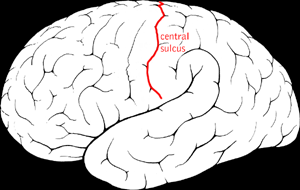
Benign Rolandic epilepsy or self-limited epilepsy with centrotemporal spikes (formerly benign childhood epilepsy with centrotemporal spikes (BECTS)) is the most common epilepsy syndrome in childhood. Most children will outgrow the syndrome (it starts around the age of 3–13 with a peak around 8–9 years and stops around age 14–18), hence the label benign. The seizures, sometimes referred to as sylvian seizures, start around the central sulcus of the brain (also called the centrotemporal area, located around the Rolandic fissure, after Luigi Rolando).
The cardinal features of Rolandic epilepsy are infrequent, often single, focal seizures consisting of:
Hemifacial sensorimotor seizures are often entirely localized in the lower lip or spread to the ipsilateral hand. Motor manifestations are sudden, continuous or bursts of clonic contractions, usually lasting from a few seconds to a minute. Ipsilateral tonic deviation of the mouth is also common. Hemifacial sensory symptoms consist of unilateral numbness mainly in the corner of the mouth. Hemifacial seizures are often associated with an inability to speak and hypersalivation: The left side of my mouth felt numb and started jerking and pulling to the left, and I could not speak to say what was happening to me. Negative myoclonus can be observed in some cases, as an interruption of tonic muscular activity
Oropharyngolaryngeal ictal manifestations are unilateral sensorimotor symptoms inside the mouth. Numbness, and more commonly paraesthesias (tingling, prickling, freezing), are usually diffuse on one side or, exceptionally, may be highly localized even to one tooth. Motor oropharyngolaryngeal symptoms produce strange sounds, such as death rattle, gargling, grunting and guttural sounds, and combinations: In his sleep, he was making guttural noises, with his mouth pulled to the right, 'as if he was chewing his tongue'. We heard her making strange noises 'like roaring' and found her unresponsive, head raised from the pillow, eyes wide open, rivers of saliva coming out of her mouth, rigid.
Arrest of speech is a form of anarthria. The child is unable to utter a single intelligible word and attempts to communicate with gestures. My mouth opened and I could not speak. I wanted to say I cannot speak. At the same time, it was as if somebody was strangling me.
Hypersalivation, a prominent autonomic manifestation, is often associated with hemifacial seizures, oro-pharynx-laryngeal symptoms and speech arrest. Hypersalivation is not just frothing: Suddenly my mouth is full of saliva, it runs out like a river and I cannot speak.
Syncope-like epileptic seizures may occur, probably as a concurrent symptom of Panayiotopoulos syndrome: She lies there, unconscious with no movements, no convulsions, like a waxwork, no life.
Consciousness and recollection are fully retained in more than half (58%) of Rolandic seizures. I felt that air was forced into my mouth, I could not speak and I could not close my mouth. I could understand well everything said to me. Other times I feel that there is food in my mouth and there is also a lot of salivation. I cannot speak. In the remainder (42%), consciousness becomes impaired during the ictal progress, and in one-third, there is no recollection of ictal events.
Hub AI
Rolandic epilepsy AI simulator
(@Rolandic epilepsy_simulator)
Rolandic epilepsy
Benign Rolandic epilepsy or self-limited epilepsy with centrotemporal spikes (formerly benign childhood epilepsy with centrotemporal spikes (BECTS)) is the most common epilepsy syndrome in childhood. Most children will outgrow the syndrome (it starts around the age of 3–13 with a peak around 8–9 years and stops around age 14–18), hence the label benign. The seizures, sometimes referred to as sylvian seizures, start around the central sulcus of the brain (also called the centrotemporal area, located around the Rolandic fissure, after Luigi Rolando).
The cardinal features of Rolandic epilepsy are infrequent, often single, focal seizures consisting of:
Hemifacial sensorimotor seizures are often entirely localized in the lower lip or spread to the ipsilateral hand. Motor manifestations are sudden, continuous or bursts of clonic contractions, usually lasting from a few seconds to a minute. Ipsilateral tonic deviation of the mouth is also common. Hemifacial sensory symptoms consist of unilateral numbness mainly in the corner of the mouth. Hemifacial seizures are often associated with an inability to speak and hypersalivation: The left side of my mouth felt numb and started jerking and pulling to the left, and I could not speak to say what was happening to me. Negative myoclonus can be observed in some cases, as an interruption of tonic muscular activity
Oropharyngolaryngeal ictal manifestations are unilateral sensorimotor symptoms inside the mouth. Numbness, and more commonly paraesthesias (tingling, prickling, freezing), are usually diffuse on one side or, exceptionally, may be highly localized even to one tooth. Motor oropharyngolaryngeal symptoms produce strange sounds, such as death rattle, gargling, grunting and guttural sounds, and combinations: In his sleep, he was making guttural noises, with his mouth pulled to the right, 'as if he was chewing his tongue'. We heard her making strange noises 'like roaring' and found her unresponsive, head raised from the pillow, eyes wide open, rivers of saliva coming out of her mouth, rigid.
Arrest of speech is a form of anarthria. The child is unable to utter a single intelligible word and attempts to communicate with gestures. My mouth opened and I could not speak. I wanted to say I cannot speak. At the same time, it was as if somebody was strangling me.
Hypersalivation, a prominent autonomic manifestation, is often associated with hemifacial seizures, oro-pharynx-laryngeal symptoms and speech arrest. Hypersalivation is not just frothing: Suddenly my mouth is full of saliva, it runs out like a river and I cannot speak.
Syncope-like epileptic seizures may occur, probably as a concurrent symptom of Panayiotopoulos syndrome: She lies there, unconscious with no movements, no convulsions, like a waxwork, no life.
Consciousness and recollection are fully retained in more than half (58%) of Rolandic seizures. I felt that air was forced into my mouth, I could not speak and I could not close my mouth. I could understand well everything said to me. Other times I feel that there is food in my mouth and there is also a lot of salivation. I cannot speak. In the remainder (42%), consciousness becomes impaired during the ictal progress, and in one-third, there is no recollection of ictal events.