Hubbry Logo
Rolling shutterRolling shutterMain
Open search
Rolling shutter
Community hub
Rolling shutter
logo
8 pages, 0 posts
0 subscribers
Be the first to start a discussion here.
Rolling shutter
Rolling shutter
from Wikipedia
Animation showing the rolling shutter effect
A de Havilland Canada Dash 8 Q-400 six-blade propeller, with severe rolling-shutter distortion from a Pixel 3 camera
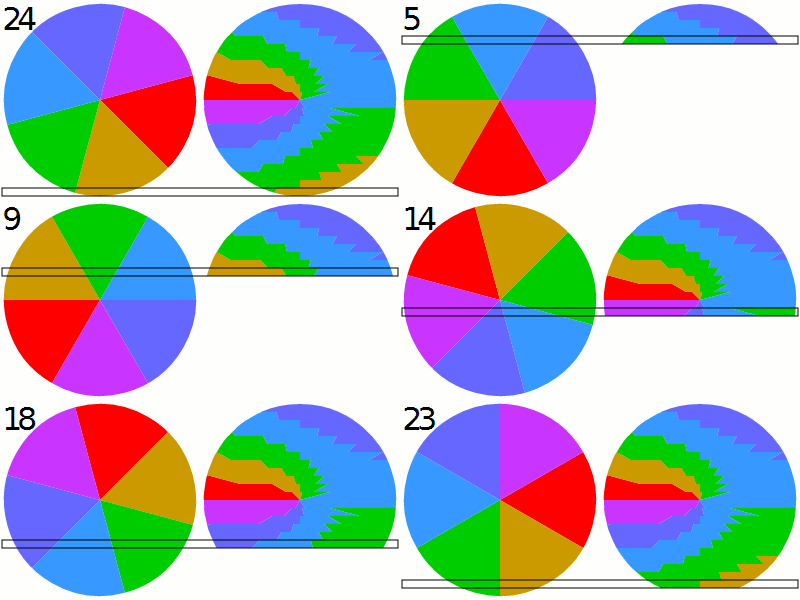
Simulation of the rolling-shutter effect on a rotating propeller and a moving car
(click for SMIL animation)

Rolling shutter is a process of image capture in which a still picture (in a still camera) or each frame of a video (in a video camera) is captured not by taking a snapshot of the entire scene at a single instant in time but rather by scanning across the scene rapidly, vertically, horizontally or rotationally. Thus, not all parts of the image of the scene are recorded at the same instant – however, during playback, the entire image of the scene is displayed at once, as if it represents a single instant in time. This produces predictable distortions of fast-moving objects or rapid flashes of light, referred to as rolling shutter effect. This process in contrast with global shutter in which the entire frame is captured at the same instant.

The rolling shutter can be either mechanical or electronic.[1][2] The advantage of this electronic rolling shutter is that the image sensor can continue to gather photons during the acquisition process, thus effectively increasing sensitivity. It is found on many digital still and video cameras using CMOS sensors. The effect is most noticeable when imaging extreme conditions of motion or the fast flashing of light. While some CMOS sensors use a global shutter,[3] the majority found in the consumer market use a rolling shutter.

CCDs (charge-coupled devices) are alternatives to CMOS sensors, which are generally more sensitive and more expensive.[citation needed] CCD-based cameras often use global shutters, which take a snapshot representing a “relative” single instant in time and therefore do not suffer from the motion artifacts caused by rolling shutters.[4]

Distortion effects

[edit]

Rolling shutters can cause such effects as:[5]

  • Wobble. This phenomenon (also known as the jello effect) appears when the camera is vibrating, in situations such as hand-held shots at telephoto settings, or when shooting from a moving vehicle. The rolling shutter causes the image to wobble unnaturally.
  • Skew. The image bends diagonally in one direction or another as the camera or subject moves from one side to another, exposing different parts of the image at different times. Skew is a minor manifestation of the wobble phenomenon described above.
  • Spatial aliasing. Vertically adjacent pixels are sampled in violation of the sampling theorem, when the camera or object motion is too rapid. One example of this is imaging of a quickly rotating propeller. The smear of each blade is caused by the propeller rotating at the same or near the same speed that the frame is read by the camera. Viewed perpendicular to a fan spinning clockwise, the blades on the left side appear thinner than usual while the blades on the right side appear thicker, and can even appear as if they aren't connected at the center.
  • Temporal aliasing, including partial exposure. If a camera flash goes on for only part of the time of the exposure, the illumination of the flash may only be present for some rows of pixels in a given frame. For example, the top third of the picture may be brightly lit by a flash, while the bottom two-thirds of the picture is dark and unlit, as the flash was off by the time that part of the CMOS was sequenced. The difference between the two distinct parts of the frame can look odd. Similar problems can arise with fluorescent lighting, strobe effects, lightning, or any extreme situation where very fast motion or very fast bursts of light are seen in the time between when the CMOS chip sequentially records a frame.

The effects of a rolling shutter can prove difficult for visual effects filming. The process of matchmoving establishes perspective in a scene based on a single point in time, but this is difficult with a rolling shutter that provides multiple points in time within the same frame. Final results depend on the readout speed of the sensor and the nature of the scene being filmed; as a rule of thumb, higher-end cinema cameras will have faster readout speeds and therefore milder rolling shutter artifacts than low-end cameras.

Images and video that suffer from rolling shutter distortion can be improved by algorithms that do rolling shutter rectification, or rolling shutter compensation. How to do this is an active area of research.[5]

This effect can be used as a side channel attack to gain secret keys from certain smart card readers: The attacker films the power LED of the reader while the reader is performing a cryptographic operation, then analyzes the video footage to identify brief voltage fluctuations. Due to the effect of the rolling shutter, the footage will reveal fluctuations at a resolution several orders of magnitude greater than the frame rate of the video camera. With knowledge about the algorithm used and its implementation in the chip, the attacker can then derive the key. Analyzing video footage is equivalent to measuring power consumption with an oscilloscope, but less invasive.[6][7]

See also

[edit]

Notes

[edit]
[edit]
Revisions and contributorsEdit on WikipediaRead on Wikipedia
from Grokipedia
Rolling shutter is a fundamental image capture mechanism in many digital cameras and sensors, in which the exposure and readout of pixels occur sequentially row by row, typically progressing from the top of the to the bottom over a brief period. This progressive scanning means that adjacent rows of pixels are exposed at slightly different times, with the temporal offset determined by the sensor's readout speed, which can range from microseconds to milliseconds depending on the device. In contrast to global shutter technology, which exposes and reads out the entire frame simultaneously to avoid timing discrepancies, rolling shutter offers a more economical and power-efficient design suitable for consumer-grade equipment like smartphones, mirrorless cameras, and video recorders. However, this sequential process introduces potential distortions, collectively known as the rolling shutter effect, including skew (slanting of straight lines), wobble (jelly-like undulations during panning), and partial exposure issues like flash banding under flickering lights. These artifacts become pronounced in scenarios involving fast-moving subjects, rapid camera movements, or high-frequency lighting, making rolling shutter less ideal for applications such as , aerial , or scientific where precision is paramount. The origins of rolling shutter trace back to mechanical s in 19th-century film cameras, where a narrow slit in a moving curtain or blind exposed the film plane progressively to control exposure time and enable faster shutter speeds. Early designs, such as William England's 1861 crude and subsequent roller-blind variants in the 1880s, laid the groundwork for this row-wise exposure principle, which was refined in 35mm cameras like the Leica in the 1910s and 1920s. With the advent of in the late , this concept evolved into electronic rolling shutter in sensors, becoming ubiquitous in affordable devices by the due to manufacturing advantages like simplified circuitry and reduced complexity compared to global shutter implementations. Despite its drawbacks, rolling shutter remains prevalent in everyday and , with software corrections in tools increasingly mitigating its effects for professional workflows.

Fundamentals

Definition and Principles

Rolling shutter is a digital imaging technique employed in complementary metal-oxide-semiconductor (CMOS) image sensors, where the exposure and readout of pixels occur sequentially row by row across the sensor array, rather than simultaneously for the entire frame. This method contrasts with global shutter approaches, which capture all pixels at the same instant, but rolling shutter enables more economical sensor designs by simplifying the circuitry required for charge storage and transfer. The core principle of rolling shutter involves staggered exposure timing for each row of pixels, introducing small temporal offsets between the start of integration for successive rows. In a typical , the process begins with the reset and exposure of the top row, followed by sequential progression downward; as one row's charge is read out and reset, the next row initiates its exposure. This row-by-row scanning can be visualized as a vertical "wave" propagating across the , where each horizontal line of pixels accumulates light-sensitive charge during its individual integration period before transfer to the output amplifier. The inherent lag arises because pixels lack dedicated storage capacitors, necessitating immediate readout upon exposure completion, unlike (CCD) s that support parallel transfer. This sequential operation originated from the drive to produce cost-effective, low-power sensors suitable for , as the electronic rolling shutter eliminates the need for complex mechanical components found in traditional film cameras while leveraging fabrication advantages. The time delay Δt\Delta t between consecutive rows is fundamentally determined by the sensor's readout speed and , given by Δt=1fN\Delta t = \frac{1}{f \cdot N} where ff is the in frames per second and NN is the number of rows in the , illustrating the progressive temporal displacement that accumulates across the frame.

Sensor Operation

In rolling shutter sensors, primarily implemented in complementary metal-oxide-semiconductor (CMOS) image sensors, the readout process occurs sequentially row by row across the pixel array. Each row undergoes three distinct phases: reset, exposure, and readout. During the reset phase, a reset transistor in each pixel is activated to discharge the photodiode, clearing accumulated charge and setting it to a reference voltage, typically through a row decoder that selects the active row. The exposure phase follows, where the reset transistor is turned off, allowing photons to generate electron-hole pairs in the photodiode, integrating charge proportional to the incident light intensity over a defined period. In the readout phase, the accumulated charge is transferred to a sense node within the pixel, buffered by a source follower transistor to produce a voltage signal, and then passed through a row select transistor to the column output when that row is addressed. The timing of these phases propagates sequentially across the , often from top to bottom, creating a "rolling" effect where the shutter signal—encompassing reset and readout—moves like a wave through the array via vertical shift registers or row address decoders in designs. Each row's exposure window is offset from the previous one by the line time, the duration required to read out a single row, which typically ranges from 5 to 25 microseconds depending on the sensor's clock speed and resolution. This sequential scanning ensures progressive readout, where the entire image is captured line by line without interlacing, resulting in a complete frame assembled from individually timed row exposures. Key hardware components facilitate this operation in sensors. Column-parallel analog-to-digital converters (ADCs) digitize the analog voltage from each pixel in the selected row simultaneously, enabling efficient parallel processing across the sensor width. Row select transistors, controlled by the row decoder, isolate and enable the output from the active row, while the source follower provides high to minimize signal disturbance during transfer. This architecture allows for lower power consumption compared to simultaneous readout systems, as only one row is active at a time.

Comparison to Global Shutter

Technical Differences

The rolling shutter mechanism operates by sequentially exposing and reading out row by row across the , initiating the exposure process at the top row and propagating downward in a sweeping manner. In contrast, the global shutter exposes all uniformly and simultaneously, followed by a sequential readout, which relies on a dedicated storage node within each to hold the charge until the entire frame is ready for transfer. This fundamental difference in capture sequence arises from the distinct architectures of the two systems, with rolling shutter mimicking a mechanical through electronic means, while global shutter achieves a snapshot-like exposure akin to traditional interline CCD operation. Hardware variances between the two are pronounced at the level, particularly in sensors, where rolling shutter employs a simpler 4-transistor (4T) design lacking per- charge storage, enabling compact and cost-effective fabrication. Global shutter, however, necessitates additional components such as floating capacitors or dual-gate transistors—typically 5 or more transistors per —to temporarily store charge across the entire array before readout, thereby increasing manufacturing complexity, area, and overall cost. These structural demands make global shutter more challenging to implement in standard processes, often confining it to advanced variants, whereas CCD sensors inherently support global shutter through charge transfer gates and shift registers without requiring per- storage. In terms of timing architecture, rolling shutter features a where each row begins and ends exposure at slightly different times, resulting in variable integration periods across the frame—potentially offset by microseconds between adjacent rows depending on readout speed. Global shutter, by comparison, synchronizes exposure initiation and termination for all rows via a unified clock , ensuring temporal uniformity before any readout commences. This synchronized approach in global shutter demands precise control circuitry to manage charge transfer, often limiting frame rates compared to the overlapped exposure-readout efficiency of rolling shutter. Global shutter has been a staple in high-end CCD sensors since their inception due to the parallel charge handling in their architecture, while in , it emerged as an advanced feature in the alongside the broader adoption of rolling shutter in standard designs, which benefited from simpler integration into manufacturing processes. Rolling shutter's dominance in consumer and mainstream sensors stems from its alignment with cost-effective fabrication techniques that proliferated during that era, whereas global shutter implementations in required iterative advancements to overcome and storage challenges.

Performance Implications

Rolling shutter sensors exhibit temporal inconsistencies during image capture, leading to artifacts such as skew and the "jello effect" in scenes with rapid motion, as different rows are exposed and read out at slightly different times. In contrast, global shutter sensors provide uniform exposure across the entire frame, ensuring consistent temporal synchronization and superior image quality for dynamic subjects without . This makes global shutter preferable for applications requiring precise , while rolling shutter suffices for static or slow-moving scenes where such inconsistencies are minimal. In terms of speed and efficiency, rolling shutter enables higher frame rates, particularly in low-cost CMOS sensors, through its pipelined readout process that allows continuous exposure and data transfer without waiting for full-frame storage. For example, rolling shutter modes can achieve up to 100 frames per second at full resolution in scientific CMOS cameras, compared to roughly half that rate for global shutter due to the additional time needed for charge transfer and readout of the stored frame. Global shutter, while offering snapshot-like efficiency for synchronized imaging, is constrained by the sequential readout of the entire pixel array after exposure, limiting its use in high-throughput streaming scenarios. Rolling shutter designs consume less power owing to their simpler , which avoids the overhead of in-pixel charge storage capacitors required in global shutter sensors. This storage necessity in global shutter increases die size and manufacturing complexity, elevating costs—often making global shutter cameras up to 10 times more expensive than equivalent rolling shutter models for consumer and industrial use. Additionally, rolling shutter serializes data output row by row, resulting in a steady data flow that eases interface bandwidth demands compared to global shutter's requirement for high-speed parallel burst transfer of the full frame.

Historical Development

Origins and Early Implementations

Electronic sequential image capture emerged in the late and as an alternative to mechanical focal-plane shutters, enabling imaging without physical moving parts in video systems. The foundational technology for early electronic imaging was the interline transfer (CCD), proposed in 1973 by researchers L. Walsh and R. Dyck at to minimize smear artifacts and support electronic shuttering through line-by-line charge transfer. This architecture enabled simultaneous exposure of all pixels followed by line-by-line charge transfer for progressive readout, which became a standard for early electronic imaging with global exposure timing. Early implementations appeared in consumer camcorders during the , where interline transfer CCDs facilitated compact, reliable video recording. pioneered this integration with the CCD-V8 in 1985, the first 8mm to combine imaging and recording in a single handheld unit, leveraging progressive readout for affordable, portable . By the late , such devices had become staples in , driven by the need for lightweight systems without bulky mechanical components. The marked a pivotal shift from CCD to sensors, where rolling shutter readout became inherent to the design for further cost reduction and on-chip integration. Eric Fossum at NASA's invented the (APS) in CMOS technology in 1993, featuring row-sequential scanning that enabled rolling exposure and readout. contributed significantly to early CMOS development during this era, focusing on affordable sensors for consumer applications and helping transition the technology from prototypes to market-ready products. This evolution was propelled by growing demand for digital still cameras and video devices, with initial CMOS implementations appearing in models like Canon's EOS D30 in 2000. The term "rolling shutter" reflects the propagating wavefront of the exposure and readout signal in sensors, first appearing in technical discussions around the mid-1980s to mid-1990s as electronic imaging matured.

Modern Adoption

The integration of rolling shutter technology into smartphones became widespread following the 2007 launch of the , which utilized a sensor for its 2-megapixel camera, and the subsequent proliferation of Android devices in the late . This approach facilitated slimmer device designs by relying on electronic sequential readout rather than mechanical components, though it imposes limitations on high-speed due to the time required to scan the sensor line by line. By the early , nearly all consumer smartphones had adopted rolling shutter sensors, driven by their low cost and compatibility with compact form factors. In the realm of cinema and broadcast, rolling shutter gained prominence with the introduction of video recording in DSLRs, exemplified by the in 2008, which employed a full-frame sensor for footage and sparked a shift toward hybrid stills-video workflows. This camera's adoption marked a turning point, enabling filmmakers to leverage affordable full-frame imaging for professional video, and rolling shutter subsequently became the standard in mirrorless systems supporting 4K and 8K resolutions, primarily due to its economic advantages over more complex global shutter implementations. By the 2020s, rolling shutter had established dominance in consumer cameras, comprising the vast majority of devices owing to its balance of performance and affordability, while professional markets continued to favor it for high-resolution video absent extreme motion requirements. A key advancement during this period was the shift toward stacked sensors, pioneered by in the early 2010s, which incorporate high-speed DRAM layers to accelerate readout rates—up to 20 times faster than traditional designs—thereby reducing readout times and minimizing distortion in dynamic scenes. The from 2020 to 2022 further propelled adoption, as surging demand for remote video conferencing led to widespread shortages of webcams and integrated cameras, most of which rely on rolling shutter sensors for their compact, cost-effective operation.

Distortion Effects

Types of Artifacts

Rolling shutter artifacts are broadly classified into geometric distortions, which alter the spatial structure of the image, and photometric distortions, which affect light intensity uniformity. These categories encompass the primary visual anomalies observed in footage captured by rolling shutter sensors. Geometric artifacts include skew and wobble. Skew manifests as the apparent tilting or leaning of straight lines, particularly vertical ones, resulting in warped perspectives such as buildings that appear slanted. Wobble, often termed the jello effect, produces undulating or jelly-like deformations across the image, where stable elements seem to ripple unnaturally. Photometric artifacts comprise flash banding and partial imaging (also known as smear). Flash banding appears as alternating horizontal bands of brighter and darker regions, creating striped patterns in areas illuminated by intermittent light sources. Partial imaging or smear causes vertical lines or edges to exhibit slanted, wavy, or blurred appearances, with uneven intensity gradients along the direction of scan. These artifacts are most pronounced under conditions of slow readout speeds or rapid motion, amplifying distortions in dynamic scenes. The nomenclature "rolling shutter effect" encompasses these phenomena collectively and gained popularity in the through widespread online video demonstrations of the jello effect in recordings.

Causes and Visual Examples

The rolling shutter distortion arises primarily from the sequential exposure and readout of sensor rows, which introduces temporal misalignment when capturing fast-moving subjects or during camera motion. As each row is exposed at slightly different times, with a row delay Δt\Delta t typically on the order of microseconds to milliseconds depending on the sensor design, any relative motion between the camera and scene during this interval causes spatial offsets in the captured image. This effect is particularly pronounced in translational or rotational movements, leading to geometric warping. For instance, in the case of camera panning, the skew angle θ\theta can be approximated as θωΔt\theta \approx \omega \Delta t, where ω\omega is the angular velocity and Δt\Delta t is the total readout time across all rows; this formula derives from the rotational displacement projected onto the image plane during the readout process. Variations in light intensity over time exacerbate distortions, especially with pulsed illumination sources that do not align with the row exposure timing. Pulsed lights, such as those using pulse-width modulation (PWM) in LEDs, flicker at high frequencies (e.g., 100–1000 Hz), creating uneven exposure across rows if the flicker cycle overlaps with the rolling readout. This interaction results in banding artifacts, where alternating bright and dark horizontal stripes appear due to rows capturing peak or trough phases of the light pulse. A common scenario is video footage from a moving vehicle under LED traffic lights, where the lights manifest as flickering stripes synchronized with the readout scan, as the relative motion and changing distances amplify the temporal mismatch. Illustrative examples highlight these causes in practice. When panning a camera across a rotating , the sequential row exposures capture the blades at incrementally different angular positions, producing a wobbling or warped appearance as if the propeller is bending unnaturally. In smartphone , rapid camera shakes—such as during handheld walking—induce the "jello effect," where vertical vibrations cause wavy undulations in the frame because upper and lower rows experience the motion offset by Δt\Delta t. Similarly, high-speed sports footage, like a tennis serve or sprinting athlete, often shows subjects leaning or stretching diagonally, as the body's rapid lateral motion displaces features across the image during the vertical readout scan. These artifacts intensify with longer exposure times, which compound motion blur atop the temporal misalignment, or slower readout speeds, where Δt\Delta t increases— for example, full HD video at 30 fps may have a Δt\Delta t of 16–33 ms, versus under 8 ms for 4K at 60 fps, amplifying skew in dynamic scenes.

Applications and Uses

Consumer Electronics

Rolling shutter technology has been integral to since the early days of cameras, enabling compact and cost-effective imaging solutions. The first , released in 2007, utilized a with rolling shutter, marking the standard for devices and paving the way for similar implementations in Android shortly thereafter. This approach prioritized slim designs and low power consumption, allowing for the integration of cameras into everyday mobile devices without the bulk or expense of global shutter alternatives. By 2025, the overwhelming majority of cameras continue to employ rolling shutter, as evidenced by the dominance of sensors in the market, which facilitate features like high-resolution stills and slow-motion video despite occasional distortions. In casual video recording, rolling shutter's line-by-line exposure can produce noticeable "" effects, such as wobbling or skewing in captured during walking shots or panning movements, which is common in user-generated content on . These artifacts arise from the sensor's sequential readout, but they are often mitigated through higher frame rates or software stabilization in modern apps, making rolling shutter suitable for the accessibility-driven demands of consumer . Action cameras like those from and consumer drones, such as models, also rely heavily on rolling shutter to achieve lightweight, wide-angle designs ideal for dynamic outdoor activities. 's Hero series, for instance, uses rolling shutter sensors to capture immersive footage during sports or adventures, where the priority on portability and battery life outweighs the need for distortion-free imaging in every scenario. In drones, this technology supports aerial for hobbyists, though it can introduce jello-like vibrations in propeller-heavy shots, emphasizing the trade-off for affordable, compact hardware in prosumer applications. Webcams integrated into laptops and external USB models for video calls predominantly feature rolling shutter sensors, driven by the need for low-cost production in the consumer market. These sensors enable seamless integration into devices for and streaming, but artifacts become apparent in dynamic presentations, such as when waving hands or moving quickly across the frame, resulting in subtle skewing during Zoom or Teams sessions. By prioritizing affordability and simplicity, rolling shutter remains the go-to choice for the vast majority of these everyday communication tools.

Professional Imaging

In professional cinema production, rolling shutter has been widely adopted in cameras like the series, introduced in the 2010s, enabling cost-effective capture of footage due to the more affordable sensor technology compared to global shutter alternatives. These models utilize electronic rolling shutter mechanisms, which provide sufficient performance for high-quality imaging while keeping production costs lower for mid-range projects. Directors often mitigate the risks of wobble artifacts—exacerbated by camera shake in dynamic scenes—by employing steady rigs such as gimbals or dollies to maintain controlled movements and minimize distortion during handheld or panning shots. In broadcast television, particularly for (ENG) cameras used in live sports coverage, rolling shutter remains a standard feature in many shoulder-mounted systems, offering a balance of portability and image quality for fast-paced environments. Faster readout variants of these sensors are specifically designed to reduce banding artifacts under variable lighting conditions, such as the flickering lights common in sports venues, where LED illumination can interact with the sequential scan to produce visible horizontal bands if the readout speed is insufficient. This approach allows broadcasters to capture high-frame-rate footage for events like football or track meets without the higher cost of global shutter hardware, though it requires careful lighting management and adjustments to ensure seamless on-air quality. Scientific applications leverage rolling shutter in machine vision and astronomy for scenarios involving static or low-motion scenes, where its higher light sensitivity and lower cost provide advantages over global shutter without significant distortion. In machine vision systems, such as industrial inspection of stationary objects, rolling shutter excels by delivering clear images with enhanced dynamic range for detailed analysis. Similarly, in astronomy, rolling shutter-equipped star trackers are used for attitude determination in satellites, though the effect requires algorithmic correction to maintain accuracy in exposure timing. However, it is generally avoided in high-speed tracking applications, such as particle image velocimetry (PIV) for fluid dynamics research, where the row-by-row exposure distorts velocity measurements of rapidly moving particles, necessitating global shutter for precise temporal synchronization. In the , advancements in cinema camera design have introduced hybrid architectures capable of blending rolling and global shutter modes, exemplified by like Nikon's patented dual-mode , allowing filmmakers to switch configurations for optimal performance in budget indie productions where rolling shutter suffices for controlled scenes.

Mitigation Strategies

Hardware Approaches

Hardware approaches to mitigating rolling shutter distortions primarily involve architectural innovations in image sensors that accelerate the readout process or synchronize exposure timing across pixels, thereby reducing the time differential () between row exposures. Stacked sensor designs, such as Sony's Exmor RS introduced in 2012, integrate a backside-illuminated (BSI) layer with an underlying logic circuit layer containing (DRAM) for buffering. This configuration enables readout speeds up to 20 times faster than conventional front-side illuminated sensors by allowing parallel and high-bandwidth data transfer, significantly minimizing and associated skew in fast-motion scenarios. The use of (Cu) interconnects in these post-2010 architectures further enhances signal propagation speed and reduces resistance compared to aluminum wiring, contributing to thinner dielectric stacks and improved overall readout efficiency. Bidirectional scanning represents another hardware strategy employed in select sensors to halve the effective readout delay. In this approach, the sensor alternates the scan direction—reading rows from top-to-bottom in one frame and bottom-to-top in the next—effectively distributing the temporal offset across frames and reducing geometric distortions like wobble in dynamic scenes. This mechanism is implemented at the pixel array level without additional storage overhead, making it suitable for consumer-grade chips where full global shutter is impractical. Hybrid implementations combine elements of rolling and global shutter operations to approximate uniform exposure. Global Reset Release (GRR) mode, a variant of rolling shutter, simultaneously resets all rows at the frame start to align exposure beginnings, followed by sequential readout; this reduces banding and partial exposure artifacts while maintaining the power efficiency of rolling designs. Multi-row parallel readout further enhances this by processing several rows concurrently through column-parallel analog-to-digital converters, scaling readout speed with pixel count and enabling higher frame rates in sensors like those used in industrial applications. Compared to pure global shutter pixels, which incorporate on-chip charge storage and additional transistors leading to increased size, optimized rolling shutter variants with Cu interconnects achieve line readout times as low as 10 microseconds, supporting 30 fps video with minimal in full-frame s. These advancements prioritize compact, cost-effective hardware solutions for reducing inherent rolling shutter effects at the level.

Software Corrections

Software corrections for rolling shutter artifacts primarily involve post-production algorithms that analyze and remap video frames to simulate global shutter capture, without requiring hardware modifications. These techniques leverage computational methods to estimate motion distortions and reconstruct undistorted images or sequences, enabling seamless integration into digital workflows such as . De-warping algorithms form a core approach, using estimation to track pixel displacements across frames and remap skewed geometry back to a rectified state. For instance, one seminal method models camera motion as a temporal super-resolution problem, employing frame-to-frame to infer high-frequency and re-render the video as if captured simultaneously across the . This technique effectively removes wobble artifacts in footage from accelerated or jittery cameras. Another influential implementation fuses data with for unified correction, automatically calibrating parameters to warp frames in real-time, achieving robust results even in low-light conditions. Commercial tools like ' Rolling Shutter Repair effect, introduced in version CS6 in , apply similar de-warping principles with user-selectable algorithms to straighten skewed lines and reduce distortions in DSLR footage. Banding removal addresses flash-induced artifacts, where uneven illumination creates horizontal stripes due to the rolling scan timing. Temporal interpolation techniques mitigate this by blending exposure data from adjacent frames to estimate and apply uniform lighting across the distorted frame. For strobe-like white bands from flashes, algorithms detect the anomaly and interpolate values to eliminate the visible shear while preserving motion details. In the , AI-based models have advanced these corrections, particularly for complex distortions. Neural networks, such as the Deep Shutter Unrolling Network, process consecutive frames end-to-end to predict and correct rolling shutter effects, outperforming traditional methods in accuracy and speed. More recent diffusion models enable single-frame corrections by generating motion fields from noisy inputs conditioned on the distorted image, achieving state-of-the-art metrics like 34.92 dB PSNR on benchmark datasets. As of 2025, multi-frame diffusion models further improve video rectification by handling temporal consistency across sequences. These models predict uniform exposure for banding while remapping geometry, making them suitable for real-world videos. Stabilization software often incorporates gyroscope fusion to counter wobble, using embedded sensor metadata to drive precise frame adjustments. Open-source tools like exemplify this, integrating gyro data from smartphones to perform rolling shutter corrections alongside stabilization, supporting mobile logging apps for on-device processing and significantly reducing jello effects in .

References

Add your contribution
Related Hubs
User Avatar
No comments yet.