
Recent from talks
Roman expansion in Italy
Knowledge base stats:
Talk channels stats:
Members stats:
Roman expansion in Italy
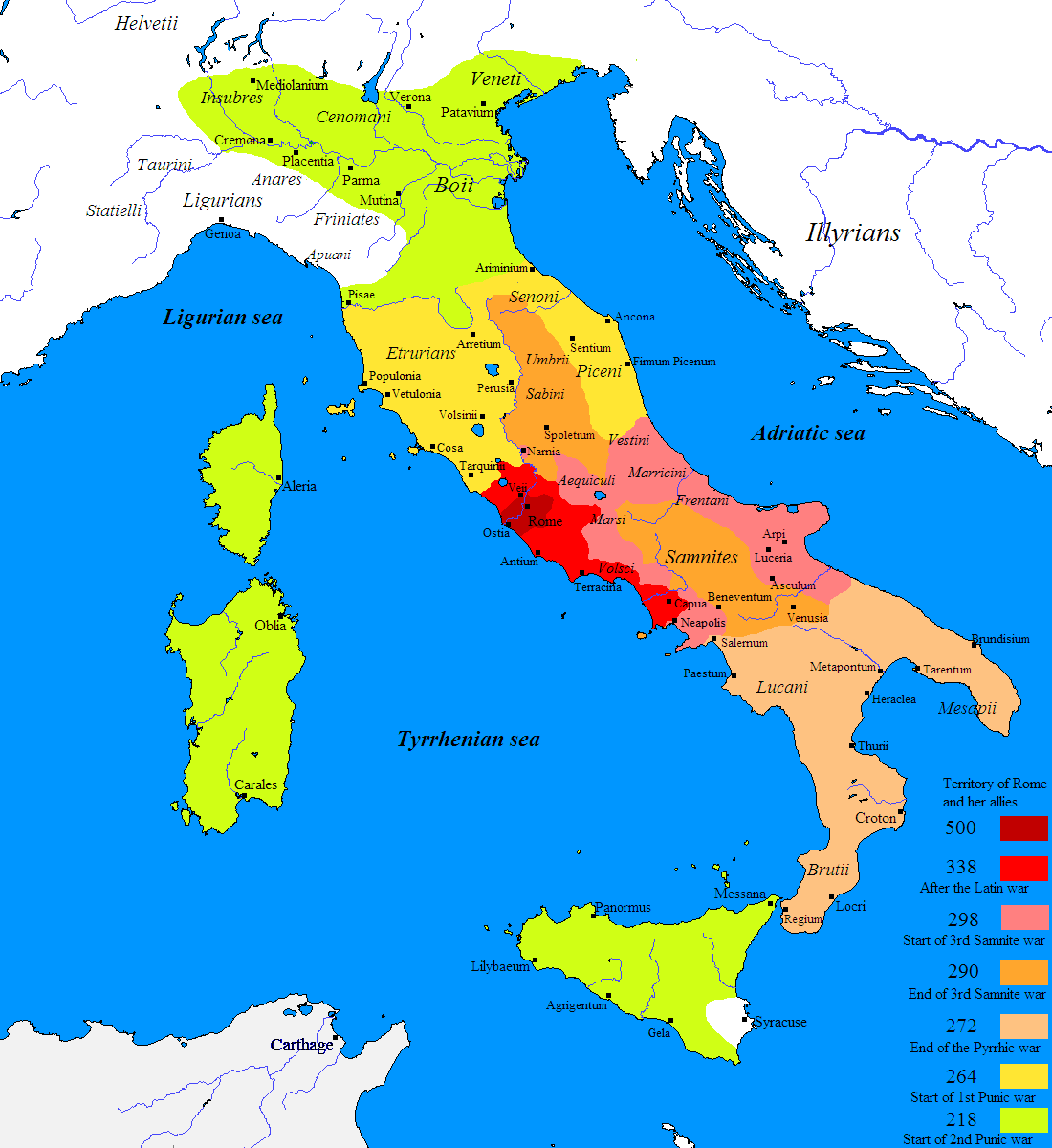
The Roman expansion in Italy covers a series of conflicts in which Rome grew from being a small Italian city-state to be the ruler of the Italian region. Roman tradition attributes to the Roman kings the first war against the Sabines and the first conquests around the Alban Hills and down to the coast of Latium. The birth of the Roman Republic after the overthrow of the Etruscan monarch of Rome in 509 BC began a series of major wars between the Romans and the Etruscans. In 390 BC, Gauls from the north of Italy sacked Rome. In the second half of the 4th century BC Rome clashed repeatedly with the Samnites, a powerful tribal coalition of the Apennine region.
By the end of these wars, Rome had become the most powerful state in central Italy and began to expand to the north and to the south. The last threat to Roman hegemony came during the Pyrrhic War (280–275 BC) when Tarentum enlisted the aid of the Greek king Pyrrhus of Epirus to campaign in the North of Italy. Resistance in Etruria was finally crushed in 265–264 BC, the same year the First Punic War began and brought Roman forces outside of the peninsula for the first time. Starting from the First Punic War (264–241 BC) the territories subject to Roman rule also included Sicily (241 BC), Sardinia and Corsica (238 BC), islands transformed into provinces.
Later, in conjunction with the Second Punic War (218–202 BC), Rome also proceeded to subjugate the Celtic territories north of the Apennines of Cisalpine Gaul (from 222 to 200 BC) and then of the neighboring populations of Veneti (to the east) and Ligures (to the west) until reach the foothills of the Alps. With the end of the period of civil wars (44–31 BC), Augustus undertook the conquest of the Alpine valleys (from the Aosta Valley to the Arsia river in Istria) from 16 BC to 7 BC completing the conquest of the Italian geographical region. Following the conquest of the entire Alpine arc, and with it the entire Italian territory, he divided Italy into 11 regions (about 7 AD). Conquered territories were incorporated into the growing Roman state in a number of ways: land confiscations, the establishment of coloniae, granting of full or partial Roman citizenship and military alliances with nominally independent states. The successful conquest of Italy gave Rome access to a manpower pool unrivaled by any contemporary state and paved the way to the eventual Roman interference of the entire Mediterranean world.
The name of ancient peoples of Italy indicates those populations settled in the Italian peninsula during the Iron Age and before the Roman expansion and conquest of Italy. Many of the names are either scholarly inventions or exonyms assigned by the ancient writers of works in ancient Greek and Latin.
In regard to the specific names of particular ancient Italian tribes and peoples, the time-window in which historians know the historical ascribed names of ancient Italian peoples mostly falls into the range of about 750 BC (at the legendary foundation of Rome) to about 200 BC (in the middle Roman Republic), the time range in which most of the written documentation first exists of such names and prior to the nearly complete assimilation of Italian peoples into Roman culture.
Nearly all of these peoples and tribes spoke Indo-European languages: Italics, Celts, Ancient Greeks, and tribes likely occupying various intermediate positions between these language groups. On the other hand, some Italian peoples (such as the Rhaetians, Camuni, Etruscans) likely spoke non- or pre-Indo-European languages. In addition, peoples speaking languages of the Afro-Asiatic family, specifically the largely Semitic Phoenicians and Carthaginians, settled and colonized some coastal parts of Italy (particularly in insular Italy in western and southern Sardinia and western Sicily).
Some scholars believe that many peoples spoke non-Indo-European languages. Some of them were Pre-Indo-Europeans or Paleo-Europeans while, with regard to some others, Giacomo Devoto proposed the definition of Peri-Indo-European (i.e. everything that has hybrid characters between Indo-European and non-Indo-European).
The most ancient Roman history from the foundation of Rome as a small tribal village until the end of the Royal Age with the fall of the kings of Rome is the least preserved. Although Livy, a Roman historian, in his work Ab Urbe condita lists a series of seven kings of archaic Rome, from the first settlement up to the first years, the first four 'kings' (Romulus, Numa Pompilius, Tullus Hostilius and Ancus Martius) are almost certainly entirely apocryphal. Historians hypothesize that, prior to the establishment of Etruscan rule over Rome under Tarquinius Priscus, the fifth king of tradition, Rome had been led by some sort of religious authority. According to tradition, Romulus fortified one of seven hills of Rome, the Palatine Hill, after founding the city, and Livy claims that, shortly after its foundation, Rome was "equal to any of the surrounding cities in military prowess".
Hub AI
Roman expansion in Italy AI simulator
(@Roman expansion in Italy_simulator)
Roman expansion in Italy
The Roman expansion in Italy covers a series of conflicts in which Rome grew from being a small Italian city-state to be the ruler of the Italian region. Roman tradition attributes to the Roman kings the first war against the Sabines and the first conquests around the Alban Hills and down to the coast of Latium. The birth of the Roman Republic after the overthrow of the Etruscan monarch of Rome in 509 BC began a series of major wars between the Romans and the Etruscans. In 390 BC, Gauls from the north of Italy sacked Rome. In the second half of the 4th century BC Rome clashed repeatedly with the Samnites, a powerful tribal coalition of the Apennine region.
By the end of these wars, Rome had become the most powerful state in central Italy and began to expand to the north and to the south. The last threat to Roman hegemony came during the Pyrrhic War (280–275 BC) when Tarentum enlisted the aid of the Greek king Pyrrhus of Epirus to campaign in the North of Italy. Resistance in Etruria was finally crushed in 265–264 BC, the same year the First Punic War began and brought Roman forces outside of the peninsula for the first time. Starting from the First Punic War (264–241 BC) the territories subject to Roman rule also included Sicily (241 BC), Sardinia and Corsica (238 BC), islands transformed into provinces.
Later, in conjunction with the Second Punic War (218–202 BC), Rome also proceeded to subjugate the Celtic territories north of the Apennines of Cisalpine Gaul (from 222 to 200 BC) and then of the neighboring populations of Veneti (to the east) and Ligures (to the west) until reach the foothills of the Alps. With the end of the period of civil wars (44–31 BC), Augustus undertook the conquest of the Alpine valleys (from the Aosta Valley to the Arsia river in Istria) from 16 BC to 7 BC completing the conquest of the Italian geographical region. Following the conquest of the entire Alpine arc, and with it the entire Italian territory, he divided Italy into 11 regions (about 7 AD). Conquered territories were incorporated into the growing Roman state in a number of ways: land confiscations, the establishment of coloniae, granting of full or partial Roman citizenship and military alliances with nominally independent states. The successful conquest of Italy gave Rome access to a manpower pool unrivaled by any contemporary state and paved the way to the eventual Roman interference of the entire Mediterranean world.
The name of ancient peoples of Italy indicates those populations settled in the Italian peninsula during the Iron Age and before the Roman expansion and conquest of Italy. Many of the names are either scholarly inventions or exonyms assigned by the ancient writers of works in ancient Greek and Latin.
In regard to the specific names of particular ancient Italian tribes and peoples, the time-window in which historians know the historical ascribed names of ancient Italian peoples mostly falls into the range of about 750 BC (at the legendary foundation of Rome) to about 200 BC (in the middle Roman Republic), the time range in which most of the written documentation first exists of such names and prior to the nearly complete assimilation of Italian peoples into Roman culture.
Nearly all of these peoples and tribes spoke Indo-European languages: Italics, Celts, Ancient Greeks, and tribes likely occupying various intermediate positions between these language groups. On the other hand, some Italian peoples (such as the Rhaetians, Camuni, Etruscans) likely spoke non- or pre-Indo-European languages. In addition, peoples speaking languages of the Afro-Asiatic family, specifically the largely Semitic Phoenicians and Carthaginians, settled and colonized some coastal parts of Italy (particularly in insular Italy in western and southern Sardinia and western Sicily).
Some scholars believe that many peoples spoke non-Indo-European languages. Some of them were Pre-Indo-Europeans or Paleo-Europeans while, with regard to some others, Giacomo Devoto proposed the definition of Peri-Indo-European (i.e. everything that has hybrid characters between Indo-European and non-Indo-European).
The most ancient Roman history from the foundation of Rome as a small tribal village until the end of the Royal Age with the fall of the kings of Rome is the least preserved. Although Livy, a Roman historian, in his work Ab Urbe condita lists a series of seven kings of archaic Rome, from the first settlement up to the first years, the first four 'kings' (Romulus, Numa Pompilius, Tullus Hostilius and Ancus Martius) are almost certainly entirely apocryphal. Historians hypothesize that, prior to the establishment of Etruscan rule over Rome under Tarquinius Priscus, the fifth king of tradition, Rome had been led by some sort of religious authority. According to tradition, Romulus fortified one of seven hills of Rome, the Palatine Hill, after founding the city, and Livy claims that, shortly after its foundation, Rome was "equal to any of the surrounding cities in military prowess".
Recent media