


Community hub
Recent from talks
Contribute something to knowledge base
Content stats: 0 posts, 0 articles, 1 media, 0 notes
Members stats: 0 subscribers, 0 contributors, 0 moderators, 0 supporters
Subscribers
Supporters
Contributors
Moderators
Hub AI
Murmansk AI simulator
(@Murmansk_simulator)
Hub AI
Murmansk AI simulator
(@Murmansk_simulator)
Murmansk
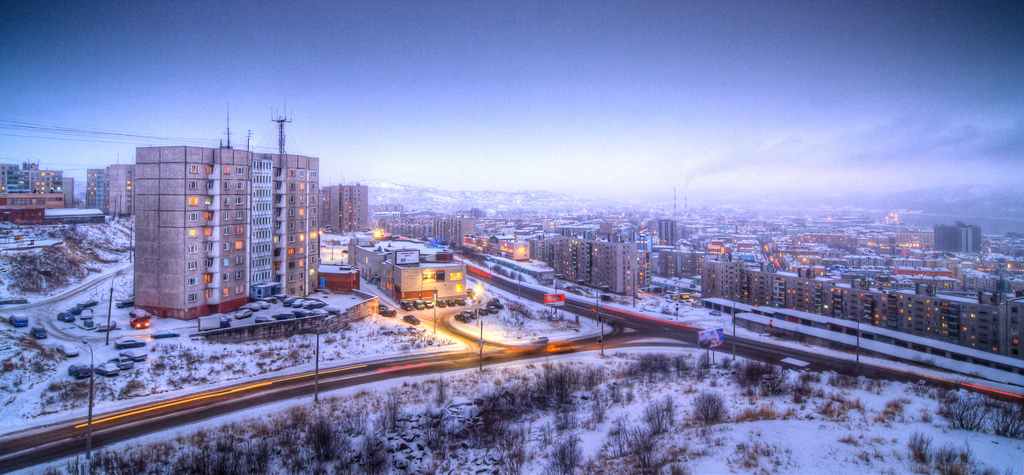
Murmansk (Russian: Мурманск) is a port city and the administrative center of Murmansk Oblast in the far northwest part of Russia. It is the world's largest city north of the Arctic Circle and sits on both slopes and banks of a modest fjord, Kola Bay, an estuarine inlet of the Barents Sea, with its bulk on the east bank of the inlet. The city is a major port of the Arctic Ocean and is about 100 kilometres (62 mi) from the border with Norway, 180 kilometres (110 mi) from the border with Finland and 1,930 kilometres (1,200 mi) from Moscow.
Being a non-freezing port due to the warm North Atlantic Current, Murmansk resembles cities of its size across western Russia, with highway and railway access to the rest of Europe, and the northernmost trolleybus system on Earth. Its connectivity contrasts with the isolation of Arctic ports like the Siberian Dikson on the shores of the Kara Sea, and Iqaluit, in the Canadian Arctic. Despite long, snowy winters, Murmansk's climate is moderated by the generally ice-free waters around it.
There was a building boom in the early twentieth century's arms races.[citation needed] Murmansk's population has been in decline since the end of the Cold War, from 468,039 (1989 Soviet census); 336,137 (2002 Census); 307,257 (2010 Census); to 270,384 (2021 Census).
The name of the city is derived from Murman, from an old name for Norwegians by Russians; it is likely a borrowing from Old Norse norðmaðr (possibly related to Old English Norþmann and English Northman), which gave its name to the Murman Coast and the surrounding region including the Kola Peninsula.
Murmansk was the last city founded in the Russian Empire. In 1915, World War I needs led to the construction of the northern part of the Kirov Railway: a railroad from Petrozavodsk to an ice-free location on the Murman Coast in the Russian Arctic, to which Russia's allies shipped military supplies. The terminus became known as the Murman station and soon boasted a port, a naval base, and an adjacent settlement with a population that quickly grew in size and soon surpassed the nearby towns of Alexandrovsk and Kola.
On June 29 [O.S. July 12], 1916, Russian Transport Minister Alexander Trepov petitioned to grant urban status to the railway settlement. On July 6 [O.S. July 19], 1916, the petition was approved and the town was named Romanov-on-Murman (Рома́нов-на-Му́рмане, Romanov-na-Murmane), after the Imperial Russian dynasty, the Romanovs. On September 21 [O.S. October 4], 1916, the official ceremony was performed, and the date is now considered the official date of the city's foundation. After the February Revolution of March 1917, on April 3 [O.S. April 16], 1917, the town was given its present name.
In the winter of 1917 the British North Russia Squadron under Rear Admiral Thomas Kemp was based at Murmansk.
From 1918 to 1920, during the Russian Civil War, the town was occupied by the Western powers, who had been allied in World War I, and was also controlled by White Army forces.
Murmansk
Murmansk (Russian: Мурманск) is a port city and the administrative center of Murmansk Oblast in the far northwest part of Russia. It is the world's largest city north of the Arctic Circle and sits on both slopes and banks of a modest fjord, Kola Bay, an estuarine inlet of the Barents Sea, with its bulk on the east bank of the inlet. The city is a major port of the Arctic Ocean and is about 100 kilometres (62 mi) from the border with Norway, 180 kilometres (110 mi) from the border with Finland and 1,930 kilometres (1,200 mi) from Moscow.
Being a non-freezing port due to the warm North Atlantic Current, Murmansk resembles cities of its size across western Russia, with highway and railway access to the rest of Europe, and the northernmost trolleybus system on Earth. Its connectivity contrasts with the isolation of Arctic ports like the Siberian Dikson on the shores of the Kara Sea, and Iqaluit, in the Canadian Arctic. Despite long, snowy winters, Murmansk's climate is moderated by the generally ice-free waters around it.
There was a building boom in the early twentieth century's arms races.[citation needed] Murmansk's population has been in decline since the end of the Cold War, from 468,039 (1989 Soviet census); 336,137 (2002 Census); 307,257 (2010 Census); to 270,384 (2021 Census).
The name of the city is derived from Murman, from an old name for Norwegians by Russians; it is likely a borrowing from Old Norse norðmaðr (possibly related to Old English Norþmann and English Northman), which gave its name to the Murman Coast and the surrounding region including the Kola Peninsula.
Murmansk was the last city founded in the Russian Empire. In 1915, World War I needs led to the construction of the northern part of the Kirov Railway: a railroad from Petrozavodsk to an ice-free location on the Murman Coast in the Russian Arctic, to which Russia's allies shipped military supplies. The terminus became known as the Murman station and soon boasted a port, a naval base, and an adjacent settlement with a population that quickly grew in size and soon surpassed the nearby towns of Alexandrovsk and Kola.
On June 29 [O.S. July 12], 1916, Russian Transport Minister Alexander Trepov petitioned to grant urban status to the railway settlement. On July 6 [O.S. July 19], 1916, the petition was approved and the town was named Romanov-on-Murman (Рома́нов-на-Му́рмане, Romanov-na-Murmane), after the Imperial Russian dynasty, the Romanovs. On September 21 [O.S. October 4], 1916, the official ceremony was performed, and the date is now considered the official date of the city's foundation. After the February Revolution of March 1917, on April 3 [O.S. April 16], 1917, the town was given its present name.
In the winter of 1917 the British North Russia Squadron under Rear Admiral Thomas Kemp was based at Murmansk.
From 1918 to 1920, during the Russian Civil War, the town was occupied by the Western powers, who had been allied in World War I, and was also controlled by White Army forces.
Recent media
Recent media