


Community hub
Recent from talks
Contribute something to knowledge base
Content stats: 0 posts, 0 articles, 1 media, 0 notes
Members stats: 0 subscribers, 0 contributors, 0 moderators, 0 supporters
Subscribers
Supporters
Contributors
Moderators
Hub AI
Rovinj AI simulator
(@Rovinj_simulator)
Hub AI
Rovinj AI simulator
(@Rovinj_simulator)
Rovinj
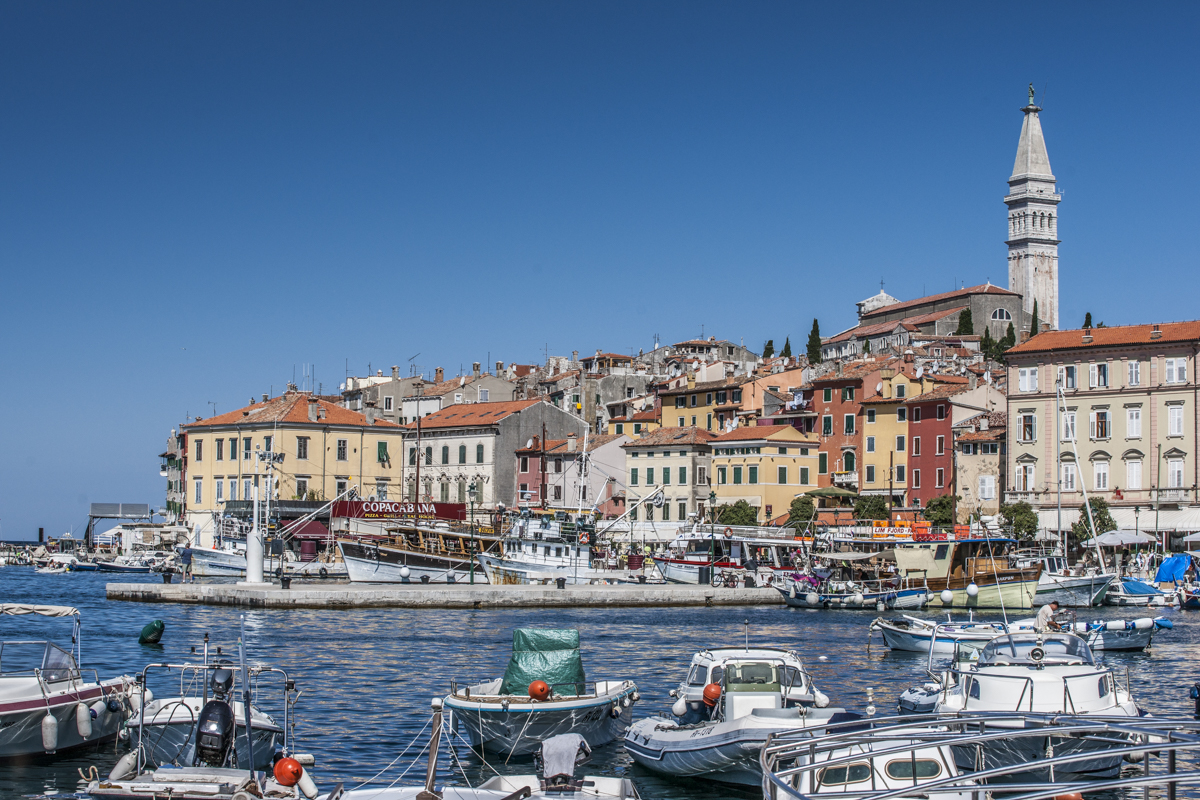
Rovinj (Croatian: [rǒviːɲ]; Venetian and Italian: Rovigno; Istriot: Ruvèigno or Ruveîgno; Ancient Greek: Ρυγίνιον, romanized: Rygínion; Latin: Ruginium) is a city in west Croatia situated on the north Adriatic Sea with a population of 14,294 (2011). Located on the western coast of the Istrian peninsula, it is a popular tourist resort and beach destination, in addition to being an active fishing port. Istriot, a Romance language once widely spoken in this part of Istria, is still spoken by some of the residents. The town is officially bilingual, Croatian and Italian, hence both town names are official and equal.
Rovinj was already a settlement of Venetian or Illyrian tribes before being captured by the Romans, who called it Arupinium or Mons Rubineus, and later Ruginium and Ruvinium.
Rovinj was eventually incorporated into the Byzantine Empire, later becoming part of the Exarchate of Ravenna in the 6th century, before being taken over by the Frankish Empire in 788. For the following several centuries it was ruled by a succession of feudal lords, and in 1209 it was acquired by the Patriarchate of Aquileia under Wolfger von Erla.
From 1283 to 1797, Rovinj was one of the most important towns in Istria governed by the Republic of Venice. During this period, three town gates were constructed and Rovinj was fortified by two rows of defensive walls, remains of which can still be seen today. The Rovinj pier is home to one of the old town gates, Balbi's Arch, dating from 1680, and a late-Renaissance clock tower. The first city statute was proclaimed in 1531.
Rovinj, built on an island close to the coast, became connected to the mainland by filling in the channel only in 1763.
Following the fall of Venice in 1797 and the ensuing Napoleonic interlude, Rovinj became part of the Austrian Empire, which lasted until World War I. According to the last Austrian census in 1911, 97.8% of the population was Italian-speaking. Rovinj then belonged to Kingdom of Italy from 1918 to 1947, when it was ceded to SFR Yugoslavia, as part of SR Croatia. The original town name "Rovigno" was then changed to "Rovinj". During the post-war period, many Italian inhabitants left Rovigno, leading to significant changes in the city's demographic structure.
Following Croatia's independence in 1991, Rovinj became one of the most important centers of Istria County, an administrative unit encompassing most of Istria. Rovinj is today the third most populous town in the county, behind Pula and Poreč.
Rovinj is one of nine settlements officially designated as towns in Istria County in western Croatia. It has a humid subtropical climate (Köppen: Cfa), with an average temperature of 4.8 °C (40.6 °F) in January and 22.3 °C (72.1 °F) in July. The average annual temperature is 13.4 °C (56.1 °F). The sea temperature is more than 20 °C (68 °F) from the mid-June to September. The average annual sea temperature is 16.6 °C (61.9 °F). The average annual insolation is 2,437 hours, which means 134 sunny days a year. Rovinj is the 3rd sunniest city, hence city with the fewest cloudy days on the Adriatic.
Rovinj
Rovinj (Croatian: [rǒviːɲ]; Venetian and Italian: Rovigno; Istriot: Ruvèigno or Ruveîgno; Ancient Greek: Ρυγίνιον, romanized: Rygínion; Latin: Ruginium) is a city in west Croatia situated on the north Adriatic Sea with a population of 14,294 (2011). Located on the western coast of the Istrian peninsula, it is a popular tourist resort and beach destination, in addition to being an active fishing port. Istriot, a Romance language once widely spoken in this part of Istria, is still spoken by some of the residents. The town is officially bilingual, Croatian and Italian, hence both town names are official and equal.
Rovinj was already a settlement of Venetian or Illyrian tribes before being captured by the Romans, who called it Arupinium or Mons Rubineus, and later Ruginium and Ruvinium.
Rovinj was eventually incorporated into the Byzantine Empire, later becoming part of the Exarchate of Ravenna in the 6th century, before being taken over by the Frankish Empire in 788. For the following several centuries it was ruled by a succession of feudal lords, and in 1209 it was acquired by the Patriarchate of Aquileia under Wolfger von Erla.
From 1283 to 1797, Rovinj was one of the most important towns in Istria governed by the Republic of Venice. During this period, three town gates were constructed and Rovinj was fortified by two rows of defensive walls, remains of which can still be seen today. The Rovinj pier is home to one of the old town gates, Balbi's Arch, dating from 1680, and a late-Renaissance clock tower. The first city statute was proclaimed in 1531.
Rovinj, built on an island close to the coast, became connected to the mainland by filling in the channel only in 1763.
Following the fall of Venice in 1797 and the ensuing Napoleonic interlude, Rovinj became part of the Austrian Empire, which lasted until World War I. According to the last Austrian census in 1911, 97.8% of the population was Italian-speaking. Rovinj then belonged to Kingdom of Italy from 1918 to 1947, when it was ceded to SFR Yugoslavia, as part of SR Croatia. The original town name "Rovigno" was then changed to "Rovinj". During the post-war period, many Italian inhabitants left Rovigno, leading to significant changes in the city's demographic structure.
Following Croatia's independence in 1991, Rovinj became one of the most important centers of Istria County, an administrative unit encompassing most of Istria. Rovinj is today the third most populous town in the county, behind Pula and Poreč.
Rovinj is one of nine settlements officially designated as towns in Istria County in western Croatia. It has a humid subtropical climate (Köppen: Cfa), with an average temperature of 4.8 °C (40.6 °F) in January and 22.3 °C (72.1 °F) in July. The average annual temperature is 13.4 °C (56.1 °F). The sea temperature is more than 20 °C (68 °F) from the mid-June to September. The average annual sea temperature is 16.6 °C (61.9 °F). The average annual insolation is 2,437 hours, which means 134 sunny days a year. Rovinj is the 3rd sunniest city, hence city with the fewest cloudy days on the Adriatic.
Recent media
Recent media