
Recent from talks
Ruhr pocket
Knowledge base stats:
Talk channels stats:
Members stats:
Ruhr pocket
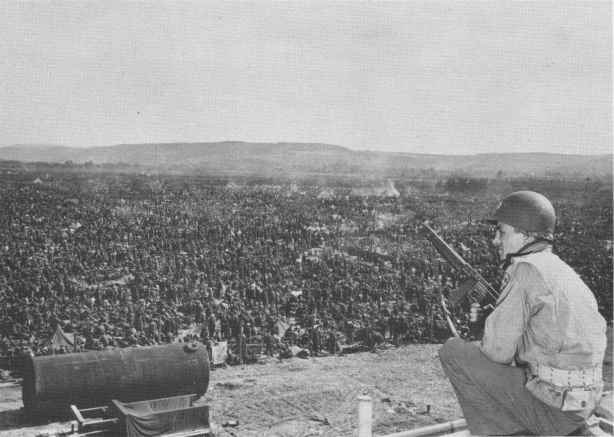
The Ruhr pocket was a battle of encirclement that took place in April 1945, on the Western Front near the end of World War II in Europe, in the Ruhr Area of Germany. Some 317,000 German troops were taken prisoner along with 24 generals. The Americans suffered 10,000 casualties including 2,000 killed or missing.
Exploiting the capture of the Ludendorff Bridge at Remagen on 7 March 1945, the U.S. 12th Army Group (General Omar Bradley) advanced rapidly into German territory south of Army Group B (Generalfeldmarschall (field marshal) Walter Model). In the north, the Allied 21st Army Group (Field Marshal Bernard Montgomery) crossed the Rhine in Operation Plunder on 23 March. The lead elements of the two Allied army groups met on 1 April 1945, east of the Ruhr, to create the encirclement of 317,000 German troops to their west.
While the bulk of the U.S. forces advanced east towards the Elbe river, 18 U.S. divisions remained behind to destroy Army Group B. The reduction of the German pocket began on 1 April by the U.S. Ninth Army, with the forces of the U.S. First Army joining on 4 April. For 13 days the Germans delayed or resisted the U.S. advance. On 14 April, the First and Ninth armies met, splitting the German pocket in half, and German resistance began to crumble.
Having lost contact with its units, the German 15th Army capitulated the same day. Model dissolved his army group on 15 April and ordered the Volkssturm and non-combatant personnel to discard their uniforms and go home. On 16 April the bulk of the German forces surrendered en masse to the U.S. divisions. Organized resistance came to an end on 18 April. Unwilling to surrender with his rank of field marshal into Allied captivity, Model committed suicide on the afternoon of 21 April.
After D-Day in June 1944, the Allies began pushing east toward Germany. In March 1945, the Allies crossed the River Rhine. South of the Ruhr, the U.S. 12th Army Group (General Omar Nelson Bradley) pursued the disintegrating German armies and captured the Ludendorff Bridge across the Rhine at Remagen with the 9th Armored Division (U.S. First Army). Bradley and his subordinates quickly exploited the crossing made on 7 March 1945 and expanded the bridgehead until the bridge collapsed 10 days later.
North of the Ruhr on 23 March 1945, the British Empire 21st Army Group (Field Marshal Sir Bernard Montgomery), which incorporated the US Ninth Army, launched Operation Plunder (with the airborne Operation Varsity in support) crossing the Rhine at Rees and Wesel.
The Ruhr was one of the Third Reich’s last major industrial centers, housing the vast Krupp steelworks. Despite the increasingly desperate military situation, the region was defended by two German armies—the 5th Panzer and the 15th Army. The latter was in the process of being redeployed to contain the American bridgehead across the Rhine during the Battle of Remagen. Both formations were still capable of inflicting heavy losses in the event of a direct assault. Allied planners had long intended to seize the Ruhr, even before D-Day, but recognized that fighting through the densely populated urban and industrial region—home to millions—could, in the words of military historian Robert M. Citino, “easily turn into a super Stalingrad.” As a result, Supreme Commander Eisenhower’s strategy had always been to encircle the Ruhr rather than attack it head-on.
During March 1945, Field Marshal Albert Kesselring was appointed the supreme commander of the Western Front. By this stage of the war, German losses were mounting rapidly, and replacement rates failed to keep pace. Increasingly, the order of battle was composed of second-rate Volksgrenadier units and third-rate Volkssturm militia. In the Ruhr, Allied forces primarily faced the remnants of a shattered Wehrmacht, supplemented by SS training units, Volkssturm militia composed of aging men—including World War I veterans—Hitlerjugend units with boys as young as twelve, combat service support personnel, and Luftwaffe crews operating flak guns.
Hub AI
Ruhr pocket AI simulator
(@Ruhr pocket_simulator)
Ruhr pocket
The Ruhr pocket was a battle of encirclement that took place in April 1945, on the Western Front near the end of World War II in Europe, in the Ruhr Area of Germany. Some 317,000 German troops were taken prisoner along with 24 generals. The Americans suffered 10,000 casualties including 2,000 killed or missing.
Exploiting the capture of the Ludendorff Bridge at Remagen on 7 March 1945, the U.S. 12th Army Group (General Omar Bradley) advanced rapidly into German territory south of Army Group B (Generalfeldmarschall (field marshal) Walter Model). In the north, the Allied 21st Army Group (Field Marshal Bernard Montgomery) crossed the Rhine in Operation Plunder on 23 March. The lead elements of the two Allied army groups met on 1 April 1945, east of the Ruhr, to create the encirclement of 317,000 German troops to their west.
While the bulk of the U.S. forces advanced east towards the Elbe river, 18 U.S. divisions remained behind to destroy Army Group B. The reduction of the German pocket began on 1 April by the U.S. Ninth Army, with the forces of the U.S. First Army joining on 4 April. For 13 days the Germans delayed or resisted the U.S. advance. On 14 April, the First and Ninth armies met, splitting the German pocket in half, and German resistance began to crumble.
Having lost contact with its units, the German 15th Army capitulated the same day. Model dissolved his army group on 15 April and ordered the Volkssturm and non-combatant personnel to discard their uniforms and go home. On 16 April the bulk of the German forces surrendered en masse to the U.S. divisions. Organized resistance came to an end on 18 April. Unwilling to surrender with his rank of field marshal into Allied captivity, Model committed suicide on the afternoon of 21 April.
After D-Day in June 1944, the Allies began pushing east toward Germany. In March 1945, the Allies crossed the River Rhine. South of the Ruhr, the U.S. 12th Army Group (General Omar Nelson Bradley) pursued the disintegrating German armies and captured the Ludendorff Bridge across the Rhine at Remagen with the 9th Armored Division (U.S. First Army). Bradley and his subordinates quickly exploited the crossing made on 7 March 1945 and expanded the bridgehead until the bridge collapsed 10 days later.
North of the Ruhr on 23 March 1945, the British Empire 21st Army Group (Field Marshal Sir Bernard Montgomery), which incorporated the US Ninth Army, launched Operation Plunder (with the airborne Operation Varsity in support) crossing the Rhine at Rees and Wesel.
The Ruhr was one of the Third Reich’s last major industrial centers, housing the vast Krupp steelworks. Despite the increasingly desperate military situation, the region was defended by two German armies—the 5th Panzer and the 15th Army. The latter was in the process of being redeployed to contain the American bridgehead across the Rhine during the Battle of Remagen. Both formations were still capable of inflicting heavy losses in the event of a direct assault. Allied planners had long intended to seize the Ruhr, even before D-Day, but recognized that fighting through the densely populated urban and industrial region—home to millions—could, in the words of military historian Robert M. Citino, “easily turn into a super Stalingrad.” As a result, Supreme Commander Eisenhower’s strategy had always been to encircle the Ruhr rather than attack it head-on.
During March 1945, Field Marshal Albert Kesselring was appointed the supreme commander of the Western Front. By this stage of the war, German losses were mounting rapidly, and replacement rates failed to keep pace. Increasingly, the order of battle was composed of second-rate Volksgrenadier units and third-rate Volkssturm militia. In the Ruhr, Allied forces primarily faced the remnants of a shattered Wehrmacht, supplemented by SS training units, Volkssturm militia composed of aging men—including World War I veterans—Hitlerjugend units with boys as young as twelve, combat service support personnel, and Luftwaffe crews operating flak guns.
Recent media