Recent from talks
Nothing was collected or created yet.
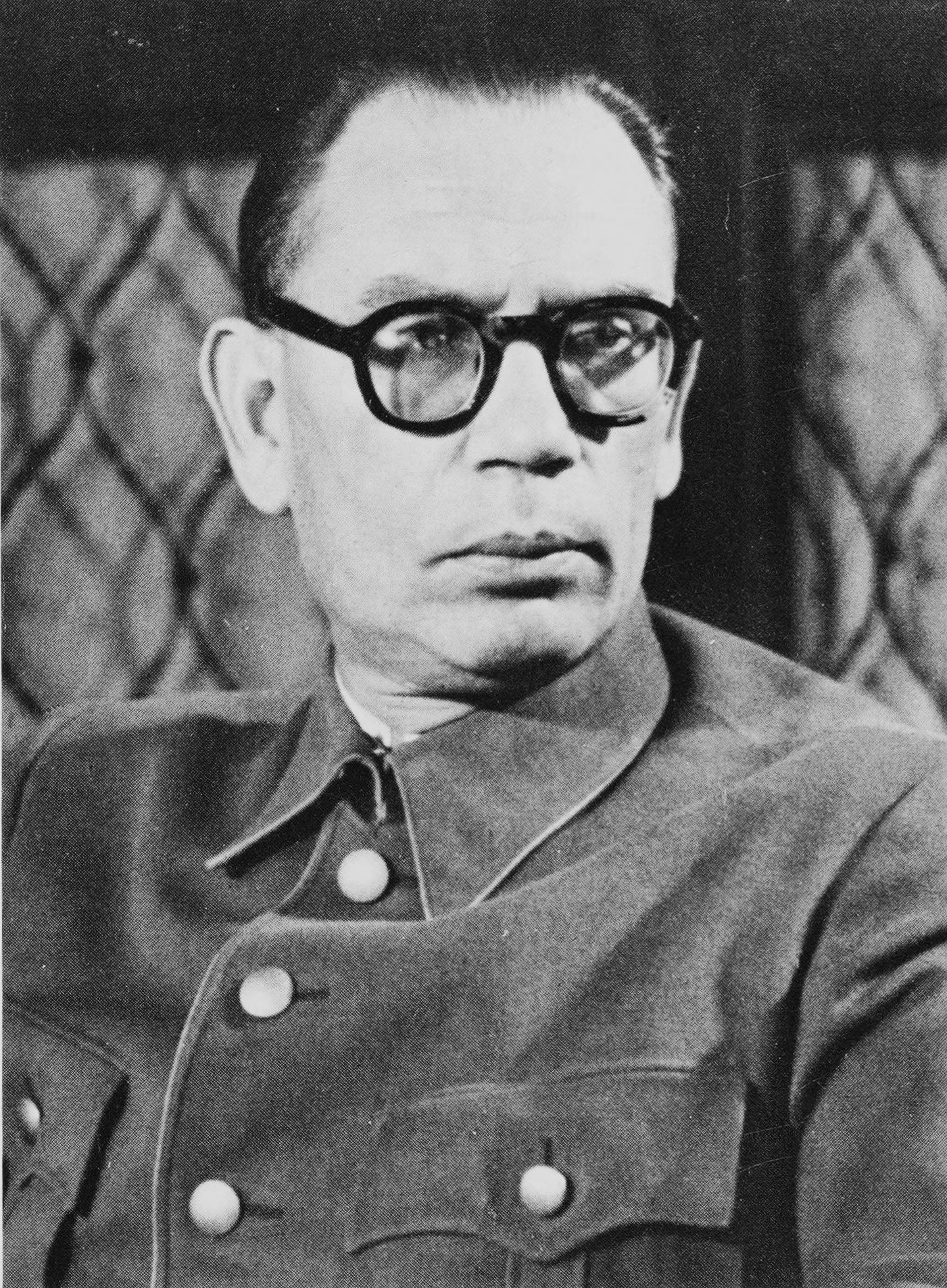
Andrey Vlasov
View on WikipediaThis article needs additional citations for verification. (March 2016) |
Andrey Andreyevich Vlasov (Russian: Андре́й Андре́евич Вла́сов, September 14 [O.S. September 1] 1901 – August 1, 1946) was a Soviet Russian Red Army general. During the Axis-Soviet campaigns of World War II, he fought (1941–1942) against the Wehrmacht in the Battle of Moscow and later was captured attempting to lift the siege of Leningrad. After his capture, he defected to the Third Reich and nominally headed the collaborationist Russian Liberation Army (Russkaya osvoboditel'naya armiya, ROA), also becoming the political leader of the Russian collaborationist anti-Soviet movement.
Key Information
Initially, this army existed only on paper and was used by Germans to goad Red Army troops to surrender, while any political and military activities were officially forbidden to him by the Nazis after his visits to the occupied territory;[2] only in November 1944 did Heinrich Himmler, aware of Germany's shortage of manpower, arrange for Vlasov’s formations, composed of Soviet prisoners of war as armed forces of Committee for the Liberation of the Peoples of Russia, a political organisation headed by Vlasov. While for the Nazis the ROA was a mere propaganda weapon, Vlasov and his associates attempted to create an armed political movement independent of the Nazi control that would present an anti-Stalinist program described by Robert Conquest as democratic,[3] while attempting to avoid Nazi antisemitism and chauvinism, with "completing the Revolution" of 1917 being the ultimate goal of the movement.[2]
In January 1945, Vlasov headed the army as it was declared that it would be no longer a part of the Wehrmacht. At the war's end, the 1st division of ROA aided the May 1945 Prague uprising against the Germans. Vlasov and the ROA were captured by Soviet forces with the United States' assistance. Vlasov was tortured,[4] and hanged for treason after a secret trial. After his death, his figure and his movement became objects of various narratives in memory politics and historiography.
Early career
[edit]
Born in Lomakino, Nizhny Novgorod Governorate, Russian Empire, Vlasov was originally a student at a Russian Orthodox seminary. He quit the study of divinity after the Russian Revolution, briefly studying agricultural sciences instead, and in 1919 joined the Red Army. He fought in the southern theatre in Ukraine, the Caucasus, and the Crimea during the Russian Civil War, including against the White forces of Anton Denikin and Pyotr Wrangel, and the anarchist army of Nestor Makhno. He distinguished himself as an officer and gradually rose through the ranks of the Red Army. In the 1920s and early 1930s he was a company, battalion, and regimental commander, and graduated from an infantry officer course. He was also an instructor at the Frunze Military Academy.[5]
Vlasov joined the Communist Party in 1930. Sent to China in 1938, he acted as a military adviser to Chiang Kai-shek until November 1939. From February to May 1939 he was the advisor to Yan Xishan, the governor of Shanxi. Vlasov was also the chief of staff to the head of the Soviet military mission, General Aleksandr Cherepanov. He received a military decoration from Chiang and a watch from his wife, Madame Chiang Kai-shek, which were both taken from him after he returned to the USSR.[6] Upon his return, Vlasov served in several assignments before being given command of the 99th Rifle Division. After just nine months under Vlasov's leadership, and an inspection by Semyon Timoshenko, the division was recognized as one of the best divisions in the Army in 1940.[7] Timoshenko presented Vlasov with an inscribed gold watch, as he "found the 99th the best of all". The historian John Erickson says of Vlasov at this point that [he] "was an up-and-coming man".[8] In 1940, Vlasov was promoted to major general, and on June 22, 1941, when the Germans and their allies invaded the Soviet Union, Vlasov was commanding the 4th Mechanized Corps.
As a lieutenant general, he commanded the 37th Army near Kiev and escaped encirclement. He then played an important role in the defense of Moscow, as his 20th Army counterattacked and retook Solnechnogorsk. Vlasov's picture was printed (along with those of other Soviet generals) in the newspaper Pravda as that of one of the "defenders of Moscow". Vlasov was decorated on January 24, 1942, with the Order of the Red Banner for his efforts in the defence of Moscow. Vlasov was ordered to relieve the ailing commander Klykov after the Second Shock Army had been encircled.[9] After this success, Vlasov was put in command of the 2nd Shock Army of the Volkhov Front and ordered to lead the attempt to lift the Siege of Leningrad—the Lyuban-Chudovo Offensive Operation of January–April 1942.
On January 7, 1942, Vlasov's army had spearheaded the Lyuban offensive operation to break the Leningrad encirclement. Planned as a combined operation between the Volkhov and Leningrad Fronts on a 30 km frontage, other armies of the Leningrad Front (including the 54th) were supposed to participate at scheduled intervals in this operation. Crossing the Volkhov River, Vlasov's army was successful in breaking through the German 18th Army's lines and penetrated 70–74 km deep inside the German rear area.[10] However, the other armies (the Volkhov Front's 4th, 52nd, and 59th Armies, 13th Cavalry Corps, and 4th and 6th Guards Rifle Corps, as well as the 54th Army of the Leningrad Front) failed to exploit Vlasov's advances and provide the required support, and Vlasov's army became stranded. Permission to retreat was refused. With the counter-offensive in May 1942, the Second Shock Army was finally allowed to retreat, but by now, too weakened, it was surrounded and in June 1942 virtually annihilated during the final breakout at Myasnoi Bor.[11]
German prisoner
[edit]
After Vlasov's army was surrounded, he himself was offered an escape by aeroplane. The general refused and hid in German-occupied territory; ten days later, on July 12, 1942, a local farmer exposed him to the Germans. Vlasov's opponent and captor, general Georg Lindemann, interrogated him about the surrounding of his army and details of battles, then "had Vlasov imprisoned in occupied Vinnytsia."
While in prison, Vlasov met Captain Wilfried Strik-Strikfeldt, a Baltic German who was attempting to foster a Russian Liberation Movement. Strik-Strikfeldt had circulated memos to this effect in the Wehrmacht. Strik-Strikfeldt, who had been a participant in the White movement during the Russian Civil War, persuaded Vlasov to become involved in aiding the German advance against the rule of Joseph Stalin and Bolshevism. With Lieutenant Colonel Vladimir Boyarsky, Vlasov wrote a memo shortly after his capture to the German military leaders suggesting cooperation between anti-Stalinist Russians and the German Army.
Defection
[edit]
Vlasov was taken to Berlin under the control of the Wehrmacht Propaganda Department. While there, he and other Soviet officers began drafting plans for the creation of a Russian provisional government and the recruitment of a Russian army of liberation under Russian command. In the spring of 1943, Vlasov wrote an anti-Bolshevik leaflet known as the "Smolensk Proclamation", which was dropped from aircraft by the millions on Soviet forces and Soviet-controlled soil. In March of the same year, Vlasov also published an open letter titled "Why I Have Taken Up the Struggle Against Bolshevism". Even though no Russian Liberation Army yet existed, the Nazi propaganda department issued Russian Liberation Army patches to Russian volunteers and tried to use Vlasov's name in order to encourage defections. Several hundred thousand former Soviet citizens served in the German army wearing this patch, but never under Vlasov's own command.

Vlasov was permitted to make several trips to German-occupied Soviet Union: most notably, to Pskov, Russia, where Russian pro-German volunteers paraded. The populace's reception of Vlasov was mixed. While in Pskov, Vlasov dealt himself a nearly fatal political blow by referring to the Germans as mere "guests" during a speech, which Hitler found belittling. Vlasov was even put under house arrest and threatened with being handed over to the Gestapo. Despondent about his mission, Vlasov threatened to resign and return to the POW camp, but was dissuaded at the last minute by his confidants.[citation needed] According to Varlam Shalamov and his tale The Last Battle of Major Pugachov, Vlasov emissaries lectured to the Russian prisoners of war, explaining to them that their government had declared them all traitors, and that escaping was pointless. As Vlasov proclaimed, even if the Soviets succeeded, Stalin would send them to Siberia.[12]
Vlasov Movement
[edit]
The creation of a political movement behind Vlasov and the Russian collaboration became a result of the conflicts within the Nazi Party and the Nazi bureaucracy. While Hitler and the supporters of the Generalplan Ost adhered to the idea of the colonization of the Untermenschen and denied any cooperation with the population of the USSR, Alfred Rosenberg proposed the creation of monoethnic nation-states as satellites of the Third Reich ruled by local nationalist collaborators. Hitler rejected this project, but the Soviet defectors were used by Wehrmacht Propaganda. Eventually Hitler agreed to use the Soviet defectors for propaganda purposes. As the reports of the Osttruppen defecting the Soviet partisans reached Hitler, he demanded that all the units be disbanded, and the men sent to the mines and factories, but this order wasn't executed due to the resistance of the OKW. After the 20 July plot, the Eastern troops were handed to the SS, and as Hitler weakened due to physical conditions, Himmler found possible the creation of a collaborationist political organisation with its army.[2]
As he defected, Vlasov became the leading figure of the so-called "Russian Liberation Movement", the main goal of which was the overthrow of Stalinism with the aid of the Nazis; the ROA was thought to be the armed force of the movement. Although the White emigres participated in its formation, the Soviet defectors eventually became its leaders and formulated its political ideals. The Committee for the Liberation of the Peoples of Russia (KONR) became the political body of this movement, and its ideals were described in the Prague Manifesto of the Committee in November 1944.[2] Robert Conquest wrote that Vlasov's "program shows that he was entirely out of sympathy with Nazism, and only concerned with a democratic Russia."[3]
As Vlasov became the undisputed leader of the movement, it became referred to as "the Vlasov Movement",[13] while his Manifesto calls it the "Liberation Movement of the Peoples of Russia",[2] underlying its multinationality. Although at first Vlasov hoped for an open co-operation of his movement and the Nazis, during his tour at the occupied territories, he emphasised that National Socialism could not be imposed on Russia, and that "a foreign coat [would] not fit a Russian." In his nationalist speeches, Vlasov promoted the idea of equal partnership with Germany and the idea of an independent Russia; his speeches angered Himmler, and in response, Wilhelm Keitel issued an order that Vlasov must be returned to POW camp and that his name henceforth should be used only for propaganda purposes. Rosenberg stopped supporting Vlasov, but he was placed under virtual house arrest in Dahlem instead of being sent to the POW camp. Disappointed, Vlasov said several times that he would return to the camp, but was dissuaded by his associates, namely Malyshkin and Wilfried Strik-Strikfeldt.[2]

Ideologically, the Vlasov movement was between the Russian nationalism of the National Alliance of Russian Solidarists, an organisation of far-right origins which collaborated with the Nazis but the members of which were repressed by Gestapo in 1943 and 1944 so Vlasov had to ask Himmler to free them, as its ideologues surrounded Vlasov, and social democratic views of the other Russian POWs in Germany.[14]
Some of Vlasov's close associates like Milety Zykov, a Soviet journalist of Jewish origins, described themselves as Marxists, Zykov was also described as a Bukharinist. Despite being captured by the Nazi secret police and killed, ostensibly for his Jewish origins and for his views, before the formation of the Committee for the Liberation of the Peoples of Russia and the creation of its Manifesto, the political organization of the Vlasovites, Zykov was a major ideologue of the Vlasov army and participated in writing of the other Vlasovite program documents. The Vlasovites opposed their programs, the Smolensk Declaration, Vlasov's open letter "Why I Decided to Fight against Bolshevism", the Prague Manifesto of the KONR and Bloknot Propagandista (an important document which was written by rather minor members of the KONR as open for discussion and was not recognized as an official program), both to the Western capitalism and Stalinism, which was called by the word "Bolshevism" and described in the Manifesto not as socialism but as "state capitalism", and proclaimed their devotion to "completing the Revolution" of 1917 without distinguishing the February Revolution and the October Revolution, and to ideals of either a "Russia without Bolsheviks and Capitalists" (Smolensk Declaration and the open letter), or a welfare state (Bloknot Propagandista); the influence of the NTS on the Manifesto is seen in the description of the future system of Russia as a "national-labour" system, some of Vlasov's generals joined the NTS. All of these documents granted the basic democratic freedoms and rights, including the right of the nations to self-determination and to separate from Russia and did not contain antisemitic remarks and invectives; Bloknot Propagandista also contained an attempt in critique of Marxism and denied both internationalism and national chauvinism. However, antisemitic remarks were made in one of the speeches of Vasily Malyshkin in 1943 and in Georgi Zhilenkov's interview to the Völkischer Beobachter; Vlasov was critical of such remarks and replied to the Nazi concerns that "the Jewish question" "was an internal Russian problem and would be dealt with after they [the ROA] had accomplished the primary aim of overthrowing the existing regime"; however, antisemitism frequently appeared in the pro-Vlasov Nazi and collaborationist newspapers issued before the formation of KONR, including the ones edited by Zykov, often in form of articles reprinted from the Völkischer Beobachter with the citation of the source. The program documents were also written as a compromise with Nazism to various extents: the Smolensk Declaration included some pro-Nazi points ("Germany was not fighting the war against the Russian people and their homeland but merely against Bolshevism"), and the Manifesto included a number of criticisms of the Western Allies as a compromise with Himmler's insistence to add antisemitic points.[2]
The Nazis were suspicious of Vlasov, his organisation and his ideological position, and the Gestapo warned about the possibility of the Vlasovites betraying the Reich. The suspicions and criticism of the Vlasovites from the Reich officials was summarised in a document by the Ministry of Propaganda official Eberhard Taubert who described his concerns about the movement being "not National Socialist": "It is significant that it does not fight Jewry, that the Jewish Question is not recognized as such at all"; instead it presented "a watered-down infusion of liberal and Bolshevik ideologies", and Taubert described the concern with "strong Anglophile sympathies" and it "toying with the idea of a possible change of course" while not "feel[ing] bound to Germany".[15][16][17]

Himmler, the head of the SS, had a negative attitude towards Vlasov and the idea of arming Russian formations. For example, in late 1942 he told another SS official who was based in Minsk that Russian collaborators should not be promised a national state and only a liberation from Bolshevism and possibly better living standards. He oversaw the creation of the SS-Volunteer Division "Galicia" in October 1943 from Ukrainian volunteers, but that same month he said that Vlasov made him "genuinely anxious." Himmler later noted that there were Wehrmacht officers who wanted to give Vlasov a million-man army, and speculated that in the future it could theoretically turn against Germany. Himmler did not want Vlasov to even be used for propaganda and on another occasion said that Vlasov's ideology "must be intellectually totally annihilated among us." Hitler had similar concerns, having said in June 1943 that Vlasov was unneeded, because the Germans "would never build up a Russian army."[18]
It was not until Germany's position was weakened in the spring of 1944 that Himmler began changing his mind, with the encouragement of Gunter d'Alquen and others, and decided to meet with Vlasov. Their meeting was scheduled for the evening of 20 July 1944, but was postponed by the assassination attempt against Hitler until 16 September 1944. When it happened, Himmler promised Vlasov several Russian divisions. Two began to be formed, the 600th Infantry Division in November 1944 and the 650th Infantry Division in January 1945, respectively. He also approved the creation of the Committee for the Liberation of the Peoples of Russia (KONR).[18][19]
Earlier, in the summer of 1944 Vlasov, who had been depressed after the first few years of failing to get German support for the Russian Liberation Movement, was sent to an SS recovery center in Ruhpolding that was run by Heidi Bielenberg, the widow of an SS officer. Several weeks after meeting they decided to get married, even though neither one spoke each other's language and Vlasov probably knew that his first wife was still alive in the Soviet Union. This may have been done under the pressure of the SS. According to the SS liaison officer assigned to Vlasov's staff, the idea for the marriage came mainly from her, because she liked the idea of her becoming the "first lady" of a future Russian state.[20][21]
Commander of the ROA
[edit]

The only combat of the ROA against the Red Army took place on February 11, 1945, on the river Oder; it was carried out by the First Division led by General Sergei Bunyachenko. After three days of battle against overwhelming forces, the First Division of the ROA was forced to retreat and marched southward to Prague, in German-controlled Bohemia. In March 1945, Bunyachenko started disobeying the commands of the Wehrmacht; eventually Ferdinand Schörner (and later Rudolf Toussaint[22]) threatened to use armed force against the ROA. Vlasov reprimanded Bunyachenko during their meeting with Schörner in assertion of his loyalty, but privately granted Bunyachenko complete independence in sign of his approval while himself taking care of the rest two incomplete divisions.[2]
During the Prague uprising, the officers of the First Division, Bunyachenko and Vlasov gathered a meeting and discussed whether the First Division should help the insurgents. Vlasov spoke against joining the uprising, but his position was not supported by the others, and the First Division joined the uprising.[22] Two days later, the First Division was forced to leave Prague as Communist Czech partisans began arresting ROA soldiers in order to hand them over to the Soviets for execution. Vlasov and the rest of his forces, trying to evade the Red Army, attempted to head west to surrender to the Allies in the closing days of the war in Europe.[2][23]
Capture by Soviet forces, trial, and execution
[edit]
Vlasov's division, commanded by General Sergei Bunyachenko, was captured 40 kilometres (25 mi) southeast of Plzeň by the Soviet 25th Tank Corps, after their attempt to surrender to US troops was rejected. Captain M. I. Yakushev of the 162nd Tank Brigade had Vlasov dragged out of his car, put on a tank and driven straight to the Soviet 13th Army HQ. Vlasov was then transported from the 13th Army HQ to Marshal Ivan Konev's command post in Dresden, and from there sent immediately to Moscow.[25]
Vlasov was confined in Lubyanka prison where he was interrogated. A secret trial was held, beginning on 30 July 1946 and was presided over by Viktor Abakumov who sentenced him and eleven other senior officers from his army to death for high treason. Vlasov was executed by hanging on 1 August 1946. His execution was among the last death sentences in the Soviet Union carried out by hanging, after which executions were conducted only by shooting.
Legacy
[edit]Historiography and memory politics
[edit]20th century
[edit]In the USSR, the figure of Vlasov was villainized because of the need to defend the official myth of the Great Patriotic War, which was "created and assiduously supported as a pillar of state legitimacy and national culture in the USSR". However, in the emigration and later in the post-Soviet Russia, he and his movement became objects of various narratives.[26]

The first narrative in the emigration was set up by the former White Guards who served in the ROA or supported Vlasov, although they were a minority in the ROA and had conflicts with the Vlasovites, since the Whites were suspicious of the former Soviet soldiers and sometimes called them "Reds", while Vasily Malyshkin, one of Vlasov's closest associates, charged that the White movement, described by him as a movement of conservative gentry, had remained distant from realities of the USSR,[26] and lacked "any progressive principles", ranging from apoliticism to reaction,[27] and through seeking a "restoration of the old noble-landowning system" did nothing but legitimizing the Bolsheviks. The Vlasovites and the Whites had very different world views, partially because for the Whites struggle against the USSR and collaboration with the Nazis was not a means of survival, partially because the Vlasovites who were grown on the Soviet culture saw conservatism of the Whites as backward-looking and irrelevant, and Malyshkin suggested that the conflict between the Whites and the Vlasovites was rooted in different social backgrounds and class origins and worldviews. However, after the war, the Whites who participated in the Vlasov Movement sought to connect it with their cause: for example, Constantine Kromiadi wrote that the Vlasov Movement was a part of the "Christian war of the 30 years of the liberation movement against communism"; the White rightists sought to "offset the opprobrium of collaboration with Germany by viewing World War Two through the prism of the Russian Civil War and the Tsarist period" and alleged that the Soviets, not the collaborators, were the real national traitors. Such ideas were not popular among the majority of the surviving Vlasovites, but for a few years the Whites became their new leaders and even established Monarchist Vlasovite organizations, since they were naturalized citizens of European states and had more chances of surviving, also because of "aristocratic cohesion" and such benefits as knowledge of foreign languages, while the Vlasovites were in danger of Operation Keelhaul, forced repatriation to the USSR carried out by the U.S. with the subsequential punishment for treason; the Whites attempted to unite the whole emigration and get funding by the CIA, and the latter could help Vlasovites survive. However, the Whites failed to get the attention of the CIA, and their narrative was soon rejected.[26] However, it would reemerge in post-Soviet Russia.[28]
To get the interest of the U.S. military intelligence, the post-war Vlasovites stressed the anti-Communist nature of their movement.[29] However, the new narrative was left-wing, being constructed by the Menshevik intellectual and historian Boris Nicolaevsky, who after visiting DP camps came to a belief that the Vlasov Movement was democratic and even anti-Nazi to some extent. His narrative was somewhat closer to the truth, as he, unlike the Whites, could cite Vlasovite documents, like the Prague Manifesto of the KONR.[26] However, it was incomplete and still had some factual errors.[30] Nikolaevsky described the Vlasovites with the word porazhentsy, "defeatists", the word used by the Bolsheviks during the World War II towards themselves, as they campaigned against the war efforts of the Russian Empire and for overthrow of the reactionary Tsarist and later imperialist bourgeois government with a revolutionary civil war;[26][30] Nikolaevsky drew a parallel between Vlasov and Leninists and thought the first to be influenced by the latter, believing that Vlasov's motivation was to begin a similar civil war.[30] The Vlasovites embraced Nicolaevsky's narrative, and he would help them to operate through the CIA-supported AMCOMLIB, however, Roman Gul believed that they were insincere and saw Nicolaevsky only as "a direct and CLEAN entry to Washington" and were interested in the Socialist émigrés, including Nicolaevsky, only as powerful representatives of American power.[26] However, the Vlasovites did not have a necessity to present themselves as left-wing democrats, since the CIA did not scruple to fund the openly far-right collaborators from the Anti-Bolshevik Bloc of Nations, like the Belarusian Central Council.[31]
Nicolaevsky's narrative resulted in a polemics among the émigrés, and opponents of Nicolaevsky among oborontsy, the word from the vocabulary of World War I to indicate the patriotic opposition to the Bolsheviks' defeatism, the supporters of the war effort of the USSR in World War II, attacked the Vlasovites and Nicolaevsky: according to them, the democratic program was just a way to court the West in the face of Nazi defeat, that they were national traitors and mere "powerless pawns" in "organized and merciless destruction" of their own people, a "propaganda trick", and that they were unscrupulous people motivated only by lust for power or physical survival whose movement could not be democratic in any way. B. Dvinov, one of the most harsh Nicolaevsky's opponents, supported his publications with documents.[26][30] Alexander Dallin called his publications "a documented but one-sided attempt in Russian émigré politics to reduce the Vlasov movement to a German propaganda trick."[32]
Among the positions of the émigrés was a compromise one that 'Vlasovism' may be a democratic movement, but Vlasov and the other leaders should be condemned, and that the Vlasovites should admit that collaboration with the Nazis was a mistake, but the Vlasovites from the SBONR, which joined the AMCOMLIB, refused to admit the latter and continued to idolize their executed leader; they accused their opponents of Communism, while the Socialist émigrés accused Vlasovites of Nazism, and both claims were dangerous since the FBI had been closely monitoring both of the factions. More to it, the SBONR in their responses made nationalist and allegedly antisemitic dog whistles, since they never mentioned the Jewish origins of their opponents, but contrasted the "Russian people" with the American exiles who "long ago forgotten how to understand" the first; later they compromised themselves more with "historical apologies for restoration and reaction", therefore making Nicolaevsky's narrative unable to be adopted as universal, since one of their publications called Kerensky a traitor for preventing the Kornilov coup in 1917.[26] However, after the polemic Nicolaevsky continued his publications about the biographies of the Vlasovite leaders and did not change his opinion, and not all the Socialist émigrés dismissed Nicolaevsky and his narrative.[30]
While Benjamin Tromly and other authors believe the description of the ROA as a somewhat revolutionary movement of ideological protest against Stalinism which conflicted with the Nazis to be largely constructed by the Vlasovites themselves,[28][26][27] this claim is rather inaccurate, since the theme of the ROA was explored in the works of several Western historians: along with the sovietologist Eugene Lyons, the chairman of the AMCOMLIB whose attitute towards the Vlasovites was ambivalent, who also believed the ROA to be influenced with Lenin's revolutionary defeatism, the historians Jurgen Thorwald and Joachim Hoffmann also contributed to the theme; the historian George Fischer, on the contrary, believed the "inertness" and opportunism caused by Stalinist totalitarianism to be the grounds of the ROA, but he saw Vlasov's political career as an overcoming of opportunism and "inertness", although he failed to "overcome" "Bolshevism"; Catherine Andreev agreed with Fischer's last point, but criticized the other two.[27][30] More to it, Tromly believes that the works of Catherine Andreev and Kirill Aleksandrov keep the "essential contours" of Nicolaevsky's narrative, and that Andreev "bypasses controversial questions about the context in which Vlasov troops were recruited, the émigrés employed in Nazi security agencies, and the deep internal hostilities within the KONR's ranks",[26] as well as the war crimes committed by the soldiers of the ROA.[29] This theme was also explored by Dallin who wrote that "Vlasov was no puppet: therein lay, from the German point of view, both his potential value and his challenge. A relatively 'autonomous' figure, as yet untarnished by association with German abuses and atrocities, he could appeal to the Soviet population more successfully than could the Germans. But as a leader with a will and a following, he and his movement could also develop a dynamic of their own and — precisely because they might be successful — could become potentially distinct from or even hostile to the interests of the German leadership." Dallin also wrote that the idea of the "third force" promoted by the Vlasovites and the NTS was doomed: "no 'third force' could succeed because there was no viable third choice; neither of the titans would tolerate a power vacuum — nor the arrogation of power by a new, autonomous competitor."[32][27] Most of these historians relied mostly on the Nazi documents and not the Soviet archives, partly because the latter were unaccessible.[29]
A new narrative was constructed in the 1970s and emerged in Aleksandr Solzhenitsyn's book The GULAG Archipelago: while not directly advocating collaboration, he and the later authors labelled Vlasov as "the symbol of the suffering Russian people" and its "victimhood" throughout the 20th century. Solzhenitsyn described the Vlasovite prisoners met by him in GULAG camps and wrote that "it's not the Vlasovites who betrayed Russia - it's the Soviet state which betrayed these soldiers", since "Stalin sacrificed armies meaninglessly. He had treated prisoners of war as traitors", and the World War II became "a double sacrifice. This is the idea that the Soviet people, now increasingly perceived as the Russian people, won the war against Nazism despite the brutality and incompetence of the Soviet state. In this context, Vlasov's sacrifice is entirely appropriate."[28] With all these narratives given, Benjamin Tromly calls Vlasov an "empty signifier".[28] Julia Shapiro writes that Vlasov during his collaboration with the Nazis managed to secure his image for the further generations, but "his intentionally murky beliefs make him a convenient straw man to suit cultural and political agendas. Based on the documents, he can be framed as an anti-Bolshevist crusader, Russian patriot, misunderstood democrat, martyred hero, and fascist puppet. Eighty years on, he still defies categorization." Shapiro believed that Vlasov's motivations were complex and laid between opportunism and ideological opposition; she believes moral relativism and "historical consciousness" to be among his most important qualities.[29]
Post-Soviet Russia
[edit]After perestroika and the fall of the Soviet Union, narratives described above entered Russian historiography and memory politics. These narratives challenge the myth of the Soviet, increasingly perceived as Russian, Victory in the Great Patriotic War, which is significant to Russian national identity. As this myth has been increasingly used by Vladimir Putin and his Putinist regime to legitimize its state and its actions, the figure of Vlasov gains a political value in contemporary Russia.[26][28] The positive attitude towards Vlasov became visible in the late 1980s, but the majority of Russian society is negative towards collaboration, although there is still no unity on this question.[33] The fall of the Soviet Union did not lead to immediate popularisation of Vlasov among the emerging far-right nationalists, since they preferred the ideals of Pan-Slavism and an Empire to a separatist nation-state.[34] A major liberal politician during the fall of the USSR and the mayor of Moscow Gavriil Popov wrote a complimentary book about Vlasov, but was not supported. In the 2000s various nationalist organizations which associated themselves with the White movement campaigned for rehabilitation of Vlasov; the support for the White narrative in the Church caused a scandal after the reunification of the Orthodox Church in Russia and the Russian Orthodox Church Abroad.[35][28]
Solzhenitsyn's narrative became more or less convenient, since it did not deny the role of Victory and the Great Patriotic War and united it with criticism of Stalin and the understanding of Vlasov's tragedy which could be reintegrated into national history, making it more inclusive. Yet, it became debated in the 1990s and received a backlash as a "slander of the entire generation" "who had fought in the war". The opponents of such narratives, including the Communist Party of the Russian Federation created in 1993, started connecting the apology for Vlasov and the ROA with the chaos of the 1990s: economic collapse, dissolution of the Soviet Union and the First Chechen War, the rize of the organized crime, making Vlasov a symbol "past and current betrayal in Russia"; in the second part of the 1990s, Boris Yeltsin turned back to commemoration of the Great Patriotic War, and after the rise of Putin, "this anti-Vlasov discourse hardens and takes on increasing domestic political uses," connecting Vlasov with the 'collapse of Empire' and influence of the West.[28] Jade McGlynn and Tromly describe how Vlasov's figure became unsuitable for the Putin regime; however, it was not until 2022 when it received significant attention.[36]
Throughout the 2000s, the state-sponsored narratives of World War II villainized Vlasov again whenever his figure appeared in public discourse, although the latter did not happen often.[36] In the 2010s, the debates over Vlasov moved to historiography, and Kirill Aleksandrov was stripped of his PhD by the Ministry of Education in 2016 after writing a dissertation about the ROA; the earlier successful defense of this dissertation was followed with a scandal, as pro-Kremlin organizations, including the CPRF, forwarded the dissertation to Russian prosecutors to inspect for violation of Putin's "memory law", which criminalizes "lies about the activities of the Soviet Union in the Second World War" and held rallies with slogans such as "Bandera in Ukraine - Vlasov in Russia", and Aleksandrov's article about Bandera written back in 2014 was designated as an extremist material; the professional historians who joined the attacks compared the dissertation with "blackening of our history" by foreigners.[37][26][28]
After the Annexation of Crimea and the beginning of the War in Donbas in 2014 Putin called the Ukrainian authorities "Banderites", and Kremlin-affiliated media and politicians alike framed the fighting as a rerun of the Second World War; the usage of the word "banderite" became popular in propaganda, and the Russian media and politicians were eager to remind of collaborators of other nationalities, Tatars and Chechens, but avoided Vlasov and the ROA: McGlynn noted that in an analysis of 3,509 comparisons between the 2014 conflict and World War II, Vlasov was mentioned just once, as a reminder of Russian collaboration could "besmirch Russia's moral authority as an heir to the Soviet Union's Great Victory of 1945 and self-appointed defender of the war's memory."[36] According to Tromly, the Russian state avoids the mentions of ethnic Russian collaboration and views "reviving a positive memory of Vlasov" as an "instrument of information war" against itself.[28]
The attention to Vlasov increased after the Russian invasion of Ukraine: McGlynn notes that "written references to Vlasovites have increased to levels that usually accompany the release of a popular new book on the subject." Some of them are related to the Ukrainian units of Russian citizens, like the Freedom of Russia Legion, while prominent nationalist figures have branded Russians fleeing mobilization as Vlasovite deserters, and some media reminded of the connection between Vlasovites and Banderites; after criticizing the war, the journalist Dmitry Kolezev received a flood of messages with the same text: "Only Vlasovites discredit the army." Before the invasion, Alexei Navalny was labelled a Vlasovite, as the official allegations included "memory crimes";[36] in 2020, the Russian Foreign Ministry officially protested against a monument to the ROA fighters who participated in the Prague Uprising.[38] Putin personally mentioned Vlasov only in 2024, after the presidential elections, during which the Ukrainian units of Russian citizens launched an incursion into Russia; he labelled as "Vlasovites" these units, reminded how the Vlasovites were executed, and ordered the FSB to track down every Russian citizen "fighting against Russia". He said: "We will punish them without a statute of limitations, wherever they are."[39][40]
Attempts of rehabilitation
[edit]In 2001, a Russian organization "For Faith and Fatherland" applied to the Russian Federation's military prosecutor for a review of Vlasov's case,[41] saying that "Vlasov was a patriot who spent much time re-evaluating his service in the Red Army and the essence of Stalin's regime before agreeing to collaborate with the Germans".[42] The military prosecutor concluded that the law of rehabilitation of victims of political repressions did not apply to Vlasov and refused to consider the case again. However, Vlasov's Article 58 conviction for anti-Soviet agitation and propaganda was vacated.[43]
Memorial
[edit]
A memorial dedicated to General Vlasov was erected at the Novo-Diveevo Russian Orthodox convent and cemetery in Nanuet, New York. Twice annually, on the anniversary of Vlasov's execution and on the Sunday following Orthodox Easter, a memorial service is held for Vlasov and the forces of the Russian Liberation Army.
See also
[edit]References
[edit]- ^ Михаил Алексеевич Меандров. Штрихи к портрету // К. М. Александров. Против Сталина. Сборник статей и материалов. СПб, 2003.
- ^ a b c d e f g h i Catherine Andreev (1987). Vlasov and the Russian Liberation Movement: Soviet Reality and Emigré Theories. Cambridge University Press. ISBN 9780511523571.
- ^ a b The Great Terror: A Reassessment. Oxford University Press. 1990. ISBN 978-0-19-507132-0.
- ^ Gordievsky & Andrew (1990). KGB : The Inside Story. Hodder & Stoughton Ltd. p. 343. ISBN 0340485612.
- ^ Andreyev 1987, pp. 19–21.
- ^ Andreyev 1987, p. 21.
- ^ Коллектив авторов. «Великая Отечественная. Командармы. Военный биографический словарь» — М.; Жуковский: Кучково поле, 2005. ISBN 5-86090-113-5
- ^ John Erickson, The Soviet High Command, MacMillan, 1962, p.558
- ^ Bellamy, Absolute War, pg 384
- ^ Meretskov, On the service of the nation, Ch.6
- ^ Erickson, Road to Stalingrad, 2003, p.352. See also p.381, where Erickson describes 2 Shock after this operation as 'an army brought back from the dead.'
- ^ Gerald Reitlinger. The House Built on Sand. Weidenfeld & Nicolson, London (1960) ASIN: B0000CKNUO. pp. 90, 100–101.
- ^ "THE VLASOV MOVEMENT, 1940-1945 | CIA FOIA (foia.cia.gov)". www.cia.gov.
- ^ Chester, Eric Thomas (8 September 1995). Covert Network: Progressives, the International Rescue Committee, and the CIA. M.E. Sharpe. ISBN 978-1-56324-550-3 – via Google Books.
- ^ Vlasov: Translated from the German by Abe Farbstein. [1st American Ed.]. Knopf. 1970.
- ^ Problems of Communism. Documentary Studies Section, International Information Administration. 1958.
- ^ Dallin, Alexander. "The Kaminsky Brigade: A Case-Study of Soviet Disaffection". Archived from the original on 26 May 2024.
- ^ a b Böhler & Gerwarth 2017, pp. 37–40.
- ^ Dallas 2005, pp. 387–388.
- ^ Andreyev 1987, p. 59.
- ^ Dallas 2005, p. 387.
- ^ a b К. Александров. Мифы о генерале Власове
- ^ Шимов, Ярослав (6 February 2018). ""Рубать немцев, освободить Прагу"". www.svoboda.org.
- ^ Žaček, Pavel (2014). "Prague under the armor of the Vlasovs - the Czech May Uprising in photography" (in Czech). Czech Republic: Mladá Fronta. ISBN 9788020426819.
- ^ Konev, I.S. (1971). "Year of Victory". Progress Publishers. pp. 230–231.
- ^ a b c d e f g h i j k l Tromly, Benjamin (January 2018). "Reinventing Collaboration: The Vlasov Movement in the Postwar Russian Emigration". Traitors, Collaborators and Deserters in Contemporary European Politics of Memory, Palgrave Macmillan Memory Studies.
- ^ a b c d К. М. Александров. Генералитет и вооружённые формирования Комитета освобождения народов России
- ^ a b c d e f g h i "The Never-Ending Story: General Vlasov in Post-Soviet Russian Collective Memory".
- ^ a b c d https://journals.flvc.org/UFJUR/article/download/130757/136333/240252
- ^ a b c d e f Мартынов А. В. По обе стороны правды. Власовское движение и отечественная коллаборация
- ^ Mark Alexander: Nazi Collaborators, American Intelligence, and the Cold War. The Case of the Byelorussian Central Council. University of Vermont Graduate College Dissertations and Theses, Nr. 424, 2015
- ^ a b Dallin, Alexander (1981). German rule in Russia, 1941-1945 : A study of occupation policies. Avalon. ISBN 978-0-86531-102-2.
- ^ The Extreme Nationalist Threat in Russia: The Growing Influence of Western Rightist Ideas. Routledge. 10 November 2004. ISBN 978-1-134-29677-4.
- ^ Theoretical and Comparative Perspectives on Nationalism: New Directions in Cross-Cultural and Post-Communist Studies. Columbia University Press. 17 December 2007. ISBN 978-3-8382-5815-7.
- ^ Memory Politics and the Russian Civil War: Reds Versus Whites. Bloomsbury. 12 November 2020. ISBN 978-1-350-14998-4.
- ^ a b c d "General Vlasov's return Scholar Jade McGlynn explains how Putin's 'unifying historical truth' is losing to reality in Ukraine".
- ^ The Future of the Soviet Past: The Politics of History in Putin's Russia. Indiana University Press. 5 October 2021. ISBN 978-0-253-05761-7.
- ^ "'A mockery of memory' Prague erects monument to Nazi collaborationist army, despite protests from Russia's Foreign Ministry".
- ^ "Putin orders FSB to hunt Russians who fight for Ukraine". 20 March 2024.
- ^ Soldatov, Andrei; Borogan, Irina (May 2024). "Putin's Defector Obsession". Foreign Affairs.
- ^ Valeria Korchagina and Andrei Zolotov Jr.It's Too Early To Forgive Vlasov The St. Petersburg Times. 6 Nov 2001.
- ^ "It's Too Early to Forgive Vlasov | the St. Petersburg Times | the leading English-language newspaper in St. Petersburg". Archived from the original on 6 February 2014. Retrieved 22 May 2008.
- ^ "РОА: предатели или патриоты?".
Literature and film
[edit]Books:
- Andreyev, Catherine (1987). Vlasov and the Russian Liberation Movement. Cambridge University Press. ISBN 978-0-521-38960-0.
- Dallas, Gregor (2005). 1945. Yale University Press. ISBN 978-0-300-11988-6.
- Böhler, Jochen; Gerwarth, Robert (2017). "Non-Germans in the Waffen-SS: An introduction". In Jochen Böhler; Robert Gerwarth (eds.). The Waffen-SS: A European History. Oxford: Oxford University Press. ISBN 978-0-19-879055-6.
- Wilfried Strik-Strikfeldt: Against Stalin and Hitler. Memoir of the Russian Liberation Movement 1941–5. Macmillan, 1970, ISBN 0-333-11528-7
- Russian version of the above: Вильфрид Штрик-Штрикфельдт: Против Сталина и Гитлера. Изд. Посев, 1975, 2003. ISBN 5-85824-005-4
- Sven Steenberg: Wlassow. Verräter oder Patriot? Verlag Wissenschaft und Politik, Köln 1968.
- Sergej Frölich: General Wlassow. Russen und Deutsche zwischen Hitler und Stalin.
- Joachim Hoffmann: Die Tragödie der 'Russischen Befreiungsarmee' 1944/45. Wlassow gegen Stalin. Herbig Verlag, 2003 ISBN 3-7766-2330-6.
- Jurgen Thorwald: The Illusion: Soviet Soldiers in Hitler's Armies. English translation, 1974.
- Martin Berger: "Impossible alternatives". The Ukrainian Quarterly, Summer-Fall 1995, pp. 258–262. [review of Catherine Andrevyev: Vlasov and the Russian liberation movement]
Documentaries:
- General for Two Devils 1995
- Europe Central by William T Vollmann
- Angels of Death 1998, director: Leo de Boer.
Fiction:
Europe Central by William T VollmannEurope Central
External links
[edit]- "It's Too Early To Forgive Vlasov", The St. Petersburg Times, November 6, 2001
- Władysław Anders and Antonio Muňoz: "Russian Volunteers in the German Wehrmacht in WWII" (describes role of Vlasov)
- Congress of Russian Americans article on Vlasov
- Newspaper clippings about Andrey Vlasov in the 20th Century Press Archives of the ZBW
Andrey Vlasov
View on GrokipediaAndrey Andreyevich Vlasov (14 September 1900 – 1 August 1946) was a lieutenant general in the Red Army during World War II, recognized for his command of the 20th Army in the defense of Moscow against the German advance in late 1941, which contributed to halting the Wehrmacht's offensive on the Soviet capital.[1][2]
Captured by German forces in July 1942 during the failed Lyuban offensive near Leningrad while leading the 2nd Shock Army, Vlasov initially became a prisoner of war but soon volunteered his services to the Nazi regime, driven by disillusionment with Joseph Stalin's leadership and a conviction that the Bolshevik system required overthrow to liberate the Russian people from communist tyranny.[3][4][5]
Under German sponsorship, he organized and nominally commanded the Russian Liberation Army (ROA), a force of up to 120,000–130,000 former Soviet prisoners of war and anti-Bolshevik volunteers, which sought to combat the Red Army and establish a non-communist government in Russia, though its combat effectiveness was limited by late-war resource shortages and German oversight.[6][7][8]
In the war's closing days, ROA units participated in fighting against Soviet forces in Czechoslovakia and briefly aided in the Prague uprising against German occupation, but Vlasov was captured by advancing Red Army troops in May 1945 while attempting to reach American lines; he was extradited to the Soviet Union, convicted of treason in a closed military tribunal, and executed by hanging in Moscow.[6][5][9]
Early Life and Military Rise
Childhood and Entry into the Red Army
Andrey Andreyevich Vlasov was born on September 1, 1901 (Old Style), in the rural village of Lomakino, Nizhny Novgorod Governorate, Russian Empire, to a family of poor farmers.[10] His early years were marked by the hardships typical of pre-revolutionary peasant life in central Russia, including limited access to formal education amid agrarian poverty and social upheaval.[10] Vlasov attended the local village school for basic literacy and arithmetic before enrolling in the theological seminary in Arzamas, where he began studies aimed at entering the Russian Orthodox clergy, reflecting the era's common path for ambitious rural youth seeking social mobility.[10] The outbreak of the Russian Civil War in 1918 disrupted this trajectory, as revolutionary fervor and conscription demands pulled many seminarians toward military service.[10][7] In the spring of 1919, at age 17, Vlasov was drafted into the Red Army as the Bolsheviks mobilized forces against White Army opponents.[10][11] Initially assigned to the 27th Infantry Volga Regiment, he quickly transitioned to combat roles, participating in operations against White forces in Ukraine and Crimea during the war's closing phases.[10][11] This entry into the Red Army marked his abandonment of clerical aspirations and immersion in the ideological and martial culture of the emerging Soviet military, where rapid promotions rewarded loyalty and battlefield effectiveness amid the chaos of 3 million casualties across the civil conflict.[7]Interwar Service and Purges Survival
Following the Russian Civil War, Andrey Vlasov continued his service in the Red Army, commanding companies and battalions in the early 1920s. By 1923, he had risen to company commander, focusing on professional military duties rather than political activities.[10] His career progressed steadily through regimental command after promotion to major, emphasizing tactical expertise over ideological engagement.[10] In 1930, Vlasov joined the Communist Party of the Soviet Union, a step that facilitated further advancement amid the regime's emphasis on political reliability.[12] Throughout the 1930s, he served as an instructor and underwent advanced training, maintaining a reputation as a competent military technician. In autumn 1938, he was dispatched to China as a senior military advisor to Chiang Kai-shek, aiding in operations against Japanese forces during the Second Sino-Japanese War.[10] This foreign assignment lasted until December 1939, during which time he avoided direct involvement in domestic Soviet military politics.[10] Vlasov's survival of Stalin's Great Purge (1936–1938), which decimated the Red Army's officer corps and eliminated around 35,000 military personnel, was primarily due to his posting in China, which placed him beyond the reach of the NKVD's arrests targeting high-ranking commanders.[10] His apolitical focus on technical proficiency and lack of association with purged factions further insulated him, as Stalin selectively spared officers demonstrating operational competence.[7] Upon return, his prior successes validated continued trust from Soviet leadership, leading to commands of the 99th Rifle Division in 1940, noted for its superior training.[10]Red Army Command During Barbarossa
Operations in Ukraine and Moscow Defense
In June 1941, following the German launch of Operation Barbarossa on June 22, Vlasov commanded the 4th Mechanized Corps within the Southwestern Front, conducting defensive operations against the invading Army Group South in western Ukraine.[13] His corps briefly recaptured Przemyśl in early July, holding the city for six days before withdrawing amid overwhelming German advances.[9] On July 23, 1941, Vlasov assumed command of the newly formed 37th Army, positioned to bolster the defense of Kiev against the German 6th Army and 17th Army.[14] [10] During the ensuing Battle of Kiev from August to September 1941, his forces resisted the German push, but the army became trapped in the massive Kiev pocket after envelopment operations commenced on September 10. Vlasov organized a fighting withdrawal and breakout eastward, escaping with remnants of his command on or around September 5, prior to the full closure of the pocket on September 16, which resulted in the capture or destruction of over 600,000 Soviet troops overall.[10] [15] This maneuver preserved a significant portion of the 37th Army's strength compared to neighboring formations like the 5th, 21st, 26th, and 38th Armies, which suffered near-total annihilation.[15] After a brief period on sick leave, Vlasov was appointed commander of the 20th Army on November 30, 1941, as part of the Western Front's desperate stabilization efforts during the Battle of Moscow.[14] [10] Positioned on the army's northern flank along the Leningrad Highway, the 20th Army under Vlasov absorbed and repelled probing attacks from German 3rd and 4th Panzer Groups in late November and early December, amid subzero temperatures and supply shortages that stalled the Wehrmacht's Typhoon offensive. In the subsequent Soviet winter counteroffensive, Vlasov's forces advanced as the spearhead of the Klin-Solnechnogorsk Offensive Operation from December 6 to 25, 1941, recapturing the key rail junction of Solnechnogorsk on December 12 and contributing to the expulsion of German troops from positions 50-70 kilometers west of Moscow.[1] [16] These actions helped blunt the German threat to the capital, earning Vlasov commendations from Stalin and public acclaim in Soviet media as a defender of Moscow.[13]Leadership of the 20th Army and Encirclement
In November 1941, following the partial success of Soviet defenses west of Moscow, Andrey Vlasov was appointed commander of the reconstituted 20th Army, a formation that had been largely destroyed in the Vyazma Pocket during Operation Typhoon the previous month.[1][10] The army, positioned on the Western Front's right flank, included fresh divisions such as Siberian rifle units, tasked with bolstering the defenses against German Army Group Center's advance toward the capital.[13] Vlasov's leadership emphasized aggressive counterattacks to exploit German overextension, aligning with the broader Soviet strategy under Georgy Zhukov to halt the Wehrmacht at the city's outskirts.[16] During the Moscow counteroffensive launched on 5 December 1941, Vlasov's 20th Army played a key role in striking the German 4th Panzer Group under Erich Hoepner near Krasnaya Polyana, contributing to the disruption of German lines and the recapture of several villages up to 20 kilometers deep.[17] The army's operations involved coordinated assaults with adjacent forces like the 16th Army, leveraging winter conditions and reinforcements to push back exhausted German units, which suffered from supply shortages and frostbite.[13] By mid-December, these efforts helped stabilize the front, earning Vlasov promotion to lieutenant general on 21 December 1941 for his effective handling of the army's maneuvers amid harsh weather and logistical challenges.[10] Soviet records attribute the 20th Army's success to Vlasov's tactical acumen in maintaining cohesion despite prior frontline disruptions, though overall casualties remained high, exceeding 100,000 across the front in the initial counteroffensive phase.[1] As the front stabilized into early 1942, Vlasov's 20th Army faced renewed German pressure during attempts to consolidate positions east of Vyazma. On 18 March 1942, a German pincer maneuver severed the army's communication lines, threatening encirclement similar to the Vyazma disaster, with elements of the 20th Army isolated amid probing attacks by Army Group Center.[1] Vlasov directed defensive redeployments to hold key sectors, preventing total collapse, until reinforcements from the Soviet High Command arrived to shatter the German salient and restore links by late March.[10] This incident highlighted ongoing vulnerabilities in Soviet command structures, including inadequate reconnaissance, but Vlasov's proactive measures minimized losses, allowing the army to remain operational until his transfer in March 1942 to other fronts.[16] The episode underscored the precarious balance of forces, where German tactical encirclements exploited Soviet overcommitments, yet were often countered by massed reserves rather than superior generalship alone.[13]Capture and German Captivity
Surrender at Leningrad Front
In April 1942, Andrey Vlasov assumed command of the Soviet 2nd Shock Army, which had been engaged in the ongoing Lyuban Offensive Operation since early January to relieve the German siege of Leningrad by pushing toward Lyuban from the Volkhov River sector.[18] The army, initially numbering around 100,000 men, had advanced into a narrow salient but faced severe logistical challenges, including inadequate supplies, ammunition shortages, and difficult terrain exacerbated by spring thaws turning the area into bogs.[18] [10] German forces, under Army Group North, responded with Operation Predator in March 1942, severing the 2nd Shock Army's supply lines and narrowing the corridor linking it to Soviet rear areas to just a few kilometers at Myasnoi Bor.[18] Despite Vlasov's requests for permission to withdraw, Stalin prohibited retreat, ordering continued offensives that depleted the army's strength amid encirclement.[18] By May 1942, the army was fully isolated, with German counterattacks preventing reinforcement or evacuation; Soviet attempts to reopen the corridor in June failed, leading to the army's systematic destruction between June 21 and 24.[18] [10] As organized resistance collapsed, over 66,000 soldiers were killed, captured, or went missing, with remnants reduced to foraging in the Volkhov forests.[18] Vlasov, separated from his command, evaded capture initially but, after approximately two weeks of wandering with a small group including his mistress, encountered a German patrol led by an intelligence officer on July 11, 1942, and surrendered without resistance.[18] [10] He was subsequently transported to Generaloberst Georg Lindemann's headquarters, marking the effective end of the 2nd Shock Army's operations and Vlasov's transition from Soviet command to German captivity.[10]Experiences in POW Camps and Initial Resistance
Following his capture on July 13, 1942, near Liuban after the encirclement and destruction of the Soviet 2nd Shock Army during the Lyuban Offensive, Andrey Vlasov was transported by German forces to Siverskaya station on July 14 and subsequently to a special prisoner-of-war camp in Vinnitsa, Ukraine, designated for high-ranking Soviet officers.[19] This facility, under the oversight of German military intelligence, housed prominent captives including generals and colonels, with the explicit aim of ideological subversion through systematic interrogation, isolation, and exposure to anti-Bolshevik propaganda; by late July 1942, it held up to 100 such prisoners.[19] Vlasov, suffering from severe dystrophy due to prolonged malnutrition during the campaign, received medical treatment unavailable to the vast majority of Soviet POWs, who faced catastrophic conditions across German camps—over 3 million died from starvation, disease, and exposure between 1941 and 1943, often in open-air enclosures lacking shelter or adequate food.[20] In Vinnitsa, Vlasov encountered German officers such as Colonel G. von Strikfeldt, who sought to recruit him for propaganda purposes, including broadcasts to Soviet troops. Vlasov initially resisted these overtures, insisting that any potential cooperation required a substantive political framework addressing Russia's national interests rather than mere subordination to German military objectives or acceptance of a puppet role. He declined to endorse immediate appeals or declarations without guarantees of autonomy for Russian forces, reflecting a cautious stance amid his physical debilitation and the camp's coercive environment, where prisoners were pressured through promises of better conditions or threats of harsher treatment. Discussions with fellow officers, including Colonel M.A. Boyarsky and Major N.A. Sakharov, further reinforced his reluctance to commit without broader ideological alignment.[19] By late summer 1942, Vlasov was relocated to other facilities, including a camp near Warsaw and eventually to Lager Wüstringen (Camp X-A) near Karlsruhe, a relatively privileged site for senior POWs featuring improved rations, medical facilities, and access to reading materials.[21] Here, under less duress, he continued to withhold full endorsement of German initiatives, drafting private memoranda critiquing Stalin's leadership and Soviet policies while emphasizing loyalty to a non-Bolshevik Russia; these writings avoided overt calls for collaboration, maintaining a position of principled reservation against unconditional service to the Nazi regime. German interrogators noted his evolving but initially guarded responses, as he probed for evidence of a genuine anti-communist partnership rather than exploitation for frontline cannon fodder. This phase of resistance persisted into autumn 1942, delaying his public alignment until subsequent developments.[22]Ideological Shift and Defection
Critiques of Stalinist Regime
Vlasov, reflecting on his two decades of service in the Red Army, came to view the Stalinist regime as fundamentally destructive to Russia, blaming its ideological dogmas and repressive apparatus for the nation's vulnerability during the German invasion. He attributed early Soviet military failures to the regime's internal purges and police state excesses, which decimated experienced leadership and fostered incompetence, rendering the army ill-prepared for Operation Barbarossa in June 1941.[1][23] Central to Vlasov's critiques was the Smolensk Declaration of December 1942, an appeal co-authored with Russian collaborators under German auspices, which portrayed Bolshevism as the primary enemy of the Russian people for plunging the country into ruin through exploitation, mismanagement, and fratricidal conflict. The document accused Stalin's tyranny of subjugating the Soviet peoples, destroying their economies and cultures, and provoking the ongoing war by prioritizing communist expansion over national defense, thereby necessitating a popular uprising to end the Bolshevik yoke.[24][25] Vlasov extended these condemnations in subsequent statements, advocating for a post-Stalin Russia grounded in private property rights, religious liberty, and freedom from totalitarian control—principles he saw as antithetical to the regime's collectivist enforced atheism and suppression of individual initiative. While some accounts attribute his shift to personal ambition or wartime desperation, Vlasov's writings consistently framed his opposition as a patriotic response to Stalinism's betrayal of Russian interests in favor of internationalist ideology, evidenced by policies like the 1939 Molotov-Ribbentrop Pact that enabled initial German advances.[10][1]Collaboration Proposal and Smolensk Manifesto
After his capture in July 1942, Vlasov began advocating for the formation of Russian armed units under German operational control to combat the Soviet regime, arguing that German victory on the Eastern Front required enlisting anti-Bolshevik Russian forces rather than relying solely on suppression.[1] In September 1942, he issued an initial anti-Stalinist leaflet targeting Red Army officers and intellectuals, framing collaboration as a patriotic struggle against communist tyranny rather than allegiance to National Socialism.[1] By late 1942, with German permission for propaganda purposes, Vlasov and fellow Soviet prisoner-officers, including generals like V. F. Malyshkin, established the Russian Committee in Smolensk as a provisional anti-Soviet authority, with Vlasov as its chairman.[26] The committee's foundational document, the Smolensk Declaration, was publicly read by Vlasov in Smolensk on December 27, 1942, and subsequently broadcast via radio and distributed as leaflets to Soviet troops and civilians.[27] The declaration outlined a nine-point program for a post-Bolshevik Russia, calling for an immediate armistice with Germany to redirect efforts against Stalin's rule, the dissolution of Soviet institutions like the NKVD and collective farms, restoration of private property and enterprise, religious freedom, and independent national governments for non-Russian Soviet peoples under a confederated Russian state.[11] It positioned the collaboration as a liberation movement from "Judeo-Bolshevik" oppression—echoing Vlasov's personal critiques of Stalinist atrocities—while avoiding explicit endorsement of German racial policies or permanent subjugation.[24] German authorities, initially skeptical of arming large Russian contingents due to security concerns, tolerated the declaration primarily for its demoralizing effect on Soviet morale, though it garnered limited immediate recruitment success amid ongoing Wehrmacht setbacks.[1] Vlasov's initiative marked the formal inception of organized Russian collaboration, emphasizing ideological opposition to communism over pragmatic alliance with the Axis, a stance rooted in his observations of regime failures during the 1941-1942 campaigns.[28]Establishment of the Vlasov Movement
Formation of the Russian Liberation Committee
In mid-1944, with Soviet forces advancing rapidly on the Eastern Front and German casualties mounting, Nazi leaders sought to bolster their war effort by granting greater organizational freedom to Andrey Vlasov and his supporters among Soviet prisoners of war and defectors. Heinrich Himmler, head of the SS, met with Vlasov in September 1944 and approved the establishment of a centralized Russian political body, marking a shift from earlier restrictions imposed by Adolf Hitler, who had been wary of arming Slavic units.[29] This concession reflected Germany's desperate need for additional manpower and propaganda tools against Bolshevism, though Vlasov insisted on framing the effort as a national liberation struggle independent of Nazi ideology.[28] The Russian Liberation Committee, formally known as the Committee for the Liberation of the Peoples of Russia (KONR), was proclaimed on November 14, 1944, at a congress held in Prague, Czechoslovakia—the largest remaining German-held Slavic city. Vlasov was elected president, with key figures such as Konstantin Kromiadi, Mikhail Meandrov, and former Soviet officers like Dmitry Zakutny and Georgy Zhilenkov filling leadership roles in administration, propaganda, and military affairs. The committee's structure included a political council representing Russian émigrés, POWs, and anti-Bolshevik intellectuals, aimed at coordinating recruitment, issuing directives, and presenting a provisional government alternative to Stalin's regime.[30][28] Under KONR auspices, the Russian Liberation Army (ROA) was reorganized as its official armed forces, with plans to field up to 10 divisions, though actual mobilization yielded fewer than 50,000 troops by early 1945 due to logistical constraints and lingering German suspicions. The formation emphasized appeals to Soviet soldiers, promising an end to Stalinist terror, land reform, and national self-determination, drawing on Vlasov's prior Smolensk appeals but now with nominal autonomy from direct Wehrmacht control. German oversight persisted, providing equipment and bases in Bohemia and Moravia, yet the committee's charter underscored a post-victory vision of a federated Russia free from both Bolshevism and foreign domination.[30][28]Prague Manifesto and Anti-Bolshevik Ideology
The Prague Manifesto, proclaimed by Andrey Vlasov on November 14, 1944, during the founding congress of the Committee for the Liberation of the Peoples of Russia (KONR) in Prague, represented the culminating ideological statement of the Vlasov movement's second phase.[30] [31] It articulated a program for Russia's reconstruction after the anticipated defeat of the Soviet Union, framing the conflict as a defensive war against Bolshevik expansionism rather than mere collaboration with Nazi Germany. The document positioned the KONR as the political authority for liberated territories, emphasizing unity among anti-Bolshevik forces, including the Russian Liberation Army (ROA), to achieve victory through coordinated military action.[31] At its core, the manifesto's anti-Bolshevik ideology rejected Stalinist tyranny as a system that had eroded national sovereignty, individual rights, and economic autonomy, attributing to it the suppression of free speech, forced collectivization, and aggressive warfare aimed at global domination.[31] It advocated for a "New Russia" as a federation of free peoples, explicitly opposing both Bolshevik communism and restoration of the pre-1917 autocracy, while calling for an honorable peace with Germany to refocus efforts on internal liberation. The ideology drew from Vlasov's prior critiques, such as his Smolensk Appeal of 1942, but expanded into a comprehensive blueprint that prioritized pragmatic anti-communism over ideological purity, attracting defectors disillusioned by Soviet atrocities like mass deportations and purges.[10] [31] The manifesto's 14 principles outlined specific reforms, including equality among peoples with rights to cultural development and self-governance; abolition of forced labor camps and collective farms, with land returned to individual farmers; protections for personal liberty and property; freedoms of speech, press, religion, and assembly; and social measures such as free education, healthcare, and support for war veterans, all within a framework of private enterprise and limited state intervention.[31] These provisions reflected a moderate, reformist stance that avoided explicit racial or anti-Semitic elements, leading to tensions with Nazi authorities who viewed the emphasis on Russian independence and distrust of Western "plutocracies" as insufficiently aligned with their racial hierarchy.[31] The ideology's causal logic rested on the premise that Bolshevism's totalitarian structure inherently bred aggression and inefficiency, necessitating total overthrow to restore self-reliant national vitality, though it notably refrained from repudiating the 1917 Revolution itself.[32] This platform aimed to rally Soviet POWs, émigrés, and occupied populations by promising liberation without foreign domination, yet its effectiveness was hampered by German oversight, which restricted independent operations and propaganda until late 1944.[10] The manifesto's call to arms—"Only the unity of all armed anti-Bolshevik forces of the peoples of Russia will lead to victory"—underscored a realist assessment that military defeat of Stalin required temporary alliances, prioritizing empirical defeat of the regime over abstract moral consistency.[31]Russian Liberation Army (ROA)
Recruitment from Soviet POWs and Emigres
The Russian Liberation Army (ROA) primarily recruited from Soviet prisoners of war held in German camps, where conditions were severe, with an estimated 3.3 million of the 5.7 million captured by mid-1942 perishing from starvation, disease, and exposure due to deliberate neglect under Nazi racial policies treating Slavs as subhuman.[33] Following Andrey Vlasov's capture in July 1942 and his subsequent collaboration proposals, German authorities initially restricted organized recruitment but permitted informal agitation through appeals like the Smolensk Manifesto of December 1942, which called on POWs to join the anti-Bolshevik struggle. Systematic efforts intensified after the Prague Manifesto on November 14, 1944, which formalized the Committee for the Liberation of the Peoples of Russia (KONR) and promised autonomy, leading to the release and enlistment of volunteers screened for ideological reliability and military skills.[7] Volunteers were drawn from disaffected POWs motivated by survival amid camp atrocities, resentment toward Stalin's regime—exemplified by Order No. 227's "not a step back" policy and punitive executions—and hopes for liberation from communism, though opportunism played a role as service offered food, pay, and combat against the Red Army.[1] By late 1944, the 1st ROA Division formed near Breslau with approximately 13,000 men, mostly former POWs, followed by the 2nd Division with around 11,000; total ROA strength peaked at roughly 50,000 armed personnel by early 1945, though effective combat-ready numbers were lower due to inadequate training and equipment.[7] Recruitment involved Vlasov personally inspecting and addressing camps, with German oversight ensuring loyalty, but distrust limited expansion; estimates suggest only 1-2% of surviving POWs volunteered for ROA specifically, contrasting with broader collaboration where 600,000 to 1 million Soviets served in various auxiliary roles.[33] Russian emigres, primarily White Army veterans from the 1917-1922 Civil War residing in Germany or occupied Europe, contributed a smaller cadre, numbering in the hundreds, often as officers or propagandists due to their anti-Bolshevik experience, but they formed a minority amid the POW influx.[34] Early initiatives, such as those by emigre Sergei Ivanov in 1942-1943, helped seed units by linking exiles with POWs, yet emigre involvement waned as ROA prioritized mass mobilization from captives over diaspora integration, reflecting Vlasov's emphasis on appealing to Soviet citizens' direct grievances rather than tsarist restorationism.[35] This recruitment strategy underscored the movement's reliance on wartime desperation, with emigres providing ideological framing but POWs the bulk manpower.Structure, Training, and German Oversight
The Russian Liberation Army (ROA) was formally structured under the Committee for the Liberation of the Peoples of Russia (KONR), established in November 1944, with Andrey Vlasov as commander-in-chief and nominal control over its forces. The army's core comprised two infantry divisions: the 1st ROA Division, commanded by Major General Sergei Bunyachenko and numbering approximately 25,000 personnel organized into three regiments with artillery and support battalions; and the 2nd ROA Division under Major General Georgy Zhyukov, similarly structured but partially incomplete due to resource shortages. Additional elements included a small air detachment, signals unit, and reserve battalions drawn from Soviet prisoners of war and Russian émigrés, though total effective strength hovered around 50,000 men by early 1945, hampered by uneven arming and equipment.[1][34] Training for ROA recruits was conducted in German military facilities, primarily the Münsingen training camp in Württemberg for the 1st Division and the Heuberg staging area near Stuttgart for other units, commencing in late 1944 and intensifying into 1945. Programs emphasized basic infantry skills, weapons familiarization with German-supplied rifles and artillery, and ideological indoctrination against Bolshevism, led by Russian officers supplemented by German instructors to instill discipline and tactical proficiency. However, the late formation and rapid Soviet advance constrained training durations to mere months, resulting in units that were inadequately prepared for sustained combat, with many soldiers retaining prior Red Army experience as their primary qualification.[36][31] German oversight of the ROA was direct and hierarchical, with the army integrated into the Wehrmacht's Reserve Army under Heinrich Himmler's command following his September 16, 1944, agreement with Vlasov, which sanctioned the ROA's expansion but subordinated it to Nazi strategic directives. While Vlasov and Russian commanders handled internal administration and recruitment, German liaison officers monitored operations, controlled logistics, and dictated deployments, such as assigning the 1st Division to the Oder Front in February 1945; autonomy was illusory, as equipment issuance remained stingy and punitive measures for dissent were enforced through SS channels. This control reflected broader Nazi policy toward collaborationist forces, prioritizing utility against the Eastern Front over genuine independence.[37][38]Combat Deployments and Limited Engagements
The Russian Liberation Army (ROA) conducted few combat operations prior to its involvement in the Prague Uprising, primarily due to its late organization in late 1944 and early 1945, inadequate arming, and German command's initial reluctance to deploy it against Soviet forces. ROA units, including the 1st Infantry Division under General Andrei Bunyachenko, were subordinated to German armies and used mostly for rear-guard duties, anti-partisan actions, and propaganda purposes rather than frontline assaults.[1][12] The ROA's first recorded engagement against the Red Army occurred on February 9, 1945, when a small volunteer detachment from the 1st Division clashed with Soviet troops near the Oder River, demonstrating resolve that impressed SS leader Heinrich Himmler and prompted him to advocate for greater ROA autonomy.[39] Some accounts date this action to February 11, 1945, emphasizing its role in testing ROA loyalty amid ongoing German retreats.[40] This skirmish involved limited forces and resulted in no major territorial gains, highlighting the ROA's nascent operational capacity.[12] In early April 1945, the ROA's most significant pre-Prague deployment unfolded on the Oder front east of Berlin, where the 1st Division—numbering around 20,000–25,000 men but under-equipped—was committed on April 6 to eliminate a Soviet bridgehead that German units had failed to dislodge.[1] The battle, insisted upon by Himmler to gauge ROA reliability, intensified around April 11 and lasted three days of heavy fighting against superior Soviet numbers, after which Bunyachenko's forces retreated southward without achieving their objective.[39][36] Casualties were substantial, with ROA losses estimated in the thousands, underscoring the army's tactical limitations and dependence on German logistics.[12] Other ROA elements, such as the 2nd Division, saw no comparable frontline action and remained in training or reserve roles in Germany and Denmark.[34] These engagements represented the ROA's sole direct confrontations with Soviet regular forces, totaling fewer than a week of combat and yielding minimal strategic impact amid the collapsing Eastern Front.[40]End of the War and Failed Western Outreach
Participation in Prague Uprising
The Prague Uprising began on 5 May 1945, when Czech resistance organizations, coordinated by the Czech National Council, launched attacks on German garrisons and infrastructure in the city, aiming to liberate it before advancing Allied armies arrived. At the time, the ROA's 1st Infantry Division, approximately 18,000 strong and commanded by Major General Sergei Bunyachenko, was stationed in the Prague area under German operational control and initially received orders to assist in quelling the revolt. Bunyachenko instead contacted Vlasov for permission to switch sides, which Vlasov granted, prompting ROA units to align with Czech forces starting 6 May and deploy artillery, tanks, and infantry against German positions.[12][41] ROA troops focused on critical objectives, including encircling Ruzyně Airport and confronting Waffen-SS elements—such as those from the Dirlewanger Brigade near Benešov—that rejected a 8 May ceasefire permitting most Wehrmacht units to evacuate westward while refusing to relinquish control. This collaboration bolstered Czech defenses for roughly 30 hours, disrupting German reinforcements and counterattacks until the city's core was secured by 8 May, though ROA incurred about 300 killed or wounded.[41][12][42] Vlasov maintained no direct presence in the fighting, remaining roughly 40 kilometers away amid reports of illness or inebriation. Post-uprising, with German capitulation formalized on 8 May, ROA elements under Bunyachenko moved southwest toward Pilsen to link with U.S. Third Army units for surrender, but Soviet forces advancing from the east intercepted and captured them, including Vlasov on 12 May near Karlovy Vary.[12][43]Attempted Surrender to Allied Forces
As Soviet forces advanced rapidly toward Prague in early May 1945, Andrey Vlasov ordered his Russian Liberation Army (ROA) units to withdraw westward, aiming to surrender to advancing U.S. troops in the hope of negotiating asylum or favorable treatment under the Yalta agreements' exceptions for anti-communist collaborators.[1] On May 6–8, elements of the ROA's 1st Division under General Sergei Bunyachenko reached American lines near Pilsen (Plzeň) and surrendered, with approximately 20,000 troops initially interned by U.S. forces before repatriation to Soviet control pursuant to Allied commitments on forced repatriation.[44] [30] Vlasov himself, accompanied by senior staff including General Ivan Blagoveshchensky and political advisor Konstantin Kromiadi, departed Prague on May 10 in a small convoy of German staff cars and an armored vehicle, heading southwest toward the demarcation line between Soviet and Western zones.[1] The group traveled approximately 100 kilometers through contested terrain, evading Red Army patrols, but navigational errors and fuel shortages delayed progress.[5] On May 12, 1945, near the village of Lnáře in South Bohemia, Czechoslovakia, the convoy was intercepted by a Soviet 25th Tank Corps reconnaissance unit under Major General Vasily Gordov; Vlasov was discovered hiding beneath a tarpaulin in one vehicle and arrested along with his entourage, preventing any direct contact with Allied forces.[45] [5] This capture thwarted Vlasov's strategy to leverage ROA participation in the Prague Uprising as evidence of alignment with Western anti-Nazi efforts, instead ensuring immediate transfer to Moscow for interrogation.[44]Soviet Recapture, Trial, and Execution
Arrest in Czechoslovakia
Following the ROA's involvement in the Prague Uprising from May 5 to 8, 1945, where General Sergei Bunyachenko's 1st Division aided Czech resistance fighters against retreating German forces, Vlasov ordered his units to withdraw westward toward Plzeň in an attempt to surrender to advancing U.S. troops rather than face Soviet recapture.[1][12] This maneuver reflected Vlasov's prior directives to avoid combat with the Red Army and seek political asylum with the Western Allies, as emissaries had been dispatched to negotiate terms but encountered resistance from Czech partisans aligned with Soviet interests.[1] On May 11, 1945, Vlasov joined Bunyachenko's division near Plzeň, but Soviet forces, including elements of the 25th Tank Corps, rapidly overran ROA positions approximately 40 kilometers southeast of the city, capturing thousands of troops amid the chaos of disintegrating German lines.[1][21] Vlasov himself, traveling in a staff vehicle while evading encirclement, was intercepted and arrested on May 12, 1945, by a Soviet reconnaissance patrol led by Captain M.I. Yakushev near the demarcation lines in western Czechoslovakia.[21][3] The capture occurred days after the European theater's effective end on May 8, preventing Vlasov's escape to American-held territory despite his knowledge of Allied repatriation policies that morning.[1]Interrogation, Show Trial, and Death Sentence
Following his arrest on May 12, 1945, by SMERSH forces near Pilsen in Czechoslovakia, Vlasov was transported to Moscow under heavy guard and placed in the custody of the NKVD (later MGB). Interrogations commenced immediately, with the first recorded session occurring on May 25, 1945, conducted by high-ranking officers including Colonel General Viktor Abakumov, head of SMERSH. These sessions, spanning over a year, involved systematic questioning on Vlasov's defection, collaboration with German authorities, formation of the Russian Liberation Army (ROA), and alleged propaganda efforts against the Soviet state. Transcripts reveal Vlasov maintaining a defensive posture, attributing his actions to opposition against Stalin's regime rather than ideological alignment with Nazism, though Soviet interrogators framed his responses as admissions of treason.[19][46] The interrogations employed standard NKVD techniques of prolonged isolation, sleep deprivation, and psychological pressure to extract confessions, though Vlasov reportedly resisted full capitulation, consistent with accounts of his defiance during captivity. By early 1946, additional sessions, such as one on February 7, 1946, focused on specifics like his interactions with SS leaders and the Prague Manifesto, yielding statements interpreted by prosecutors as evidence of high treason under Article 58-1(b) of the Soviet criminal code. No public records detail physical torture in Vlasov's case, but the era's practices under Abakumov—known from declassified files on other high-profile detainees—often included beatings and threats to family members to compel compliance.[46][47] Vlasov's trial, held in secret by the Military Collegium of the USSR Supreme Court from July 30 to August 1, 1946, was not a public spectacle like the 1930s Moscow show trials but a closed proceeding presided over by Abakumov. Alongside Vlasov, eleven other ROA officers, including Grigory Zhilenkov and Mikhail Meandrov, faced charges of treason, sabotage, and aiding the enemy; all were stripped of ranks and sentenced to death by hanging. Prosecutors presented interrogation-derived "confessions" as irrefutable proof, emphasizing Vlasov's role in recruiting Soviet POWs and broadcasting anti-Soviet propaganda, while defense arguments—limited to procedural formalities—were overruled. The verdict, announced internally, portrayed the defendants as irredeemable collaborators, with no appeals permitted under wartime statutes.[47][48][49] Execution occurred on August 1, 1946, at a military facility in Moscow, where Vlasov and the co-defendants were hanged simultaneously; Soviet authorities confirmed the deaths via an official communiqué on August 2, 1946, published in Pravda to underscore the regime's intolerance for defection. Bodies were cremated, and ashes dispersed in an unmarked grave at Donskoye Cemetery, denying any posthumous honors or burial rites. This marked one of the final uses of capital punishment by hanging in the USSR before a moratorium shifted methods, reflecting the Stalinist emphasis on exemplary deterrence against perceived internal enemies.[48][47]Historical Assessments and Controversies
Soviet and Communist Narratives as Traitor
In the official Soviet narrative, Andrey Vlasov epitomized betrayal by a high-ranking military figure, transitioning from a decorated Red Army general to a collaborator who actively aided Nazi Germany against the USSR. Captured during the Battle of Lyuban in January 1942 after criticizing Soviet command failures, Vlasov was initially downplayed in propaganda to avoid eroding troop morale, with state media accusing him of cowardice and voluntary surrender rather than acknowledging his pre-capture successes, such as contributing to the defense of Moscow in late 1941.[50] This framing dismissed his public appeals for anti-Bolshevik resistance as mere German-orchestrated deceit, portraying him as driven by careerist opportunism or latent counter-revolutionary tendencies rather than legitimate grievances against Stalin's purges and wartime mismanagement, which had decimated Soviet officer corps.[51] Soviet accounts systematically obscured evidence of widespread POW discontent fueling the Russian Liberation Army (ROA), instead emphasizing Vlasov's meetings with German leaders like Heinrich Himmler in December 1944 as proof of subservience to fascism, thereby reinforcing the myth of unbroken Soviet unity under party leadership.[52] The 1946 show trial in Moscow, conducted in secrecy without public disclosure of proceedings, cemented Vlasov's status as the "number one traitor," charging him under Article 58-1b of the RSFSR Criminal Code for high treason through armed struggle against the USSR alongside the Axis powers.[47] He and eleven associates, including ROA commanders like Georgy Zhilenkov, were sentenced to death, with Vlasov hanged on August 1, 1946, in Lubyanka Prison—a method chosen for its humiliating symbolism over the traditional firing squad for military personnel.[47] Communist historiography, as reflected in post-war publications and Gulag testimonies, depicted ROA units not as disaffected patriots but as expendable Nazi auxiliaries who committed atrocities under German orders, justifying their mass repatriation and execution or imprisonment as inevitable justice against "Vlasovites" who polluted the anti-fascist cause.[26] This portrayal, disseminated through Pravda and historical texts, served to delegitimize any narrative of Vlasov as a critic of totalitarianism, instead attributing his defection to moral depravity and foreign intrigue, while suppressing data on the estimated 50,000–250,000 Soviet citizens who joined anti-communist formations under his nominal leadership.[51] Beyond the USSR, Communist parties in Eastern Europe and the international movement echoed this view, framing Vlasov as a symbol of collaborationist infamy in works like those from the Cominform era, where his case underscored the incompatibility of nationalism with proletarian internationalism.[53] Soviet-aligned historiography persisted into the Khrushchev thaw and Brezhnev stagnation, occasionally acknowledging Vlasov's early competence only to heighten the treachery contrast, but always within a framework that absolved systemic wartime errors—such as the encirclement disasters he had protested—by externalizing blame onto individual defectors. This biased lens, rooted in regime self-preservation, overlooked causal factors like Stalin's Order No. 227 ("Not a Step Back") and NKVD executions of retreating units, which empirical records show exacerbated desertions, instead privileging a hagiographic account of the Great Patriotic War as a purely defensive triumph unmarred by internal dissent.[50]Post-Soviet Views: Patriot Against Tyranny vs. Collaborator
Following the dissolution of the Soviet Union in 1991, Russian historical discourse on Andrey Vlasov began to diverge from the monolithic Soviet portrayal of him as a traitor, with some scholars and nationalists reframing him as a patriot resisting Stalinist tyranny rather than a mere Nazi collaborator.[54] Proponents of this view, including figures like Aleksandr Solzhenitsyn in the 1990s, emphasized Vlasov's anti-Bolshevik manifestos, such as the Prague Manifesto of May 1945, which called for the overthrow of Soviet communism and the establishment of a non-totalitarian Russian state, arguing that his alliance with Germany was pragmatic and aimed at liberating Russia from Stalin's regime rather than endorsing Nazi ideology.[55] Nationalist intellectuals like Gavril Popov in 2007 portrayed Vlasov as an anti-Stalinist hero whose Russian Liberation Army (ROA) represented a genuine opposition to totalitarian oppression, citing his pre-capture criticisms of Soviet leadership and efforts to position the ROA as fighting primarily against the Red Army.[54] Opposing this interpretation, mainstream Russian scholarship and state narratives maintain that Vlasov was fundamentally a collaborator who voluntarily defected to German forces after his capture in July 1942, subordinating the ROA to Nazi command structures despite initial reservations.[54] Historians such as those in the Kremlin-commissioned 2020 report The Vlasov Case: History of a Betrayal argue that Vlasov's meetings with German leaders, including Heinrich Himmler in 1944, and the ROA's participation in anti-partisan operations demonstrated complicity in Axis war crimes, undermining claims of pure anti-tyranny motives.[54] This perspective highlights archival evidence of Vlasov's suppression of internal dissent within collaborationist units and his failure to achieve operational independence from German oversight, framing his actions as opportunistic treason rather than principled resistance. Attempts to rehabilitate Vlasov legally or academically have faced consistent suppression, reflecting the Russian state's prioritization of a unified World War II memory centered on the Great Patriotic War victory. In 2001, monarchist organizations lobbied for his official exoneration, linking him to the anti-Bolshevik White movement tradition, but these efforts were rebuffed.[54] Similarly, in 2016, historian Kirill Aleksandrov's dissertation portraying Vlasov sympathetically was blocked by government intervention, leading to professional repercussions amid broader crackdowns on revisionist history.[54] Under Vladimir Putin since the 2000s, memory laws enacted in 2014 have criminalized "falsification" of WWII events, entrenching Vlasov as a symbol of betrayal; positive depictions are often labeled historical distortion, as seen in the 2018 revocation of a scholar's PhD for favorable ROA analysis.[55] Contemporary usage reinforces the collaborator stigma, with state media invoking "Vlasovites" since 2022 to denounce perceived internal traitors, such as mobilization evaders or opposition figures, while avoiding nuanced debate on his anti-Stalinist elements.[55] Andrei Zubov's 2009 works and other ethno-nationalist reassessments persist in intellectual circles, yet public opinion polls indicate majority disapproval, with Vlasov's legacy remaining divisive: a potential patriot for a minority critiquing Soviet excesses, but predominantly a collaborator whose German ties tainted any anti-tyranny credentials.[54][55] This tension underscores ongoing battles over Russia's historical self-image, where empirical archival access post-1991 has fueled reevaluation but not consensus.[54]Debates on Motivations and ROA's Role in Axis War Effort
Historians debate Andrey Vlasov's motivations for defecting to German forces after his capture on July 12, 1942, with interpretations ranging from principled anti-Bolshevism to personal opportunism driven by survival instincts and career advancement.[51] Vlasov articulated an anti-communist ideology in the Smolensk Declaration of December 27, 1942, calling for the destruction of Bolshevik "enemies of the people" and framing collaboration as liberation from Stalinist tyranny, a stance echoed in the later Prague Manifesto of November 1944 under the Committee for the Liberation of the Peoples of Russia (KONR).[27] [56] Scholars like Catherine Andreyev emphasize Vlasov's genuine resistance to communism, viewing his pre-capture criticisms of Stalin—expressed in letters to superiors—as evidence of ideological conviction rather than mere post-hoc rationalization.[51] Conversely, analyses of Soviet interrogation transcripts and Heinrich Himmler's 1943 remarks portray Vlasov as motivated by fear of execution as a Soviet POW (where over 3 million died in camps) and promises of German support for autonomy, suggesting pragmatism over idealism.[51] Mark Edele posits a spectrum of motives among Vlasovites, from anti-Stalin patriotism to self-preservation, noting that while Vlasov sought to position himself as a "third force" against both Nazism and Bolshevism, his willingness to negotiate with SS leaders undermined claims of pure anti-totalitarianism.[51] [57] The Russian Liberation Army (ROA), nominally under Vlasov's command from 1943, played a marginal role in the Axis war effort, primarily as a propaganda instrument rather than a decisive military asset.[12] German authorities propagated the ROA's existence from 1942 to recruit from Soviet POWs—totaling around 5.7 million captured by 1943—but actual formation lagged until late 1944, when two divisions (about 30,000-50,000 troops total, including former POWs and White émigrés) were equipped amid collapsing Eastern Front lines.[7] [12] Combat engagements were sparse and ineffective for Axis goals: a single skirmish near the Oder River in February 1945 against Soviet forces, followed by defensive actions in Munich, yielded negligible strategic gains due to inadequate arming, German distrust (limiting operational independence), and the ROA's late activation when Soviet advances were irreversible.[12] [51] In the Prague Uprising of May 6, 1945, ROA units under Sergei Bunyachenko shifted against SS forces, aiding Czech partisans with artillery and reducing reported civilian deaths to around 1,500, but this opportunistic pivot—aimed at currying Western Allied favor—highlighted the ROA's unreliability as an Axis ally rather than bolstering German defenses.[12] Alexander Dallin argues the ROA's value lay in psychological warfare to erode Soviet morale, yet recruitment remained low (tens of thousands versus millions of potential defectors) owing to Nazi occupation atrocities, rendering its overall contribution to the Axis effort symbolically inflated but militarily insignificant.[51] Post-war assessments, including those questioning Soviet traitor narratives, concur that the ROA failed to alter the war's trajectory, serving more as a desperate German expedient than a viable anti-Soviet force.[12]Legacy in Russia and Beyond
Memory Politics Under Putin
Under Vladimir Putin's leadership, the memory of Andrey Vlasov has been instrumentalized as a symbol of national betrayal, reinforcing the state's narrative of unwavering loyalty during the Great Patriotic War and condemning perceived modern defectors or opponents. The term "Vlasovite" (vlasovtsy) has been revived in official discourse to denounce those collaborating with foreign powers against Russian interests, particularly in the context of the Ukraine conflict, where Ukrainian forces and Russian dissidents are labeled as ideological heirs to Vlasov's treason.[55][58] In a March 2024 address to the Federal Security Service (FSB), Putin explicitly referenced Vlasovites as historical traitors executed under Stalin, urging the agency to monitor contemporary equivalents among military personnel who might defect or criticize the regime, thereby linking Vlasov's legacy to ongoing security imperatives.[58] Patriotic intellectuals and state-aligned media under Putin invoke Vlasov to discredit anti-regime voices, portraying any reevaluation of his actions as a threat to the canonical WWII historiography that emphasizes Soviet unity and victory. Efforts to rehabilitate Vlasov or portray him as an anti-Stalin patriot have faced suppression, including censorship of academic works and public discussions that challenge the traitor label, aligning with broader "memory laws" that criminalize distortion of wartime events.[59][60] This approach sustains Vlasov's vilification to bolster regime legitimacy, contrasting with limited post-Soviet debates by prioritizing collective memory of heroism over individual motivations for collaboration.[60]Rehabilitation Attempts and Their Suppression
In the immediate post-Soviet period of the 1990s, amid a reevaluation of Stalin-era repressions, some Russian intellectuals and historians sought to reframe Andrey Vlasov as an anti-Bolshevik patriot whose defection stemmed from disillusionment with Soviet tyranny rather than pro-Nazi sympathy. Influential figures like Aleksandr Solzhenitsyn portrayed Vlasov and his followers as martyrs against Stalinism, highlighting their post-war suffering in Gulags as evidence of ideological persecution rather than just punishment for collaboration.[26] These views drew on Vlasov's pre-capture military record and manifestos decrying Bolshevik rule, positioning the Russian Liberation Army as a proto-nationalist force fighting dual oppressors—Stalin and Hitler—though limited by German oversight.[61] Efforts to formalize rehabilitation included legal petitions under Russia's 1991 law on victims of political repression, with relatives and advocates arguing Vlasov's 1946 trial was a show proceeding lacking due process. In 2001, however, the Main Military Prosecutor's Office denied such a request, ruling that wartime treason disqualified him from retroactive exoneration as a repression victim, thereby blocking official status reversal.[49] Academic works exploring sympathetic interpretations, such as those emphasizing Vlasov's anti-communist writings over his ROA's minimal combat role against Soviets, gained niche traction but faced marginalization as state-sponsored historiography reinforced the traitor narrative.[60] Under Vladimir Putin's presidency from 2000 onward, rehabilitation attempts encountered systematic suppression aligned with policies consolidating a monolithic "Great Patriotic War" memory, where any nuance toward collaborators threatened national unity. Positive depictions of Vlasov were branded as historical revisionism akin to "rehabilitating Nazism," invoking laws like Article 354.1 of the Criminal Code (introduced 2014) penalizing dissemination of "false information" about Soviet WWII contributions, with fines or imprisonment for offenders.[62] Scholars advancing pro-Vlasov arguments reported censorship, funding cuts, or public denunciations, as the regime prioritized WWII victory mythology to bolster patriotism amid geopolitical tensions.[60] By the 2010s, state media and education curricula solidified Vlasov as an archetypal betrayer, sidelining debates on his motivations and ensuring rehabilitation remained confined to dissident fringes.[63]Cultural Representations and Modern Analogies
In Soviet-era propaganda, Andrey Vlasov was depicted as the archetype of betrayal and collaboration with fascism, appearing in posters, paintings, and official narratives that associated his name with atrocities committed by Russian Liberation Army units against civilians.[64] For instance, post-war artworks from the late 1940s to early 1950s illustrated Vlasovite forces executing or terrorizing Soviet villagers, reinforcing his role as a symbol of internal treachery in state-controlled media and education.[63] Post-Soviet literature has occasionally portrayed Vlasov more sympathetically, marking a departure from decades of uniform condemnation; in certain catastrophic narratives, he emerges as a figure resisting Stalinist tyranny rather than mere opportunism, though such depictions remain marginal and provoke backlash for challenging entrenched patriotic memory.[65] These representations, often confined to niche historical fiction or dissident writings, contrast with dominant cultural outputs like films on the Great Patriotic War, where Vlasov is either omitted or vilified as a Nazi puppet, as in dramatized WWII epics emphasizing Soviet unity.[63] In modern Russian political discourse, Vlasov serves as an analogy for perceived national disloyalty, with state-aligned media invoking "Vlasovites" to stigmatize draft evaders and war critics during the 2022 mobilization for the Ukraine conflict, equating flight from conscription with wartime defection.[55] Similarly, after Yevgeny Prigozhin's 2023 armed revolt against military leadership, some analysts drew parallels to Vlasov for switching allegiances mid-crisis, highlighting how his legacy underscores fears of elite betrayal amid ongoing geopolitical tensions.[66] This usage persists in propaganda framing Ukraine aid recipients or Russian expatriates as contemporary collaborators, perpetuating Vlasov's symbolic utility in suppressing dissent despite post-Soviet reevaluations of Stalinism.[67]References
- https://en.wikisource.org/wiki/Smolensk_Declaration
