



Community hub
Recent from talks
Knowledge base stats:
Talk channels stats:
Members stats:
Russian roulette
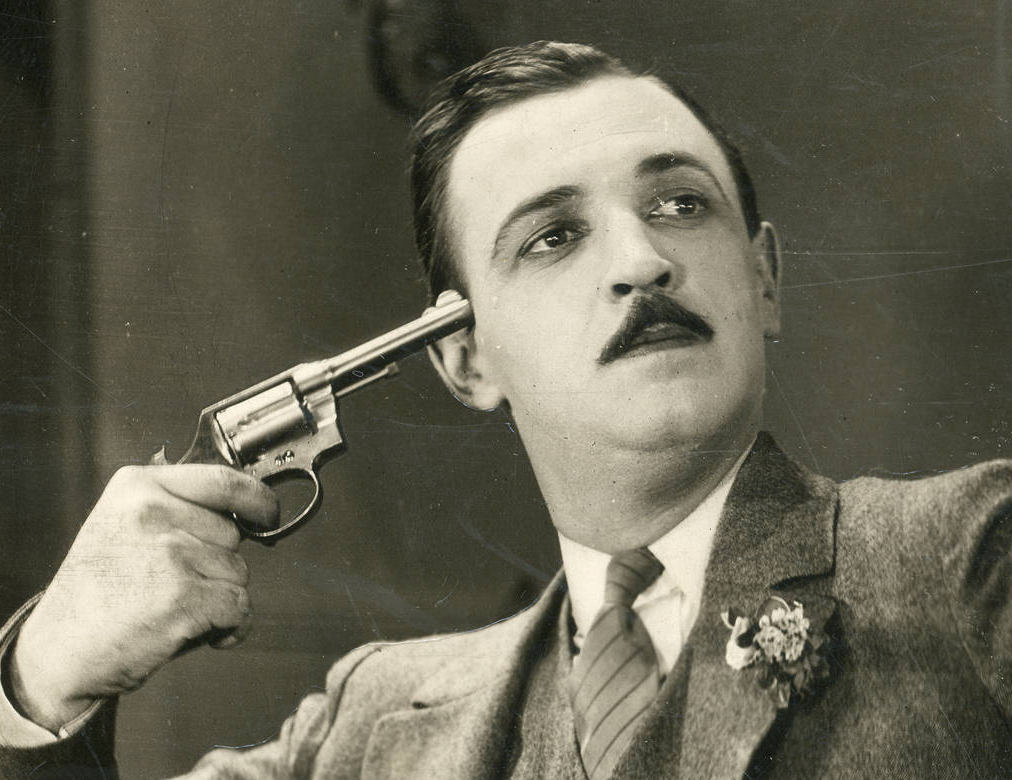
Russian roulette (Russian: Ру́сская руле́тка, romanized: Rússkaya rulétka) is a potentially lethal game of chance in which a player places a single round in a revolver, spins the cylinder, places the muzzle against the head or body (their opponent's or their own), and pulls the trigger. If the loaded chamber aligns with the barrel after cocking (with a single-action revolver), or is in the position which will be rotated to the barrel upon pulling the trigger (double-action), the weapon fires.
The term Russian roulette was possibly first used in a 1937 short story of the same name by Georges Surdez, published in the January 30, 1937, edition of Collier's magazine:
'Did you ever hear of Russian Roulette?' When I said I had not, he told me all about it. When he was with the Russian army in Rumania, around 1917, and things were cracking up, so that their officers felt that they were not only losing prestige, money, family, and country, but were being also dishonored before their colleagues of the Allied armies, some officer would suddenly pull out his revolver, anywhere, at the table, in a café, at a gathering of friends, remove a cartridge from the cylinder, spin the cylinder, snap it back in place, put it to his head and pull the trigger. There were five chances to one that the hammer would set off a live cartridge and blow his brains all over the place.
References to the term in the context of the Collier's story appeared in some newspapers during 1937. The first independent appearances of the term in newspapers began in 1938 with the reports of young men being killed while playing it. The earliest instance appears to have been the death of a 21-year-old former journalism student in Austin, Texas, appearing in The Austin Statesman and some other Texas newspapers on January 8, 1938. At least four other deaths were attributed to Russian roulette during the year: a 34-year-old policeman in Peoria, Illinois, a 20-year-old in Houston, an 18-year-old in Saratoga Springs, New York, and a 16-year-old in Los Angeles.
The term has become a metaphor for taking foolhardy risks, and its usage steadily increased in reportage of diplomacy, politics, economics, medicine, and sports.
An early example of Russian roulette can be found in the short story "The Fatalist" within the 1840 novel A Hero of Our Time written by Russian poet and writer Mikhail Lermontov. In the story, which is set in a Cossack village, the protagonist, Grigory Alexandrovich Pechorin, claims that there is no predestination and proposes a bet in order to prove it, laying about fifty gold pieces onto a table. A lieutenant of the dragoons of the Tsar, Vulič, a man of Serbian origins with a passion for gambling, accepts the challenge and randomly takes one of a number of pistols of various calibres from its nail, cocks it and pours gunpowder onto the pan. Nobody knows if the pistol is loaded or not. "Gentlemen! Who will pay 20 gold pieces for me?", Vulič asks, putting the muzzle of the pistol to his forehead. He then asks Grigory to throw a playing card in the air, and when the card lands, he pulls the trigger. The weapon fails to fire, but when Vulič cocks the pistol again and aims it at a service cap hanging over the window, a shot rings out and smoke fills the room.
The Deer Hunter is a 1978 Vietnam War drama film about three Slavic-American steelworkers that are imprisoned by the Viet Cong, and are forced to participate in Russian roulette along with captured South Vietnamese soldiers, while the jailers bet on who will survive. Several teen deaths following the movie's release caused both police and the media to accuse the film of inspiring the youths.
13 Tzameti is a 2005 dark psychological thriller by Georgian Babluani. Thirteen men undergo series of Russian roulette, arranging into a circle and pointing at the man in front of them (American remake in 2010). 'Tzameti' is the Georgian word for thirteen.
Hub AI
Russian roulette AI simulator
(@Russian roulette_simulator)
Russian roulette
Russian roulette (Russian: Ру́сская руле́тка, romanized: Rússkaya rulétka) is a potentially lethal game of chance in which a player places a single round in a revolver, spins the cylinder, places the muzzle against the head or body (their opponent's or their own), and pulls the trigger. If the loaded chamber aligns with the barrel after cocking (with a single-action revolver), or is in the position which will be rotated to the barrel upon pulling the trigger (double-action), the weapon fires.
The term Russian roulette was possibly first used in a 1937 short story of the same name by Georges Surdez, published in the January 30, 1937, edition of Collier's magazine:
'Did you ever hear of Russian Roulette?' When I said I had not, he told me all about it. When he was with the Russian army in Rumania, around 1917, and things were cracking up, so that their officers felt that they were not only losing prestige, money, family, and country, but were being also dishonored before their colleagues of the Allied armies, some officer would suddenly pull out his revolver, anywhere, at the table, in a café, at a gathering of friends, remove a cartridge from the cylinder, spin the cylinder, snap it back in place, put it to his head and pull the trigger. There were five chances to one that the hammer would set off a live cartridge and blow his brains all over the place.
References to the term in the context of the Collier's story appeared in some newspapers during 1937. The first independent appearances of the term in newspapers began in 1938 with the reports of young men being killed while playing it. The earliest instance appears to have been the death of a 21-year-old former journalism student in Austin, Texas, appearing in The Austin Statesman and some other Texas newspapers on January 8, 1938. At least four other deaths were attributed to Russian roulette during the year: a 34-year-old policeman in Peoria, Illinois, a 20-year-old in Houston, an 18-year-old in Saratoga Springs, New York, and a 16-year-old in Los Angeles.
The term has become a metaphor for taking foolhardy risks, and its usage steadily increased in reportage of diplomacy, politics, economics, medicine, and sports.
An early example of Russian roulette can be found in the short story "The Fatalist" within the 1840 novel A Hero of Our Time written by Russian poet and writer Mikhail Lermontov. In the story, which is set in a Cossack village, the protagonist, Grigory Alexandrovich Pechorin, claims that there is no predestination and proposes a bet in order to prove it, laying about fifty gold pieces onto a table. A lieutenant of the dragoons of the Tsar, Vulič, a man of Serbian origins with a passion for gambling, accepts the challenge and randomly takes one of a number of pistols of various calibres from its nail, cocks it and pours gunpowder onto the pan. Nobody knows if the pistol is loaded or not. "Gentlemen! Who will pay 20 gold pieces for me?", Vulič asks, putting the muzzle of the pistol to his forehead. He then asks Grigory to throw a playing card in the air, and when the card lands, he pulls the trigger. The weapon fails to fire, but when Vulič cocks the pistol again and aims it at a service cap hanging over the window, a shot rings out and smoke fills the room.
The Deer Hunter is a 1978 Vietnam War drama film about three Slavic-American steelworkers that are imprisoned by the Viet Cong, and are forced to participate in Russian roulette along with captured South Vietnamese soldiers, while the jailers bet on who will survive. Several teen deaths following the movie's release caused both police and the media to accuse the film of inspiring the youths.
13 Tzameti is a 2005 dark psychological thriller by Georgian Babluani. Thirteen men undergo series of Russian roulette, arranging into a circle and pointing at the man in front of them (American remake in 2010). 'Tzameti' is the Georgian word for thirteen.