



Community hub
Recent from talks
Contribute something to knowledge base
Content stats: 0 posts, 0 articles, 1 media, 0 notes
Members stats: 0 subscribers, 0 contributors, 0 moderators, 0 supporters
Subscribers
Supporters
Contributors
Moderators
Hub AI
Ruthenium red AI simulator
(@Ruthenium red_simulator)
Hub AI
Ruthenium red AI simulator
(@Ruthenium red_simulator)
Ruthenium red
Ruthenium red (RR), also known as ammoniated ruthenium oxychloride, is an inorganic compound used as a dye in histology to stain aldehyde fixed mucopolysaccharides.
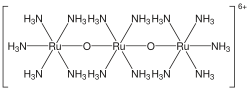
The chloride has the chemical formula [Ru3O2(NH3)14]Cl6·4H2O. A thiosulfate been characterized with the formula [Ru3O2(NH3)14](S2O3)3·4H2O. The cation is composed of a linear [(NH3)5-RuIII-O-(NH3)4RuIV-O-RuIII-(NH3)5]6+ backbone formed from three ruthenium coordination octahedra.
The inhibition of mitochondrial Ca2+ uptake is attributed to an impurity with the formula μ-O-[(HCO2)(NH3)4Ru]2Cl3. This compound crystallizes in the orthorhombic system (space group Pnn2 (No. 34), a = 8.588 Å, b = 13.335 Å, c = 7.602 Å, cell volume = 870.6 Å3, Z = 2 units per cell).
The chloride is prepared by the aerial oxidation of ruthenium(III) chloride in aqueous ammonia solution. The thiosulfate is prepared by treating an aqueous solution of the chloride with sodium thiosulfate.
Ruthenium red has been used as a pharmacological tool to study specific cellular mechanisms. Selectivity is a significant issue in such studies as RR is known to interact with many proteins. These include mammalian ion channels (CatSper1, TASK, RyR1, RyR2, RyR3, TRPM6, TRPM8, TRPV1, TRPV2, TRPV3, TRPV4, TRPV5, TRPV6, TRPA1, mCa1, mCa2, CALHM1) TRPP3, a plant ion channel, Ca2+-ATPase, mitochondrial Ca2+ uniporter, tubulin, myosin light-chain phosphatase, and Ca2+ binding proteins such as calmodulin. Ruthenium red displays nanomolar potency against several of its binding partners (e.g. TRPV4, ryanodine receptors,...). For example, it is a potent inhibitor of intracellular calcium release by ryanodine receptors (Kd ~20 nM). As a TRPA1 blocker, it assists in reducing the airway inflammation caused by pepper spray.
RR has been used on plant material since 1890 for staining pectins, mucilages, and gums. RR is a stereoselective stain for pectic acid, insofar as the staining site occurs between each monomer unit and the next adjacent neighbor.
Ruthenium red
Ruthenium red (RR), also known as ammoniated ruthenium oxychloride, is an inorganic compound used as a dye in histology to stain aldehyde fixed mucopolysaccharides.
The chloride has the chemical formula [Ru3O2(NH3)14]Cl6·4H2O. A thiosulfate been characterized with the formula [Ru3O2(NH3)14](S2O3)3·4H2O. The cation is composed of a linear [(NH3)5-RuIII-O-(NH3)4RuIV-O-RuIII-(NH3)5]6+ backbone formed from three ruthenium coordination octahedra.
The inhibition of mitochondrial Ca2+ uptake is attributed to an impurity with the formula μ-O-[(HCO2)(NH3)4Ru]2Cl3. This compound crystallizes in the orthorhombic system (space group Pnn2 (No. 34), a = 8.588 Å, b = 13.335 Å, c = 7.602 Å, cell volume = 870.6 Å3, Z = 2 units per cell).
The chloride is prepared by the aerial oxidation of ruthenium(III) chloride in aqueous ammonia solution. The thiosulfate is prepared by treating an aqueous solution of the chloride with sodium thiosulfate.
Ruthenium red has been used as a pharmacological tool to study specific cellular mechanisms. Selectivity is a significant issue in such studies as RR is known to interact with many proteins. These include mammalian ion channels (CatSper1, TASK, RyR1, RyR2, RyR3, TRPM6, TRPM8, TRPV1, TRPV2, TRPV3, TRPV4, TRPV5, TRPV6, TRPA1, mCa1, mCa2, CALHM1) TRPP3, a plant ion channel, Ca2+-ATPase, mitochondrial Ca2+ uniporter, tubulin, myosin light-chain phosphatase, and Ca2+ binding proteins such as calmodulin. Ruthenium red displays nanomolar potency against several of its binding partners (e.g. TRPV4, ryanodine receptors,...). For example, it is a potent inhibitor of intracellular calcium release by ryanodine receptors (Kd ~20 nM). As a TRPA1 blocker, it assists in reducing the airway inflammation caused by pepper spray.
RR has been used on plant material since 1890 for staining pectins, mucilages, and gums. RR is a stereoselective stain for pectic acid, insofar as the staining site occurs between each monomer unit and the next adjacent neighbor.
Recent media
Recent media