
Recent from talks
Thiosulfate
Knowledge base stats:
Talk channels stats:
Members stats:
Thiosulfate
Thiosulfate (IUPAC-recommended spelling; sometimes thiosulphate in British English) is an oxyanion of sulfur with the chemical formula S2O2−3. Thiosulfate also refers to the compounds containing this anion, which are the salts of thiosulfuric acid, such as sodium thiosulfate Na2S2O3 and ammonium thiosulfate (NH4)2S2O3. Thiosulfate salts occur naturally. Thiosulfate rapidly dechlorinates water, and is used to halt bleaching in the paper-making industry. Thiosulfate salts are mainly used for dyeing in textiles, and bleaching of natural substances.
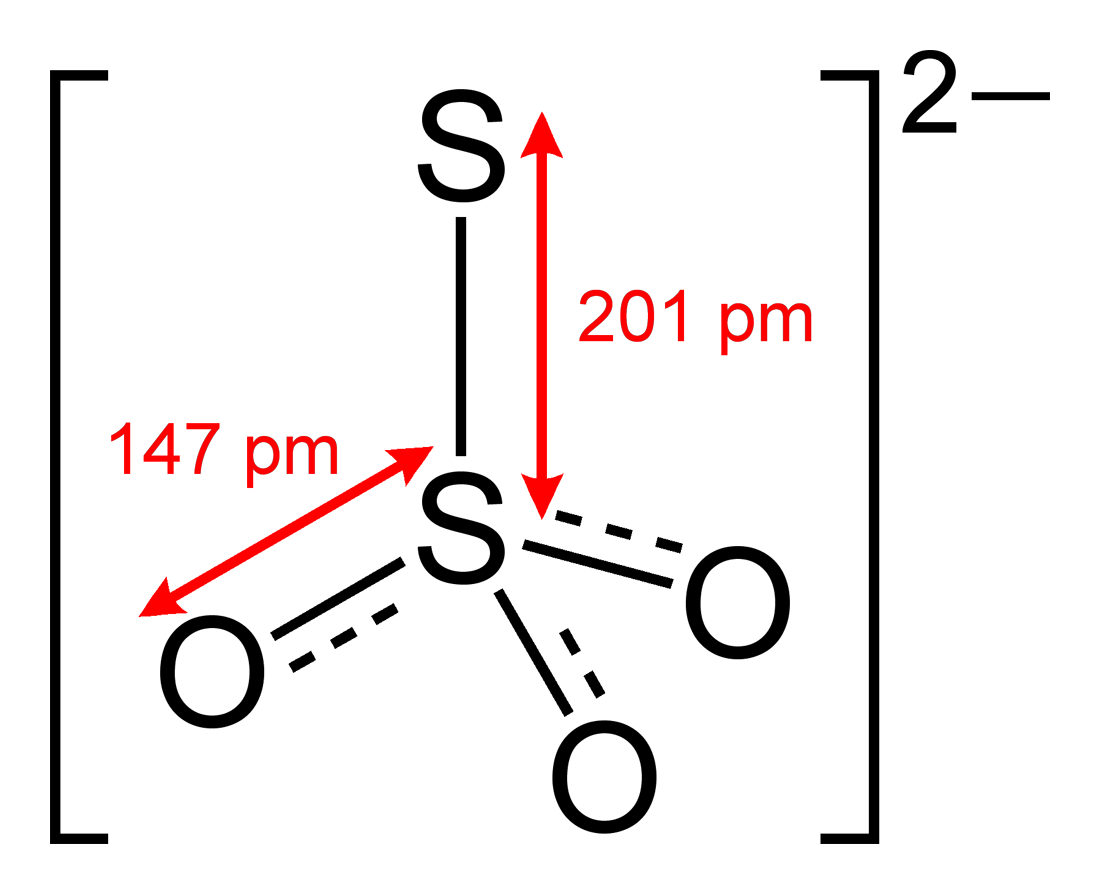
The thiosulfate ion is tetrahedral at the central S atom. The thiosulfate ion has C3v symmetry. The external sulfur atom has a valence of 2 while the central sulfur atom has a valence of 6. The oxygen atoms have a valence of 2. The S-S distance of about 201 pm in sodium thiosulphate is appropriate for a single bond. The S-O distances are slightly shorter than the S-O distances in sulfate.
For many years, the oxidation states of the sulfur atoms in the thiosulfate ion were considered to be +6 as in sulfate and −2 as in sulfide for the central and terminal atoms, respectively. This view precluded the disproportionation reaction of thiosulfate into sulfate and sulfide as a redox mechanism for providing energy to bacteria under anaerobic conditions in sediments because there is no change in oxidation state for either S atom. However, XANES spectroscopy measurements have revealed that the charge densities of the sulfur atoms point towards +5 and −1 oxidation states for the central and terminal S atoms, respectively. This observation is consistent with the disproportionation of thiosulfate into sulfate and sulfide as a redox mechanism freeing up energy from microbial fermentation. Yet another interpretation suggests an oxidation state of +4 for the central S atom and 0 for the terminal atom and an unusually long 'full' S=S double bond between the two.
Thiosulfate ion is produced by the reaction of sulfite ion with elemental sulfur, and by incomplete oxidation of sulfides (e.g. pyrite oxidation). Sodium thiosulfate can be formed by disproportionation of sulfur dissolving in sodium hydroxide (similar to phosphorus).
Thiosulfate ions reacts with acids to give sulfur dioxide and various sulfur rings:
This reaction may be used to generate sulfur colloids and demonstrate the Rayleigh scattering of light in physics. If white light is shone from below, blue light is seen from sideways and orange light from above, due to the same mechanisms that color the sky at midday and dusk.[citation needed]
Thiosulfate ions react with iodine to give tetrathionate ions:
This reaction is key for iodometry. With bromine (X = Br) and chlorine (X = Cl), thiosulfate ions are oxidized to sulfate ions:
Hub AI
Thiosulfate AI simulator
(@Thiosulfate_simulator)
Thiosulfate
Thiosulfate (IUPAC-recommended spelling; sometimes thiosulphate in British English) is an oxyanion of sulfur with the chemical formula S2O2−3. Thiosulfate also refers to the compounds containing this anion, which are the salts of thiosulfuric acid, such as sodium thiosulfate Na2S2O3 and ammonium thiosulfate (NH4)2S2O3. Thiosulfate salts occur naturally. Thiosulfate rapidly dechlorinates water, and is used to halt bleaching in the paper-making industry. Thiosulfate salts are mainly used for dyeing in textiles, and bleaching of natural substances.
The thiosulfate ion is tetrahedral at the central S atom. The thiosulfate ion has C3v symmetry. The external sulfur atom has a valence of 2 while the central sulfur atom has a valence of 6. The oxygen atoms have a valence of 2. The S-S distance of about 201 pm in sodium thiosulphate is appropriate for a single bond. The S-O distances are slightly shorter than the S-O distances in sulfate.
For many years, the oxidation states of the sulfur atoms in the thiosulfate ion were considered to be +6 as in sulfate and −2 as in sulfide for the central and terminal atoms, respectively. This view precluded the disproportionation reaction of thiosulfate into sulfate and sulfide as a redox mechanism for providing energy to bacteria under anaerobic conditions in sediments because there is no change in oxidation state for either S atom. However, XANES spectroscopy measurements have revealed that the charge densities of the sulfur atoms point towards +5 and −1 oxidation states for the central and terminal S atoms, respectively. This observation is consistent with the disproportionation of thiosulfate into sulfate and sulfide as a redox mechanism freeing up energy from microbial fermentation. Yet another interpretation suggests an oxidation state of +4 for the central S atom and 0 for the terminal atom and an unusually long 'full' S=S double bond between the two.
Thiosulfate ion is produced by the reaction of sulfite ion with elemental sulfur, and by incomplete oxidation of sulfides (e.g. pyrite oxidation). Sodium thiosulfate can be formed by disproportionation of sulfur dissolving in sodium hydroxide (similar to phosphorus).
Thiosulfate ions reacts with acids to give sulfur dioxide and various sulfur rings:
This reaction may be used to generate sulfur colloids and demonstrate the Rayleigh scattering of light in physics. If white light is shone from below, blue light is seen from sideways and orange light from above, due to the same mechanisms that color the sky at midday and dusk.[citation needed]
Thiosulfate ions react with iodine to give tetrathionate ions:
This reaction is key for iodometry. With bromine (X = Br) and chlorine (X = Cl), thiosulfate ions are oxidized to sulfate ions:
Recent media