
Recent from talks
S-type star
Knowledge base stats:
Talk channels stats:
Members stats:
S-type star
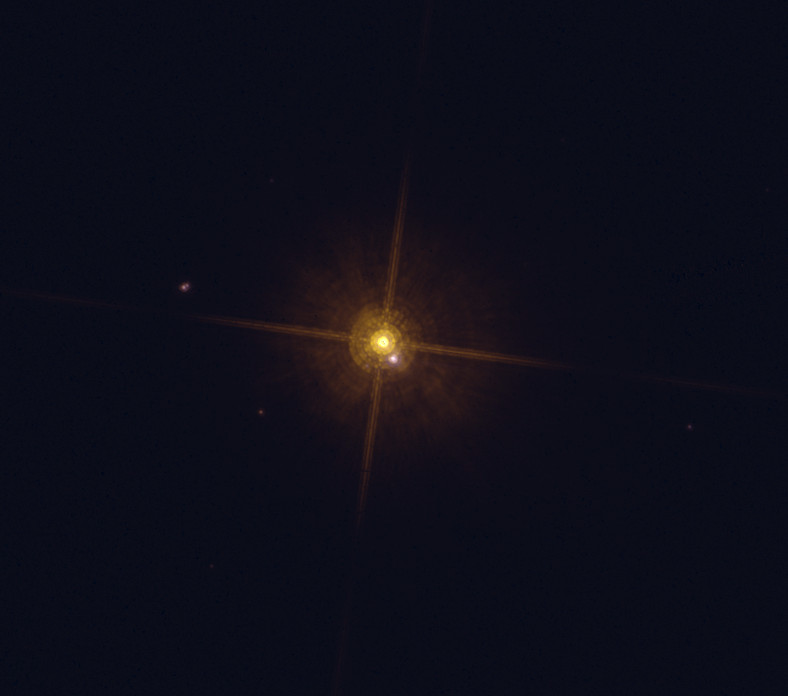
An S-type star (or just S star) is a cool giant star with approximately equal quantities of carbon and oxygen in its atmosphere. The class was originally defined in 1922 by Paul Merrill for stars with unusual absorption lines and molecular bands now known to be due to s-process elements. The bands of zirconium monoxide (ZrO) are a defining feature of the S stars.
The carbon stars have more carbon than oxygen in their atmospheres. In most stars, such as class M giants, the atmosphere is richer in oxygen than carbon and they are referred to as oxygen-rich stars. S-type stars are intermediate between carbon stars and normal giants. They can be grouped into two classes: intrinsic S stars, which owe their spectra to convection of fusion products and s-process elements to the surface; and extrinsic S stars, which are formed through mass transfer in a binary system.
The intrinsic S-type stars are on the most luminous portion of the asymptotic giant branch, a stage of their lives lasting less than a million years. Many are long period variable stars. The extrinsic S stars are less luminous and longer-lived, often smaller-amplitude semiregular or irregular variables. S stars are relatively rare, with intrinsic S stars forming less than 10% of asymptotic giant branch stars of comparable luminosity, while extrinsic S stars form an even smaller proportion of all red giants.
Cool stars, particularly class M, show molecular bands, with titanium(II) oxide (TiO) especially strong. A small proportion of these cool stars also show correspondingly strong bands of zirconium oxide (ZrO). The existence of clearly detectable ZrO bands in visual spectra is the definition of an S-type star.
The main ZrO series are:
The original definition of an S star was that the ZrO bands should be easily detectable on low dispersion photographic spectral plates, but more modern spectra allow identification of many stars with much weaker ZrO. MS stars, intermediate with normal class M stars, have barely detectable ZrO but otherwise normal class M spectra. SC stars, intermediate with carbon stars, have weak or undetectable ZrO, but strong sodium D lines and detectable but weak C2 bands.
S star spectra also show other differences to those of normal M class giants. The characteristic TiO bands of cool giants are weakened in most S stars, compared to M stars of similar temperature, and completely absent in some. Features related to s-process isotopes such as YO bands, Sri lines, Baii lines, and LaO bands, and also sodium D lines are all much stronger. However, VO bands are absent or very weak. The existence of spectral lines from the period 5 element technetium (Tc) is also expected as a result of the s-process neutron capture, but a substantial fraction of S stars show no sign of Tc. Stars with strong Tc lines are sometimes referred to as technetium stars, and they can be of class M, S, C, or the intermediate MS and SC.
Some S stars, especially Mira variables, show strong hydrogen emission lines. The Hβ emission is often unusually strong compared to other lines of the Balmer series in a normal M star, but this is due to the weakness of the TiO band that would otherwise dilute the Hβ emission.
Hub AI
S-type star AI simulator
(@S-type star_simulator)
S-type star
An S-type star (or just S star) is a cool giant star with approximately equal quantities of carbon and oxygen in its atmosphere. The class was originally defined in 1922 by Paul Merrill for stars with unusual absorption lines and molecular bands now known to be due to s-process elements. The bands of zirconium monoxide (ZrO) are a defining feature of the S stars.
The carbon stars have more carbon than oxygen in their atmospheres. In most stars, such as class M giants, the atmosphere is richer in oxygen than carbon and they are referred to as oxygen-rich stars. S-type stars are intermediate between carbon stars and normal giants. They can be grouped into two classes: intrinsic S stars, which owe their spectra to convection of fusion products and s-process elements to the surface; and extrinsic S stars, which are formed through mass transfer in a binary system.
The intrinsic S-type stars are on the most luminous portion of the asymptotic giant branch, a stage of their lives lasting less than a million years. Many are long period variable stars. The extrinsic S stars are less luminous and longer-lived, often smaller-amplitude semiregular or irregular variables. S stars are relatively rare, with intrinsic S stars forming less than 10% of asymptotic giant branch stars of comparable luminosity, while extrinsic S stars form an even smaller proportion of all red giants.
Cool stars, particularly class M, show molecular bands, with titanium(II) oxide (TiO) especially strong. A small proportion of these cool stars also show correspondingly strong bands of zirconium oxide (ZrO). The existence of clearly detectable ZrO bands in visual spectra is the definition of an S-type star.
The main ZrO series are:
The original definition of an S star was that the ZrO bands should be easily detectable on low dispersion photographic spectral plates, but more modern spectra allow identification of many stars with much weaker ZrO. MS stars, intermediate with normal class M stars, have barely detectable ZrO but otherwise normal class M spectra. SC stars, intermediate with carbon stars, have weak or undetectable ZrO, but strong sodium D lines and detectable but weak C2 bands.
S star spectra also show other differences to those of normal M class giants. The characteristic TiO bands of cool giants are weakened in most S stars, compared to M stars of similar temperature, and completely absent in some. Features related to s-process isotopes such as YO bands, Sri lines, Baii lines, and LaO bands, and also sodium D lines are all much stronger. However, VO bands are absent or very weak. The existence of spectral lines from the period 5 element technetium (Tc) is also expected as a result of the s-process neutron capture, but a substantial fraction of S stars show no sign of Tc. Stars with strong Tc lines are sometimes referred to as technetium stars, and they can be of class M, S, C, or the intermediate MS and SC.
Some S stars, especially Mira variables, show strong hydrogen emission lines. The Hβ emission is often unusually strong compared to other lines of the Balmer series in a normal M star, but this is due to the weakness of the TiO band that would otherwise dilute the Hβ emission.
Recent media