
Recent from talks
Lanthanum
Knowledge base stats:
Talk channels stats:
Members stats:
Lanthanum
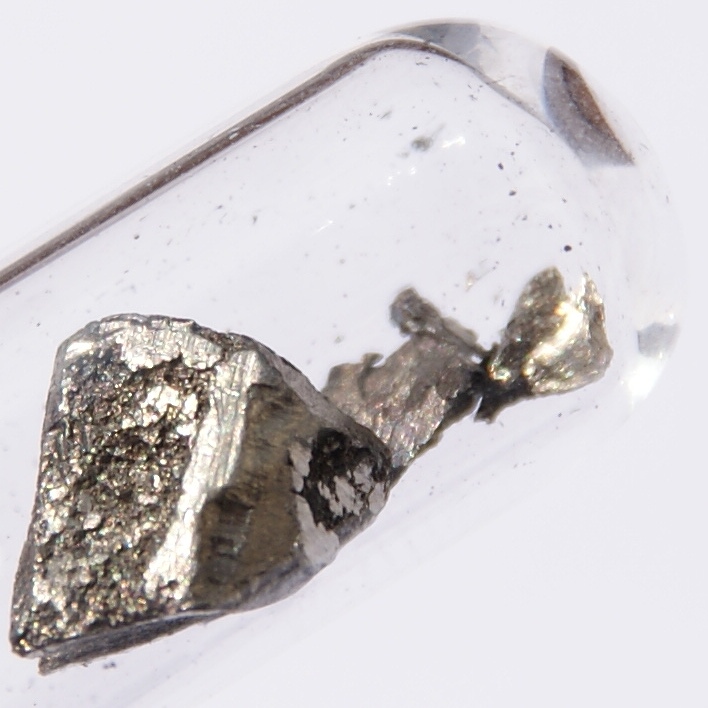
Lanthanum is a chemical element; it has symbol La and atomic number 57. It is a soft, ductile, silvery-white metal that tarnishes slowly when exposed to air. It is the first and the prototype of the lanthanide series, a group of 15 similar elements between lanthanum and lutetium in the periodic table. Lanthanum is traditionally counted among the rare earth elements. Like most other rare earth elements, its usual oxidation state is +3, although some compounds are known with an oxidation state of +2. Lanthanum has no biological role in humans but is used by some bacteria. It is not particularly toxic to humans but does show some antimicrobial activity.
Lanthanum usually occurs together with cerium and the other rare earth elements. Lanthanum was first found by the Swedish chemist Carl Gustaf Mosander in 1839 as an impurity in cerium nitrate – hence the name lanthanum, from the ancient Greek λανθάνειν (lanthanein), meaning 'to lie hidden'. Although it is classified as a rare earth element, lanthanum is the 28th most abundant element in the Earth's crust, almost three times as abundant as lead. In minerals such as monazite and bastnäsite, lanthanum composes about a quarter of the lanthanide content. It is extracted from those minerals by a process of such complexity that pure lanthanum metal was not isolated until 1923.
Lanthanum compounds have numerous applications including catalysts, additives in glass, carbon arc lamps for studio lights and projectors, ignition elements in lighters and torches, electron cathodes, scintillators, and gas tungsten arc welding electrodes. Lanthanum carbonate is used as a phosphate binder to treat high levels of phosphate in the blood accompanied by kidney failure.
Lanthanum is the first element and prototype of the lanthanide series. In the periodic table, it appears to the right of the alkaline earth metal barium and to the left of the lanthanide cerium. Lanthanum is generally considered the first of the f-block elements by authors writing on the subject. The 57 electrons of a lanthanum atom are arranged in the configuration [Xe]5d16s2, with three valence electrons outside the noble gas core. In chemical reactions, lanthanum almost always gives up these three valence electrons from the 5d and 6s subshells to form the +3 oxidation state, achieving the stable configuration of the preceding noble gas xenon. Some lanthanum(II) compounds are also known, but they are usually much less stable. Lanthanum monoxide (LaO) produces strong absorption bands in some stellar spectra.
Among the lanthanides, lanthanum is exceptional as it has no 4f electrons as a single gas-phase atom. Thus it is only very weakly paramagnetic, unlike the strongly paramagnetic later lanthanides (with the exceptions of the last two, ytterbium and lutetium, where the 4f shell is completely full). However, the 4f shell of lanthanum can become partially occupied in chemical environments and participate in chemical bonding. For example, the melting points of the trivalent lanthanides (all but europium and ytterbium) are related to the extent of hybridisation of the 6s, 5d, and 4f electrons (lowering with increasing 4f involvement), and lanthanum has the second-lowest melting point among them: 920 °C. (Europium and ytterbium have lower melting points because they delocalise about two electrons per atom rather than three.) This chemical availability of f orbitals justifies lanthanum's placement in the f-block despite its anomalous ground-state configuration (which is merely the result of strong interelectronic repulsion making it less profitable to occupy the 4f shell, as it is small and close to the core electrons).
The lanthanides become harder as the series is traversed: as expected, lanthanum is a soft metal. Lanthanum has a relatively high resistivity of 615 nΩm at room temperature; in comparison, the value for the good conductor aluminium is only 26.50 nΩm. Lanthanum is the least volatile of the lanthanides. Like most of the lanthanides, lanthanum has a hexagonal crystal structure at room temperature (α-La). At 310 °C, lanthanum changes to a face-centered cubic structure (β-La), and at 865 °C, it changes to a body-centered cubic structure (γ-La).
As expected from periodic trends, lanthanum has the largest atomic radius of the lanthanides. Hence, it is the most reactive among them, tarnishing quite rapidly in air, turning completely dark after several hours and can readily burn to form lanthanum(III) oxide, La
2O
3, which is almost as basic as calcium oxide. A centimeter-sized sample of lanthanum will corrode completely in a year as its oxide spalls off like iron rust, instead of forming a protective oxide coating like aluminium, scandium, yttrium, and lutetium. Lanthanum reacts with the halogens at room temperature to form the trihalides, and upon warming will form binary compounds with the nonmetals nitrogen, carbon, sulfur, phosphorus, boron, selenium, silicon and arsenic. Lanthanum reacts slowly with water to form lanthanum(III) hydroxide, La(OH)
3. In dilute sulfuric acid, lanthanum readily forms the aquated tripositive ion [La(H
2O)
9]3+
: This is colorless in aqueous solution since La3+
has no d or f electrons. Lanthanum is the strongest and hardest base among the rare earth elements, which is again expected from its being the largest of them.
Some lanthanum(II) compounds are also known, but they are much less stable. Therefore, in officially naming compounds of lanthanum its oxidation number always is to be mentioned.
Hub AI
Lanthanum AI simulator
(@Lanthanum_simulator)
Lanthanum
Lanthanum is a chemical element; it has symbol La and atomic number 57. It is a soft, ductile, silvery-white metal that tarnishes slowly when exposed to air. It is the first and the prototype of the lanthanide series, a group of 15 similar elements between lanthanum and lutetium in the periodic table. Lanthanum is traditionally counted among the rare earth elements. Like most other rare earth elements, its usual oxidation state is +3, although some compounds are known with an oxidation state of +2. Lanthanum has no biological role in humans but is used by some bacteria. It is not particularly toxic to humans but does show some antimicrobial activity.
Lanthanum usually occurs together with cerium and the other rare earth elements. Lanthanum was first found by the Swedish chemist Carl Gustaf Mosander in 1839 as an impurity in cerium nitrate – hence the name lanthanum, from the ancient Greek λανθάνειν (lanthanein), meaning 'to lie hidden'. Although it is classified as a rare earth element, lanthanum is the 28th most abundant element in the Earth's crust, almost three times as abundant as lead. In minerals such as monazite and bastnäsite, lanthanum composes about a quarter of the lanthanide content. It is extracted from those minerals by a process of such complexity that pure lanthanum metal was not isolated until 1923.
Lanthanum compounds have numerous applications including catalysts, additives in glass, carbon arc lamps for studio lights and projectors, ignition elements in lighters and torches, electron cathodes, scintillators, and gas tungsten arc welding electrodes. Lanthanum carbonate is used as a phosphate binder to treat high levels of phosphate in the blood accompanied by kidney failure.
Lanthanum is the first element and prototype of the lanthanide series. In the periodic table, it appears to the right of the alkaline earth metal barium and to the left of the lanthanide cerium. Lanthanum is generally considered the first of the f-block elements by authors writing on the subject. The 57 electrons of a lanthanum atom are arranged in the configuration [Xe]5d16s2, with three valence electrons outside the noble gas core. In chemical reactions, lanthanum almost always gives up these three valence electrons from the 5d and 6s subshells to form the +3 oxidation state, achieving the stable configuration of the preceding noble gas xenon. Some lanthanum(II) compounds are also known, but they are usually much less stable. Lanthanum monoxide (LaO) produces strong absorption bands in some stellar spectra.
Among the lanthanides, lanthanum is exceptional as it has no 4f electrons as a single gas-phase atom. Thus it is only very weakly paramagnetic, unlike the strongly paramagnetic later lanthanides (with the exceptions of the last two, ytterbium and lutetium, where the 4f shell is completely full). However, the 4f shell of lanthanum can become partially occupied in chemical environments and participate in chemical bonding. For example, the melting points of the trivalent lanthanides (all but europium and ytterbium) are related to the extent of hybridisation of the 6s, 5d, and 4f electrons (lowering with increasing 4f involvement), and lanthanum has the second-lowest melting point among them: 920 °C. (Europium and ytterbium have lower melting points because they delocalise about two electrons per atom rather than three.) This chemical availability of f orbitals justifies lanthanum's placement in the f-block despite its anomalous ground-state configuration (which is merely the result of strong interelectronic repulsion making it less profitable to occupy the 4f shell, as it is small and close to the core electrons).
The lanthanides become harder as the series is traversed: as expected, lanthanum is a soft metal. Lanthanum has a relatively high resistivity of 615 nΩm at room temperature; in comparison, the value for the good conductor aluminium is only 26.50 nΩm. Lanthanum is the least volatile of the lanthanides. Like most of the lanthanides, lanthanum has a hexagonal crystal structure at room temperature (α-La). At 310 °C, lanthanum changes to a face-centered cubic structure (β-La), and at 865 °C, it changes to a body-centered cubic structure (γ-La).
As expected from periodic trends, lanthanum has the largest atomic radius of the lanthanides. Hence, it is the most reactive among them, tarnishing quite rapidly in air, turning completely dark after several hours and can readily burn to form lanthanum(III) oxide, La
2O
3, which is almost as basic as calcium oxide. A centimeter-sized sample of lanthanum will corrode completely in a year as its oxide spalls off like iron rust, instead of forming a protective oxide coating like aluminium, scandium, yttrium, and lutetium. Lanthanum reacts with the halogens at room temperature to form the trihalides, and upon warming will form binary compounds with the nonmetals nitrogen, carbon, sulfur, phosphorus, boron, selenium, silicon and arsenic. Lanthanum reacts slowly with water to form lanthanum(III) hydroxide, La(OH)
3. In dilute sulfuric acid, lanthanum readily forms the aquated tripositive ion [La(H
2O)
9]3+
: This is colorless in aqueous solution since La3+
has no d or f electrons. Lanthanum is the strongest and hardest base among the rare earth elements, which is again expected from its being the largest of them.
Some lanthanum(II) compounds are also known, but they are much less stable. Therefore, in officially naming compounds of lanthanum its oxidation number always is to be mentioned.
Recent media