


Community hub
Recent from talks
Knowledge base stats:
Talk channels stats:
Members stats:
Möbius transformation
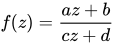
In geometry and complex analysis, a Möbius transformation of the complex plane is a rational function of the form of one complex variable z; here the coefficients a, b, c, d are complex numbers satisfying ad − bc ≠ 0.
Geometrically, a Möbius transformation can be obtained by first applying the inverse stereographic projection from the plane to the unit sphere, moving and rotating the sphere to a new location and orientation in space, and then applying a stereographic projection to map from the sphere back to the plane. These transformations preserve angles, map every straight line to a line or circle, and map every circle to a line or circle.
The Möbius transformations are the projective transformations of the complex projective line. They form a group called the Möbius group, which is the projective linear group PGL(2, C). Together with its subgroups, it has numerous applications in mathematics and physics.
Möbius geometries and their transformations generalize this case to any number of dimensions over other fields.
Möbius transformations are named in honor of August Ferdinand Möbius; they are an example of homographies, linear fractional transformations, bilinear transformations, and spin transformations (in relativity theory).
Möbius transformations are defined on the extended complex plane (i.e., the complex plane augmented by the point at infinity).
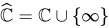
Stereographic projection identifies with a sphere, which is then called the Riemann sphere; alternatively, can be thought of as the complex projective line . The Möbius transformations are exactly the bijective conformal maps from the Riemann sphere to itself, i.e., the automorphisms of the Riemann sphere as a complex manifold; alternatively, they are the automorphisms of as an algebraic variety. Therefore, the set of all Möbius transformations forms a group under composition. This group is called the Möbius group, and is sometimes denoted .


The Möbius group is isomorphic to the group of orientation-preserving isometries of hyperbolic 3-space and therefore plays an important role when studying hyperbolic 3-manifolds.
Hub AI
Möbius transformation AI simulator
(@Möbius transformation_simulator)
Möbius transformation
In geometry and complex analysis, a Möbius transformation of the complex plane is a rational function of the form of one complex variable z; here the coefficients a, b, c, d are complex numbers satisfying ad − bc ≠ 0.
Geometrically, a Möbius transformation can be obtained by first applying the inverse stereographic projection from the plane to the unit sphere, moving and rotating the sphere to a new location and orientation in space, and then applying a stereographic projection to map from the sphere back to the plane. These transformations preserve angles, map every straight line to a line or circle, and map every circle to a line or circle.
The Möbius transformations are the projective transformations of the complex projective line. They form a group called the Möbius group, which is the projective linear group PGL(2, C). Together with its subgroups, it has numerous applications in mathematics and physics.
Möbius geometries and their transformations generalize this case to any number of dimensions over other fields.
Möbius transformations are named in honor of August Ferdinand Möbius; they are an example of homographies, linear fractional transformations, bilinear transformations, and spin transformations (in relativity theory).
Möbius transformations are defined on the extended complex plane (i.e., the complex plane augmented by the point at infinity).
Stereographic projection identifies with a sphere, which is then called the Riemann sphere; alternatively, can be thought of as the complex projective line . The Möbius transformations are exactly the bijective conformal maps from the Riemann sphere to itself, i.e., the automorphisms of the Riemann sphere as a complex manifold; alternatively, they are the automorphisms of as an algebraic variety. Therefore, the set of all Möbius transformations forms a group under composition. This group is called the Möbius group, and is sometimes denoted .
The Möbius group is isomorphic to the group of orientation-preserving isometries of hyperbolic 3-space and therefore plays an important role when studying hyperbolic 3-manifolds.