Hubbry Logo
IsometryIsometryMain
Open search
Isometry
Community hub
Isometry
logo
8 pages, 0 posts
0 subscribers
Be the first to start a discussion here.
Contribute something
Isometry
Isometry
from Wikipedia
A composition of two opposite isometries is a direct isometry. A reflection in a line is an opposite isometry, like R 1 or R 2 on the image. Translation T is a direct isometry: a rigid motion.[1]

In mathematics, an isometry (or congruence, or congruent transformation) is a distance-preserving transformation between metric spaces, usually assumed to be bijective.[a] The word isometry is derived from the Ancient Greek: ἴσος isos meaning "equal", and μέτρον metron meaning "measure". If the transformation is from a metric space to itself, it is a kind of geometric transformation known as a motion.

Introduction

[edit]

Given a metric space (loosely, a set and a scheme for assigning distances between elements of the set), an isometry is a transformation which maps elements to the same or another metric space such that the distance between the image elements in the new metric space is equal to the distance between the elements in the original metric space. In a two-dimensional or three-dimensional Euclidean space, two geometric figures are congruent if they are related by an isometry;[b] the isometry that relates them is either a rigid motion (translation or rotation), or a composition of a rigid motion and a reflection.

Isometries are often used in constructions where one space is embedded in another space. For instance, the completion of a metric space involves an isometry from into a quotient set of the space of Cauchy sequences on The original space is thus isometrically isomorphic to a subspace of a complete metric space, and it is usually identified with this subspace. Other embedding constructions show that every metric space is isometrically isomorphic to a closed subset of some normed vector space and that every complete metric space is isometrically isomorphic to a closed subset of some Banach space.

An isometric surjective linear operator on a Hilbert space is called a unitary operator.

Definition

[edit]

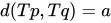
Let and be metric spaces with metrics (e.g., distances) and A map is called an isometry or distance-preserving map if for any ,

[4][c]

An isometry is automatically injective;[a] otherwise two distinct points, a and b, could be mapped to the same point, thereby contradicting the coincidence axiom of the metric d, i.e., if and only if . This proof is similar to the proof that an order embedding between partially ordered sets is injective. Clearly, every isometry between metric spaces is a topological embedding.

A global isometry, isometric isomorphism or congruence mapping is a bijective isometry. Like any other bijection, a global isometry has a function inverse. The inverse of a global isometry is also a global isometry.

Two metric spaces X and Y are called isometric if there is a bijective isometry from X to Y. The set of bijective isometries from a metric space to itself forms a group with respect to function composition, called the isometry group.

There is also the weaker notion of path isometry or arcwise isometry:

A path isometry or arcwise isometry is a map which preserves the lengths of curves; such a map is not necessarily an isometry in the distance preserving sense, and it need not necessarily be bijective, or even injective.[5][6] This term is often abridged to simply isometry, so one should take care to determine from context which type is intended.

Examples

Isometries between normed spaces

[edit]

The following theorem is due to Mazur and Ulam.

Definition:[7] The midpoint of two elements x and y in a vector space is the vector 1/2(x + y).

Theorem[7][8]Let A : XY be a surjective isometry between normed spaces that maps 0 to 0 (Stefan Banach called such maps rotations) where note that A is not assumed to be a linear isometry. Then A maps midpoints to midpoints and is linear as a map over the real numbers . If X and Y are complex vector spaces then A may fail to be linear as a map over .

Linear isometry

[edit]

Given two normed vector spaces and a linear isometry is a linear map that preserves the norms:

for all [9] Linear isometries are distance-preserving maps in the above sense. They are global isometries if and only if they are surjective.

In an inner product space, the above definition reduces to

for all which is equivalent to saying that This also implies that isometries preserve inner products, as

.

Linear isometries are not always unitary operators, though, as those require additionally that and (i.e. the domain and codomain coincide and defines a coisometry).

By the Mazur–Ulam theorem, any isometry of normed vector spaces over is affine.

A linear isometry also necessarily preserves angles, therefore a linear isometry transformation is a conformal linear transformation.

Examples

Manifold

[edit]

An isometry of a manifold is any (smooth) mapping of that manifold into itself, or into another manifold that preserves the notion of distance between points. The definition of an isometry requires the notion of a metric on the manifold; a manifold with a (positive-definite) metric is a Riemannian manifold, one with an indefinite metric is a pseudo-Riemannian manifold. Thus, isometries are studied in Riemannian geometry.

A local isometry from one (pseudo-)Riemannian manifold to another is a map which pulls back the metric tensor on the second manifold to the metric tensor on the first. When such a map is also a diffeomorphism, such a map is called an isometry (or isometric isomorphism), and provides a notion of isomorphism ("sameness") in the category Rm of Riemannian manifolds.

Definition

[edit]

Let and be two (pseudo-)Riemannian manifolds, and let be a diffeomorphism. Then is called an isometry (or isometric isomorphism) if

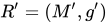
where denotes the pullback of the rank (0, 2) metric tensor by . Equivalently, in terms of the pushforward we have that for any two vector fields on (i.e. sections of the tangent bundle ),

If is a local diffeomorphism such that then is called a local isometry.

Properties

[edit]

A collection of isometries typically form a group, the isometry group. When the group is a continuous group, the infinitesimal generators of the group are the Killing vector fields.

The Myers–Steenrod theorem states that every isometry between two connected Riemannian manifolds is smooth (differentiable). A second form of this theorem states that the isometry group of a Riemannian manifold is a Lie group.

Symmetric spaces are important examples of Riemannian manifolds that have isometries defined at every point.

Generalizations

[edit]
  • Given a positive real number ε, an ε-isometry or almost isometry (also called a Hausdorff approximation) is a map between metric spaces such that
    1. for one has and
    2. for any point there exists a point with
That is, an ε-isometry preserves distances to within ε and leaves no element of the codomain further than ε away from the image of an element of the domain. Note that ε-isometries are not assumed to be continuous.
  • The restricted isometry property characterizes nearly isometric matrices for sparse vectors.
  • Quasi-isometry is yet another useful generalization.
  • One may also define an element in an abstract unital C*-algebra to be an isometry:
    is an isometry if and only if
Note that as mentioned in the introduction this is not necessarily a unitary element because one does not in general have that left inverse is a right inverse.

See also

[edit]

Footnotes

[edit]

References

[edit]

Bibliography

[edit]
Revisions and contributorsEdit on WikipediaRead on Wikipedia
from Grokipedia
An isometry is a bijective mapping between metric spaces that preserves distances, meaning for any points xx and yy in the domain, the distance d(f(x),f(y))d(f(x), f(y)) equals d(x,y)d(x, y), where ff is the isometry and dd denotes the metric. In the context of Euclidean geometry, isometries are rigid transformations that maintain the shape and size of figures, including translations, rotations, reflections, glide reflections, and the identity transformation. These transformations preserve not only distances but also angles, lengths of segments, and congruence of triangles, ensuring that the intrinsic geometric properties of objects remain unchanged. Every isometry of the Euclidean plane can be expressed as the composition of at most three reflections, providing a fundamental classification into the five types mentioned. Isometries play a central role in understanding symmetry groups and the structure of geometric spaces, with applications extending to crystallography, computer graphics, and differential geometry.

Fundamentals

Introduction

An isometry is a mapping between spaces that preserves the distances between points, thereby maintaining the intrinsic geometric relations without distortion or scaling. This core concept underpins much of modern geometry and analysis, allowing for the study of shapes and structures in a way that emphasizes their essential properties rather than their positions. The idea of isometries traces its origins to Euclidean geometry, where Euclid, in his Elements around 300 BCE, introduced the notion of congruence through figures that could be superimposed via motion, implicitly relying on distance-preserving transformations to establish equality of size and shape. This intuitive understanding evolved significantly in the 19th century with the advent of non-Euclidean geometries; mathematicians like Nikolai Lobachevsky and János Bolyai independently developed hyperbolic geometry, extending the role of isometries to curved spaces where parallel lines diverge, yet distances remained rigorously preserved under transformations. The formal abstraction of isometries within general metric spaces was pioneered by Maurice Fréchet in his 1906 doctoral thesis, which laid the groundwork for treating arbitrary sets equipped with distance functions as unified mathematical objects. Isometries play a vital role in preserving geometric structure across diverse fields, enabling the analysis of symmetries and invariances that are fundamental to natural phenomena. In physics, they model motions, such as translations and rotations, which describe the dynamics of undeformable objects without altering internal distances. In , groups of isometries classify the periodic symmetries of crystal lattices, providing a framework for understanding atomic arrangements and material properties. Similarly, in , isometries facilitate transformations like rotations and reflections that maintain object integrity during rendering and . Global isometries are bijective by definition, ensuring a complete, reversible correspondence between spaces.

Definition in Metric Spaces

In metric spaces, an isometry is formally defined as a function f:(X,dX)(Y,dY)f: (X, d_X) \to (Y, d_Y) between two metric spaces that preserves distances, meaning dX(a,b)=dY(f(a),f(b))d_X(a, b) = d_Y(f(a), f(b)) for all points a,bXa, b \in X. This preservation ensures that the intrinsic geometry of distances in the domain space XX is mirrored exactly in the image under ff within the space YY. Isometries are always injective mappings. To see this, suppose f(a)=f(b)f(a) = f(b) for some a,bXa, b \in X; then dX(a,b)=dY(f(a),f(b))=0d_X(a, b) = d_Y(f(a), f(b)) = 0, which implies a=ba = b by the properties of a metric. If an isometry is also surjective, it becomes bijective, and its inverse is likewise an isometry, as distances are preserved in both directions through composition. Such bijective isometries are often termed global isometries when considered on a single space. In contrast, a local isometry preserves distances only within neighborhoods of points, meaning for every xXx \in X, there exists a neighborhood UU of xx such that the restriction of ff to UU is an isometry onto its image in YY. This distinction allows local isometries to capture approximate geometric preservation without requiring global bijectivity, though they may fail to extend uniformly across the entire space. The collection of all bijective isometries from a (X,d)(X, d) to itself, denoted Iso(X)\mathrm{Iso}(X), forms a group under , known as the of XX. Composition of two isometries preserves distances, the identity map serves as the group identity, and inverses exist and are isometries, satisfying the group axioms. Basic examples illustrate these concepts in simple metric spaces. The identity map f(x)=xf(x) = x on any metric space (X,d)(X, d) is the trivial isometry, preserving all distances exactly. On the real line R\mathbb{R} equipped with the standard metric d(x,y)=xyd(x, y) = |x - y|, translations f(x)=x+cf(x) = x + c for any constant cRc \in \mathbb{R} and reflections f(x)=x+cf(x) = -x + c are isometries, as both maintain absolute differences between points.

Isometries in Euclidean Geometry

Classification

Isometries of are broadly classified into direct isometries, which preserve orientation, and opposite isometries, which reverse it. Direct isometries maintain the of figures, while opposite isometries invert it, corresponding to transformations with +1 and -1, respectively, in their linear parts. In two dimensions, direct isometries consist of translations and . Translations shift every point by a fixed vector, preserving parallelism and distances without rotation. turn points around a fixed by a specified . Opposite isometries in 2D include reflections over a line and glide reflections, which combine a reflection over a line with a translation parallel to that line. In three dimensions, the classification expands to account for the additional spatial freedom. Direct isometries comprise translations, , and screw displacements, which combine a about an axis with a translation along the same axis. Opposite isometries include reflections across a plane, glide reflections (a reflection across a plane followed by translation parallel to the plane), inversions through a point, improper (a composed with a reflection perpendicular to the axis), and rotary inversions (a followed by an inversion through a point on the axis). A fundamental classification theorem states that every isometry of Rn\mathbb{R}^n is a composition of at most n+1n+1 reflections, with isometries arising from an even number of reflections and isometries from an odd number. In 2D, this limits compositions to at most three reflections, directly yielding the four types listed above. In 3D, up to four reflections are possible, encompassing the extended set of transformations. Fixed-point properties further distinguish these types. Translations have no fixed points in any dimension. Rotations fix a single point (the center) in 2D or a line (the axis) in 3D. Reflections fix a line in 2D or a plane in 3D. Glide reflections and screw displacements generally have no fixed points unless the translational component is zero, reducing to pure reflections or rotations. Inversions and rotary inversions fix a single point (the center).

Examples and Group Structure

In , concrete examples of isometries illustrate their role in preserving distances and orientations. A in the plane by an angle θ around the origin is given by the matrix (cosθsinθsinθcosθ)\begin{pmatrix} \cos \theta & -\sin \theta \\ \sin \theta & \cos \theta \end{pmatrix}, which maps any point (x,y)(x, y) to (cosθxsinθy,sinθx+cosθy)(\cos \theta \cdot x - \sin \theta \cdot y, \sin \theta \cdot x + \cos \theta \cdot y). provide another fundamental example; in three dimensions, a by a vector v=(v1,v2,v3)\mathbf{v} = (v_1, v_2, v_3) shifts every point x\mathbf{x} to x+v\mathbf{x} + \mathbf{v}, maintaining all distances without altering orientations. Reflections, such as over the x-axis in the plane, map (x,y)(x, y) to (x,y)(x, -y) and reverse orientation while preserving distances. The full group of isometries in n-dimensional , denoted E(n), forms a ℝ^n ⋊ O(n, where O(n is the of linear isometries (rotations and reflections) and ℝ^n represents the translation ; the action is by conjugation, reflecting the composition of linear transformations followed by translations. The orientation-preserving , consisting of rotations and translations, is the ℝ^n ⋊ SO(n), where SO(n) is the special . Subgroups of E(n) capture discrete symmetries in geometric objects. For instance, the rotation group of the , a , is the A5 of order 60, extended by reflections to the full icosahedral group of order 120, which acts as a finite subgroup of E(3). In two dimensions, wallpaper groups classify the 17 distinct symmetry patterns of periodic tilings under translations, , reflections, and glide reflections. Three-dimensional analogues, , number 230 and describe crystal lattice symmetries, combining translations with operations. These group structures find applications in analyzing symmetries of physical systems. In molecular chemistry, the isometry group of a molecule like benzene (D6h symmetry) determines its vibrational modes and stability under Euclidean transformations. Similarly, in tiling theory, wallpaper groups underpin the classification of Islamic geometric patterns and quasicrystals, ensuring periodic or aperiodic arrangements preserve distances.

Isometries in Normed Spaces

General Isometries

In this section, we consider distance-preserving maps (isometric embeddings) between normed spaces; surjective such maps are bijective isometries in the sense of the article's general definition. In normed linear spaces over the real numbers, an isometry is a function f:XYf: X \to Y between normed spaces (X,X)(X, \|\cdot\|_X) and (Y,Y)(Y, \|\cdot\|_Y) that preserves distances induced by the norms, meaning f(x)f(y)Y=xyX\|f(x) - f(y)\|_Y = \|x - y\|_X for all x,yXx, y \in X. This condition is equivalent to norm preservation up to translation, as f(x)f(0)Y=xX\|f(x) - f(0)\|_Y = \|x\|_X whenever f(0)=0f(0) = 0. Unlike isometries in metric spaces more generally, those in normed spaces leverage the vector space structure, though the maps need not be linear or continuous without additional assumptions. Not all isometries between normed spaces are surjective or bijective. In finite-dimensional spaces, surjectivity follows from injectivity by dimension arguments, but infinite-dimensional examples abound. For instance, the right T:ppT: \ell_p \to \ell_p ( 1p<1 \leq p < \infty) defined by T(x1,x2,x3,)=(0,x1,x2,)T(x_1, x_2, x_3, \dots) = (0, x_1, x_2, \dots) preserves the p\ell_p-norm since Txpp=n=1xnp=xpp\|T x\|_p^p = \sum_{n=1}^\infty |x_n|^p = \|x\|_p^p, yet its range excludes sequences starting with nonzero first components, such as (1,0,0,)(1, 0, 0, \dots). Such embeddings highlight how isometries can be proper inclusions in infinite-dimensional settings like p\ell_p spaces. A foundational result characterizing many isometries is the Mazur–Ulam theorem, which states that every surjective isometry f:XYf: X \to Y between real normed spaces with f(0)=0f(0) = 0 is linear. More generally, any surjective isometry is affine, meaning f(x)=L(x)+bf(x) = L(x) + b for some linear isometry LL and translation vector bYb \in Y. The theorem's proof outline relies on showing that such ff preserves convex combinations: first, it maps extreme points of the unit ball to extreme points; second, using the fact that midpoints in normed spaces satisfy (x+y)/2(x+y)/2\| (x+y)/2 \| \leq (\|x\| + \|y\|)/2 with equality under isometry preservation, ff extends affinely to rational combinations and, by continuity, to all points. This result, originally established in 1932, underscores that linearity emerges from surjectivity and origin fixation in real scalar fields, but fails over complex numbers or without surjectivity. Examples of isometries in specific normed spaces illustrate these properties. In Rn\mathbb{R}^n equipped with the Euclidean norm, all isometries are compositions of orthogonal linear maps and translations, aligning with the Mazur–Ulam conclusion since the space is finite-dimensional and strictly convex. In contrast, for the \ell_\infty norm on sequence spaces, coordinate permutations π:\pi: \ell_\infty \to \ell_\infty defined by (πx)i=xπ(i)(\pi x)_i = x_{\pi(i)} are linear isometries, as πx=supixπ(i)=supixi=x\|\pi x\|_\infty = \sup_i |x_{\pi(i)}| = \sup_i |x_i| = \|x\|_\infty, and signed variants (multiplying by ±1\pm 1) also preserve the norm. Unlike Euclidean spaces, where all surjective isometries fixing the origin are linear orthogonal transformations, general normed spaces admit non-affine isometries when surjectivity fails, particularly in non-strictly convex norms like 1\ell_1. For example, consider the map f:RR2f: \mathbb{R} \to \mathbb{R}^2 with the \ell_\infty norm on the codomain, given by f(t)=(t,sint)f(t) = (t, \sin t); then f(t)f(s)=max(ts,sintsins)=ts\|f(t) - f(s)\|_\infty = \max(|t - s|, |\sin t - \sin s|) = |t - s|, since sintsinsts|\sin t - \sin s| \leq |t - s| by the mean value theorem, making ff an isometry onto its image but non-affine (hence non-linear). Such constructions exploit the "flat" unit balls in norms like 1\ell_1 or \ell_\infty, allowing non-linear embeddings that preserve distances without extending affinely to the whole space.

Linear Isometries

In normed linear spaces XX and YY, a linear isometry is a bounded linear operator T:XYT: X \to Y that preserves the norm, meaning Tx=x\|Tx\| = \|x\| for all xXx \in X. In finite-dimensional Euclidean spaces equipped with the standard inner product, linear isometries are precisely those represented by orthogonal matrices AA satisfying ATA=IA^T A = I, where II is the identity matrix. Such operators preserve inner products, as norm preservation implies inner product preservation via the polarization identity: for real spaces, x,y=14(x+y2xy2),\langle x, y \rangle = \frac{1}{4} \left( \|x + y\|^2 - \|x - y\|^2 \right), and a similar formula holds for complex spaces involving additional terms with iyiy. In general normed spaces, including infinite-dimensional Banach spaces, linear isometries do not necessarily preserve inner products unless the space is Hilbert. For instance, in p\ell_p spaces with 1p<1 \leq p < \infty and p2p \neq 2, surjective linear isometries take the form T((an))=(ϵnaπ(n))T((a_n)) = (\epsilon_n a_{\pi(n)}), where π\pi is a permutation of the indices and ϵn=±1\epsilon_n = \pm 1; these operators preserve the p\ell_p norm but fail to preserve the 2\ell_2 inner product. Similar structures appear in spaces like c0c_0 and cc, where isometries involve coordinate permutations and sign changes without inducing an inner product structure. The Mazur-Ulam theorem, which states that surjective isometries between real normed spaces are affine, extends naturally to the linear case: a surjective linear isometry fixing the origin is precisely a norm-preserving linear operator, and in Hilbert spaces, such operators are unitary, satisfying TT=I=TTT^* T = I = T T^*. In complex Hilbert spaces, unitary operators have all eigenvalues lying on the unit circle in the complex plane, reflecting their norm-preserving and phase-shifting nature.

Isometries on Manifolds

Definition and Types

An isometry between two Riemannian manifolds (M,gM)(M, g_M) and (N,gN)(N, g_N) is a smooth map f:MNf: M \to N that preserves the Riemannian metric tensor, meaning the pullback satisfies fgN=gMf^* g_N = g_M. Equivalently, for every point pMp \in M and tangent vectors X,YTpMX, Y \in T_p M, the inner product is preserved: gM(X,Y)=gN(dfp(X),dfp(Y))g_M(X, Y) = g_N(df_p(X), df_p(Y)), where dfp:TpMTf(p)Ndf_p: T_p M \to T_{f(p)} N is the differential of ff. This definition ensures that ff preserves lengths, angles, and the overall geometric structure induced by the metrics. Local isometries are smooth maps that preserve the metric in sufficiently small neighborhoods, specifically local diffeomorphisms ϕ:(M,gM)(N,gN)\phi: (M, g_M) \to (N, g_N) such that ϕgN=gM\phi^* g_N = g_M locally around each point. For instance, covering maps between Riemannian manifolds, such as the universal cover of a manifold, are local isometries because they lift the metric exactly in local charts while possibly being non-injective globally. In contrast, global isometries are bijective smooth maps with smooth inverses (i.e., diffeomorphisms) that satisfy the pullback condition everywhere, ensuring a one-to-one correspondence between the entire manifolds. Isometric immersions preserve the metric but may self-intersect, whereas isometric embeddings are injective immersions that yield global isometries when combined with surjectivity. Among global isometries, which are precisely the diffeomorphisms preserving the metric, one distinguishes orientation-preserving types—those that preserve the orientation of tangent spaces—and orientation-reversing types, which reverse it, often corresponding to reflections or improper rotations in the isometry group. For example, the isometries of the nn-sphere SnS^n with its round metric form the orthogonal group O(n+1)O(n+1), acting by rotations and reflections on the embedding in Rn+1\mathbb{R}^{n+1}, where the special orthogonal subgroup SO(n+1)SO(n+1) consists of the orientation-preserving isometries. Similarly, the isometries of the hyperbolic plane H2\mathbb{H}^2 (e.g., with the upper half-plane metric g=1y2(dx2+dy2)g = \frac{1}{y^2}(dx^2 + dy^2)) are given by Möbius transformations of the form zaz+bcz+dz \mapsto \frac{az + b}{cz + d} with a,b,c,dRa, b, c, d \in \mathbb{R} and adbc=1ad - bc = 1, with the orientation-preserving ones forming PSL(2,R)PSL(2, \mathbb{R}), while the full isometry group also includes orientation-reversing transformations such as reflections, forming a group isomorphic to PGL(2,R)PGL(2, \mathbb{R}).

Properties and Theorems

Isometries of a Riemannian manifold possess several fundamental properties that stem from their definition as metric-preserving diffeomorphisms. A key result is the Myers-Steenrod theorem, which establishes that the group of all isometries of a Riemannian manifold, endowed with the compact-open topology, forms a finite-dimensional whose dimension is at most n(n+1)/2n(n+1)/2, where nn is the dimension of the manifold. This theorem underscores the smooth structure inherent in the isometry group, ensuring that local flows of infinitesimal isometries () integrate to global one-parameter subgroups of isometries. Isometries preserve a wide array of geometric structures derived from the Riemannian metric. Specifically, they map geodesics to geodesics, as the minimizing property of geodesic segments is invariant under distance-preserving maps. Moreover, since isometries pull back the metric tensor and thus the Levi-Civita connection, they preserve the Riemann curvature tensor pointwise, implying that sectional, Ricci, and scalar curvatures remain unchanged along corresponding points. Volumes are also preserved by orientation-preserving isometries, as the Riemannian volume form, defined via the determinant of the metric, transforms covariantly under such maps. Additionally, isometries conjugate Killing vector fields to Killing vector fields, since the Lie derivative condition for Killing fields—vanishing on the metric—is preserved under metric isomorphisms. Rigidity results highlight the constrained nature of isometries in certain manifolds. In spaces of constant sectional curvature, such as , spheres, or , any isometry is uniquely determined by its value and first derivative (its 1-jet) at a single point, reflecting the high degree of symmetry and the fact that the isometry group acts simply transitively on the tangent bundle. This uniqueness follows from the Cartan-Hadamard framework for complete simply connected manifolds of constant curvature, where the exponential map is a global diffeomorphism, allowing reconstruction of the map from local data. A notable distinction arises between local and global isometries on manifolds. While every local isometry preserves the metric in a neighborhood, it may not extend to a global isometry of the entire manifold; for instance, the universal cover of a compact hyperbolic surface admits local isometries from the surface that fail to extend globally due to the non-trivial fundamental group. Symmetric spaces provide concrete examples of these properties in action. These are Riemannian manifolds where the isometry group acts transitively, with the isotropy representation at any point being orthogonal, and the geodesic symmetries (reflections through a point) generate local isometries. In such spaces, the isometry group is a Lie group that decomposes as a semidirect product of the maximal compact subgroup and the vector space of parallel translations, ensuring transitive action and preservation of all curvature invariants.

Extensions and Generalizations

Approximate Isometries

In metric spaces, an approximate isometry, also known as an ε-isometry, is a map f:XYf: X \to Y between metric spaces (X,dX)(X, d_X) and (Y,dY)(Y, d_Y) such that there exists ε>0\varepsilon > 0 with dX(a,b)dY(f(a),f(b))ε|d_X(a, b) - d_Y(f(a), f(b))| \leq \varepsilon for all a,bXa, b \in X. These maps preserve distances up to an additive error bounded by ε\varepsilon, making them useful for studying spaces where exact preservation is not required but bounded distortion is. Unlike exact isometries, ε-isometries need not be bijective, though they can approximate the geometry of the original space closely when ε\varepsilon is small. A more flexible notion in coarse geometry is that of a quasi-isometry, which allows both multiplicative and additive distortions. Specifically, a map f:XYf: X \to Y is a (λ,ε)(\lambda, \varepsilon)-quasi-isometry if λ1\lambda \geq 1, ε0\varepsilon \geq 0, and it satisfies 1λdX(a,b)εdY(f(a),f(b))λdX(a,b)+ε\frac{1}{\lambda} d_X(a, b) - \varepsilon \leq d_Y(f(a), f(b)) \leq \lambda d_X(a, b) + \varepsilon for all a,bXa, b \in X, along with a quasi-surjectivity condition: there exists R>0R > 0 such that every point in YY is within distance RR of the image f(X)f(X). Quasi-isometries capture the large-scale structure of metric spaces, ignoring bounded-scale features, and form an : if f:XYf: X \to Y is a quasi-isometry, then there exists a quasi-inverse g:YXg: Y \to X such that both d(fg(y),y)d(f \circ g(y), y) and d(gf(x),x)d(g \circ f(x), x) are bounded for all xXx \in X, yYy \in Y. This equivalence preserves asymptotic properties, such as connectivity at infinity or growth rates. Quasi-isometries play a central role in , where they classify up to their coarse geometry. For a GG with finite generating set SS, the word metric dS(g,h)=g1hSd_S(g, h) = |g^{-1}h|_S—the minimal length of a word in SS1S \cup S^{-1} representing g1hg^{-1}h—endows GG with a structure. Different finite generating sets SS and SS' induce quasi-isometric word metrics on GG, as the identity map between (G,dS)(G, d_S) and (G,dS)(G, d_{S'}) is a quasi-isometry. A key application is the quasi-isometric invariance of Gromov hyperbolicity: a XX is δ\delta-hyperbolic if, for all x,y,z,wXx, y, z, w \in X, the Gromov product satisfies (xy)zmin{(xw)z,(yw)z}δ(x|y)_z \geq \min\{(x|w)_z, (y|w)_z\} - \delta, where (xy)z=12(d(z,x)+d(z,y)d(x,y))(x|y)_z = \frac{1}{2}(d(z,x) + d(z,y) - d(x,y)); if f:XYf: X \to Y is a quasi-isometry, then XX is hyperbolic if and only if YY is. This invariance implies that hyperbolicity is a geometric property of groups, independent of the choice of generating set, and enables the study of group actions on hyperbolic spaces via their boundaries. To quantify how far two metric spaces are from being isometric, the Gromov-Hausdorff distance provides a metric on the space of compact metric spaces up to isometry. For compact metric spaces XX and YY, dGH(X,Y)=inf{dH(ϕ(X),ψ(Y))}d_{GH}(X, Y) = \inf \{ d_H(\phi(X), \psi(Y)) \}, where the infimum is over all metric spaces ZZ and isometric embeddings ϕ:XZ\phi: X \to Z, ψ:YZ\psi: Y \to Z, and dH(A,B)=max{supaAdZ(a,B),supbBdZ(b,A)}d_H(A, B) = \max\{\sup_{a \in A} d_Z(a, B), \sup_{b \in B} d_Z(b, A)\} is the between subsets A,BZA, B \subseteq Z. If dGH(X,Y)<εd_{GH}(X, Y) < \varepsilon, then there exists an ε\varepsilon-isometry between XX and YY up to isometric embeddings into a common space. This distance extends to non-compact spaces via pointed versions and is used to study convergence of sequences of metric spaces in applications like manifold approximation and shape analysis. Bilipschitz maps offer a refinement of quasi-isometries focused on multiplicative control without additive terms. A map f:XYf: X \to Y is bilipschitz with constants c,C>0c, C > 0 if cdX(a,b)dY(f(a),f(b))CdX(a,b)c \, d_X(a, b) \leq d_Y(f(a), f(b)) \leq C \, d_X(a, b) for all a,bXa, b \in X; if bijective with bilipschitz inverse, it is a bilipschitz equivalence. Every bilipschitz map is a quasi-isometry (with λ=max{1/c,C}\lambda = \max\{1/c, C\} and ε=0\varepsilon = 0), but the converse fails, as quasi-isometries allow additive errors that grow irrelevant at large scales. Bilipschitz equivalences preserve more refined geometric features, such as Assouad-Nagata dimension, and are crucial in embedding theory for metric spaces.

In Other Structures

In the field of compressed sensing, the (RIP) generalizes the notion of isometry to matrices acting on sparse vectors. A matrix ARm×nA \in \mathbb{R}^{m \times n} satisfies the RIP of order kk with constant δk\delta_k if, for all kk-sparse vectors xx (those with at most kk nonzero entries), (1δk)x22Ax22(1+δk)x22,(1 - \delta_k) \|x\|_2^2 \leq \|A x\|_2^2 \leq (1 + \delta_k) \|x\|_2^2, ensuring that AA behaves like an isometry on the subspace of kk-sparse signals, with singular values bounded near 1. This property, introduced by Candès, Romberg, and , guarantees stable recovery of sparse signals from underdetermined measurements via , such as basis pursuit. In C*-algebras, isometries are defined as surjective linear maps ϕ:AB\phi: A \to B between C*-algebras that preserve the operator norm, i.e., ϕ(a)=a\|\phi(a)\| = \|a\| for all aAa \in A. Such maps are precisely the *-isomorphisms, which additionally preserve the involution and algebraic structure, as established in foundational work on operator algebras. For example, spatial isometries arise from unitary representations, composing a unitary operator with the identity map to yield norm preservation. From a category-theoretic perspective, isometries appear as in the category of metric spaces enriched over the monoidal poset ([0,],,+)([0, \infty], \geq, +), where objects are sets equipped with metrics as "hom-objects" and morphisms are distance-non-increasing maps. In this framework, due to Lawvere, an is a bijective enriched that admits an inverse, corresponding exactly to a distance-preserving (isometry) with distance-preserving inverse. This enriched structure unifies metric with categorical limits and colimits, such as Cauchy completions. Discrete isometries arise in lattice theory, particularly for the Zn\mathbb{Z}^n endowed with the Euclidean norm. An isometry here is a linear f:ZnZnf: \mathbb{Z}^n \to \mathbb{Z}^n that preserves both the lattice structure and distances, equivalent to an element of the modular O(n,Z)={AGL(n,Z)ATA=I}O(n, \mathbb{Z}) = \{ A \in GL(n, \mathbb{Z}) \mid A^T A = I \}. These maps induce congruence relations on the lattice points, preserving volumes and angles modulo lattice translations, and play a key role in classifying coincidence site lattices in . For instance, in Z2\mathbb{Z}^2, rotations by 90 degrees generate such isometries, forming finite subgroups isomorphic to cyclic or dihedral groups. Examples of isometries in other structures include distance-preserving maps on graphs and transformations in probability measures. A graph isometry is a bijection ϕ:V(G)V(H)\phi: V(G) \to V(H) between vertex sets of graphs GG and HH such that the shortest-path distance satisfies dG(u,v)=dH(ϕ(u),ϕ(v))d_G(u, v) = d_H(\phi(u), \phi(v)) for all vertices u,vu, v, generalizing metric isometries to combinatorial settings; trees admit rich automorphism groups of such isometries. In probability theory, an isometry with respect to total variation distance on Borel probability measures is a surjective map TT such that μνTV=T#μT#νTV\| \mu - \nu \|_{TV} = \| T_\# \mu - T_\# \nu \|_{TV} for all measures μ,ν\mu, \nu, where T#T_\# denotes pushforward; these are characterized as compositions of measurable bijections with their inverses preserving the distance.

References

Add your contribution
Related Hubs
Contribute something
User Avatar
No comments yet.