


Community hub
Recent from talks
Contribute something
Nothing was collected or created yet.
Riemann sphere
View on Wikipedia


In mathematics, the Riemann sphere, named after Bernhard Riemann, [1] is a model of the extended complex plane (also called the closed complex plane): the complex plane plus one point at infinity. This extended plane represents the extended complex numbers, that is, the complex numbers plus a value for infinity. With the Riemann model, the point is near to very large numbers, just as the point is near to very small numbers.


The extended complex numbers are useful in complex analysis because they allow for division by zero in some circumstances, in a way that makes expressions such as well-behaved. For example, any rational function on the complex plane can be extended to a holomorphic function on the Riemann sphere, with the poles of the rational function mapping to infinity. More generally, any meromorphic function can be thought of as a holomorphic function whose codomain is the Riemann sphere.

In geometry, the Riemann sphere is the prototypical example of a Riemann surface, and is one of the simplest complex manifolds. In projective geometry, the sphere is an example of a complex projective space and can be thought of as the complex projective line , the projective space of all complex lines in . As with any compact Riemann surface, the sphere may also be viewed as a projective algebraic curve, making it a fundamental example in algebraic geometry. It also finds utility in other disciplines that depend on analysis and geometry, such as the Bloch sphere of quantum mechanics and in other branches of physics.


Extended complex numbers
[edit]The extended complex numbers consist of the complex numbers together with . The set of extended complex numbers may be written as , and is often denoted by adding some decoration to the letter , such as


The notation has also seen use, but as this notation is also used for the punctured plane , it can lead to ambiguity.[2]


Geometrically, the set of extended complex numbers is referred to as the Riemann sphere (or extended complex plane).
Arithmetic operations
[edit]Addition of complex numbers may be extended by defining, for ,


and multiplication may be defined by

for all nonzero complex numbers , with . Note that , , and are left undefined. Unlike the complex numbers, the extended complex numbers do not form a field, since does not have an additive nor multiplicative inverse. Nonetheless, it is customary to define division on by





for all nonzero complex numbers with and . The quotients and are left undefined.


Rational functions
[edit]Any rational function (in other words, is the ratio of polynomial functions and of with complex coefficients, such that and have no common factor) can be extended to a continuous function on the Riemann sphere. Specifically, if is a complex number such that the denominator is zero but the numerator is nonzero, then can be defined as . Moreover, can be defined as the limit of as , which may be finite or infinite.



The set of complex rational functions—whose mathematical symbol is —form all possible holomorphic functions from the Riemann sphere to itself, when it is viewed as a Riemann surface, except for the constant function taking the value everywhere. The functions of form an algebraic field, known as the field of rational functions on the sphere.

For example, given the function
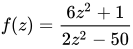
we may define , since the denominator is zero at , and since as . Using these definitions, becomes a continuous function from the Riemann sphere to itself.


As a complex manifold
[edit]As a one-dimensional complex manifold, the Riemann sphere can be described by two charts, both with domain equal to the complex number plane . Let be a complex number in one copy of , and let be a complex number in another copy of . Identify each nonzero complex number of the first with the nonzero complex number of the second . Then the map


is called the transition map between the two copies of —the so-called charts—glueing them together. Since the transition maps are holomorphic, they define a complex manifold, called the Riemann sphere. As a complex manifold of 1 complex dimension (i.e. 2 real dimensions), this is also called a Riemann surface.
Intuitively, the transition maps indicate how to glue two planes together to form the Riemann sphere. The planes are glued in an "inside-out" manner, so that they overlap almost everywhere, with each plane contributing just one point (its origin) missing from the other plane. In other words, (almost) every point in the Riemann sphere has both a value and a value, and the two values are related by . The point where should then have -value ""; in this sense, the origin of the -chart plays the role of in the -chart. Symmetrically, the origin of the -chart plays the role of in the -chart.


Topologically, the resulting space is the one-point compactification of a plane into the sphere. However, the Riemann sphere is not merely a topological sphere. It is a sphere with a well-defined complex structure, so that around every point on the sphere there is a neighborhood that can be biholomorphically identified with .
On the other hand, the uniformization theorem, a central result in the classification of Riemann surfaces, states that every simply-connected Riemann surface is biholomorphic to the complex plane, the hyperbolic plane, or the Riemann sphere. Of these, the Riemann sphere is the only one that is a closed surface (a compact surface without boundary). Hence the two-dimensional sphere admits a unique complex structure turning it into a one-dimensional complex manifold.
As the complex projective line
[edit]The Riemann sphere can also be defined as the complex projective line. The points of the complex projective line can be defined as equivalence classes of non-null vectors in the complex vector space : two non-null vectors and are equivalent iff for some non-zero coefficient .




In this case, the equivalence class is written using projective coordinates. Given any point in the complex projective line, one of and must be non-zero, say . Then by the notion of equivalence, , which is in a chart for the Riemann sphere manifold.[3]
![{\displaystyle [w,z]}](https://wikimedia.org/api/rest_v1/media/math/render/svg/35df723ea782005592eef7065e0c2e15cda4b8dc)


![{\displaystyle [w,z]=\left[1,z/w\right]}](https://wikimedia.org/api/rest_v1/media/math/render/svg/269372fe3c508319f5fd7d5532706c59aac30ecc)
This treatment of the Riemann sphere connects most readily to projective geometry. For example, any line (or smooth conic) in the complex projective plane is biholomorphic to the complex projective line. It is also convenient for studying the sphere's automorphisms, later in this article.
As a sphere
[edit]

The Riemann sphere can be visualized as the unit sphere in the three-dimensional real space . To this end, consider the stereographic projection from the unit sphere minus the point onto the plane which we identify with the complex plane by . In Cartesian coordinates and spherical coordinates on the sphere (with the zenith angle and the azimuth), the projection is



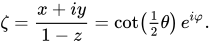
Similarly, stereographic projection from onto the plane identified with another copy of the complex plane by is written



The inverses of these two stereographic projections are maps from the complex plane to the sphere. The first inverse covers the sphere except the point , and the second covers the sphere except the point . The two complex planes, that are the domains of these maps, are identified differently with the plane , because an orientation-reversal is necessary to maintain consistent orientation on the sphere.

The transition maps between -coordinates and -coordinates are obtained by composing one projection with the inverse of the other. They turn out to be and , as described above. Thus the unit sphere is diffeomorphic to the Riemann sphere.

Under this diffeomorphism, the unit circle in the -chart, the unit circle in the -chart, and the equator of the unit sphere are all identified. The unit disk is identified with the southern hemisphere , while the unit disk is identified with the northern hemisphere .


Metric
[edit]A Riemann surface does not come equipped with any particular Riemannian metric. The Riemann surface's conformal structure does, however, determine a class of metrics: all those whose subordinate conformal structure is the given one. In more detail: The complex structure of the Riemann surface does uniquely determine a metric up to conformal equivalence. (Two metrics are said to be conformally equivalent if they differ by multiplication by a positive smooth function.) Conversely, any metric on an oriented surface uniquely determines a complex structure, which depends on the metric only up to conformal equivalence. Complex structures on an oriented surface are therefore in one-to-one correspondence with conformal classes of metrics on that surface.
Within a given conformal class, one can use conformal symmetry to find a representative metric with convenient properties. In particular, there is always a complete metric with constant curvature in any given conformal class.
In the case of the Riemann sphere, the Gauss–Bonnet theorem implies that a constant-curvature metric must have positive curvature . It follows that the metric must be isometric to the sphere of radius in via stereographic projection. In the -chart on the Riemann sphere, the metric with is given by


In real coordinates , the formula is


Up to a constant factor, this metric agrees with the standard Fubini–Study metric on complex projective space (of which the Riemann sphere is an example). The two non-vanishing Christoffel symbols of its Levi-Civita connection are and its conjugate. This metric is therefore equal to its own Ricci curvature, .


Up to scaling, this is the only metric on the sphere whose group of orientation-preserving isometries is 3-dimensional (and none is more than 3-dimensional); that group is called . In this sense, this is by far the most symmetric metric on the sphere. (The group of all isometries, known as , is also 3-dimensional, but unlike is not a connected space.)


Conversely, let denote the sphere (as an abstract smooth or topological manifold). By the uniformization theorem there exists a unique complex structure on up to conformal equivalence. It follows that any metric on is conformally equivalent to the round metric. All such metrics determine the same conformal geometry. The round metric is therefore not intrinsic to the Riemann sphere, since "roundness" is not an invariant of conformal geometry. The Riemann sphere is only a conformal manifold, not a Riemannian manifold. However, if one needs to do Riemannian geometry on the Riemann sphere, the round metric is a natural choice (with any fixed radius, though radius is the simplest and most common choice). That is because only a round metric on the Riemann sphere has its isometry group be a 3-dimensional group. (Namely, the group known as , a continuous ("Lie") group that is topologically the 3-dimensional projective space .)


Automorphisms
[edit]
The study of any mathematical object is aided by an understanding of its group of automorphisms, meaning the maps from the object to itself that preserve the essential structure of the object. In the case of the Riemann sphere, an automorphism is an invertible conformal map (i.e. biholomorphic map) from the Riemann sphere to itself. It turns out that the only such maps are the Möbius transformations. These are functions of the form
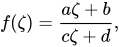
where , , , and are complex numbers such that . Examples of Möbius transformations include dilations, rotations, translations, and complex inversion. In fact, any Möbius transformation can be written as a composition of these.


The Möbius transformations are homographies on the complex projective line. In projective coordinates, the transformation f can be written
![{\displaystyle [\zeta ,\ 1]{\begin{pmatrix}a&c\\b&d\end{pmatrix}}\ =\ [a\zeta +b,\ c\zeta +d]\ =\ {\begin{pmatrix}{\tfrac {a\zeta +b}{c\zeta +d}}&1\end{pmatrix}}\ =\ [f(\zeta ),\ 1].}](https://wikimedia.org/api/rest_v1/media/math/render/svg/a646e37fae38b7019f24cf225eb27b6d0cf4b920)
Thus the Möbius transformations can be described as two-by-two complex matrices with nonzero determinant. Since they act on projective coordinates, two matrices yield the same Möbius transformation if and only if they differ by a nonzero factor. The group of Möbius transformations is the projective linear group .

If one endows the Riemann sphere with the Fubini–Study metric, then not all Möbius transformations are isometries; for example, the dilations and translations are not. The isometries form a proper subgroup of , namely . This subgroup is isomorphic to the rotation group , which is the group of symmetries of the unit sphere in (which, when restricted to the sphere, become the isometries of the sphere).

Applications
[edit]In complex analysis, a meromorphic function on the complex plane (or on any Riemann surface, for that matter) is a ratio of two holomorphic functions and . As a map to the complex numbers, it is undefined wherever is zero. However, it induces a holomorphic map to the complex projective line that is well-defined even where . This construction is helpful in the study of holomorphic and meromorphic functions. For example, on a compact Riemann surface there are no non-constant holomorphic maps to the complex numbers, but holomorphic maps to the complex projective line are abundant.


The Riemann sphere is often cited as a construction on which one can easily visualise generalised circles, Möbius transformations and conformal maps between connected open subsets of the extended complex plane.
The Riemann sphere has many uses in physics. In quantum mechanics, points on the complex projective line are natural values for photon polarization states, spin states of massive particles of spin , and 2-state particles in general (see also Quantum bit and Bloch sphere). The Riemann sphere has been suggested as a relativistic model for the celestial sphere.[4] In string theory, the worldsheets of strings are Riemann surfaces, and the Riemann sphere, being the simplest Riemann surface, plays a significant role. It is also important in twistor theory.

See also
[edit]- Conformal geometry – Study of angle-preserving transformations of a geometric space
- Cross-ratio – Invariant in projective geometry
- Dessin d'enfant – Graph drawing used to study Riemann surfaces
- Hopf bundle – Fiber bundle of the 3-sphere over the 2-sphere, with 1-spheres as fibers
- Möbius plane
- Parallel (operator) § Properties
- Projectively extended real line – Real numbers with an added point at infinity
- Smith chart – Electrical engineers graphical calculator
- Wheel theory – Algebra where division is always defined
Notes
[edit]- ^ Riemann 1857.
- ^ "C^*". Archived from the original on October 8, 2021. Retrieved December 12, 2021.
- ^ Goldman 1999, p. 1.
- ^ Penrose 2007, pp. 428–430.
References
[edit] | This article includes a list of general references, but it lacks sufficient corresponding inline citations. (August 2010) |
 | This article cites its sources but does not provide page references. (September 2010) |
- Brown, James & Churchill, Ruel (1989). Complex Variables and Applications. New York: McGraw-Hill. ISBN 0-07-010905-2.
- Goldman, William Mark (1999). Complex Hyperbolic Geometry. Oxford : New York: Oxford University Press. ISBN 0-19-853793-X.
- Griffiths, Phillip & Harris, Joseph (1978). Principles of Algebraic Geometry. John Wiley & Sons. ISBN 0-471-32792-1.
- Penrose, Roger (2007). The Road to Reality. London: National Geographic Books. ISBN 978-0-679-77631-4.
- Riemann, Bernhard (1857). "Theorie der Abel'schen Functionen" [Theory of Abelian functions]. Journal für die reine und angewandte Mathematik (in German). 54: 115–155.
- Rudin, Walter (1987). Real and Complex Analysis. New York: McGraw–Hill. ISBN 0-07-100276-6.
External links
[edit]
- "Riemann sphere", Encyclopedia of Mathematics, EMS Press, 2001 [1994]
- Moebius Transformations Revealed, by Douglas N. Arnold and Jonathan Rogness (a video by two University of Minnesota professors explaining and illustrating Möbius transformations using stereographic projection from a sphere)

Riemann sphere
View on GrokipediaFoundations and Construction
Extended Complex Plane
The extended complex plane, denoted , augments the standard complex plane by adjoining a single point at infinity, forming what is known as the Riemann sphere. This construction provides a compact topological space that includes all finite complex numbers alongside the idealized point , enabling a unified treatment of complex analysis at both finite points and the "boundary" at infinity.[1][9] The primary motivation for this compactification arises from the need to resolve singularities inherent in rational functions and to facilitate the evaluation of contour integrals over unbounded regions. Rational functions, such as , exhibit poles at finite points and behave irregularly as , but on , they extend to meromorphic functions that are holomorphic everywhere except at their poles, with the degree of zeros equaling the degree of poles when including behavior at infinity. Similarly, for integrals like those enclosing the entire plane, the point at infinity allows computation of residues there, transforming improper integrals into finite sums via the residue theorem.[10][9] The topology on combines the standard Euclidean topology on with a specific structure at infinity to ensure compactness and continuity. Open neighborhoods of finite points are the usual open disks , while basic neighborhoods of consist of sets for sufficiently large , representing the "exteriors" of compact disks in the plane. This one-point compactification yields a space homeomorphic to the 2-sphere, making Hausdorff and compact.[9][1] The concept of the extended complex plane builds upon ideas introduced by Bernhard Riemann in his 1851 doctoral thesis, Grundlagen für eine allgemeine Theorie der Functionen einer veränderlichen complexen Grösse, which laid the foundations for Riemann surfaces and complex function theory. The explicit construction of the Riemann sphere via stereographic projection was developed later by mathematicians such as Carl Neumann in 1868.[3][11][5] Riemann's work emphasized the extended plane's role in providing a conformal structure that uniformizes analytic continuations, laying the groundwork for modern complex geometry.Stereographic Projection
The stereographic projection establishes a explicit bijection between the unit sphere , serving as the geometric realization of the Riemann sphere, and the extended complex plane . It is defined geometrically by projecting points on from the north pole onto the equatorial plane , which is identified with the complex plane via the identification . For a point , the projection is the intersection of the line connecting to with the plane . This yields the explicit formula with the north pole assigned to to complete the map .[12][1] The inverse projection maps to the unique point on lying on the line from through the point in the plane, given by and . This construction maps the south pole to , since and , yielding . The equator (where ) projects to the unit circle , as and . The northern hemisphere maps to the exterior of the unit disk , while the southern hemisphere maps to the interior .[2][1] Bijectivity follows from the geometric setup: every point in determines a unique line through that intersects at exactly one other point (solving the parametric line equation yields a unique solution on the sphere), and conversely, every line through except the one tangent at intersects the plane at a unique point in , with itself corresponding to . The maps and are mutual inverses, confirming the one-to-one correspondence. Both and are continuous as rational functions of the coordinates (polynomials in the real and imaginary parts of , and ratios thereof), extending continuously to the compact sets and via the assignments at and .[2][13] The stereographic projection extends holomorphically to the entire Riemann sphere, providing local complex coordinates. On , is a holomorphic function of the complex structure induced on the sphere, as it is a rational function preserving the Cauchy-Riemann equations in suitable charts. At infinity, holomorphicity is verified by changing to the chart centered at , where the local coordinate is ; functions holomorphic near in correspond to holomorphic functions near via composition with , ensuring the transition map is biholomorphic. This makes a complex manifold diffeomorphic to .[10][13]Algebraic Structure
Arithmetic Operations
The Riemann sphere, denoted , extends the field of complex numbers by adjoining a point at infinity, allowing arithmetic operations to be defined in a manner consistent with limits as . Addition is extended by setting for any finite complex number , and . These rules ensure that the operation aligns with the behavior of sequences or functions diverging to infinity, though forms like remain indeterminate and undefined to preserve consistency with limits.[14][15] Multiplication on the Riemann sphere follows analogous extensions: for any nonzero finite complex number , , and . The product is indeterminate, as it can approach any value depending on the path of approach in the complex plane, and is thus left undefined in the algebraic structure. These definitions facilitate the analysis of products involving large magnitudes but introduce limitations, such as the absence of a multiplicative inverse for .[14][15] Inversion provides a natural way to handle the point at infinity: the map sends to and to , with and . This operation is well-defined for all points except where it would require dividing by zero in the finite plane, and it plays a key role in understanding symmetries and transformations on the sphere. Division extends accordingly, with and , mirroring the inversion behavior.[14][15] Although these operations endow with an algebraic structure resembling a field, it fails to be one due to the indeterminate forms like , , and , which cannot be consistently defined without violating associativity or distributivity. The lack of a multiplicative inverse for further underscores this, distinguishing from the field . Rational functions, as quotients of polynomials, rely on these extended operations to define poles and behavior at infinity.[14]Rational Functions
Rational functions on the Riemann sphere are defined as quotients of two polynomials and with complex coefficients, where is not identically zero, expressed as .[16] These functions extend naturally to holomorphic maps from the extended complex plane to itself, making them meromorphic on the entire Riemann sphere, with the point at infinity incorporated via the behavior of as .[16] The zeros of a rational function occur at the roots of , counted with multiplicity, while the finite poles are located at the roots of , also with multiplicity equal to the order of the zero of . At infinity, has a pole of order if , a zero of order if , or is holomorphic (possibly constant) if .[17] This compactification ensures that every rational function has finitely many zeros and poles on , with the total order of zeros equaling the total order of poles.[16] The degree of a rational function is defined as , after reducing to lowest terms. This degree determines the mapping properties of , which is a branched covering of degree , meaning that for any , the equation has exactly solutions in , counted with multiplicity.[16] The branching occurs at the ramification points where the local degree exceeds 1, including the zeros of and higher-order zeros or poles.[18] For a rational function meromorphic on , the residue at infinity is given by the formula where the sum is over all finite poles of .[19] This relation follows from applying the residue theorem to a large contour enclosing all finite poles, with the orientation at infinity accounting for the negative sign, and it underscores the global balance of residues on the compact Riemann sphere.Analytic and Topological Structure
As a Complex Manifold
The Riemann sphere, denoted , is a one-dimensional complex manifold, providing a compactification of the complex plane that allows for a uniform treatment of holomorphic functions extending to infinity.[20] As such, it serves as the prototypical Riemann surface of genus zero, on which the meromorphic functions are precisely the rational functions (in the affine coordinate on ).[21] To define its complex structure, an atlas consists of two charts: the first is the identity map on the open set , and the second is the map on the open set .[20] These charts cover entirely, with the first chart sending points in to themselves and the second inverting nonzero complex numbers while mapping to 0.[21] The transition map between these charts, defined on the overlap , is given by , which is holomorphic (as the reciprocal of a nonzero holomorphic function) and biholomorphic (with inverse ) on this punctured plane.[20] This atlas endows with the structure of a compact Riemann surface, as it is Hausdorff, second-countable, and the transition maps are holomorphic, ensuring local holomorphy of functions.[18] It is orientable, inheriting a consistent orientation from the complex plane via the charts, and has genus 0, classifying it as topologically equivalent to the sphere with no handles or crosscaps.[21] The Riemann sphere is conformally equivalent to the standard 2-sphere in through stereographic projection, which preserves angles due to the conformal property of holomorphic maps arising from the Cauchy-Riemann equations.[20] This equivalence underscores the angle-preserving nature of complex differentiability, where local isometries in the conformal metric align with the spherical geometry.[18]As the Complex Projective Line
The Riemann sphere can be formalized as the complex projective line , which is the quotient space , where the equivalence relation identifies points and for any .[22] Points in are represented by homogeneous coordinates , with finite points corresponding to for and the point at infinity denoted by .[23] This construction unifies the complex plane with its point at infinity under projective equivalence, providing an algebraic framework for the extended complex plane.[22] The natural projection map from to sends to , and dehomogenization yields the affine coordinate on the open set where , recovering the standard complex structure on .[23] Where , the coordinate at infinity is realized, ensuring compactifies algebraically.[22] Geometrically, is the Grassmannian consisting of all complex lines through the origin in , where each point represents the one-dimensional subspace spanned by the vector .[24] This perspective highlights as a foundational example in algebraic geometry, linking linear algebra to the topology of the Riemann sphere.[24] The Fubini-Study metric on arises as the natural Kähler metric induced from the quotient of the round metric on the unit sphere by the -action, endowing the Riemann sphere with a Hermitian structure of constant holomorphic sectional curvature 4 (detailed further in the metrics section).[25][26] This metric aligns with the complex manifold atlas derived from the homogeneous coordinates, providing a compatible Riemannian structure.[27]Geometry and Metrics
Spherical Geometry
The Riemann sphere is homeomorphic to the standard 2-sphere via stereographic projection, which establishes a bijection between the extended complex plane and the unit sphere in excluding the north pole, with the north pole mapped to infinity.[13][1] This homeomorphism preserves the topological structure, rendering the Riemann sphere a compact, orientable surface without boundary, equivalent to the classical sphere as a topological manifold.[10][13] As a compact orientable surface, the Riemann sphere is classified by genus 0, the simplest non-trivial case for such surfaces, and possesses an Euler characteristic of , computed via the formula for a surface of genus .[10][28] This topological invariant underscores its role as the unique simply connected compact Riemann surface up to biholomorphism, distinguishing it from higher-genus surfaces like tori (, ).[28] Under stereographic projection, straight lines and circles in the complex plane map to circles on the Riemann sphere, with lines—regarded as circles passing through the point at infinity—projecting specifically to great circles, which are the geodesics on .[10][1] For instance, a line through the origin in corresponds to a great circle passing through the north and south poles on the sphere, while a general circle in maps to a smaller circle not intersecting the north pole.[1] This correspondence highlights the sphere's geometry, where the equator aligns with the unit circle in , and hemispheres map to the interior and exterior of the unit disk.[1] Certain Möbius transformations on the Riemann sphere can be visualized as rotations of , providing an intuitive geometric interpretation of these conformal automorphisms.[29] Specifically, a transformation of the form with induces a rotation about an axis determined by the vector associated with and , rotating points on the sphere through an angle where and encodes the axis direction.[29][10] This equivalence to elements of facilitates the study of the sphere's symmetries, as the group of rotations acts transitively on the surface.[10]Metrics and Distances
The chordal metric on the Riemann sphere, denoted , is defined for points by the formula with the understanding that and .[14] This metric arises from the Euclidean distance in between the corresponding points on the unit sphere via stereographic projection, where the projection maps the complex plane to the sphere minus the north pole, and the distance captures the straight-line chord length projected back.[30] It satisfies the properties of a metric, including the triangle inequality, due to the embedding in Euclidean space, and ranges from 0 to 1, achieving the maximum between 0 and .[14] The spherical metric, or geodesic distance on the Riemann sphere, is given by representing the length of the shortest path along the great circle connecting the points on the unit sphere.[14] This distance measures the angular separation scaled by the sphere's radius (here 1), with , and it induces the same topology as the chordal metric while emphasizing the intrinsic geometry of the sphere.[30] Unlike the chordal metric, which is non-geodesic, the spherical metric provides the natural Riemannian distance for paths on the surface. The Fubini-Study metric equips the Riemann sphere, identified as the complex projective line , with a Kähler structure. Its associated Kähler form is defined in the affine chart , where this form extends smoothly to the point at infinity.[31] This metric has constant holomorphic sectional curvature 4, making it Einstein with positive Ricci curvature, and it coincides (up to scaling) with the round metric on the 2-sphere.[31] These metrics exhibit conformal invariance in the sense that the spherical and Fubini-Study metrics are conformally equivalent to the flat Euclidean metric on via stereographic projection, preserving angles while distorting distances.[14] Additionally, the Riemann sphere is complete with respect to each of these metrics, as the underlying space is compact, ensuring all Cauchy sequences converge within .[30] The chordal metric, while not Riemannian, generates the same uniformity and completeness as the others.[14]Transformations
Automorphisms
The group of biholomorphic automorphisms of the Riemann sphere is , the projective general linear group over the complex numbers.[32] This group acts on via fractional linear transformations of the form , where and , with matrices identified up to nonzero scalar multiples.[32] These transformations fix the point at infinity in the sense that they map to itself bijectively, preserving the structure of the extended complex plane.[10] Möbius transformations are conformal symmetries of the sphere, preserving oriented angles between curves with respect to the spherical metric.[32] All non-constant holomorphic automorphisms of are Möbius transformations, as established by an extension of Liouville's theorem: any holomorphic bijection from to itself must be a rational function of degree one, since higher-degree rational maps are not injective and constant maps are excluded.[10] Möbius transformations are classified by the nature of their fixed points, determined by solving or equivalently by the trace (normalized with ) of the associated matrix.- Parabolic transformations have exactly one fixed point (a double root), occurring when ; near the fixed point, they behave like translations with .[33]
- Elliptic transformations have two distinct fixed points and with ; they act like rotations around these points, with multiplier for .[32]
- Hyperbolic transformations also have two distinct fixed points but with and ; they resemble dilations or boosts, attracting orbits to one fixed point and repelling from the other.[33]
- Loxodromic transformations have two distinct fixed points with ; they act like combined rotations and scalings, with multiplier where , , producing spiraling orbits.[33]