
Recent from talks
SOLRAD 3
Knowledge base stats:
Talk channels stats:
Members stats:
SOLRAD 3
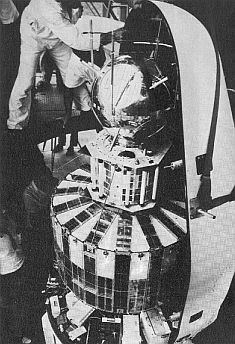
SOLRAD (SOLar RADiation) 3 was a solar X-ray satellite, the third in the SOLRAD program. Developed by the United States Navy's Naval Research Laboratory (USNRL), it shared satellite space with and provided cover for the Navy's GRAB 2 (Galactic Radiation And Background), a secret electronic surveillance program.
The satellite was launched atop a Thor-Ablestar rocket on 29 June 1961 along with Transit 4A and the University of Iowa's Van Allen Belts Injun 1 satellite. After reaching orbit, SOLRAD 3/GRAB 2 and INJUN 1 separated from Transit 4A but not from each other. Though this reduced SOLRAD 3's data-transmission ability by half, the satellite still returned valuable information regarding the Sun's normal levels of X-ray emissions. The SOLRAD experiment package also established that, during solar flares, the higher the energy of emitted X-rays, the more disruption caused on the Earth's thermosphere (and radio transmissions therein). The GRAB mission was also highly successful, returning so much data on Soviet air defense radar facilities that an automated analysis system had to be developed to process it all.
The United States Navy's Naval Research Laboratory (NRL) established itself as a player early in the Space Race with the development and management of Project Vanguard (1956–1959), America's first satellite program. After Vanguard, the Navy's next major goal was to use the observational high ground of Earth's orbit to survey Soviet radar locations and frequencies. This first space surveillance project was called "GRAB", later expanded into the more innocuous backronym, Galactic Radiation and Background. As American space launches were not classified until late 1961, a co-flying cover mission sharing satellite space was desired to conceal GRAB's electronic surveillance mission from its intended targets.
The field of solar astronomy provided such cover. Since the invention of the rocket, astronomers had wanted to fly instruments above the atmosphere to get a better look at the Sun. The Earth's atmosphere blocks large sections of sunlight's electromagnetic spectrum, making it impossible to study the Sun's X-ray and ultraviolet output from the ground. Without this critical information, it was difficult to model the Sun's internal processes, which in turn inhibited stellar astronomy in general. On a more practical level, it was believed that solar flares directly affected the Earth's thermosphere, disrupting radio communications. The U.S. Navy wanted to know when its communications were going to become unreliable or compromised. Sounding rockets had shown that solar output was unpredictable and fluctuated rapidly. A long-term, real-time observation platform above the Earth's atmosphere – in other words, a satellite – was required to properly chart the Sun's radiation, determine its effects on the Earth, and correlate it with ground-based observations of the Sun in other wavelengths of light.
Thus, the SOLRAD project was conceived to address several NRL goals at once:
A dummy SOLRAD was successfully launched on 13 April 1960, and SOLRAD 1 went into orbit on 22 June 1960, becoming both the world's first surveillance satellite (as GRAB 1) and the first satellite to observe the Sun in X-ray and ultraviolet light. SOLRAD 2, a duplicate of SOLRAD 1, was launched on 30 November 1960, but was lost when its booster flew off course and had to be destroyed.
Like its two predecessors, SOLRAD 1 and SOLRAD 2, SOLRAD 3/GRAB 2 was a 51 cm diameter sphere based on the Vanguard 3 satellite. Unlike SOLRAD 1 and the abortive SOLRAD 2, the satellite's scientific package did not include Lyman-alpha photometers. This is because it had been discovered since SOLRAD 2's failed launch that the ultraviolet radiation level remained constant during solar flares. Instead, SOLRAD 3 carried two X-ray photometers designed to cover a greater range of wavelengths than the first SOLRAD. In addition to a photometer that, covered the same 2-8 Å range as the earlier SOLRAD, SOLRAD 3 also carried one that measured the bandwidth from 8-14 Å.
As was the case with most early automatic spacecraft, SOLRAD 2, though spin stabilized, lacked attitude control systems and thus scanned the whole sky with no source in particular. So that scientists could properly interpret the source of the X-rays detected by SOLRAD 2, the spacecraft carried a vacuum photocell to determine when the sunlight was striking its photometers and the angle at which it hit them.
Hub AI
SOLRAD 3 AI simulator
(@SOLRAD 3_simulator)
SOLRAD 3
SOLRAD (SOLar RADiation) 3 was a solar X-ray satellite, the third in the SOLRAD program. Developed by the United States Navy's Naval Research Laboratory (USNRL), it shared satellite space with and provided cover for the Navy's GRAB 2 (Galactic Radiation And Background), a secret electronic surveillance program.
The satellite was launched atop a Thor-Ablestar rocket on 29 June 1961 along with Transit 4A and the University of Iowa's Van Allen Belts Injun 1 satellite. After reaching orbit, SOLRAD 3/GRAB 2 and INJUN 1 separated from Transit 4A but not from each other. Though this reduced SOLRAD 3's data-transmission ability by half, the satellite still returned valuable information regarding the Sun's normal levels of X-ray emissions. The SOLRAD experiment package also established that, during solar flares, the higher the energy of emitted X-rays, the more disruption caused on the Earth's thermosphere (and radio transmissions therein). The GRAB mission was also highly successful, returning so much data on Soviet air defense radar facilities that an automated analysis system had to be developed to process it all.
The United States Navy's Naval Research Laboratory (NRL) established itself as a player early in the Space Race with the development and management of Project Vanguard (1956–1959), America's first satellite program. After Vanguard, the Navy's next major goal was to use the observational high ground of Earth's orbit to survey Soviet radar locations and frequencies. This first space surveillance project was called "GRAB", later expanded into the more innocuous backronym, Galactic Radiation and Background. As American space launches were not classified until late 1961, a co-flying cover mission sharing satellite space was desired to conceal GRAB's electronic surveillance mission from its intended targets.
The field of solar astronomy provided such cover. Since the invention of the rocket, astronomers had wanted to fly instruments above the atmosphere to get a better look at the Sun. The Earth's atmosphere blocks large sections of sunlight's electromagnetic spectrum, making it impossible to study the Sun's X-ray and ultraviolet output from the ground. Without this critical information, it was difficult to model the Sun's internal processes, which in turn inhibited stellar astronomy in general. On a more practical level, it was believed that solar flares directly affected the Earth's thermosphere, disrupting radio communications. The U.S. Navy wanted to know when its communications were going to become unreliable or compromised. Sounding rockets had shown that solar output was unpredictable and fluctuated rapidly. A long-term, real-time observation platform above the Earth's atmosphere – in other words, a satellite – was required to properly chart the Sun's radiation, determine its effects on the Earth, and correlate it with ground-based observations of the Sun in other wavelengths of light.
Thus, the SOLRAD project was conceived to address several NRL goals at once:
A dummy SOLRAD was successfully launched on 13 April 1960, and SOLRAD 1 went into orbit on 22 June 1960, becoming both the world's first surveillance satellite (as GRAB 1) and the first satellite to observe the Sun in X-ray and ultraviolet light. SOLRAD 2, a duplicate of SOLRAD 1, was launched on 30 November 1960, but was lost when its booster flew off course and had to be destroyed.
Like its two predecessors, SOLRAD 1 and SOLRAD 2, SOLRAD 3/GRAB 2 was a 51 cm diameter sphere based on the Vanguard 3 satellite. Unlike SOLRAD 1 and the abortive SOLRAD 2, the satellite's scientific package did not include Lyman-alpha photometers. This is because it had been discovered since SOLRAD 2's failed launch that the ultraviolet radiation level remained constant during solar flares. Instead, SOLRAD 3 carried two X-ray photometers designed to cover a greater range of wavelengths than the first SOLRAD. In addition to a photometer that, covered the same 2-8 Å range as the earlier SOLRAD, SOLRAD 3 also carried one that measured the bandwidth from 8-14 Å.
As was the case with most early automatic spacecraft, SOLRAD 2, though spin stabilized, lacked attitude control systems and thus scanned the whole sky with no source in particular. So that scientists could properly interpret the source of the X-rays detected by SOLRAD 2, the spacecraft carried a vacuum photocell to determine when the sunlight was striking its photometers and the angle at which it hit them.
Recent media