



Community hub
Recent from talks
Contribute something to knowledge base
Content stats: 0 posts, 0 articles, 1 media, 0 notes
Members stats: 0 subscribers, 0 contributors, 0 moderators, 0 supporters
Subscribers
Supporters
Contributors
Moderators
Hub AI
STS-41-B AI simulator
(@STS-41-B_simulator)
Hub AI
STS-41-B AI simulator
(@STS-41-B_simulator)
STS-41-B
STS-41-B was NASA's tenth Space Shuttle mission and the fourth flight of the Space Shuttle Challenger. It launched on February 3, 1984 and landed on February 11, 1984, after deploying two communications satellites. It was also notable for including the first untethered spacewalk.
Following STS-9, the flight numbering system for the Space Shuttle program was changed. Because the original successor to STS-9, STS-10, was canceled due to payload delays, the next flight, originally and internally designated STS-11, became STS-41-B as part of the new numbering system.
The STS-41-B crew included commander Vance D. Brand, making his second Shuttle flight; pilot Robert L. Gibson; and mission specialists Bruce McCandless II, Ronald E. McNair, and Robert L. Stewart.
Challenger lifted off from Kennedy Space Center at 08:00:00 a.m. EST on February 3, 1984. It was estimated that 100,000 people attended the launch. Two communications satellites were deployed about 8 hours after launch; one, Westar 6, was for America's Western Union, and the other, Palapa B2, for Indonesia; both were Hughes-built HS-376-series satellites. However, the Payload Assist Modules (PAM) for both satellites malfunctioned, placing them into a lower-than-planned orbit. Both satellites were retrieved successfully in November 1984 during STS-51-A, which was conducted by the orbiter Discovery.
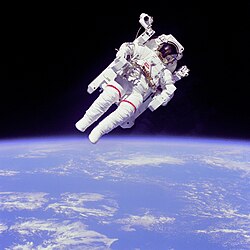
On February 7, the fourth day of the mission, astronauts McCandless and Stewart performed the first untethered spacewalk, operating the Manned Maneuvering Unit (MMU) for the first time. At 8:25 a.m. EST, pulsing the MMU's thrusters, McCandless ventured out of Challenger's payload bay, and reached 98 m (322 ft) from the orbiter. Stewart tested the "work station" foot restraint at the end of the Remote Manipulator System (Canadarm). On the seventh day of the mission, both astronauts performed another extravehicular activity (EVA) to practice capture procedures for the Solar Maximum Mission (SMM) satellite retrieval and repair operation, which was planned for the next mission, STS-41-C.
STS-41-B also achieved the reflight of the West German-sponsored SPAS-1 pallet/satellite, which had originally flown on STS-7. This time, however, it remained in the payload bay due to an electrical problem in the RMS (Canadarm). The mission also carried five Get Away Special (GAS) canisters, six live rats in the middeck area, a Cinema-360 camera and a continuation of the Continuous Flow Electrophoresis System and Monodisperse Latex Reactor experiments. Included in one of the GAS canisters was the first experiment designed and built by a high school team to fly in space. The experiment, on seed germination and growth in zero gravity, was created and built by a team of four students from Brighton High School in Utah through a partnership with Utah State University.
During the mission, the nozzles of Challenger's supply and wastewater venting systems experienced below-freezing temperatures; subsequently, the supply water dump valve failed to open, so excess water was dumped through the flash evaporator for the remainder of the mission. During re-entry, ice from the dump valves broke off their nozzles situated near the nose of the orbiter and struck the left Orbital Maneuvering System (OMS) pod, damaging three Thermal Protection System (TPS) tiles and leading to a burn-through, but the damage was minimal enough that Challenger and its crew were unharmed. During the post-flight inspection it was found that the dump line upstream of the two nozzles had ruptured due to the wastewater expanding as it froze, and insulation was missing around both nozzles. The TPS tiles near the nozzles were also discolored, indicating ice had built up prior to re-entry.
The 7 days, 23 hours, 15 minutes, and 55 seconds flight ended on February 11, 1984 with a successful landing at Kennedy Space Center's Shuttle Landing Facility. This marked the first landing of a spacecraft at its launch site. Challenger completed 128 orbits and traveled 5,329,150 km (3,311,380 mi).
STS-41-B
STS-41-B was NASA's tenth Space Shuttle mission and the fourth flight of the Space Shuttle Challenger. It launched on February 3, 1984 and landed on February 11, 1984, after deploying two communications satellites. It was also notable for including the first untethered spacewalk.
Following STS-9, the flight numbering system for the Space Shuttle program was changed. Because the original successor to STS-9, STS-10, was canceled due to payload delays, the next flight, originally and internally designated STS-11, became STS-41-B as part of the new numbering system.
The STS-41-B crew included commander Vance D. Brand, making his second Shuttle flight; pilot Robert L. Gibson; and mission specialists Bruce McCandless II, Ronald E. McNair, and Robert L. Stewart.
Challenger lifted off from Kennedy Space Center at 08:00:00 a.m. EST on February 3, 1984. It was estimated that 100,000 people attended the launch. Two communications satellites were deployed about 8 hours after launch; one, Westar 6, was for America's Western Union, and the other, Palapa B2, for Indonesia; both were Hughes-built HS-376-series satellites. However, the Payload Assist Modules (PAM) for both satellites malfunctioned, placing them into a lower-than-planned orbit. Both satellites were retrieved successfully in November 1984 during STS-51-A, which was conducted by the orbiter Discovery.
On February 7, the fourth day of the mission, astronauts McCandless and Stewart performed the first untethered spacewalk, operating the Manned Maneuvering Unit (MMU) for the first time. At 8:25 a.m. EST, pulsing the MMU's thrusters, McCandless ventured out of Challenger's payload bay, and reached 98 m (322 ft) from the orbiter. Stewart tested the "work station" foot restraint at the end of the Remote Manipulator System (Canadarm). On the seventh day of the mission, both astronauts performed another extravehicular activity (EVA) to practice capture procedures for the Solar Maximum Mission (SMM) satellite retrieval and repair operation, which was planned for the next mission, STS-41-C.
STS-41-B also achieved the reflight of the West German-sponsored SPAS-1 pallet/satellite, which had originally flown on STS-7. This time, however, it remained in the payload bay due to an electrical problem in the RMS (Canadarm). The mission also carried five Get Away Special (GAS) canisters, six live rats in the middeck area, a Cinema-360 camera and a continuation of the Continuous Flow Electrophoresis System and Monodisperse Latex Reactor experiments. Included in one of the GAS canisters was the first experiment designed and built by a high school team to fly in space. The experiment, on seed germination and growth in zero gravity, was created and built by a team of four students from Brighton High School in Utah through a partnership with Utah State University.
During the mission, the nozzles of Challenger's supply and wastewater venting systems experienced below-freezing temperatures; subsequently, the supply water dump valve failed to open, so excess water was dumped through the flash evaporator for the remainder of the mission. During re-entry, ice from the dump valves broke off their nozzles situated near the nose of the orbiter and struck the left Orbital Maneuvering System (OMS) pod, damaging three Thermal Protection System (TPS) tiles and leading to a burn-through, but the damage was minimal enough that Challenger and its crew were unharmed. During the post-flight inspection it was found that the dump line upstream of the two nozzles had ruptured due to the wastewater expanding as it froze, and insulation was missing around both nozzles. The TPS tiles near the nozzles were also discolored, indicating ice had built up prior to re-entry.
The 7 days, 23 hours, 15 minutes, and 55 seconds flight ended on February 11, 1984 with a successful landing at Kennedy Space Center's Shuttle Landing Facility. This marked the first landing of a spacecraft at its launch site. Challenger completed 128 orbits and traveled 5,329,150 km (3,311,380 mi).
Recent media
Recent media