


Community hub
Recent from talks
Contribute something
Nothing was collected or created yet.
Space Shuttle program
View on Wikipedia
 | |
| Program overview | |
|---|---|
| Country | United States |
| Organization | NASA |
| Purpose | Crewed orbital flight |
| Status | Completed |
| Program history | |
| Cost | US$196 billion (2011) |
| Duration | 1972–2011[a] |
| First flight | August 12, 1977 (ALT-12) |
| First crewed flight | April 12, 1981 (STS-1) |
| Last flight | July 21, 2011 (STS-135) |
| Successes | 133 |
| Failures | 2 (STS-51-L, STS-107) |
| Partial failures | 1 (STS-83) |
| Launch sites | |
| Vehicle information | |
| Crewed vehicle | Space Shuttle orbiter |
| Launch vehicle | Space Shuttle |
| Part of a series on the |
| United States space program |
|---|
  |
The Space Shuttle program was the fourth human spaceflight program carried out by the U.S. National Aeronautics and Space Administration (NASA), which accomplished routine transportation for Earth-to-orbit crew and cargo from 1981 to 2011. Its official program name was Space Transportation System (STS), taken from a 1969 plan for a system of reusable spacecraft where it was the only item funded for development, as a proposed nuclear shuttle in the plan was cancelled in 1972.[1][2] It flew 135 missions and carried 355 astronauts from 16 countries, many on multiple trips.
The Space Shuttle, composed of an orbiter launched with two reusable solid rocket boosters and a disposable external fuel tank, carried up to eight astronauts and up to 50,000 lb (23,000 kg) of payload into low Earth orbit (LEO). When its mission was complete, the orbiter would reenter the Earth's atmosphere and land like a glider at either the Kennedy Space Center or Edwards Air Force Base.
The Shuttle is the only winged crewed spacecraft to have achieved orbit and landing, and the first reusable crewed space vehicle that made multiple flights into orbit.[b] Its missions involved carrying large payloads to various orbits including the International Space Station (ISS), providing crew rotation for the space station, and performing service missions on the Hubble Space Telescope. The orbiter also recovered satellites and other payloads (e.g., from the ISS) from orbit and returned them to Earth, though its use in this capacity was rare. Each vehicle was designed with a projected lifespan of 100 launches, or 10 years' operational life. Original selling points on the shuttles were over 150 launches over a 15-year operational span with a 'launch per month' expected at the peak of the program, but extensive delays in the development of the International Space Station[3] never created such a peak demand for frequent flights.
Background
[edit]Various shuttle concepts had been explored since the late 1960s. The program formally commenced in 1972, becoming the sole focus of NASA's human spaceflight operations after the Apollo, Skylab, and Apollo–Soyuz programs in 1975. The Shuttle was originally conceived of and presented to the public in 1972 as a 'Space Truck' which would, among other things, be used to build a United States space station in low Earth orbit during the 1980s and then be replaced by a new vehicle by the early 1990s. The stalled plans for a U.S. space station evolved into the International Space Station and were formally initiated in 1983 by President Ronald Reagan, but the ISS suffered from long delays, design changes and cost over-runs[3] and forced the service life of the Space Shuttle to be extended several times until 2011 when it was finally retired—serving twice as long as it was originally designed to do. In 2004, according to President George W. Bush's Vision for Space Exploration, use of the Space Shuttle was to be focused almost exclusively on completing assembly of the ISS, which was far behind schedule at that point.
The first experimental orbiter, Enterprise, was a high-altitude glider, launched from the back of a specially modified Boeing 747, only for initial atmospheric landing tests (ALT). Enterprise's first test flight was on February 18, 1977, only five years after the Shuttle program was formally initiated; leading to the launch of the first space-worthy shuttle Columbia on April 12, 1981, on STS-1. The Space Shuttle program finished with its last mission, STS-135 flown by Atlantis, in July 2011, retiring the final Shuttle in the fleet. The Space Shuttle program formally ended on August 31, 2011.[4]
Conception and development
[edit]
Before the Apollo 11 Moon landing in 1969, NASA began studies of Space Shuttle designs as early as October 1968. The early studies were denoted "Phase A", and in June 1970, "Phase B", which were more detailed and specific. The primary intended use of the Phase A Space Shuttle was supporting the future space station, ferrying a minimum crew of four and about 20,000 pounds (9,100 kg) of cargo, and being able to be rapidly turned around for future flights, with larger payloads like space station modules being lifted by the Saturn V.
Two designs emerged as front-runners. One was designed by engineers at the Manned Spaceflight Center, and championed especially by George Mueller. This was a two-stage system with delta-winged spacecraft, and generally complex. An attempt to re-simplify was made in the form of the DC-3, designed by Maxime Faget, who had designed the Mercury capsule among other vehicles. Numerous offerings from a variety of commercial companies were also offered but generally fell by the wayside as each NASA lab pushed for its own version.
All of this was taking place in the midst of other NASA teams proposing a wide variety of post-Apollo missions, a number of which would cost as much as Apollo or more.[citation needed] As each of these projects fought for funding, the NASA budget was at the same time being severely constrained. Three were eventually presented to United States Vice President Spiro Agnew in 1969. The shuttle project rose to the top, largely due to tireless campaigning by its supporters.[citation needed] By 1970 the shuttle had been selected as the one major project for the short-term post-Apollo time frame.
When funding for the program came into question, there were concerns that the project might be canceled. This became especially pressing as it became clear that the Saturn V would no longer be produced, which meant that the payload to orbit needed to be increased in both mass - all the way to 60,600 pounds (27,500 kg) - and size to supplement its heavy-lift capabilities, necessary for planned interplanetary probes and space station modules, which meant a bigger and costlier vehicle was needed during Phase B. Therefore, NASA tried to interest the US Air Force and a variety of other customers in using the shuttle for their missions as well. To lower the development costs of the proposed designs, boosters were added, a throw-away fuel tank was adopted, and many other changes were made that greatly lowered the reusability and greatly added to the vehicle and operational costs.Program history
[edit]

All Space Shuttle missions were launched from the Kennedy Space Center (KSC) in Florida. Some civilian and military circumpolar space shuttle missions were planned for Vandenberg AFB in California. However, the use of Vandenberg AFB for space shuttle missions was canceled after the Challenger disaster in 1986. The weather criteria used for launch included, but were not limited to: precipitation, temperatures, cloud cover, lightning forecast, wind, and humidity.[5] The Shuttle was not launched under conditions where it could have been struck by lightning.
The first fully functional orbiter was Columbia (designated OV-102), built in Palmdale, California. It was delivered to Kennedy Space Center (KSC) on March 25, 1979, and was first launched on April 12, 1981—the 20th anniversary of Yuri Gagarin's space flight—with a crew of two.
Challenger (OV-099) was delivered to KSC in July 1982, Discovery (OV-103) in November 1983, Atlantis (OV-104) in April 1985 and Endeavour (OV-105) in May 1991. Challenger was originally built and used as a Structural Test Article (STA-099), but was converted to a complete orbiter when this was found to be less expensive than converting Enterprise from its Approach and Landing Test configuration into a spaceworthy vehicle.
On April 24, 1990, Discovery carried the Hubble Space Telescope into space during STS-31.
In the course of 135 missions flown, two orbiters (Columbia and Challenger) suffered catastrophic accidents, with the loss of all crew members, totaling 14 astronauts.
The accidents led to national level inquiries, detailed analysis of why the accidents occurred, and significant pauses where changes were made before the Shuttles returned to flight.[6] After the Challenger disaster in January 1986, there was a delay of 32 months before the next Shuttle launch.[7] A similar delay of 29 months occurred after the Columbia disaster in February 2003.[6]
The longest Shuttle mission was STS-80 lasting 17 days, 15 hours. The final flight of the Space Shuttle program was STS-135 on July 8, 2011.
Since the Shuttle's retirement in 2011, many of its original duties are performed by an assortment of government and private vessels. The European ATV Automated Transfer Vehicle supplied the ISS between 2008 and 2015. Classified military missions are being flown by the US Air Force's uncrewed spaceplane, the X-37B.[8] By 2012, cargo to the International Space Station was already being delivered commercially under NASA's Commercial Resupply Services by SpaceX's partially reusable Dragon spacecraft, followed by Orbital Sciences' Cygnus spacecraft in late 2013. Crew service to the ISS is currently provided by the Russian Soyuz and, since 2020, the SpaceX Dragon 2 crew capsule, launched on the company's reusable Falcon 9 rocket as part of NASA's Commercial Crew Development program.[9] Boeing's Starliner capsule is scheduled to start ISS crew service from 2025. For missions beyond low Earth orbit, NASA is building the Space Launch System and the Orion spacecraft, part of the Artemis program.
-
 NASA Administrator address the crowd at the Spacelab arrival ceremony in February 1982. On the podium with him is then-Vice President George Bush, the director general of European Space Agency (ESA), Eric Quistgaard, and director of Kennedy Space Center Richard G. Smith
 -
!["President Ronald Reagan chats with NASA astronauts Henry Hartsfield and Ken Mattingly on the runway as first lady Nancy Reagan inspects the nose of Space Shuttle Columbia following its Independence Day landing at Edwards Air Force Base on July 4, 1982."[10]](//upload.wikimedia.org/wikipedia/commons/thumb/9/93/Ronald_and_Nancy_Reagan_NASA_1982.jpg/250px-Ronald_and_Nancy_Reagan_NASA_1982.jpg) "President Ronald Reagan chats with NASA astronauts Henry Hartsfield and Ken Mattingly on the runway as first lady Nancy Reagan inspects the nose of Space Shuttle Columbia following its Independence Day landing at Edwards Air Force Base on July 4, 1982."[10]
"President Ronald Reagan chats with NASA astronauts Henry Hartsfield and Ken Mattingly on the runway as first lady Nancy Reagan inspects the nose of Space Shuttle Columbia following its Independence Day landing at Edwards Air Force Base on July 4, 1982."[10] -
 STS-3 lands in March 1982

!["President Ronald Reagan chats with NASA astronauts Henry Hartsfield and Ken Mattingly on the runway as first lady Nancy Reagan inspects the nose of Space Shuttle Columbia following its Independence Day landing at Edwards Air Force Base on July 4, 1982."[10]](https://en.wikipedia.org/wiki/File:Ronald_and_Nancy_Reagan_NASA_1982.jpg)

Accomplishments
[edit]

Space Shuttle missions have included:
- Spacelab missions[11] Including:
- Construction of the International Space Station (ISS)
- Crew rotation and servicing of Mir and the International Space Station (ISS)
- Servicing missions, such as to repair the Hubble Space Telescope (HST) and orbiting satellites
- Human experiments in low Earth orbit (LEO)
- Carried to low Earth orbit (LEO):
- The Hubble Space Telescope (HST)
- Components of the International Space Station (ISS)
- Supplies in Spacehab modules or Multi-Purpose Logistics Modules
- The Long Duration Exposure Facility
- The Upper Atmosphere Research Satellite
- The Compton Gamma Ray Observatory
- The Earth Radiation Budget Satellite
- The Mir Shuttle Docking Node
- Carried satellites with a booster, such as the Payload Assist Module (PAM-D) or the Inertial Upper Stage (IUS), to the point where the booster sends the satellite to:
- A higher Earth orbit; these have included:
- Chandra X-ray Observatory
- The first six TDRS satellites
- Two DSCS-III (Defense Satellite Communications System) communications satellites in one mission
- A Defense Support Program satellite
- An interplanetary mission; these have included:
- A higher Earth orbit; these have included:
-
 U.S. Shuttle Columbia landing at the end of STS-73, 1995
 -
 Space art for the Spacelab 2 mission, showing some of the various experiments in the payload bay. Spacelab was a major European contribution to the Space Shuttle program
 -
 European astronauts prepare for their Spacelab mission, 1984.
 -
 SpaceLab hardware included a pressurized lab, but also other equipment allowing the Orbiter to serve as a crewed space observatory (Astro-2 mission, 1995, shown)
 -
 Astronauts Thomas D. Akers and Kathryn C. Thornton install corrective optics on the Hubble Space Telescope during STS-61.


Budget
[edit]

Early during development of the Space Shuttle, NASA had estimated that the program would cost $7.45 billion ($43 billion in 2011 dollars, adjusting for inflation) in development/non-recurring costs, and $9.3M ($54M in 2011 dollars) per flight.[12] Early estimates for the cost to deliver payload to low-Earth orbit were as low as $118 per pound ($260/kg) of payload ($635/lb or $1,400/kg in 2011 dollars), based on marginal or incremental launch costs, and assuming a 65,000 pound (30 000 kg) payload capacity and 50 launches per year.[13][14] A more realistic projection of 12 flights per year for the 15-year service life combined with the initial development costs would have resulted in a total cost projection for the program of roughly $54 billion (in 2011 dollars).
The total cost of the actual 30-year service life of the Shuttle program through 2011, adjusted for inflation, was $196 billion.[15] In 2010, the incremental cost per flight of the Space Shuttle was $409 million, or $14,186 per kilogram ($6,435 per pound) to low Earth orbit (LEO). In contrast, the comparable Proton launch vehicle cost was $141 million, or $6,721 per kilogram ($3,049 per pound) to LEO and the Soyuz 2.1 was $55 million, or $6,665 per kilogram ($3,023 per pound), despite these launch vehicles not being reusable.[16]
NASA's budget for 2005 allocated 30%, or $5 billion, to space shuttle operations;[17] this was decreased in 2006 to a request of $4.3 billion.[18] Non-launch costs account for a significant part of the program budget: for example, during fiscal years 2004 to 2006, NASA spent around $13 billion on the Space Shuttle program,[19] even though the fleet was grounded in the aftermath of the Columbia disaster and there were a total of three launches during this period of time. In fiscal year 2009, NASA budget allocated $2.98 billion for 5 launches to the program, including $490 million for "program integration", $1.03 billion for "flight and ground operations", and $1.46 billion for "flight hardware" (which includes maintenance of orbiters, engines, and the external tank between flights.)
Per-launch costs can be measured by dividing the total cost over the life of the program (including buildings, facilities, training, salaries, etc.) by the number of launches. With 135 missions, and the total cost of US$192 billion (in 2010 dollars), this gives approximately $1.5 billion per launch over the life of the Shuttle program.[20] A 2017 study found that carrying one kilogram of cargo to the ISS on the Shuttle cost $272,000 in 2017 dollars, twice the cost of Cygnus and three times that of Dragon.[21]
NASA used a management philosophy known as success-oriented management during the Space Shuttle program which historian Alex Roland described in the aftermath of the Columbia disaster as "hoping for the best".[22] Success-oriented management has since been studied by several analysts in the area.[23][24][25]
Accidents
[edit]In the course of 135 missions flown, two orbiters were destroyed, with loss of crew totalling 14 astronauts:
- Challenger – lost 73 seconds after liftoff, STS-51-L, January 28, 1986
- Columbia – lost approximately 16 minutes before its expected landing, STS-107, February 1, 2003
There was also one abort-to-orbit and some fatal accidents on the ground during launch preparations.
STS-51-L (Challenger, 1986)
[edit]
Close-up video footage of Challenger during its final launch on January 28, 1986, clearly shows that the problems began due to an O-ring failure on the right solid rocket booster (SRB). The hot plume of gas leaking from the failed joint caused the collapse of the external tank, which then resulted in the orbiter's disintegration due to high aerodynamic stress. The accident resulted in the loss of all seven astronauts on board. Endeavour (OV-105) was built to replace Challenger (using structural spare parts originally intended for the other orbiters) and delivered in May 1991; it was first launched a year later.
After the loss of Challenger, NASA grounded the Space Shuttle program for over two years, making numerous safety changes recommended by the Rogers Commission Report, which included a redesign of the SRB joint that failed in the Challenger accident. Other safety changes included a new escape system for use when the orbiter was in controlled flight, improved landing gear tires and brakes, and the reintroduction of pressure suits for Shuttle astronauts (these had been discontinued after STS-4; astronauts wore only coveralls and oxygen helmets from that point on until the Challenger accident). The Shuttle program continued in September 1988 with the launch of Discovery on STS-26.
The accidents did not just affect the technical design of the orbiter, but also NASA.[7] Quoting some recommendations made by the post-Challenger Rogers commission:[7]
Recommendation I – The faulty Solid Rocket Motor joint and seal must be changed. This could be a new design eliminating the joint or a redesign of the current joint and seal. ... the Administrator of NASA should request the National Research Council to form an independent Solid Rocket Motor design oversight committee to implement the Commission's design recommendations and oversee the design effort.
Recommendation II – The Shuttle Program Structure should be reviewed. ... NASA should encourage the transition of qualified astronauts into agency management Positions.
Recommendation III – NASA and the primary shuttle contractors should review all Criticality 1, 1R, 2, and 2R items and hazard analyses.
Recommendation IV – NASA should establish an Office of Safety, Reliability and Quality Assurance to be headed by an Associate Administrator, reporting directly to the NASA Administrator.
Recommendation VI – NASA must take actions to improve landing safety. The tire, brake and nosewheel system must be improved.
Recommendation VII – Make all efforts to provide a crew escape system for use during controlled gliding flight.
Recommendation VIII – The nation's reliance on the shuttle as its principal space launch capability created a relentless pressure on NASA to increase the flight rate ... NASA must establish a flight rate that is consistent with its resources.
STS-107 (Columbia, 2003)
[edit]
The Shuttle program operated accident-free for seventeen years and 88 missions after the Challenger disaster, until Columbia broke up on reentry, killing all seven crew members, on February 1, 2003. The ultimate cause of the accident was a piece of foam separating from the external tank moments after liftoff and striking the leading edge of the orbiter's left wing, puncturing one of the reinforced carbon-carbon (RCC) panels that covered the wing edge and protected it during reentry. As Columbia reentered the atmosphere at the end of an otherwise normal mission, hot gas penetrated the wing and destroyed it from the inside out, causing the orbiter to lose control and disintegrate.
After the Columbia disaster, the International Space Station operated on a skeleton crew of two for more than two years and was serviced primarily by Russian spacecraft. While the "Return to Flight" mission STS-114 in 2005 was successful, a similar piece of foam from a different portion of the tank was shed. Although the debris did not strike Discovery, the program was grounded once again for this reason.
The second "Return to Flight" mission, STS-121 launched on July 4, 2006, at 14:37 (EDT). Two previous launches were scrubbed because of lingering thunderstorms and high winds around the launch pad, and the launch took place despite objections from its chief engineer and safety head. A five-inch (13 cm) crack in the foam insulation of the external tank gave cause for concern; however, the Mission Management Team gave the go for launch.[26] This mission increased the ISS crew to three. Discovery touched down successfully on July 17, 2006, at 09:14 (EDT) on Runway 15 at Kennedy Space Center.
Following the success of STS-121, all subsequent missions were completed without major foam problems, and the construction of the ISS was completed (during the STS-118 mission in August 2007, the orbiter was again struck by a foam fragment on liftoff, but this damage was minimal compared to the damage sustained by Columbia).
The Columbia Accident Investigation Board, in its report, noted the reduced risk to the crew when a Shuttle flew to the International Space Station (ISS), as the station could be used as a safe haven for the crew awaiting rescue in the event that damage to the orbiter on ascent made it unsafe for reentry. The board recommended that for the remaining flights, the Shuttle always orbit with the station. Prior to STS-114, NASA Administrator Sean O'Keefe declared that all future flights of the Space Shuttle would go to the ISS, precluding the possibility of executing the final Hubble Space Telescope servicing mission which had been scheduled before the Columbia accident, despite the fact that millions of dollars' worth of upgrade equipment for Hubble were ready and waiting in NASA warehouses. Many dissenters, including astronauts [who?], asked NASA management to reconsider allowing the mission, but initially the director stood firm. On October 31, 2006, NASA announced approval of the launch of Atlantis for the fifth and final shuttle servicing mission to the Hubble Space Telescope, scheduled for August 28, 2008. However SM4/STS-125 eventually launched in May 2009.
One impact of Columbia was that future crewed launch vehicles, namely the Ares I, had a special emphasis on crew safety compared to other considerations.[27]
Retirement
[edit]
The Space Shuttle retirement was announced in January 2004.[28]: III-347 President George W. Bush announced his Vision for Space Exploration, which called for the retirement of the Space Shuttle once it completed construction of the ISS.[29][30] To ensure the ISS was properly assembled, the contributing partners determined the need for 16 remaining assembly missions in March 2006.[28]: III-349 One additional Hubble Space Telescope servicing mission was approved in October 2006.[28]: III-352 Originally, STS-134 was to be the final Space Shuttle mission. However, the Columbia disaster resulted in additional orbiters being prepared for launch on need in the event of a rescue mission. As Atlantis was prepared for the final launch-on-need mission, the decision was made in September 2010 that it would fly as STS-135 with a four-person crew that could remain at the ISS in the event of an emergency.[28]: III-355 STS-135 launched on July 8, 2011, and landed at the KSC on July 21, 2011, at 5:57 a.m. EDT (09:57 UTC).[28]: III-398 From then until the launch of Crew Dragon Demo-2 on May 30, 2020, the US launched its astronauts aboard Russian Soyuz spacecraft.[31]
Following each orbiter's final flight, it was processed to make it safe for display. The OMS and RCS systems used presented the primary dangers due to their toxic hypergolic propellant, and most of their components were permanently removed to prevent any dangerous outgassing.[28]: III-443 Atlantis is on display at the Kennedy Space Center Visitor Complex in Florida,[28]: III-456 Discovery is on display at the Steven F. Udvar-Hazy Center in Virginia,[28]: III-451 Endeavour is on display at the California Science Center in Los Angeles,[28]: III-457 and Enterprise is displayed at the Intrepid Museum in New York.[28]: III-464 Components from the orbiters were transferred to the US Air Force, ISS program, and Russian and Canadian governments. The engines were removed to be used on the Space Launch System, and spare RS-25 nozzles were attached for display purposes.[28]: III-445
For many Artemis program missions, the Space Launch System's two solid rocket boosters' engines and casings and four main engines and the Orion spacecraft's main engine will all be previously flown Space Shuttle main engines, solid rocket boosters, and Orbital Maneuvering System engines. They are refurbished legacy engines from the Space Shuttle program, some of which even date back to the early 1980s. For example, Artemis I had components that flew on 83 of the 135 Space Shuttle missions. From Artemis I to Artemis IV recycled Shuttle main engines will be used before manufacturing new engines. From Artemis I to Artemis III recycled Shuttle solid rocket boosters' engines and steel casings are to be used before building new ones. From Artemis I to Artemis VI the Orion main engine will use six previously flown Space Shuttle OMS engines.[32][33][34]Preservation
[edit]
Out of the five fully functional shuttle orbiters built, three remain. Enterprise, which was used for atmospheric test flights but not for orbital flight, had many parts taken out for use on the other orbiters. It was later visually restored and was on display at the National Air and Space Museum's Steven F. Udvar-Hazy Center until April 19, 2012. Enterprise was moved to New York City in April 2012 to be displayed at the Intrepid Museum, whose Space Shuttle Pavilion opened on July 19, 2012. Discovery replaced Enterprise at the National Air and Space Museum's Steven F. Udvar-Hazy Center. Atlantis formed part of the Space Shuttle Exhibit at the Kennedy Space Center visitor complex and has been on display there since June 29, 2013, following its refurbishment.[35]
On October 14, 2012, Endeavour completed an unprecedented 12 mi (19 km) drive on city streets from Los Angeles International Airport to the California Science Center, where it has been on display in a temporary hangar since late 2012. The transport from the airport took two days and required major street closures, the removal of over 400 city trees, and extensive work to raise power lines, level the street, and temporarily remove street signs, lamp posts, and other obstacles. Hundreds of volunteers, and fire and police personnel, helped with the transport. Large crowds of spectators waited on the streets to see the shuttle as it passed through the city. Endeavour, along with the last flight-qualified external tank (ET-94), is currently on display at the Science Center's Samuel Oschin Pavilion (in a horizontal orientation) until the completion of the Samuel Oschin Air and Space Center (a planned addition to the California Science Center). Once moved, it will be permanently displayed in launch configuration, complete with genuine solid rocket boosters and external tank.[36][37]
Crew modules
[edit]| External image | |
|---|---|
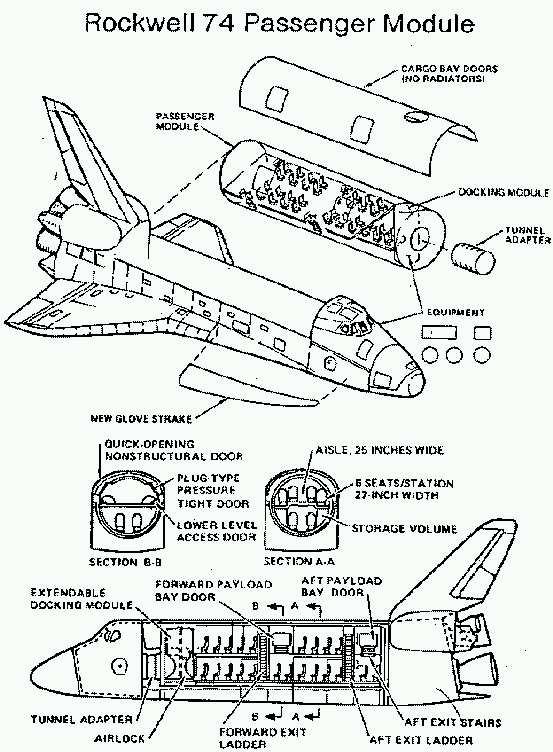
 Rockwell 74 Passenger Module Rockwell 74 Passenger Module © Rockwell— host |


One area of Space Shuttle applications is an expanded crew.[38] Crews of up to eight have been flown in the Orbiter, but it could have held at least a crew of ten.[38] Various proposals for filling the payload bay with additional passengers were also made as early as 1979.[39] One proposal by Rockwell provided seating for 74 passengers in the Orbiter payload bay, with support for three days in Earth orbit.[39] With a smaller 64 seat orbiter, costs for the late 1980s would be around US$1.5 million per seat per launch.[40] The Rockwell passenger module had two decks, four seats across on top and two on the bottom, including a 25-inch (63.5 cm) wide aisle and extra storage space.[40]
Another design was Space Habitation Design Associates 1983 proposal for 72 passengers in the Space Shuttle Payload bay.[40] Passengers were located in 6 sections, each with windows and its own loading ramp at launch, and with seats in different configurations for launch and landing.[40] Another proposal was based on the Spacelab habitation modules, which provided 32 seats in the payload bay in addition to those in the cockpit area.[40]
There were some efforts to analyze commercial operation of STS.[41] Using the NASA figure for average cost to launch a Space Shuttle as of 2011 at about $450 million per mission,[42] a cost per seat for a 74[43] seat module envisioned by Rockwell came to less than $6 million, not including the regular crew. Some passenger modules used hardware similar to existing equipment, such as the tunnel,[43] which was also needed for Spacehab and Spacelab
Successors
[edit]During the three decades of operation, various follow-on and replacements for the STS Space Shuttle were partially developed but not finished.[44]
Examples of possible future space vehicles to supplement or supplant STS:[44]
- Advanced Crewed Earth-to-Orbit Vehicle
- Shuttle II, Johnson Space Center concept for a follow-on, with 2 boosters and 2 tanks mounted on its wings.[45]
- National Aero-Space Plane (NASP)
- Rockwell X-30 (not funded)
- VentureStar, SSTO spacelane concept using an aerospike engine.
- Lockheed Martin X-33 (cancelled 2001)
- Ares I (ended with Constellation cancellation)
- Orbital Space Plane Program
One effort in the direction of space transportation was the Reusable Launch Vehicle (RLV) program, initiated in 1994 by NASA.[46] This led to work on the X-33 and X-34 vehicles.[46] NASA spent about US$1 billion on developing the X-33 hoping for it be in operation by 2005.[46] Another program around the turn of the millennium was the Space Launch Initiative, which was a next generation launch initiative.[47]
The Space Launch Initiative program was started in 2001, and in late 2002 it was evolved into two programs, the Orbital Space Plane Program and the Next Generation Launch Technology program.[47] OSP was oriented towards provided access to the International Space Station.[47]
Other vehicles that would have taken over some of the Shuttles responsibilities were the HL-20 Personnel Launch System or the NASA X-38 of the Crew Return Vehicle program, which were primarily for getting people down from ISS. The X-38 was cancelled in 2002,[48] and the HL-20 was cancelled in 1993.[49] Several other programs in this existed such as the Station Crew Return Alternative Module (SCRAM) and Assured Crew Return Vehicle (ACRV)[50]
According to the 2004 Vision for Space Exploration, the next human NASA program was to be Constellation program with its Ares I and Ares V launch vehicles and the Orion spacecraft; however, the Constellation program was never fully funded, and in early 2010 the Obama administration asked Congress to instead endorse a plan with heavy reliance on the private sector for delivering cargo and crew to LEO.
The Commercial Orbital Transportation Services (COTS) program began in 2006 with the purpose of creating commercially operated uncrewed cargo vehicles to service the ISS.[51] The first of these vehicles, SpaceX Dragon 1, became operational in 2012, and the second, Orbital Sciences's Cygnus did so in 2014.[52]
The Commercial Crew Development (CCDev) program was initiated in 2010 with the purpose of creating commercially operated crewed spacecraft capable of delivering at least four crew members to the ISS, staying docked for 180 days and then returning them back to Earth.[53] These spacecraft, like SpaceX's Dragon 2 and Boeing CST-100 Starliner were expected to become operational around 2020.[54] On the Crew Dragon Demo-2 mission, SpaceX's Dragon 2 sent astronauts to the ISS, restoring America's human launch capability. The first operational SpaceX mission launched on November 15, 2020, at 7:27:17 p.m. ET, carrying four astronauts to the ISS.
Although the Constellation program was canceled, it has been replaced with a very similar Artemis program. The Orion spacecraft has been left virtually unchanged from its previous design. The planned Ares V rocket has been replaced with the smaller Space Launch System (SLS), which is planned to launch both Orion and other necessary hardware.[55] Exploration Flight Test-1 (EFT-1), an uncrewed test flight of the Orion spacecraft, launched on December 5, 2014, on a Delta IV Heavy rocket.[56]
Artemis 1 is the first flight of the SLS and was launched as a test of the completed Orion and SLS system.[57] During the mission, an uncrewed Orion capsule spent 10 days in a 57,000-kilometer (31,000-nautical-mile) distant retrograde orbit around the Moon before returning to Earth.[58] Artemis 2, the first crewed mission of the program, will launch four astronauts in 2024[59] on a free-return flyby of the Moon at a distance of 8,520 kilometers (4,600 nautical miles).[60][61] After Artemis 2, the Power and Propulsion Element of the Lunar Gateway and three components of an expendable lunar lander are planned to be delivered on multiple launches from commercial launch service providers.[62] Artemis 3 is planned to launch in 2025 aboard a SLS Block 1 rocket and will use the minimalist Gateway and expendable lander to achieve the first crewed lunar landing of the program. The flight is planned to touch down on the lunar south pole region, with two astronauts staying there for about one week.[62][63][64][65][66]
For many Artemis missions, the Space Launch System's two solid rocket boosters' engines and casings and four main engines and the Orion spacecraft's main engine will all be previously flown Space Shuttle main engines, solid rocket boosters, and Orbital Maneuvering System engines. They are refurbished legacy engines from the Space Shuttle program, some of which even date back to the early 1980s. For example, Artemis I had components that flew on 83 of the 135 Space Shuttle missions. From Artemis I to Artemis IV recycled Shuttle main engines will be used before manufacturing new engines. From Artemis I to Artemis III recycled Shuttle solid rocket boosters' engines and steel casings will be used before manufacturing new ones. From Artemis I to Artemis VI the Orion main engine will use six previously flown Space Shuttle OMS engines.[67][68][69]
Gallery
[edit]-
 Linear aerospike engine for the cancelled X-33
 -
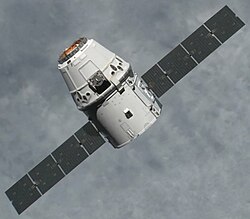 The Dragon spacecraft, one of the Space Shuttle's several successors, is seen here on its way to deliver cargo to the ISS
 -
 NASA's Orion Spacecraft for the Artemis 1 mission seen in Plum Brook On December 1, 2019
 -
 The Core Stage for the Space Launch System rocket for Artemis I
 -
 The Space Launch System Core Stage rolling out of the Michoud Facility for shipping to Stennis
 -
 The Boeing CST-100 Starliner spacecraft in the process of docking to the International Space Station
 -
 The SpaceX Crew Dragon in the process of docking to the International Space Station


_(cropped).jpg)
.jpg)
Assets and transition plan
[edit]
The Space Shuttle program occupied over 654 facilities, used over 1.2 million line items of equipment, and employed over 5,000 people. The total value of equipment was over $12 billion. Shuttle-related facilities represented over a quarter of NASA's inventory. There were over 1,200 active suppliers to the program throughout the United States. NASA's transition plan had the program operating through 2010 with a transition and retirement phase lasting through 2015. During this time, the Ares I and Orion as well as the Altair Lunar Lander were to be under development,[70] although these programs have since been canceled.
In the 2010s, two major programs for human spaceflight are Commercial Crew Program and the Artemis program. Kennedy Space Center Launch Complex 39A is, for example, used to launch Falcon Heavy and Falcon 9.
Criticism
[edit]The partial reusability of the Space Shuttle was one of the primary design requirements during its initial development.[71]: 164 The technical decisions that dictated the orbiter's return and re-use reduced the per-launch payload capabilities. The original intention was to compensate for this lower payload by lowering the per-launch costs and a high launch frequency. However, the actual costs of a Space Shuttle launch were higher than initially predicted, and the Space Shuttle did not fly the intended 24 missions per year as initially predicted by NASA.[72][28]: III–489–490
The Space Shuttle was originally intended as a launch vehicle to deploy satellites, which it was primarily used for on the missions prior to the Challenger disaster. NASA's pricing, which was below cost, was lower than expendable launch vehicles; the intention was that the high volume of Space Shuttle missions would compensate for early financial losses. The improvement of expendable launch vehicles and the transition away from commercial payloads on the Space Shuttle resulted in expendable launch vehicles becoming the primary deployment option for satellites.[28]: III–109–112 A key customer for the Space Shuttle was the National Reconnaissance Office (NRO) responsible for spy satellites. The existence of NRO's connection was classified through 1993, and secret considerations of NRO payload requirements led to lack of transparency in the program. The proposed Shuttle-Centaur program, cancelled in the wake of the Challenger disaster, would have pushed the spacecraft beyond its operational capacity.[73]
The fatal Challenger and Columbia disasters demonstrated the safety risks of the Space Shuttle that could result in the loss of the crew. The spaceplane design of the orbiter limited the abort options, as the abort scenarios required the controlled flight of the orbiter to a runway or to allow the crew to egress individually, rather than the abort escape options on the Apollo and Soyuz space capsules.[74] Early safety analyses advertised by NASA engineers and management predicted the chance of a catastrophic failure resulting in the death of the crew as ranging from 1 in 100 launches to as rare as 1 in 100,000.[75][76] Following the loss of two Space Shuttle missions, the risks for the initial missions were reevaluated, and the chance of a catastrophic loss of the vehicle and crew was found to be as high as 1 in 9.[77] NASA management was criticized afterwards for accepting increased risk to the crew in exchange for higher mission rates. Both the Challenger and Columbia reports explained that NASA culture had failed to keep the crew safe by not objectively evaluating the potential risks of the missions.[76][78]: 195–203Support vehicles
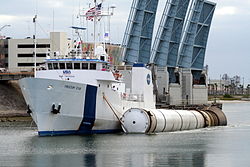
[edit]Many other vehicles were used in support of the Space Shuttle program, mainly terrestrial transportation vehicles.
- The crawler-transporter carried the mobile launcher platform and the Space Shuttle from the Vehicle Assembly Building (VAB) to Launch Complex 39, originally built for Project Apollo.
- The Shuttle Carrier Aircraft (SCA) were two modified Boeing 747s. Either could fly an orbiter from alternative landing sites back to the Kennedy Space Center.[79]: I–377, 382 These aircraft were retired to the Joe Davies Heritage Airpark at the Armstrong Flight Research Center and Space Center Houston.
- A 36-wheeled transport trailer, the Orbiter Transfer System, originally built for the U.S. Air Force's launch facility at Vandenberg Air Force Base in California (since then converted for Delta IV rockets) would transport the orbiter from the landing facility to the launch pad, which allowed both "stacking" and launch without utilizing a separate VAB-style building and crawler-transporter roadway. Prior to the closing of the Vandenberg facility, orbiters were transported from the OPF to the VAB on their undercarriages, only to be raised when the orbiter was being lifted for attachment to the SRB/ET stack. The trailer allowed the transportation of the orbiter from the OPF to either the SCA "Mate-Demate" stand or the VAB without placing any additional stress on the undercarriage.
- The Crew Transport Vehicle (CTV), a modified airport jet bridge, was used to assist astronauts to egress from the orbiter after landing. Upon entering the CTV, astronauts could take off their launch and reentry suits then proceed to chairs and beds for medical checks before being transported back to the crew quarters in the Operations and Checkout Building. Originally built for Project Apollo.
- The Astrovan was used to transport astronauts from the crew quarters in the Operations and Checkout Building to the launch pad on launch day. It was also used to transport astronauts back again from the Crew Transport Vehicle at the Shuttle Landing Facility.
- The three locomotives serving the NASA Railroad, used to transport segments of the Space Shuttle Solid Rocket Boosters, were determined to be no longer needed for day-to-day operation at the Kennedy Space Center. In April 2015, locomotive No. 1 was sent to Natchitoches Parish Port and No. 3 sent to the Madison Railroad. Locomotive No. 2 was sent to the Gold Coast Railroad Museum in 2014.[80]
-
 Crawler-transporter No.2 ("Franz") in a December 2004 road test after track shoe replacement
 -
 Atlantis being prepared to be mated to the Shuttle Carrier Aircraft using the Mate-Demate Device following STS-44.
 -


See also
[edit]
|
|
|

References
[edit]Footnotes
Citations
- ^ Portree, David S. F. "The Last Days of the Nuclear Shuttle (1971)". Wired.com. Retrieved August 1, 2024.
- ^ Launius, Roger D. (1969). "Space Task Group Report, 1969". NASA. Archived from the original on January 14, 2016. Retrieved July 31, 2024.
- ^ a b "International Space Station Historical Timeline". Center for Advancement of Science in Space. Retrieved November 27, 2022.
- ^ "Breaking News | Shannon to review options for deep space exploration". Spaceflight Now. August 29, 2011. Retrieved May 17, 2012.
- ^ "Space Shuttle Weather Launch Commit Criteria and KSC End of Mission Weather Landing Criteria". KSC Release No. 39-99. NASA Kennedy Space Center. Archived from the original on June 26, 2009. Retrieved July 6, 2009.
- ^ a b "Columbia's White External Fuel Tanks". Space.com. April 12, 2006.
- ^ a b c Logsdon, John A. "Return to Flight...Challenger Accident".
- ^ "Secretive US space plane X-37B lands after record 908 days in orbit". New Scientist. November 14, 2022. Retrieved November 27, 2022.
- ^ "NASA, Partners Update Commercial Crew Launch Dates". NASA Commercial Crew Program Blog. February 6, 2019.
- ^ Administrator, NASA (March 6, 2016). "Independence Day at NASA Dryden – 30 Years Ago". NASA.
- ^ a b c d e "Spacelab joined diverse scientists and disciplines on 28 Shuttle missions". NASA. March 15, 1999. Retrieved February 11, 2011.
- ^ Bulletin of the Atomic Scientists. February 1973. p. 39.
- ^ NASA (2003) Columbia Accident Investigation Board Public Hearing Transcript Archived August 12, 2006, at the Wayback Machine
- ^ Comptroller General (1972). "Report to the Congress: Cost-Benefit Analylsis Used in Support of the Space Shuttle Program" (PDF). United States General Accounting Office. Archived (PDF) from the original on October 9, 2022. Retrieved November 25, 2008.
- ^ Borenstein, Seth (July 5, 2011). "Space shuttle's legacy: Soaring in orbit and costs". Phys.org. Associated Press. Retrieved September 30, 2021.
- ^ Xu, Qin; Hollingsworth, Peter; Smith, Katharine (July 2019). "Launch Cost Analysis and Optimization Based on Analysis of Space System Characteristics". Transactions of the Japan Society for Aeronautical and Space Sciences. 62 (4): 177–178. doi:10.2322/tjsass.62.175. Retrieved January 13, 2024.
- ^ David, Leonard (February 11, 2005). "Total Tally of Shuttle Fleet Costs Exceed Initial Estimates". Space.com. Retrieved August 6, 2006.
- ^ Berger, Brian (February 7, 2006). "NASA 2006 Budget Presented: Hubble, Nuclear Initiative Suffer". Space.com. Retrieved August 6, 2006.
- ^ "NASA Budget Information". January 27, 2015.
- ^ Pielke, Roger Jr.; Radford Byerly (April 7, 2011). "Shuttle programme lifetime cost". Nature. 472 (7341): 38. Bibcode:2011Natur.472...38P. doi:10.1038/472038d. PMID 21475182.
- ^ Foust, Jeff (November 20, 2017). "Review: The Space Shuttle Program: Technologies and Accomplishments". The Space Review.
- ^ "Roland Statement". NASA. Retrieved June 18, 2018.
- ^ Weinrich, Heinz (2013). Management: A Global, Innovative, and Entrepreneurial Perspective. p. 126.
- ^ Klikauer, Thomas (2016). Management Education: Fragments of an Emancipatory Theory. p. 220.
- ^ Keuper, Franz (2013). Finance Bundling and Finance Transformation: Shared Services Next Level. p. i.
- ^ Chien, Philip (June 26, 2006). "NASA wants shuttle to fly despite safety misgivings". The Washington Times. Archived from the original on March 26, 2023. Retrieved February 8, 2023.
- ^ Halvorson, Todd (August 12, 2009). "Dumping NASA's New Ares I Rocket Would Cost Billions". Space.com. Archived from the original on December 9, 2022.
- ^ a b c d e f g h i j k l m Jenkins, Dennis R. (2016). Space Shuttle: Developing an Icon – 1972–2013. Specialty Press. ISBN 978-1-58007-249-6.
- ^ "The Vision for Space Exploration" (PDF). NASA. February 2004. Archived (PDF) from the original on January 11, 2012. Retrieved July 6, 2020.
- ^ Bush, George W. (January 14, 2004). "President Bush Announces New Vision for Space Exploration Program". NASA. Archived from the original on October 18, 2004. Retrieved July 6, 2020.
- ^ Chang, Kenneth (May 30, 2020). "SpaceX Lifts NASA Astronauts to Orbit, Launching New Era of Spaceflight". The New York Times. Archived from the original on August 10, 2020. Retrieved July 5, 2020.
- ^ "NASA's Artemis I mission to launch using space shuttle-used parts". CollectSpace.com. Archived from the original on August 31, 2022. Retrieved March 15, 2025.
- ^ Harbaugh, Jennifer A. (February 3, 2022). "Fired Up: Engines and Motors Put Artemis Mission in Motion". NASA. Retrieved March 15, 2025.
- ^ "SLS (Space Launch System) Solid Rocket Booster". NASA. July 25, 2024. Retrieved March 15, 2025.
- ^ "Space Shuttle Atlantis Exhibit Opens with Support from Souvenirs". June 29, 2013.
- ^ "Space Shuttle Endeavour homepage". California Science Center. Retrieved November 27, 2022.
- ^ "California Science Center breaks ground on space shuttle Endeavour's new vertical home". Los Angeles Daily News. June 1, 2022. Retrieved November 27, 2022.
- ^ a b "Human Space Flight (HSF) – Space Shuttle". Archived from the original on August 31, 2000.
- ^ a b (www.spacefuture.com), Peter Wainwright. "Space Future – The Future of Space Tourism".
- ^ a b c d e (www.spacefuture.com), Peter Wainwright. "Space Future – The Space Tourist".
- ^ "Commercial Orbital Transportation Services" (PDF). NASA. February 2014. Archived (PDF) from the original on June 6, 2014. Retrieved November 20, 2022.
- ^ NASA (2011). "How much does it cost to launch a Space Shuttle?". NASA. Archived from the original on December 5, 2022. Retrieved June 28, 2011.
- ^ a b "Rockwell 74 Passenger Module". Retrieved November 20, 2022.
- ^ a b "Politics played a big role in why NASA doesn't already have a new spacecraft to replace the retiring space shuttles. Funding and technical challenges put a stop to any attempts to build the ' Space Shuttle 2.'". Space.com. April 12, 2011.
- ^ "Shuttle II". Archived from the original on December 28, 2016.
- ^ a b c "Reusable Launch Vehicle". Archived from the original on February 24, 2013.
- ^ a b c "NASA's Space Launch Initiative: The Next Generation Launch Technology Program" (PDF). NASA. May 2003. Retrieved November 20, 2022.
- ^ "X-38 project's cancellation irks NASA, partners". June 9, 2002.
- ^ "HL-20 – Lifting Body Spaceplane for Personnel Launch System". August 4, 2016.
- ^ "NASA ACRV". Archived from the original on December 24, 2016.
- ^ "NASA Selects Crew and Cargo Transportation to Orbit Partners" (Press release). NASA. August 18, 2006. Retrieved November 21, 2006.
- ^ Bergin, Chris (October 6, 2011). "ISS partners prepare to welcome SpaceX and Orbital in a busy 2012". NASASpaceFlight.com (Not affiliated with NASA). Retrieved December 13, 2011.
- ^ Berger, Brian (February 1, 2011). "Biggest CCDev Award Goes to Sierra Nevada". Imaginova Corp. Archived from the original on September 9, 2012. Retrieved December 13, 2011.
- ^ "NASA Commercial Crew Program Mission in Sight for 2018". NASA. January 4, 2018. Retrieved April 14, 2018.
- ^ "NASA Announces Design for New Deep Space Exploration System". NASA. September 14, 2011. Retrieved April 28, 2012.
- ^ Bergin, Chris (February 23, 2012). "Acronyms to Ascent – SLS managers create development milestone roadmap". NASA. Retrieved April 29, 2012.
- ^ Foust, Jeff (November 16, 2022). "SLS launches Artemis 1 mission". Space News. Retrieved November 27, 2022.
- ^ Jones, Sandra (November 25, 2022). "Artemis I – Flight Day 10: Orion Enters Distant Retrograde Orbit". NASA. Retrieved November 27, 2022.
- ^ "Report No. IG-20-018: NASA's Management of the Orion Multi-Purpose Crew Vehicle Program" (PDF). OIG. NASA. July 16, 2020. Archived (PDF) from the original on October 9, 2022. Retrieved December 28, 2020.
- ^ Hambleton, Kathryn (August 27, 2018). "First Flight With Crew Important Step on Long-Term Return to Moon". NASA. Retrieved November 27, 2022.
- ^ Hambleton, Kathryn (May 23, 2019). "NASA's First Flight With Crew Important Step on Long-term Return to the Moon, Missions to Mars". NASA. Retrieved July 10, 2019.
- ^ a b Weitering, Hanneke (May 23, 2019). "NASA Has a Full Plate of Lunar Missions Before Astronauts Can Return to Moon". Space.com. Retrieved November 27, 2022.
And before NASA sends astronauts to the moon in 2024, the agency will first have to launch five aspects of the lunar Gateway, all of which will be commercial vehicles that launch separately and join each other in lunar orbit. First, a power and propulsion element will launch in 2022. Then, the crew module will launch (without a crew) in 2023. In 2024, during the months leading up to the crewed landing, NASA will launch the last critical components: a transfer vehicle that will ferry landers from the Gateway to a lower lunar orbit, a descent module that will bring the astronauts to the lunar surface, and an ascent module that will bring them back up to the transfer vehicle, which will then return them to the Gateway.
- ^ Grush, Loren (May 17, 2019). "NASA administrator on new Moon plan: 'We're doing this in a way that's never been done before'". The Verge. Retrieved November 27, 2022.
Now, for Artemis 3 that carries our crew to the Gateway, we need to have the crew have access to a lander. So, that means that at Gateway we're going to have the Power and Propulsion Element, which will be launched commercially, the Utilization Module, which will be launched commercially, and then we'll have a lander there.
- ^ Grush, Loren (May 17, 2019). "NASA administrator on new Moon plan: 'We're doing this in a way that's never been done before'". The Verge. Retrieved November 27, 2022.
The direction that we have right now is that the next man and the first woman will be Americans, and that we will land on the south pole of the Moon in 2024.
- ^ Chang, Kenneth (May 25, 2019). "For Artemis Mission to Moon, NASA Seeks to Add Billions to Budget". The New York Times. Archived from the original on May 25, 2019. Retrieved May 25, 2019.
Under the NASA plan, a mission to land on the moon would take place during the third launch of the Space Launch System. Astronauts, including the first woman to walk on the moon, Mr. Bridenstine said, would first stop at the orbiting lunar outpost. They would then take a lander to the surface near its south pole, where frozen water exists within the craters.
- ^ "NASA outlines plans for lunar lander development through commercial partnerships". July 21, 2019.
- ^ http://www.collectspace.com/news/news-082422a-artemis-i-space-shuttle-hardware.html . Retrieved 15 March 2025.
- ^ https://www.nasa.gov/missions/artemis/orion/fired-up-engines-and-motors-put-artemis-mission-in-motion/ . Retrieved 15 March 2025.
- ^ https://www.nasa.gov/reference/sls-space-launch-system-solid-rocket-booster/ . Retrieved 15 March 2025.
- ^ Olson, John; Joel Kearns (August 2008). "NASA Transition Management Plan" (PDF). JICB-001. National Aeronautics and Space Administration. Archived (PDF) from the original on October 9, 2022.
- ^ Williamson, Ray (1999). "Developing the Space Shuttle" (PDF). Exploring the Unknown: Selected Documents in the History of the U.S. Civil Space Program, Volume IV: Accessing Space. Washington, D.C.: NASA. Archived (PDF) from the original on May 31, 2020. Retrieved April 23, 2019.
- ^ Griffin, Michael D. (March 14, 2007). "Human Space Exploration: The Next 50 Years". Aviation Week. Archived from the original on August 7, 2020. Retrieved June 15, 2020.
- ^ Cook, Richard (2007). Challenger Revealed: An Insider's Account of How the Reagan Administration Caused the Greatest Tragedy of the Space Ag. Basic Books. ISBN 978-1560259800.
- ^ Klesius, Mike (March 31, 2010). "Spaceflight Safety: Shuttle vs. Soyuz vs. Falcon 9". Air & Space. Archived from the original on August 7, 2020. Retrieved June 15, 2020.
- ^ Bell, Trudy; Esch, Karl (January 28, 2016). "The Challenger Disaster: A Case of Subjective Engineering". IEEE Spectrum. IEEE. Archived from the original on May 29, 2019. Retrieved June 18, 2020.
- ^ a b Feynman, Richard (June 6, 1986). "Appendix F – Personal observations on the reliability of the Shuttle". Report of the Presidential Commission on the Space Shuttle Challenger Accident. NASA. Archived from the original on August 7, 2020. Retrieved June 18, 2020.
- ^ Flatow, Ira; Hamlin, Teri; Canga, Mike (March 4, 2011). "Earlier Space Shuttle Flights Riskier Than Estimated". Talk of the Nation. NPR. Archived from the original on August 8, 2020. Retrieved June 18, 2020.
- ^ "Columbia Accident Investigation Board" (PDF). NASA. August 2003. Archived from the original (PDF) on November 9, 2004. Retrieved June 18, 2020.
- ^ Jenkins, Dennis R. (2016). Space Shuttle: Developing an Icon − 1972–2013. Specialty Press. ISBN 978-1-58007-249-6.
- ^ Dean, James (May 23, 2015). "NASA Railroad rides into sunset". Florida Today. Retrieved November 27, 2022.
 This article incorporates public domain material from websites or documents of the National Aeronautics and Space Administration.

Further reading
[edit]- Shuttle Reference manual
- Orbiter Vehicles Archived February 9, 2021, at the Wayback Machine
- Shuttle Program Funding 1992 – 2002
- NASA Space Shuttle News Reference – 1981 (PDF document)
- R. A. Pielke, "Space Shuttle Value open to Interpretation", Aviation Week, issue 26. July 1993, p. 57 (.pdf)
External links
[edit]
- Official NASA Mission Site
- NASA Johnson Space Center Space Shuttle Site
- Official Space Shuttle Mission Archives
- NASA Space Shuttle Multimedia Gallery & Archives
- Shuttle audio, video, and images – searchable archives from STS-67 (1995) to present
- Kennedy Space Center Media Gallery – searchable video/audio/photo gallery
- Congressional Research Service (CRS) Reports regarding the Space Shuttle
- U.S. Space Flight History: Space Shuttle Program
- Weather criteria for Shuttle launch
- Consolidated Launch Manifest: Space Shuttle Flights and ISS Assembly Sequence
- USENET posting – Unofficial Space FAQ by Jon Leech
Space Shuttle and Buran-class orbiters | |||||||
|---|---|---|---|---|---|---|---|
 |
|  | |||||
| Active |  | |
|---|---|---|
| Completed | ||
| Canceled | ||

| |||||||||||||||||||||||||||||||
| |||||||||||||||||||||||||||||||
| |||||||||||||||||||||||||||||||
| |||||||||||||||||||||||||||||||

Space Shuttle program
View on GrokipediaApproved by President Richard Nixon in 1972 as the Space Transportation System to provide routine, cost-effective access to low Earth orbit for satellite deployment, scientific missions, and eventual space station support, the program overcame early design trade-offs between reusability, payload capacity, and cross-range landing requirements influenced by Air Force needs.[2][3]
Five operational orbiters—Columbia, Challenger, Discovery, Atlantis, and Endeavour—completed 135 missions, carrying 355 astronauts from 16 nations, deploying over 100 satellites including Galileo and Magellan probes, servicing the Hubble Space Telescope through multiple repair missions, and delivering more than 80 percent of the International Space Station's pressurized modules and truss segments.[2][4]
Key achievements included the first in-orbit satellite retrieval and repair, extended-duration flights up to 17 days, and international collaborations like Spacelab modules and joint missions with the Soviet Mir space station, demonstrating the orbiter's versatility as a winged laboratory and cargo hauler.[1]
The program faced severe setbacks from two fatal accidents: the 1986 Challenger disintegration 73 seconds after launch due to O-ring seal failure in its solid rocket booster exacerbated by cold weather and management pressures to maintain launch schedules, killing all seven crew members; and the 2003 Columbia breakup during reentry from foam debris impact damage to its thermal protection system, also claiming seven lives and exposing persistent vulnerabilities in debris risk assessment and organizational culture.[5][6]
Ultimately, chronic high costs exceeding $200 billion total, limited reusability due to extensive refurbishments between flights, and safety imperatives post-accidents prompted retirement after STS-135 in 2011, transitioning U.S. human spaceflight to commercial vehicles and the Constellation program successor.[2]
Origins and Development
Historical Context and Conception
The Space Shuttle program originated amid the transition from NASA's Apollo lunar missions to more economical and routine space access in the post-1969 era. After the Apollo 11 Moon landing on July 20, 1969, escalating costs and diminishing political support led President Richard Nixon to cancel Apollo missions 18 through 20 in January 1970, redirecting resources toward reusable systems that could support satellite deployment, space station construction, and national security payloads.[7] NASA's early shuttle concepts, explored since the mid-1960s as part of broader spaceplane studies, aimed to replace expendable rockets with a partially reusable vehicle to drastically cut per-pound orbital delivery costs from approximately $10,000 to as low as $10–$20.[3] By 1970, NASA refined technical requirements during Phase B studies, evaluating designs from contractors like North American Rockwell, McDonnell Douglas, and Grumman, which emphasized winged orbiters for horizontal runway landings to enhance reusability and operational flexibility.[3] These efforts addressed U.S. strategic needs, including competition with the Soviet Union's Salyut space stations launched from 1971 and Department of Defense demands for polar orbit capabilities and a 65,000-pound payload capacity to low Earth orbit.[8] Initial proposals featured fully reusable two-stage configurations, but budgetary constraints—capped at $5.15 billion for development—forced compromises toward a baseline design with an expendable external tank and recoverable solid rocket boosters.[9] On January 5, 1972, President Nixon formally approved the Space Shuttle program during a meeting with NASA Administrator James C. Fletcher in San Clemente, California, authorizing development of a reusable transportation system to ensure continued American leadership in space exploration and applications.[10] This decision allocated initial funding of $5.5 million and set the stage for the program's evolution into the Space Transportation System (STS), prioritizing manned orbital flight over purely unmanned alternatives despite debates on cost-effectiveness and risk.[11] The conception reflected first-principles engineering goals of reusability to enable frequent missions, though subsequent analyses highlighted over-optimistic projections on launch rates and economics influenced by political imperatives rather than unadulterated technical feasibility.[12]Design Requirements and Compromises
The Space Shuttle program originated from NASA's need for a reusable spacecraft to achieve routine, cost-effective access to low Earth orbit following the Apollo era, with initial design requirements emphasizing a payload capacity of up to 65,000 pounds to a 28.5-degree inclination orbit and a 15-by-60-foot payload bay to accommodate large satellites and space station modules.[13] Reusability goals targeted a fully reusable two-stage system capable of multiple missions akin to aircraft operations, with projected operational costs as low as $4.6 million per flight in 1970s dollars, aiming to support up to 500 annual launches by the 1990s.[13] Mission durations were envisioned to extend up to 30 days for interim space station support, with the orbiter designed for rapid turnaround, potentially preparing for the next flight in two weeks.[13] Department of Defense requirements significantly shaped the baseline configuration, mandating a 1,100-nautical-mile cross-range capability for unpowered landings after polar orbit insertions from Vandenberg Air Force Base, as well as the ability to deploy and retrieve reconnaissance satellites weighing up to 30,000 pounds.[14][13] This necessitated a delta-wing orbiter for enhanced hypersonic lift and maneuverability, rejecting simpler straight-wing or lifting-body designs that offered only about 230 nautical miles of cross-range and struggled with large payload integration.[14] The Air Force also drove the payload bay dimensions to 15 feet in diameter and 60 feet in length to fit oversized military payloads like the KH-11 satellite, expanding the orbiter's fuselage and increasing overall vehicle mass.[14] Budgetary constraints under the Nixon administration compelled major compromises, capping development costs at $5.5 billion as approved on January 5, 1972, which halved expenses by abandoning fully reusable architectures in favor of a partially reusable stage-and-a-half design featuring an expendable external tank and reusable solid rocket boosters.[13] Solid boosters were selected in March 1972 over liquid alternatives for their $1 billion cost savings, despite reducing reusability margins, with SRBs designed for parachute recovery and refurbishment after each use.[13] These shifts prioritized affordability over full recoverability, projecting revised per-launch costs around $10 million but ultimately leading to higher real-world expenses due to maintenance complexities.[13] The integration of civil and military needs resulted in a heavier, more complex orbiter that compromised payload performance; final specifications settled on 45,000 pounds to orbit with a slightly reduced 14-by-45-foot bay, underperforming initial goals amid added thermal protection demands from delta wings and polar launch provisions.[13] DoD insistence on classified payloads and Vandenberg compatibility delayed full operational flexibility, while fiscal pressures deferred a dedicated space station, limiting the Shuttle's role to standalone missions initially.[13] These trade-offs reflected causal trade-offs between ambitious reusability, military utility, and fiscal realism, yielding a versatile but maintenance-intensive system.[14]Development Timeline and Milestones
The Space Shuttle program's development originated from post-Apollo studies in the late 1960s, with NASA Associate Administrator George Mueller approving initial contract negotiations for reusable launch vehicle designs on January 23, 1969.[15] These efforts addressed the need for cost-effective space access amid budget constraints following the Moon landings. By 1971, NASA refined proposals to balance reusability, payload capacity, and affordability, incorporating Air Force requirements for polar orbits and larger satellites.[3] On January 5, 1972, President Richard Nixon announced approval for the Space Shuttle as the primary U.S. manned space vehicle, directing NASA to develop a reusable system costing approximately $5.5 billion over development.[7] This decision prioritized a partially reusable orbiter launched by expendable boosters, rejecting fully reusable concepts due to technical and fiscal risks. NASA awarded the prime orbiter contract to North American Rockwell on July 26, 1972, valued at $2.6 billion for design, development, and initial production.[16] The first orbiter, Enterprise (OV-101), a test vehicle without engines or main systems, rolled out on September 17, 1976, at Rockwell's Palmdale facility.[17] Approach and Landing Tests (ALT) commenced in February 1977 at Edwards Air Force Base, validating unpowered glider performance; the first captive flight occurred on February 18, followed by the inaugural free flight on August 12, 1977, with astronauts Fred Haise and Gordon Fullerton.[18] Five free flights through October 1977 confirmed handling qualities, though tailcone modifications were needed post-initial tests to address stability issues.[19] Development progressed to orbital hardware, with Columbia (OV-102) structural assembly starting in 1975 and rollout in 1979. Ground testing included vibration and thermal simulations at Marshall Space Flight Center. The program achieved initial operational capability with STS-1, the first orbital flight of Columbia on April 12, 1981, crewed by John Young and Robert Crippen, lasting 54 hours and 23 minutes over two orbits.[20] This milestone validated the integrated stack—orbiter, solid rocket boosters, and external tank—despite minor tile shedding observed on reentry.[15]Vehicle Architecture and Engineering
Orbiter Structure and Thermal Protection
The Space Shuttle orbiter's structure consisted of a fuselage divided into three primary sections: forward, mid, and aft, supporting a delta-wing configuration with a 78-foot wingspan.[1] The forward fuselage, constructed from 2024 aluminum alloy skin-stringer panels, frames, and bulkheads, housed the pressurized crew compartment with a volume of 65.8 cubic meters, including the cockpit and living quarters.[21] [1] The mid-fuselage, a 60-foot-long section, incorporated the payload bay—measuring 60 feet long and 15 feet in diameter—and the wing carry-through structure, utilizing aluminum alloy for primary load-bearing elements.[1] [21] The aft fuselage, 18 feet long, contained mounts for the three main engines, orbital maneuvering system pods, and the body flap, with titanium alloy used in the engine thrust structure for enhanced strength.[1] [22] Composite materials supplemented the aluminum primary structure in non-load-bearing or high-temperature areas, including graphite-epoxy for payload bay doors and graphite-polyimide for elevons, vertical tail, and the aft body flap to withstand operational thermal loads.[23] Later orbiters incorporated aluminum-lithium alloys in fuselage, wing, and vertical tail components to reduce weight while maintaining structural integrity.[24] The overall airframe relied on advanced fabrication techniques, such as superplastic forming and diffusion bonding for aluminum panels, enabling reusability across up to 100 missions in design intent.[25] The thermal protection system (TPS) shielded the underlying aluminum structure from re-entry temperatures exceeding 1,650°C (3,000°F), preventing structural melting or deformation through insulation and ablation.[26] Comprising over 20,000 components, the TPS included reinforced carbon-carbon (RCC) panels on the nose cap, wing leading edges (22 panels per wing), and chin panel, which could endure peaks above 1,600°C without significant mass loss due to their carbon fiber-reinforced matrix coated for oxidation resistance.[27] [28] High-temperature reusable surface insulation (HRSI) tiles, made of silica fibers, covered hotter areas like the underside, bonded via felt pads to the aluminum skin to minimize heat conduction.[29] [30] Lower-temperature regions utilized low-density silica tiles (LI-900) and fibrous refractory composite insulation (FRCI), with multi-layer blankets and gap fillers addressing seams to maintain airtightness and thermal barriers.[26] The TPS interfaced directly with the structure via strain isolation pads and adhesive bonding, allowing for tile replacement after flights; however, vulnerabilities, such as RCC oxidation degradation over missions, required periodic inspections and refurbishment.[28] [26] This system enabled the orbiter's hypersonic glide and unpowered landing while preserving the airframe for reuse, though maintenance demands highlighted trade-offs in the program's reusability goals.[25]Solid Rocket Boosters and External Tank
The Solid Rocket Boosters (SRBs) were two reusable, solid-propellant motors mounted symmetrically on the External Tank, generating the majority—approximately 83 percent—of the thrust at liftoff to overcome gravity and atmospheric drag. Each SRB consisted of four cylindrical propellant segments stacked end-to-end within D6AC high-strength steel cases, with an overall length of 149.2 feet, diameter of 12.17 feet, and fueled mass of roughly 1.3 million pounds. The propellant, a composite of polybutadiene acrylonitrile (PBAN) mixed with ammonium perchlorate oxidizer and aluminum powder, provided an average sea-level thrust of 3.3 million pounds-force per booster while burning for about 124 seconds, propelling the stack to an altitude of approximately 28 miles before separation.[31][32][33] The design prioritized high thrust density and partial reusability, with steel cases recovered via parachute descent into the Atlantic Ocean, towed to shore, disassembled, and refurbished for up to 25 flights per motor assembly, though actual refurbishment costs exceeded initial projections due to rigorous nondestructive testing and segment recasting.[34] SRB performance relied on precise control of internal ballistics, including a star-shaped grain geometry in the forward segments for initial high thrust and cylindrical aft segments for sustained burn, achieving a vacuum specific impulse of around 268 seconds. Thrust vector control was provided by a gimbal system actuated by hydraulic servos, enabling nozzle deflection up to 8 degrees for steering during ascent. A design vulnerability in the factory and field joints between segments—sealed by dual Viton O-rings—manifested in O-ring erosion from hot combustion gases during flights prior to STS-51-L, culminating in catastrophic failure on January 28, 1986, when unusually cold temperatures (around 31°F at launch) reduced O-ring resiliency, preventing resealing after initial blow-by and allowing flame penetration that destabilized the stack.[33] Post-accident redesigns by Thiokol (later ATK) incorporated joint heaters to maintain temperatures above 75°F, a tapered capture feature for the secondary O-ring, and enhanced filtration of joint grease, restoring flight certification after 32 months of ground testing and static fires that verified pressure containment up to 1,000 psi.[35] The External Tank (ET) served as the structural backbone and propellant reservoir for the three reusable Space Shuttle Main Engines (SSMEs), holding supercritical liquid hydrogen (LH2) and subcooled liquid oxygen (LOX) under flight pressures without active pressurization beyond vent systems. The ET measured 154 feet long and 27.6 feet in diameter, comprising a forward domed LOX tank (1,100,000 pounds capacity), an aluminum intertank barrel for structural load transfer, and an elongated aft LH2 tank (1,500,000 pounds capacity), totaling about 1.6 million pounds of propellants equivalent to 528,600 gallons.[36][37] Constructed from 2195 aluminum-lithium alloy in later Super Lightweight Tanks (SLWT) introduced in 1998, the ET's empty mass was reduced to 58,500 pounds from 76,000 pounds in early Lightweight Tanks (LWT), enabling up to 8,000 pounds more orbital payload by minimizing structural density while withstanding dynamic pressures exceeding 1,000 psf and axial loads from SRB thrust.[38] Spray-applied polyurethane foam insulation, averaging 1-4 inches thick, prevented propellant boil-off (limited to 0.25 percent per day on the pad) and shielded against aerodynamic heating, though foam shedding during ascent was observed in flight data without structural compromise until unrelated orbiter issues.[39] During ascent, the ET structurally absorbed the combined 7 million pounds of thrust from the SRBs and SSMEs via forward and aft attachments to the orbiter, with umbilicals transferring propellants at rates up to 1,000 gallons per second until SSME cutoff at 520 seconds. Separation occurred via frangible bolts and springs, deploying the ET on a suborbital trajectory to re-enter and burn up over remote ocean areas, ensuring no ground hazards from its expendable nature—a deliberate cost-saving choice over reusability, as cryogenic tank recovery would have added prohibitive mass and complexity without proportional benefits in a high-flight-rate system. Early ETs were painted white for UV protection, but SLWTs were left bare aluminum to shed 834 pounds, reflecting iterative mass optimization driven by empirical static load tests confirming buckling margins above 1.4.[40]Main Engines and Reusability Features
The Space Shuttle's propulsion system featured three RS-25 (formerly SSME) main engines, gimbaled-mounted on the orbiter's aft fuselage to provide primary thrust during ascent.[41] These cryogenic, liquid-fueled engines operated on a staged-combustion cycle, burning liquid hydrogen (LH2) and liquid oxygen (LOX) propellants drawn from the External Tank via the orbiter's plumbing, with the hydrogen serving as both fuel and regenerative coolant for the thrust chamber.[42] Each RS-25 generated approximately 418,000 pounds-force (1.86 MN) of thrust at sea level and 512,000 lbf (2.28 MN) in vacuum, contributing to a combined cluster output exceeding 1.5 million lbf at liftoff, while supporting throttling from 67% to 109% rated power level for precise trajectory control and ascent abort options.[41] [42] Reusability was a core design objective for the RS-25, marking it as the first large-scale liquid rocket engine certified for repeated human-rated flights, with features including high-pressure turbopumps (up to 37,000 RPM shaft speeds), closed-loop control of chamber pressure exceeding 3,000 psi and oxidizer-to-fuel mixture ratio, and integrated health monitoring via redundant controllers to detect anomalies in real-time.[42] Materials such as Inconel superalloys in turbine blades and niobium-stabilized alloys in the thrust chamber enabled durability against extreme temperatures from -423°F (-253°C) in propellants to over 6,000°F (3,300°C) in combustion, while regenerative cooling and film coefficients minimized thermal stress for post-flight integrity.[42] The engines ignited sequentially on the pad, firing for about 8.5 minutes per mission to achieve orbit before shutdown and separation of the External Tank. Post-mission, the RS-25 engines remained attached to the orbiter during reentry and landing, facilitating immediate recovery and ground turnaround.[43] Following each of the program's 135 flights, engines underwent disassembly, ultrasonic and X-ray inspections, and selective refurbishment at NASA's Stennis Space Center, replacing wear-prone components like seals or turbopump bearings while aiming for fleet-leading durability margins.[42] [44] This process achieved cumulative hot-fire durations exceeding 1 million seconds across ground tests and flights, with individual engines supporting multiple missions—some exceeding a dozen reuses—demonstrating viability but revealing limitations in full rapid reusability due to erosion in high-heat zones and the need for labor-intensive overhauls, which increased operational complexity compared to expendable alternatives.[42] [41] The design prioritized performance and partial reuse over minimal refurbishment, aligning with program goals for cost amortization over dozens of flights, though actual turnaround times averaged months per engine set.[43]Operational Missions
Early Test Flights (1981–1985)
The early test flights of the Space Shuttle program comprised four orbital missions, designated STS-1 through STS-4, conducted between April 1981 and July 1982 using the orbiter Columbia. These flights aimed to verify the integrated performance of the orbiter, solid rocket boosters, external tank, and main engines, demonstrating safe launch, orbital operations, and atmospheric reentry with a reusable vehicle. Unlike prior U.S. manned spacecraft, no unmanned orbital tests preceded crewed flights, relying instead on extensive ground simulations and suborbital tests.[20][45] STS-1 launched on April 12, 1981, from Kennedy Space Center's Launch Complex 39A, with Commander John W. Young and Pilot Robert L. Crippen aboard Columbia. The primary objectives included safe ascent to orbit, on-orbit checkout of systems, and controlled glide landing. The mission achieved 36 orbits over 2 days, 6 hours, 20 minutes, and 53 seconds, landing at Edwards Air Force Base on April 14. Minor issues, such as tile shedding and unexpected vibrations during ascent, were noted but did not compromise safety, validating the shuttle's basic flight envelope.[20][15] STS-2, the first reflights of a manned orbital spacecraft, lifted off on November 12, 1981, crewed by Commander Joe H. Engle and Pilot Richard H. Truly. Objectives expanded to include payload bay operations with the first scientific experiments, such as the OSTA-1 remote sensing package and a Canadian mechanical arm test. A fuel cell malfunction prompted early termination after 2 days, 3 hours, and 23 minutes, with 52 orbits completed and landing at Edwards. The mission confirmed orbiter reusability, with turnaround time under six months, though post-flight inspections revealed tile damage from plasma heating.[46][47] The third test flight, STS-3, launched March 22, 1982, with Commander Jack R. Lousma and Pilot C. Gordon Fullerton. It featured extended duration testing of thermal protection systems and the Office of Space Science-1 (OSS-1) pallet with experiments like the Plasma Diagnostics Package. Lasting 8 days, 0 hours, 4 minutes, and 46 seconds over 129 orbits, the mission landed at White Sands Space Harbor due to weather at Edwards, resulting in unexpected dust abrasion to underside tiles. This flight provided critical data on low-gravity effects and vehicle dynamics.[48][49] STS-4, concluding the test phase, launched June 27, 1982, crewed by Commander Thomas K. Mattingly II and Pilot Henry W. Hartsfield Jr. It carried a classified Department of Defense payload and tested the first external tank with continuous weld seams to reduce leaks. The 7-day, 1-hour, 1-minute mission completed 112 orbits, landing at Edwards on July 4. Performance met all objectives, including rendezvous simulations and continuous hydraulic burn, affirming the shuttle's readiness for operational missions despite minor avionics glitches.[50][51]| Mission | Launch Date | Crew | Duration | Orbits | Key Outcomes |
|---|---|---|---|---|---|
| STS-1 | April 12, 1981 | Young, Crippen | 2d 6h 21m | 36 | First orbital flight; ascent/landing validation[20] |
| STS-2 | November 12, 1981 | Engle, Truly | 2d 3h 23m | 52 | Orbiter reuse; initial payloads; fuel cell abort[46] |
| STS-3 | March 22, 1982 | Lousma, Fullerton | 8d 0h 5m | 129 | Thermal testing; OSS-1; tile abrasion on landing[48] |
| STS-4 | June 27, 1982 | Mattingly, Hartsfield | 7d 1h 1m | 112 | DoD payload; ET weld test; operational certification[50] |
Routine Operations and Peak Era (1985–2003)
The Space Shuttle program conducted routine operational missions emphasizing payload deployment, scientific experimentation, and national security objectives, with 1985 marking a high point of activity prior to the Challenger incident. That year featured nine launches, including STS-51-D (April 12–19), which deployed a communications satellite and conducted the first in-orbit repair attempt of a satellite, and STS-51-I (August 27–September 3), where astronauts successfully retrieved and repaired a malfunctioning Syncom satellite before redeploying it.[52] These flights showcased the orbiter's versatility in handling commercial and Department of Defense (DoD) payloads, such as the classified STS-51-J (October 3–7), the first dedicated DoD mission.[8] Spacelab modules, contributed by the European Space Agency, supported multidisciplinary research on missions like STS-51-B (April 29–May 6) and STS-61-A (October 30–November 6), the latter carrying 76 experiments with the largest multinational crew of eight, including payload specialists from Germany.[53] Routine operations were suspended following the STS-51-L Challenger disaster on January 28, 1986, which destroyed the orbiter 73 seconds after liftoff, prompting a comprehensive safety review and redesign of the solid rocket boosters.[54] Flights resumed with STS-26 on September 29, 1988, aboard Discovery, verifying post-accident modifications and deploying the Tracking and Data Relay Satellite. Thereafter, annual flight rates stabilized at 6 to 9 missions through the 1990s, enabling diverse payloads including planetary probes like Galileo, launched by Atlantis on STS-34 (October 18–26, 1989) to study Jupiter.[1] Spacelab continued as a cornerstone of microgravity research, with 22 total flights through 1998 encompassing life sciences, fluid physics, and astrophysics experiments, often in dedicated long-duration configurations like STS-90 Neurolab (April 17–May 3, 1998).[55] The era peaked with high-profile astronomical and international cooperative missions. Discovery deployed the Hubble Space Telescope on STS-31 (April 24–29, 1990), placing the 11-meter observatory into orbit for ultraviolet and optical observations.[56] Its flawed primary mirror was corrected during Servicing Mission 1 on Endeavour's STS-61 (December 2–13, 1993), where astronauts installed corrective optics and new instruments during five spacewalks, dramatically improving image quality.[57] Follow-on repairs on STS-82 (February 11–21, 1997) and STS-103 (December 19–27, 1999) added advanced spectrographs and replaced gyroscopes, extending Hubble's lifespan.[56] The Shuttle-Mir program advanced U.S.-Russian collaboration, with Atlantis' STS-71 (June 27–July 7, 1995) achieving the first Shuttle docking to Mir, crew exchange, and transfer of 2,000 kg of supplies.[1] By the late 1990s, missions shifted toward International Space Station (ISS) assembly, exemplified by Endeavour's STS-88 (December 4–15, 1998), which connected the U.S. Unity module to Russia's Zarya, initiating permanent human presence in orbit.[1] These operations logged over 1,000 cumulative days in space by 2003, deploying more than 1.36 million kg of cargo.[1]Post-Columbia Missions (2005–2011)
Following the Columbia disaster on February 1, 2003, which resulted from foam debris damaging the orbiter's thermal protection system during ascent, NASA implemented extensive modifications to resume shuttle operations. These included redesigning the external tank's foam insulation to reduce shedding risks, developing on-orbit inspection procedures using the orbiter's robotic arm extended boom for thermal tile surveys, and enhancing repair capabilities for in-flight damage. The return-to-flight mission, STS-114 on Space Shuttle Discovery, launched on July 26, 2005, from Kennedy Space Center and docked with the International Space Station (ISS) on July 28 to test these safety upgrades, deliver supplies via the Raffaello Multi-Purpose Logistics Module, and deploy the Japanese Kibo experiment platform. Despite successes in inspection and repair demonstrations, the mission encountered a protruding gap filler on the belly and further external tank foam loss during launch, prompting additional fixes and delaying the next flight.[58] STS-121, also on Discovery, lifted off on July 4, 2006, serving as a second return-to-flight verification with similar objectives, including fuel cell testing and ISS resupply, but was preceded by launch delays due to hail damage and lightning strikes on the external tank. From 2005 to 2011, the program executed 22 missions (STS-114 through STS-135), primarily dedicated to ISS assembly and logistics, as the shuttle's payload capacity was essential for delivering large modules like the U.S. Destiny laboratory extensions and European Columbus laboratory, which could not be launched by expendable rockets. These flights completed the station's core structure, enabling full-time habitation by international crews and supporting over 1,000 research experiments in microgravity.[59][60] Notable missions included STS-125 on Atlantis in May 2009, which performed the final servicing of the Hubble Space Telescope by installing new instruments like the Wide Field Camera 3 and Cosmic Origins Spectrograph, extending its operational life and scientific output. STS-131 on Discovery in April 2010 delivered the ammonia tank assembly critical for ISS cooling systems, while STS-133 on Discovery in March 2011 installed the Permanent Multipurpose Module Leonardo, converted into a permanent storage unit. Safety protocols evolved with routine launch footage analysis and post-undocking inspections, mitigating risks without further losses, though thermal protection concerns persisted.[58] The program concluded with STS-135 on Atlantis, launching July 8, 2011, and landing July 21, 2011, after delivering the final Raffaello module loaded with over 2 tons of supplies and spare parts to the ISS, ensuring station operability post-shuttle. This 13-day mission marked the 135th and last shuttle flight, with Atlantis logging 307 days in space across 33 missions. Post-Columbia operations demonstrated improved reliability, flying without crew or vehicle loss, but highlighted ongoing challenges with aging infrastructure and the program's high per-mission costs, averaging around $450 million.[61][59]| Mission | Orbiter | Launch Date | Key Objective |
|---|---|---|---|
| STS-114 | Discovery | July 26, 2005 | Return to flight, ISS resupply, safety tests |
| STS-121 | Discovery | July 4, 2006 | Second return verification, ISS logistics |
| STS-125 | Atlantis | May 11, 2009 | Hubble Servicing Mission 4 |
| STS-135 | Atlantis | July 8, 2011 | Final ISS resupply and spares delivery |
Achievements and Contributions
Satellite Deployment, Repair, and Military Missions
The Space Shuttle program facilitated the deployment of numerous satellites, including commercial communications satellites, NASA tracking satellites, and scientific probes. The first operational mission, STS-5 on November 11, 1982, deployed two commercial satellites, SBS-3 and Anik C3, marking the shuttle's initial payload deployment capability.[62] Between 1982 and 1986, the shuttle deployed approximately 24 commercial geosynchronous communications satellites using perigee kick motors or inertial upper stages for final orbit insertion.[63] Additionally, the program launched eight Tracking and Data Relay Satellites (TDRS) essential for NASA's communications network, beginning with TDRS-1 on STS-6 in April 1983.[64] Scientific deployments included the Galileo probe to Jupiter on STS-34 from Atlantis on October 18, 1989, and the Ulysses solar observatory on STS-41 from Discovery on October 6, 1990, both utilizing the shuttle's payload bay for precise low-Earth orbit release followed by upper stage boosts.[65][66] Shuttle crews also conducted satellite retrievals and repairs, demonstrating the vehicle's unique on-orbit servicing potential. On STS-51-A in November 1984, Discovery retrieved the malfunctioning Westar 6 and Palapa B2 communications satellites using the Remote Manipulator System, returned them to Earth for refurbishment, and redeployed them on subsequent missions.[63] The most prominent repair efforts targeted the Hubble Space Telescope, whose primary mirror flaw was corrected during Servicing Mission 1 (SM1) on STS-61 from Endeavour, launched December 2, 1993, via installation of the Corrective Optics Space Telescope Axial Replacement (COSTAR) and new instruments during five spacewalks.[56] Subsequent missions included SM2 on STS-82 in February 1997, replacing instruments and gyroscopes; SM3A on STS-103 in December 1999 for urgent gyro swaps; and SM4 on STS-125 in May 2009, installing advanced cameras and batteries, extending Hubble's operational life.[56] Military missions constituted a significant portion of shuttle operations, with the Department of Defense sponsoring eight dedicated flights between 1985 and 1992 to deploy classified payloads and conduct experiments. The inaugural dedicated DoD mission, STS-51-C on Discovery launched January 24, 1985, deployed a large reconnaissance satellite, likely an ELINT platform codenamed Magnum, into geosynchronous orbit using a Titan III upper stage.[67] Subsequent classified missions, such as STS-27 on Atlantis in December 1988 and STS-36 on Discovery in February 1990, involved payloads for the National Reconnaissance Office, including signals intelligence satellites, though details remain partially restricted due to national security.[68] Unclassified DoD efforts, like STS-39 in 1992, tested radar and infrared sensors, while STS-53 in December 1992 deployed the final shuttle-launched DoD satellite, emphasizing the program's role in enhancing U.S. space-based intelligence capabilities before transitioning to expendable launchers post-Challenger for sensitive payloads.[67] These missions highlighted the shuttle's versatility but also underscored risks, as evidenced by tile damage on STS-27 from debris impacts.[67]International Space Station Assembly
The Space Shuttle fleet conducted 37 missions dedicated to International Space Station (ISS) assembly and outfitting from December 1998 to July 2011, delivering all major U.S.-built pressurized modules, integrated truss segments, and solar array wings that formed the station's core structure.[69] These flights were essential because the shuttle's payload bay could accommodate oversized components exceeding the capacity of Russian Proton or Soyuz launchers, enabling the construction of a habitable orbital laboratory capable of supporting long-duration human presence and research.[70] Shuttle crews performed over 160 extravehicular activities (EVAs) specifically for ISS construction, installing structural elements and outfitting systems during docked operations.[71] Assembly commenced with STS-88 on December 4, 1998, when Endeavour launched the Unity connecting module (Node 1), which was berthed to the Russian Zarya module—launched two weeks earlier—on December 6 via robotic arm operations and EVAs, officially uniting the first ISS elements.[72] [73] Subsequent early missions added foundational infrastructure: STS-92 delivered the Z1 truss on October 11, 2000, providing the initial mounting point for the U.S. solar arrays and radiator; STS-98 brought the Destiny laboratory module on February 7, 2001, the primary U.S. research facility; and STS-100 installed the Canadarm2 robotic manipulator on April 19, 2001, enhancing assembly capabilities.[69] The Quest Joint Airlock, delivered by STS-104 on July 12, 2001, enabled U.S. EVA operations independent of the shuttle, transitioning assembly autonomy to the station.[69] Over the following years, shuttle missions progressively extended the station's framework through the Integrated Truss Structure. Key deliveries included the S0 truss by STS-110 on April 8, 2002, serving as the central spine; P1 and S1 trusses with photovoltaic radiator assemblies in STS-113 (November 23, 2002) and STS-112 (October 7, 2002), respectively; and the final P3/P4 solar array truss segment via STS-117 on June 8, 2007, completing the power-generating backbone.[69] International partner contributions, such as the European Columbus laboratory module delivered by STS-122 on February 7, 2008, and Japan's Kibo elements across STS-123 (March 11, 2008) and STS-124 (May 31, 2008), were integrated during these phases, with shuttle robotics and EVAs facilitating precise installations.[69] Following the Columbia disaster in 2003, which halted flights until 2005, assembly resumed with STS-121 on July 4, 2006, delivering the second Starboard Solar Alpha Rotary Joint.[70] The program's final assembly missions included STS-134 on May 16, 2011, installing the Alpha Magnetic Spectrometer particle detector and ExPRESS Logistics Carrier 3, and STS-135 on July 8, 2011, which supplied the Raffaello logistics module and marked the shuttle's last ISS visit, leaving the station fully assembled for post-shuttle operations reliant on Soyuz and automated cargo vehicles.[69] By program's end, the ISS spanned approximately 109 meters in length with eight solar arrays providing 84 kilowatts of power, a direct result of shuttle-enabled modular construction.[70]Microgravity Research and Technology Demonstrations
The Space Shuttle program's microgravity research leveraged the vehicle's low-Earth orbit environment to conduct experiments unattainable under terrestrial gravity, focusing on fluid dynamics, materials processing, combustion phenomena, and biological responses.[74] Dedicated facilities like the European Space Agency's Spacelab module, flown on 16 missions from 1983 to 1998, provided pressurized workspaces for crew-tended investigations, yielding data on protein crystallization for pharmaceutical applications and alloy solidification behaviors.[75] These efforts produced over 750 experiments across 19 life and microgravity science shuttle flights, advancing knowledge in areas such as bone demineralization mechanisms and low-gravity flame propagation.[76] United States Microgravity Laboratory missions exemplified targeted research campaigns. USML-1, launched on STS-50 aboard Columbia on June 25, 1992, featured 30 experiments in biotechnology, fluid physics, and combustion science over 13 days, including vapor diffusion protein growth yielding higher-quality crystals than ground controls for enzymes like lysozyme.[74][77] USML-2 on STS-73, flown October 20 to November 5, 1995, on Columbia, extended this with 137 investigations, notably in zeolite crystal formation and advanced materials, where microgravity enabled uniform pore structures absent in 1g simulations, informing catalyst development.[78] International collaborations amplified scope through missions like IML-1 on STS-42 (January 22-30, 1992, Discovery), which tested microgravity effects on organisms including frogs and bacteria, and IML-2 on STS-65 (July 8-23, 1994, Columbia), encompassing 82 experiments from six agencies in life sciences and materials processing.[79][80] These yielded empirical data on cellular responses to weightlessness, such as altered gene expression in plant cells, supporting models of gravitational sensing.[81] Technology demonstrations validated space-based manufacturing techniques, including semiconductor crystal growth and optical fiber production in the payload bay.[82] Commercial modules like Spacehab, integrated on missions such as STS-73, facilitated private-sector payloads, testing alloy processing for improved microstructures used in aerospace components.[83] Outcomes included enhanced understanding of diffusional limits in crystal growth, directly benefiting terrestrial drug discovery by providing atomic-resolution structures of therapeutic proteins.[84] Despite shuttle duration constraints limiting long-term studies, these efforts established causal links between microgravity and process efficiencies, informing subsequent International Space Station research protocols.[78]Economic and Programmatic Analysis
Development and Operational Costs
The Space Shuttle program's development phase, initiated following President Richard Nixon's approval on January 5, 1972, was initially projected by NASA to cost $5.15 billion over five years for the orbiter, engines, and initial infrastructure, with expectations of high flight rates reducing long-term expenses.[85] Actual development expenditures, spanning 1972 to 1982 and encompassing research, prototyping, testing, and facilities like the Vehicle Assembly Building modifications, totaled approximately $10.6 billion in then-year dollars, more than doubling the original estimate due to design iterations for reusability, thermal protection challenges, and integration of military requirements that shifted the orbiter toward a heavier "flyback" configuration.[85] These overruns stemmed from causal factors including underestimation of composite materials' complexity for the airframe and tiles, as well as phased funding constraints that prioritized cost control over risk reduction, leading to deferred issues like solid rocket booster joint seals later implicated in accidents.[85] Operational costs during the 1981–2011 flight era, comprising 135 missions, were dominated by recurring expenditures on refurbishment, payload integration, and ground support, with NASA's Government Accountability Office (GAO)-reviewed average cost per flight estimated at $413.5 million in fiscal year 1993 dollars for direct shuttle operations, excluding broader program overhead like research and development amortization.[86] However, when incorporating fixed infrastructure maintenance, pension liabilities, and amortized development, lifetime per-flight costs rose to approximately $1.5 billion in 2010 dollars, reflecting the program's total expenditure of $209 billion from inception through fiscal year 2010 as per NASA estimates.[87] Key drivers included mandatory disassembly and requalification of orbiters and boosters after each flight—averaging 100,000 worker-hours per mission—due to reusability mandates that prioritized component longevity over streamlined expendability, compounded by achieved flight rates peaking at nine per year but averaging under five annually, far below the 50 flights per year projected in 1972 to achieve economies of scale.[87][86]| Cost Category | Estimated Amount (in then-year or specified dollars) | Notes |
|---|---|---|
| Initial Development Projection (1972) | $5.15 billion | Covered orbiter, engines, initial facilities; excluded later overruns.[85] |
| Actual Development (1972–1982) | $10.6 billion | Included R&D, prototypes, testing; doubled due to technical and scope changes.[85] |
| Average Operational Cost per Flight (1993 NASA/GAO) | $413.5 million | Marginal costs for operations; excludes amortized fixed expenses.[86] |
| Lifetime Total Program Cost (through FY2010) | $209 billion (2010 dollars) | Encompasses development, operations, and support for 135 flights; ~$1.5 billion average per flight.[87] |