


Community hub
Recent from talks
Contribute something to knowledge base
Content stats: 0 posts, 0 articles, 1 media, 0 notes
Members stats: 0 subscribers, 0 contributors, 0 moderators, 0 supporters
Subscribers
Supporters
Contributors
Moderators
Hub AI
Cyril and Methodius AI simulator
(@Cyril and Methodius_simulator)
Hub AI
Cyril and Methodius AI simulator
(@Cyril and Methodius_simulator)
Cyril and Methodius
Cyril (Greek: Κύριλλος, romanized: Kýrillos; born Constantine, 826–869) and Methodius (Μεθόδιος, Methódios; born Michael, 815–885) were brothers, Byzantine Christian theologians and missionaries. For their work evangelizing the Slavs, they are known as the "Apostles to the Slavs".
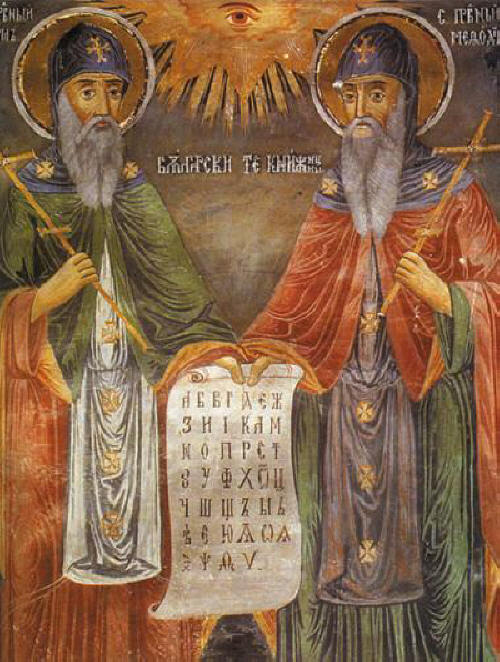
They are credited with devising the Glagolitic alphabet, the first alphabet used to transcribe Old Church Slavonic. After their deaths, their pupils continued their missionary work among other Slavs. Both brothers are venerated in the Eastern Orthodox Church as saints with the title of "equal-to-apostles". In 1880, Pope Leo XIII introduced their feast into the calendar of the Roman Rite of the Catholic Church. In 1980, the first Slav pope, Pope John Paul II declared them co-patron saints of Europe, together with Benedict of Nursia.
The two brothers were born in Thessalonica, at that time in the Byzantine province of the same name (today in Greece) – Cyril in 827–828, and Methodius in 815–820. According to the Vita Cyrilli ("The Life of Cyril"), Cyril was reputedly the youngest of seven brothers; he was born Constantine, but was given the name Cyril upon becoming a monk in Rome shortly before his death. Methodius was born Michael and was given the name Methodius upon becoming a monk in Polychron Monastery at Mysian Olympus (present-day Uludağ in northwest Turkey). Their father was Leo, a droungarios of the Byzantine theme of Thessalonica, and their mother's name was Maria.
The exact ethnic origins of the brothers are unknown; there is controversy as to whether Cyril and Methodius were of Slavic or Greek origin, or both. The two brothers lost their father when Cyril was fourteen, and the powerful minister Theoktistos, who was logothetes tou dromou, one of the chief ministers of the Empire, became their protector. He was also responsible, along with the regent Bardas, for initiating a far-reaching educational program within the Empire which culminated in the establishment of the University of Magnaura, where Cyril was to teach. Cyril was ordained as priest some time after his education, while his brother Methodius remained a deacon until 867/868.
About the year 860, Byzantine Emperor Michael III and the Patriarch of Constantinople Photius (a professor of Cyril's at the university and his guiding light in earlier years), sent Cyril on a missionary expedition to the Khazars who had requested a scholar be sent to them who could converse with both Jews and Saracens. It has been claimed that Methodius accompanied Cyril on the mission to the Khazars, but this may be a later invention. The account of his life presented in the Latin "Legenda" claims that he learned the Khazar language while in Chersonesos, in Taurica (today Crimea).
After his return to Constantinople, Cyril assumed the role of professor of philosophy at the university. His brother had by this time become a significant figure in Byzantine political and administrative affairs, and an abbot of his monastery.
In 862, the brothers began the work which would give them their historical importance. That year Prince Rastislav of Great Moravia requested that Emperor Michael III and the Patriarch Photius send missionaries to evangelize his Slavic subjects. His motives in doing so were probably more political than religious. Rastislav had become king with the support of the Frankish ruler Louis the German, though he subsequently sought to assert his independence from the Franks. That Cyril and Methodius might have been the first to bring Christianity to Moravia is a common misconception; Rastislav's letter to Michael III states clearly that his people "had already rejected paganism and adhere to the Christian law." Rastislav is said to have expelled missionaries of the Roman Church and instead turned to Constantinople for ecclesiastical assistance and, presumably, a degree of political support. The Emperor quickly chose to send Cyril, accompanied by his brother Methodius. The request provided a convenient opportunity to expand Byzantine influence. Their first work seems to have been the training of assistants. In 863, they began the task of translating the Gospels and essential liturgical books into what is now known as Old Church Slavonic, and travelled to Great Moravia to promote it. This endeavour was amply rewarded. However, they came into conflict with German ecclesiastics, who opposed their efforts to create a specifically Slavic liturgy.
For the purpose of this mission, they devised the Glagolitic script, the first alphabet to be used for Slavonic manuscripts. The Glagolitic alphabet was suited to match the specific features of the Slavic language. Its descendant script, the Cyrillic, is still used by many languages today.
Cyril and Methodius
Cyril (Greek: Κύριλλος, romanized: Kýrillos; born Constantine, 826–869) and Methodius (Μεθόδιος, Methódios; born Michael, 815–885) were brothers, Byzantine Christian theologians and missionaries. For their work evangelizing the Slavs, they are known as the "Apostles to the Slavs".
They are credited with devising the Glagolitic alphabet, the first alphabet used to transcribe Old Church Slavonic. After their deaths, their pupils continued their missionary work among other Slavs. Both brothers are venerated in the Eastern Orthodox Church as saints with the title of "equal-to-apostles". In 1880, Pope Leo XIII introduced their feast into the calendar of the Roman Rite of the Catholic Church. In 1980, the first Slav pope, Pope John Paul II declared them co-patron saints of Europe, together with Benedict of Nursia.
The two brothers were born in Thessalonica, at that time in the Byzantine province of the same name (today in Greece) – Cyril in 827–828, and Methodius in 815–820. According to the Vita Cyrilli ("The Life of Cyril"), Cyril was reputedly the youngest of seven brothers; he was born Constantine, but was given the name Cyril upon becoming a monk in Rome shortly before his death. Methodius was born Michael and was given the name Methodius upon becoming a monk in Polychron Monastery at Mysian Olympus (present-day Uludağ in northwest Turkey). Their father was Leo, a droungarios of the Byzantine theme of Thessalonica, and their mother's name was Maria.
The exact ethnic origins of the brothers are unknown; there is controversy as to whether Cyril and Methodius were of Slavic or Greek origin, or both. The two brothers lost their father when Cyril was fourteen, and the powerful minister Theoktistos, who was logothetes tou dromou, one of the chief ministers of the Empire, became their protector. He was also responsible, along with the regent Bardas, for initiating a far-reaching educational program within the Empire which culminated in the establishment of the University of Magnaura, where Cyril was to teach. Cyril was ordained as priest some time after his education, while his brother Methodius remained a deacon until 867/868.
About the year 860, Byzantine Emperor Michael III and the Patriarch of Constantinople Photius (a professor of Cyril's at the university and his guiding light in earlier years), sent Cyril on a missionary expedition to the Khazars who had requested a scholar be sent to them who could converse with both Jews and Saracens. It has been claimed that Methodius accompanied Cyril on the mission to the Khazars, but this may be a later invention. The account of his life presented in the Latin "Legenda" claims that he learned the Khazar language while in Chersonesos, in Taurica (today Crimea).
After his return to Constantinople, Cyril assumed the role of professor of philosophy at the university. His brother had by this time become a significant figure in Byzantine political and administrative affairs, and an abbot of his monastery.
In 862, the brothers began the work which would give them their historical importance. That year Prince Rastislav of Great Moravia requested that Emperor Michael III and the Patriarch Photius send missionaries to evangelize his Slavic subjects. His motives in doing so were probably more political than religious. Rastislav had become king with the support of the Frankish ruler Louis the German, though he subsequently sought to assert his independence from the Franks. That Cyril and Methodius might have been the first to bring Christianity to Moravia is a common misconception; Rastislav's letter to Michael III states clearly that his people "had already rejected paganism and adhere to the Christian law." Rastislav is said to have expelled missionaries of the Roman Church and instead turned to Constantinople for ecclesiastical assistance and, presumably, a degree of political support. The Emperor quickly chose to send Cyril, accompanied by his brother Methodius. The request provided a convenient opportunity to expand Byzantine influence. Their first work seems to have been the training of assistants. In 863, they began the task of translating the Gospels and essential liturgical books into what is now known as Old Church Slavonic, and travelled to Great Moravia to promote it. This endeavour was amply rewarded. However, they came into conflict with German ecclesiastics, who opposed their efforts to create a specifically Slavic liturgy.
For the purpose of this mission, they devised the Glagolitic script, the first alphabet to be used for Slavonic manuscripts. The Glagolitic alphabet was suited to match the specific features of the Slavic language. Its descendant script, the Cyrillic, is still used by many languages today.
Recent media
Recent media