



Community hub
Recent from talks
Knowledge base stats:
Talk channels stats:
Members stats:
Sajur
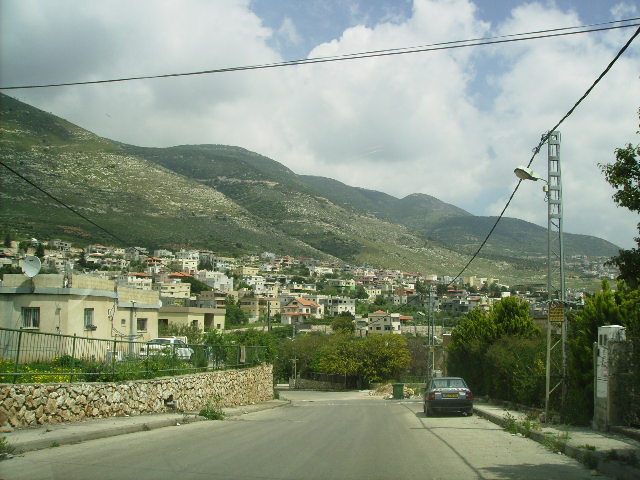
Sajur (Hebrew: סָג'וּר; Arabic: ساجور) is a Druze town (local council) in the Galilee region of northern Israel, with an area of 3,000 dunams (3 km2). It achieved recognition as an independent local council in 1992. In 2023 it had a population of 4,267.
Sajur is identified with Shazur, an ancient village associated with Simeon Shezuri. According to Jewish traditions, Ishmael ben Elisha ha-Kohen, Simeon Shezuri and Simeon ben Eleazar are buried in Sajur.
Excavations in 1951, 1980 and 1993, on behalf of the Israel Antiquities Authority revealed, respectively, a tomb with 13 loculi that dated to the Roman–Byzantine periods, a tomb with eight or nine loculi dating to the end of the second century CE and a small tomb with a single room dating to the first–second centuries CE. A salvage dig in January 2002, prior to building a car park, revealed a bedrock-hewn cave, devoid of finds, which may have been a tomb, and various unremarkable finds, although the presence of many finds at the bottom of the stratigraphic sequence is evidence of Iron Age occupation at Sajur.
In the Crusader era Sajur was known as Seisor or Saor. In 1249 John Aleman transferred land, including the casalia of Beit Jann, Sajur, Majd al-Krum and Nahf to the Teutonic Knights.
In 1322 Marino Sanuto the Elder showed Sajur on his map, named Seggori.
Sajur was mentioned as a village in the Ottoman defter for the year 1555-6, located in the Nahiya of Acre of the Liwa of Safad. The land was designated as Sahi land, that is, land belonging to the Sultan.
In 1875, Victor Guérin noted that "It is today a small village, inhabited by Druze; it is located on a hill that was once completely covered with houses. At the bottom, some gardens are planted with fig, olive, pomegranate and mulberry trees."
In 1881, the PEF's Survey of Western Palestine (SWP) described it as: "A village, built of stone, containing about 100 Druzes; in the plain, with olives and arable land; water from cisterns and spring near".
Hub AI
Sajur AI simulator
(@Sajur_simulator)
Sajur
Sajur (Hebrew: סָג'וּר; Arabic: ساجور) is a Druze town (local council) in the Galilee region of northern Israel, with an area of 3,000 dunams (3 km2). It achieved recognition as an independent local council in 1992. In 2023 it had a population of 4,267.
Sajur is identified with Shazur, an ancient village associated with Simeon Shezuri. According to Jewish traditions, Ishmael ben Elisha ha-Kohen, Simeon Shezuri and Simeon ben Eleazar are buried in Sajur.
Excavations in 1951, 1980 and 1993, on behalf of the Israel Antiquities Authority revealed, respectively, a tomb with 13 loculi that dated to the Roman–Byzantine periods, a tomb with eight or nine loculi dating to the end of the second century CE and a small tomb with a single room dating to the first–second centuries CE. A salvage dig in January 2002, prior to building a car park, revealed a bedrock-hewn cave, devoid of finds, which may have been a tomb, and various unremarkable finds, although the presence of many finds at the bottom of the stratigraphic sequence is evidence of Iron Age occupation at Sajur.
In the Crusader era Sajur was known as Seisor or Saor. In 1249 John Aleman transferred land, including the casalia of Beit Jann, Sajur, Majd al-Krum and Nahf to the Teutonic Knights.
In 1322 Marino Sanuto the Elder showed Sajur on his map, named Seggori.
Sajur was mentioned as a village in the Ottoman defter for the year 1555-6, located in the Nahiya of Acre of the Liwa of Safad. The land was designated as Sahi land, that is, land belonging to the Sultan.
In 1875, Victor Guérin noted that "It is today a small village, inhabited by Druze; it is located on a hill that was once completely covered with houses. At the bottom, some gardens are planted with fig, olive, pomegranate and mulberry trees."
In 1881, the PEF's Survey of Western Palestine (SWP) described it as: "A village, built of stone, containing about 100 Druzes; in the plain, with olives and arable land; water from cisterns and spring near".